Inspiration
As a full-time content creator, I grew frustrated with generic budgeting tools that didn’t account for creator-specific finances—gear investments, brand deal income, or tax-deductible production costs. I saw peers overspend on equipment without calculating ROI, and I knew a tailored tool could turn chaotic finances into actionable insights.
What it does
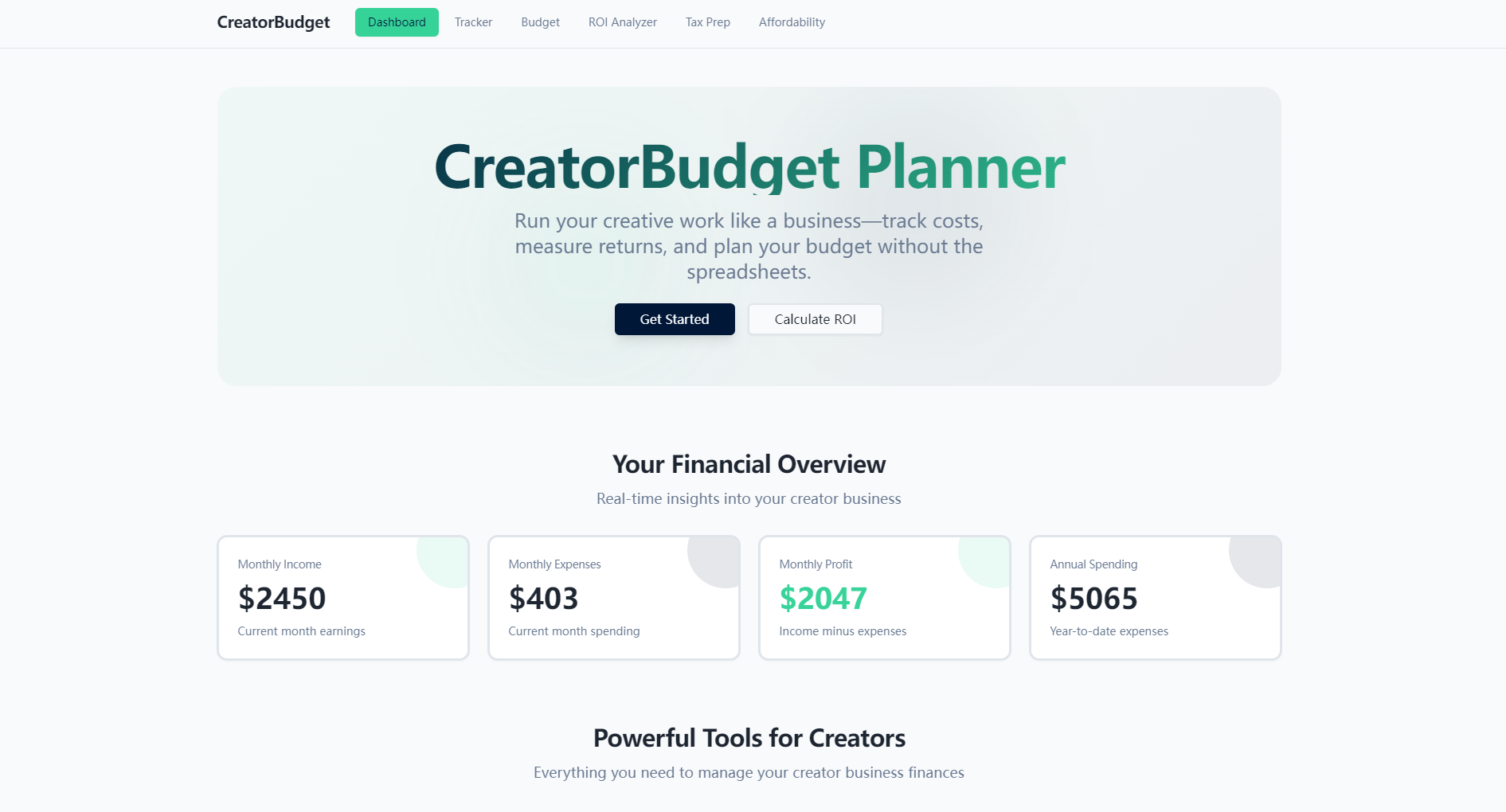
CreatorBudget Planner centralizes 6 core financial workflows: a real-time dashboard for key metrics, income/expense tracking (custom creator categories), budget planning (planned vs. actual comparisons), ROI analysis for gear investments, tax prep (deductible expense summaries), and an affordability calculator for safe spending limits.
How we built it
I started by mapping creator-specific financial pain points, then structured modular pages for each tool. Used React for dynamic UI, TailwindCSS for a mobile-responsive, minimalist design, and Chart.js for visualizing ROI break-even timelines and budget variances. All calculations (e.g., monthly ROI = $((projectedIncomeLift×lifespan - cost)/cost)/lifespan×100$) were coded client-side for instant updates, with LocalStorage to preserve session data.
Challenges we ran into
The biggest hurdle was balancing mathematical accuracy with user-friendliness—creators don’t want to parse accounting jargon. I also had to handle edge cases (e.g., zero/negative ROI inputs) with clear error messages, and ensure real-time data sync across modules (e.g., updating the dashboard when a user adjusts budget values).
Accomplishments that we're proud of
Creating a tool that’s both financially rigorous and creator-centric—no login, intuitive navigation, and visual cues (green/red indicators for ROI/affordability) that make complex data actionable. Users can complete a full financial review in under 2 minutes, and the tax module simplifies deductible categorization for common creator expenses.
What we learned
I deepened my understanding of financial modeling for small creative businesses and how to translate complex formulas into accessible UI. I also learned the value of prioritizing user experience over feature bloat—focusing on the 6 core tools creators actually need, not generic accounting features.
What's next for this project
I plan to add customizable expense categories, integrate exportable tax summaries (CSV/PDF), and build a historical trend analyzer to track income/expense patterns over time. Long-term, I want to add multi-currency support and optional cloud sync for persistent data across devices.
