-
-
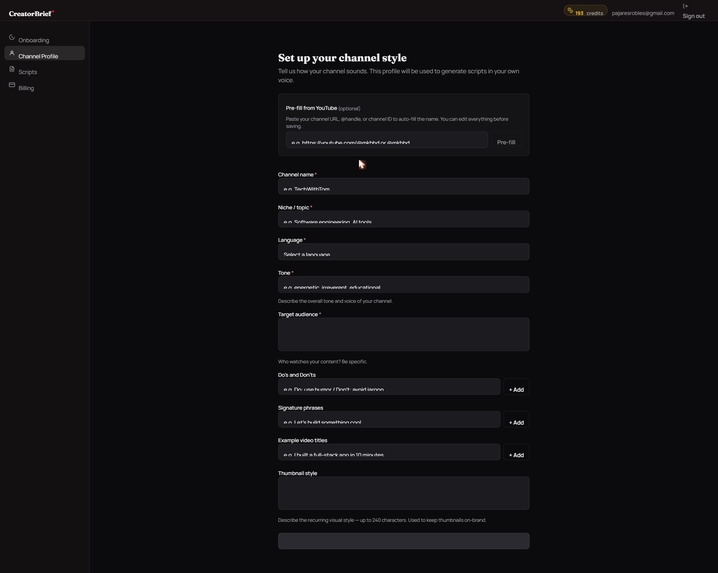
Channel profile setup — define your style, tone and audience so CreatorBrief writes in your own voice
-
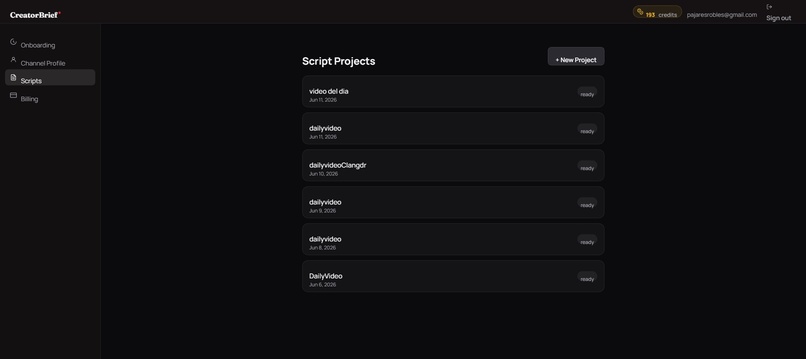
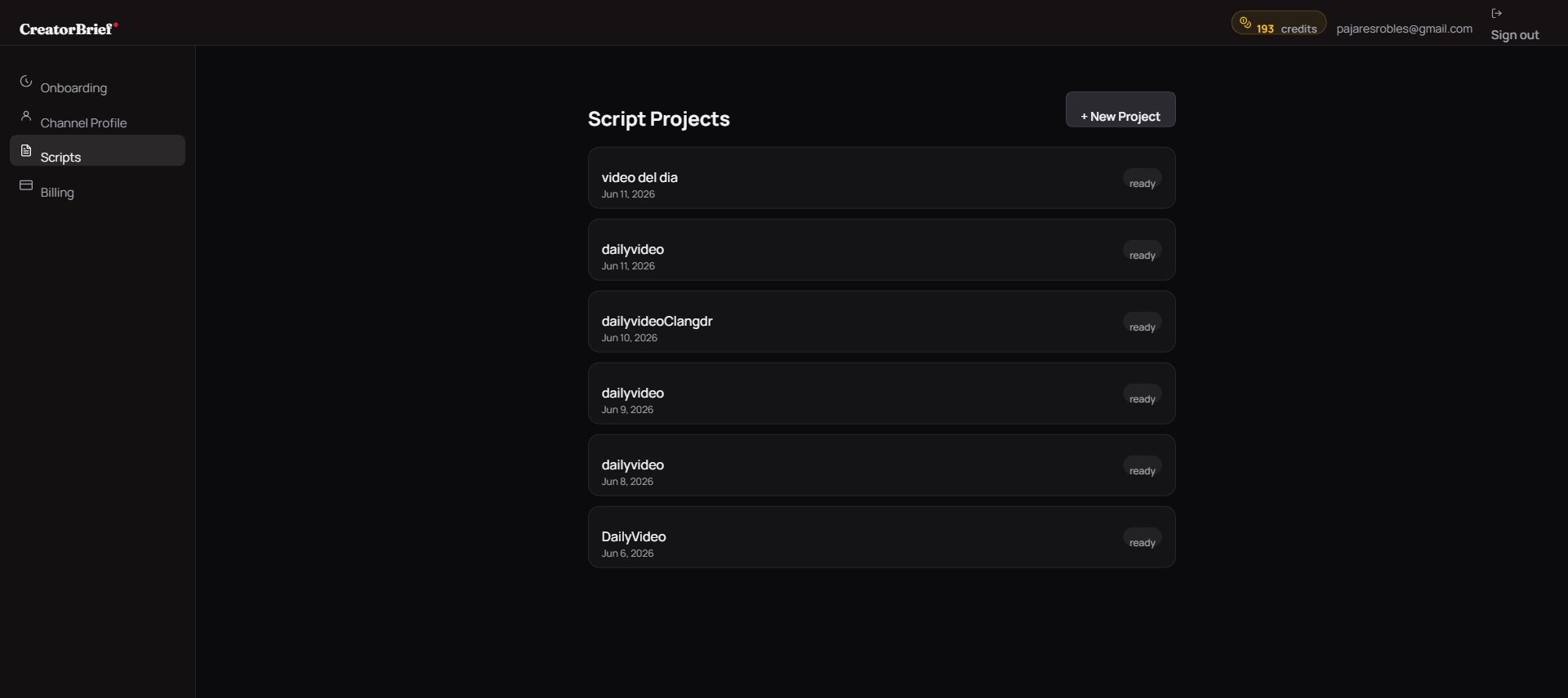
Scripts dashboard — all your video projects in one place, each powered by real-time news sources
-
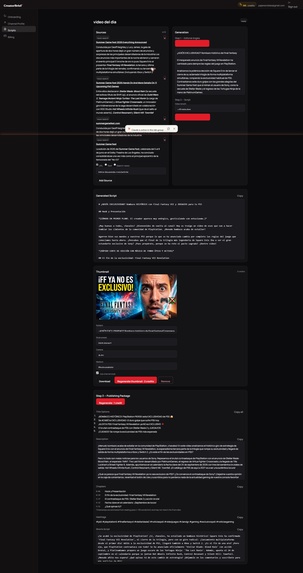
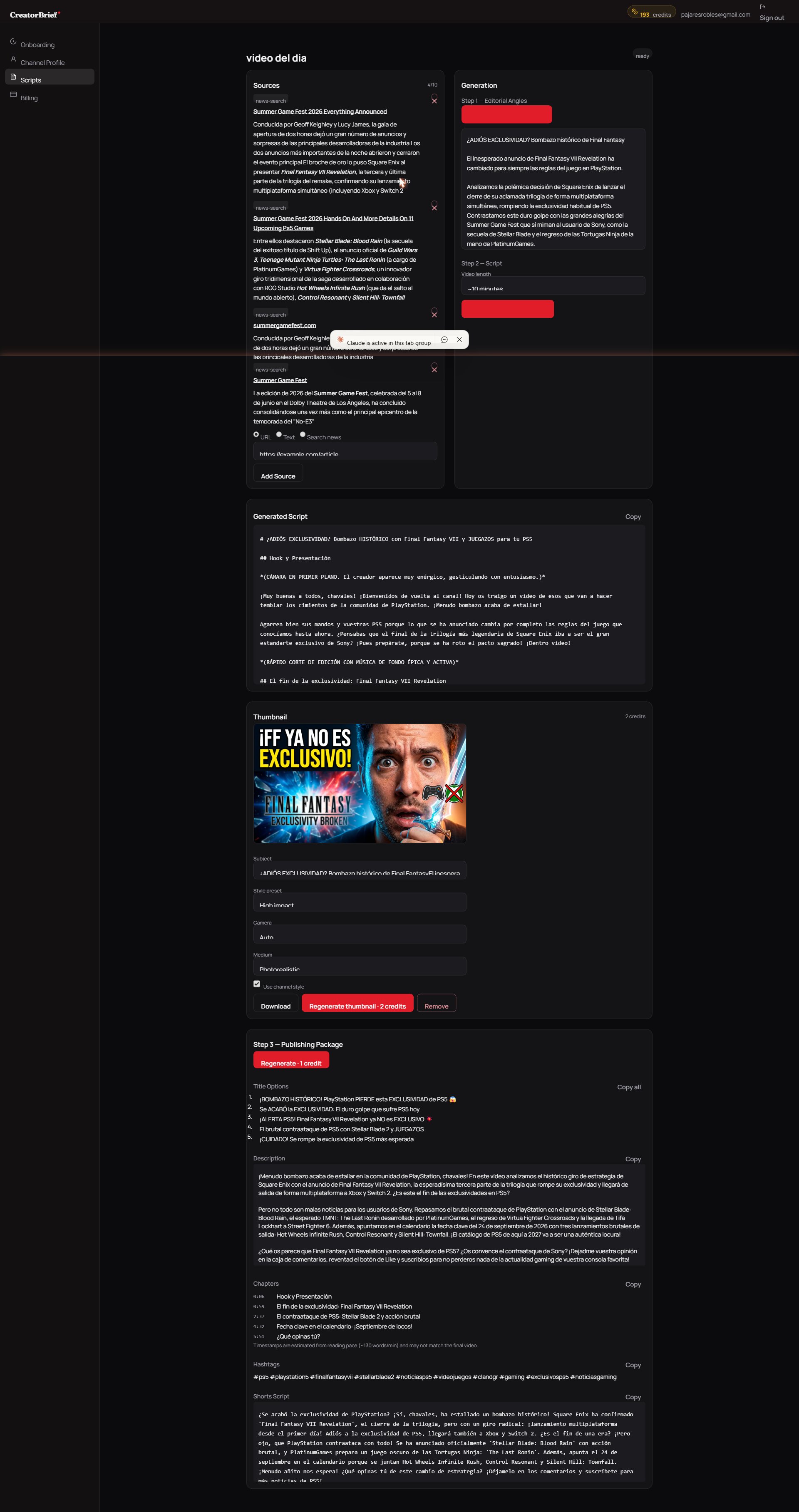
Script detail — sources panel with live news on the left, AI generation steps on the right
Inspiration
Content creators spend hours every day doing work that has nothing to do with creating. They search for news across dozens of tabs, read multiple sources, decide on an editorial angle, write a script from scratch, come up with a title that competes in a crowded feed, and then design a thumbnail that earns the click. For a solo YouTuber or a small content agency, that process can take half the working day — before a single second of footage is filmed.
We built CreatorBrief because we saw creators burning out not from a lack of ideas, but from the friction between having an idea and having something ready to record. The bottleneck is editorial production, not creativity.
The arrival of capable foundation models — and specifically Gemini's ability to reason across long, multi-source contexts — made it possible to solve this at a quality level that actually works for professionals.
What We Built
CreatorBrief is an AI-powered editorial assistant for video creators. You paste your sources — news links, articles, personal notes, press releases, transcripts — select your channel and the type of video you want to make, and CreatorBrief generates a complete production package:
- Script structured block by block, with hook, intro, development, and closing
- Titles (main + A/B variants, from informational to emotional)
- Thumbnail concept with composition, main text, and visual suggestions
- Video description, chapters, and hashtags
- Short-form version adapted for YouTube Shorts, TikTok, or Reels
The defining feature is the channel style profile. CreatorBrief analyzes the creator's existing content or samples they provide and builds a profile capturing tone, pace, video structure, CTA style, level of opinion, and more. Every script generated is adapted to that specific channel's voice — not a generic AI output, but content that sounds like you.
How We Built It
CreatorBrief is built on a clean, production-ready stack:
- TanStack Start (TypeScript) for the full-stack application with file-based routing and server functions
- Gemini via Vertex AI (Google Cloud) as the AI backbone — every script, title, thumbnail concept, and style analysis runs through Gemini
- Google Cloud Run for deployment, satisfying the XPRIZE's Google Cloud infrastructure requirement
- Supabase for authentication, PostgreSQL database (with row-level security), and asset storage
- Stripe for payments — credits and subscription plans, integrated early to generate real revenue within the competition window
The architecture follows Clean Architecture + SOLID principles: business logic is completely decoupled from the framework. Gemini is consumed exclusively through a GeminiClient port, meaning the AI layer can be swapped or extended without touching any use case logic. Prompts are versioned in a dedicated /prompts directory.
AI usage is instrumented in a usage_events table that tracks tokens consumed, cost, latency, and errors per generation — giving full visibility into unit economics and supporting the competition's "AI-Native Operations" criterion.
Challenges
Consistency across sources. Getting Gemini to synthesize 5–10 heterogeneous sources — a news article, a press release, a YouTube transcript, and personal notes — into a single coherent editorial piece without hallucinating or losing nuance required careful prompt engineering and a structured multi-pass approach.
Channel style fidelity. Teaching the model to internalize a creator's actual voice from limited samples, and maintain it consistently across a full 10-minute script, is a harder problem than it looks. We iterated heavily on the channel profile extraction prompts.
Revenue-first timeline. The XPRIZE requires real revenue from arm's-length customers as evidence of business viability. That forced us to integrate Stripe and build the monetization layer early — before polish, before secondary features, before anything that doesn't directly support a paying customer's workflow. This constraint made the product more focused and more honest.
Streaming long outputs. Full scripts for 10–15 minute videos are long. Waiting for a synchronous response degrades the user experience significantly. Implementing server-function streaming with TanStack Start required working through some rough edges in the SSR/streaming boundary.
What We Learned
Building with Gemini through Vertex AI gave us access to a model that genuinely handles long, multi-document context well. The ability to pass a complete channel style profile, multiple source documents, and detailed formatting instructions in a single prompt — and get back a structured, coherent script — is what makes this product possible at a quality level creators will actually pay for.
We also learned that AI-native products need AI instrumented into their operations, not just their features. Tracking every token, every generation, every error in a structured way from day one made it possible to understand our cost structure, catch prompt regressions, and move fast with confidence.
The biggest lesson: constraints are design tools. The XPRIZE's revenue requirement forced us to build something people want to pay for before we built everything else. That's just good product development.
Built With
- ai
- api
- cloud
- data
- gemini
- node.js
- postgresql
- run
- start
- stripe
- supabase
- tanstack
- typescript
- vertex
- youtube


Log in or sign up for Devpost to join the conversation.