Inspiration
Every day, millions of people come together around creators on Twitch. They watch, talk, celebrate, make friends, and become part of communities that can last for years.
But most of that shared experience exists only while the stream is live.
We started with a question: What if a community could build something together that continues to grow even after the stream ends?
That's where Creator's Village began.
We envisioned a living world belonging to a creator and their community. Not just another dashboard, chat overlay, or collection of rewards, but a place that feels like home. Somewhere every contribution can leave a mark, where the settlement evolves over time, and where people have a reason to return.
From the beginning, we approached Creator's Village as a potential long-term product. The hackathon became an opportunity to build the first working foundation of that much larger idea.
What it does
Creator's Village transforms community participation into a persistent, illustrated village that members can develop together.
Creators connect their Twitch accounts and access their own villages through a web application.
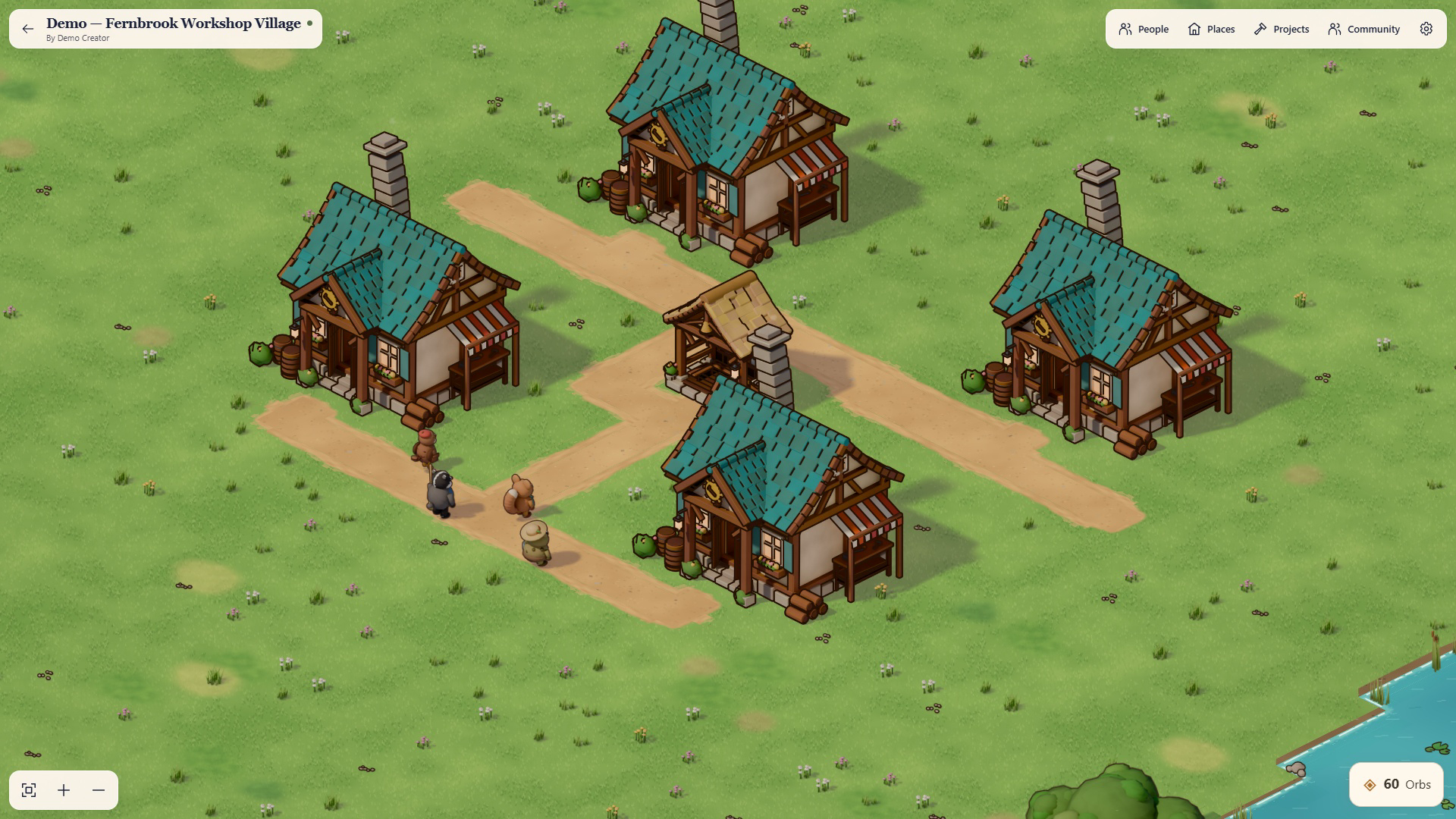
Each village contains procedurally generated terrain, buildings, and autonomous inhabitants. Residents follow daily routines: walking, working, gathering, resting, and reacting to changes around them.
Players can explore the environment, follow inhabitants, inspect structures, and see how their village evolves.
Building together
The central mechanic is collaborative construction powered by Orbs, a community-specific resource.
Members receive an initial Orb balance and accumulate additional Orbs over time. A creator can choose where to build a supported structure, with the system validating placement and generating a suitable connecting path.
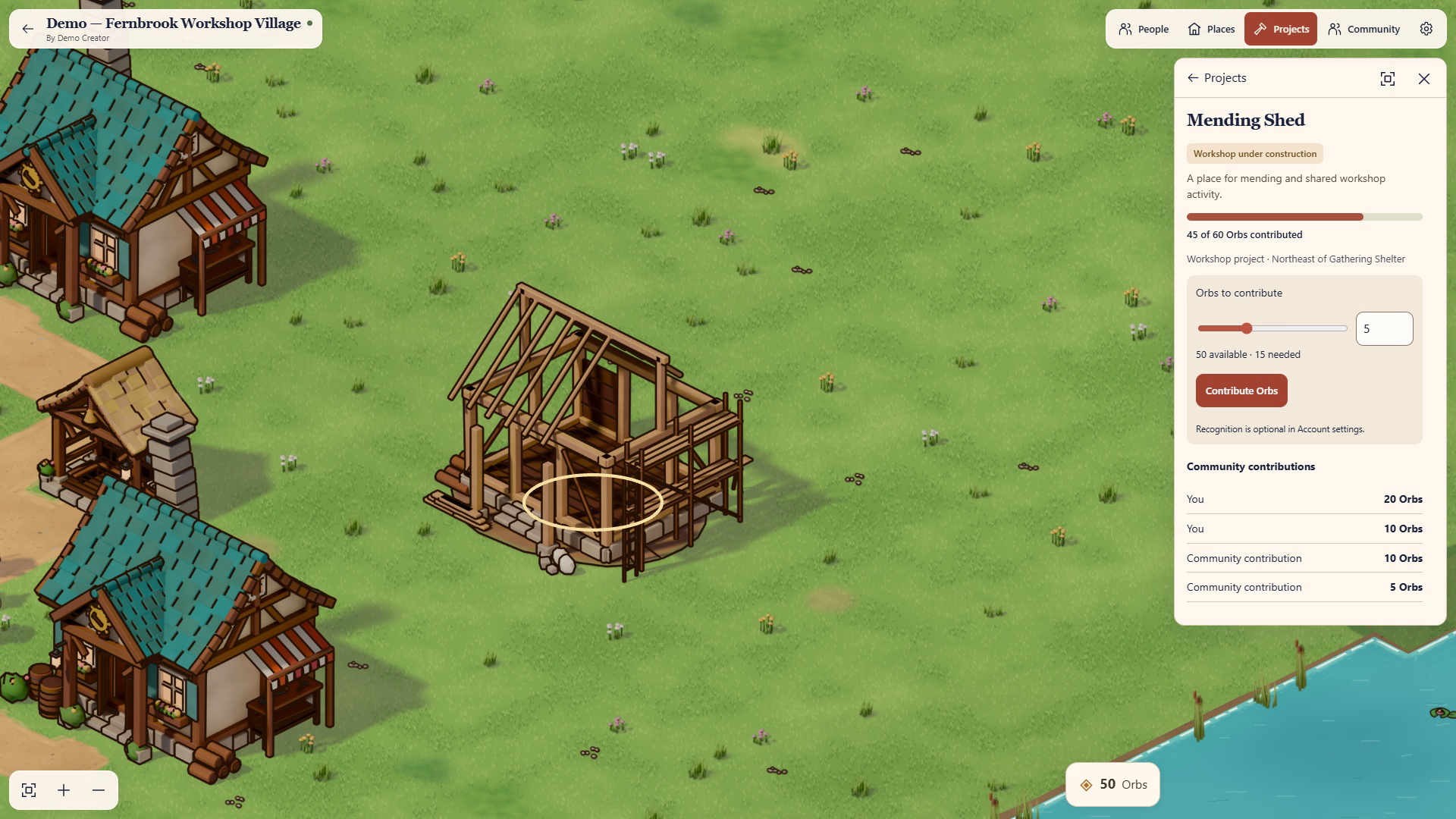
Community members contribute their available Orbs toward construction. They can contribute different amounts, and their contributions are recorded.
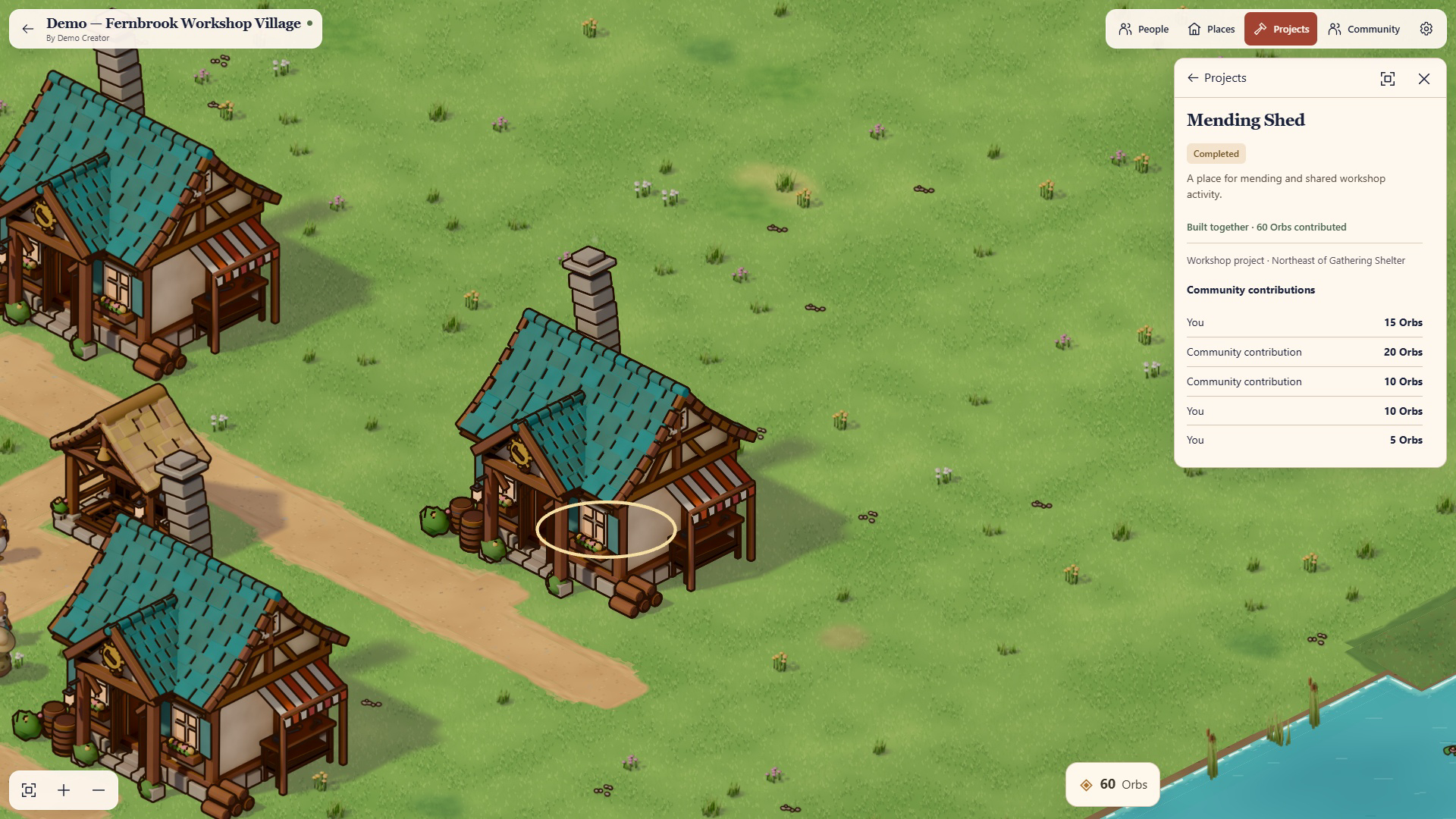
As the project receives funding, its construction progresses through visible stages, from foundation to framing and finally to a completed building.
Once finished, that structure becomes a permanent part of the shared village.
Orb balances, contributions, construction progress, and world changes are stored persistently and synchronized across connected sessions.
The result is a simple but meaningful loop: participate, contribute, build, and watch your shared world grow.
How we built it
Creator's Village was developed in a short, intensive hackathon window, with the goal of delivering a functioning experience rather than only a visual prototype.
The project was led by a solo developer, with extensive assistance from OpenAI Codex as an engineering partner and other AI-assisted tools for design and art production.
The development process involved defining the product vision, designing the underlying systems, implementing and reviewing functionality, refining the visual experience, and repeatedly testing how the different components behaved together.
Codex helped implement:
- Twitch OAuth authentication and creator identity.
- Persistent, procedurally generated village environments.
- Animated inhabitants and deterministic activity systems.
- Server-authoritative building placement and road connections.
- Collaborative construction with multiple participants.
- Community-specific Orb wallets and periodic earning.
- Atomic pooled contributions, transaction records, and synchronized project progress.
- Authorization, persistence, reconnect handling, and automated testing.
The original illustrated buildings, inhabitants, terrain, environmental details, animations, and visual identity were developed through a separate Blender-based, AI-assisted art workflow.
The application combines real-time browser rendering, a persistent backend, and PostgreSQL storage, deployed as an accessible web experience.
Challenges we ran into
One of our biggest challenges was deciding how much of the vision we could meaningfully build within the hackathon.
The complete concept includes individual creator villages, personal homes, richer inhabitant identities, extensive construction systems, community events, regional settlements, and an interconnected world.
It would have been easy to create an attractive demonstration of these ideas without making the underlying systems work.
Instead, we prioritized a smaller set of mechanics that could form a real foundation for future development.
Persistence was particularly important. A village shouldn't reset when someone closes their browser. Buildings, contributions, and changes to the world needed to remain consistent.
Collaborative construction also introduced engineering challenges: concurrent contributions, avoiding duplicate transactions, validating resource balances, synchronizing progress, and making sure a completed structure appeared correctly for everyone.
Another challenge was bringing together detailed illustrated artwork, procedural terrain, resident behaviors, and interactive construction without sacrificing consistency or usability.
Throughout development, we had to balance ambition with reliability, continually deciding which systems belonged in the hackathon release and which deserved a more complete implementation afterward.
Accomplishments that we're proud of
We're particularly proud that Creator's Village became a working application with genuine persistent systems, rather than only a cinematic representation of the idea.
The hackathon release includes:
- Real Twitch authentication.
- Persistent creator villages.
- Procedurally generated environments.
- Autonomous residents with daily activities.
- Interactive building inspection and navigation.
- Creator-controlled construction planning.
- Community-specific Orb balances and automatic earning.
- Collaborative funding with variable contributions.
- Visible construction progression and completed structures.
- Synchronized state and persistent contribution history.
The final release passed 161 automated tests, alongside build, packaging, and deployment verification.
The collaborative construction demonstration uses clearly labeled synthetic accounts, allowing the full multi-participant process to be shown without pretending those identities are real Twitch followers.
What matters most to us is that these systems establish a foundation on which the larger product can genuinely grow.
What's next
The founding village is only the beginning.
A more personal community
We want Twitch communities to become recognizable inside their villages.
In the future, people could discover the villages of creators they follow, voluntarily join them, choose their own inhabitants, and receive personal homes within the world.
Different inhabitants could develop routines, occupations, personalities, and relationships that make each community feel unique.
Freedom to build and shape the world
We envision much greater freedom in how a village develops.
Communities could construct different types of buildings, expand neighborhoods, clear land, create paths, establish landmarks, and shape the appearance and purpose of their settlement.
As their population and activity grow, procedural world generation could open new areas: forests, lakes, rivers, mountains, and entirely new districts.
Each village would gradually develop its own identity, shaped by the people who live and participate there.
Activities, events, and competition
Creator's Village could become a platform for experiences shared between communities.
Imagine collaborative challenges, seasonal events, village competitions, cooperative objectives, and even opt-in conflicts or strategic battles between settlements.
These experiences could give creators and their viewers new ways to interact, cooperate, compete, and create stories together.
Beyond individual creator villages
Our longer-term vision extends beyond a single Twitch creator.
Individual communities could eventually connect through larger, voluntary regional villages, bringing together people from places such as Italy, France, the United States, and beyond.
Communities within these regions could collaborate on shared projects, participate in events, and develop regional identities.
Beyond that, we imagine a much larger connected world where villages and communities from across Twitch could discover one another, visit, build, and participate in shared experiences.
These are future possibilities, not features claimed to be implemented in the current hackathon release.
A world that keeps growing
We approached this project with the ambition of building something that could remain meaningful long after the hackathon.
There is still a great deal we want to explore, from richer Twitch integrations and new community activities to more expressive residents, advanced construction systems, and much larger persistent worlds.
But the core idea remains the same:
A community doesn't just watch something together. It can build something that remains.
Built With
- blender
- github
- javascript
- neon
- node.js
- oauth-2.0
- openai-codex
- pixijs
- playwright
- postgresql
- react
- render
- server-sent
- twitch
- typescript

