-
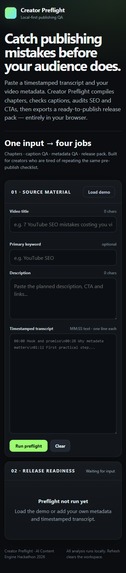
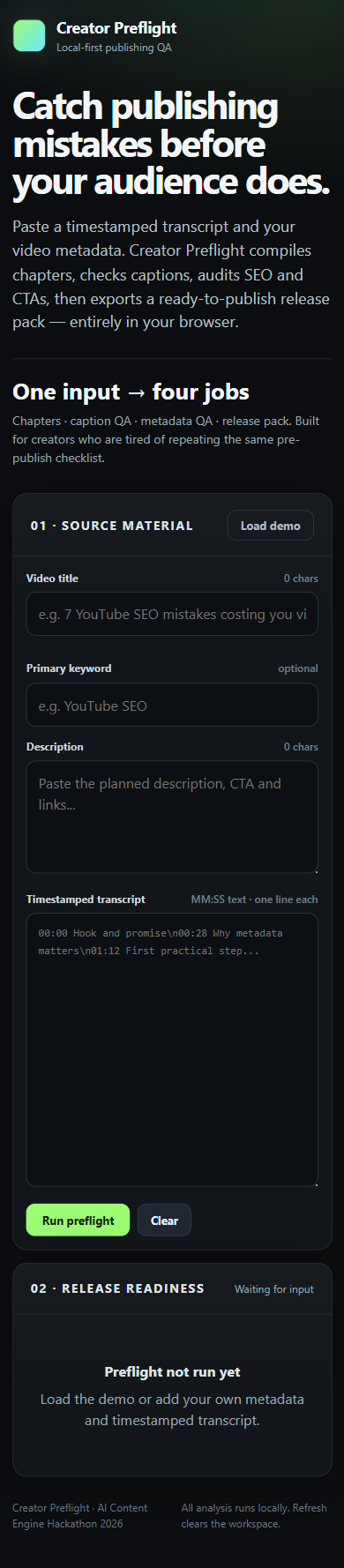
Mobile acceptance: 99/100 readiness, 9 chapters, 12 transcript cues, and 1 actionable review item at 390×844.
-
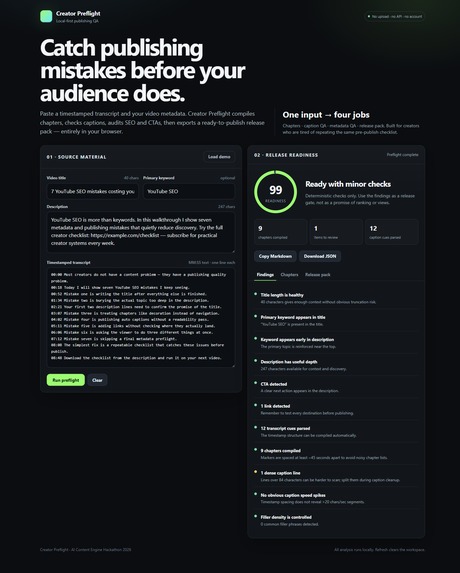
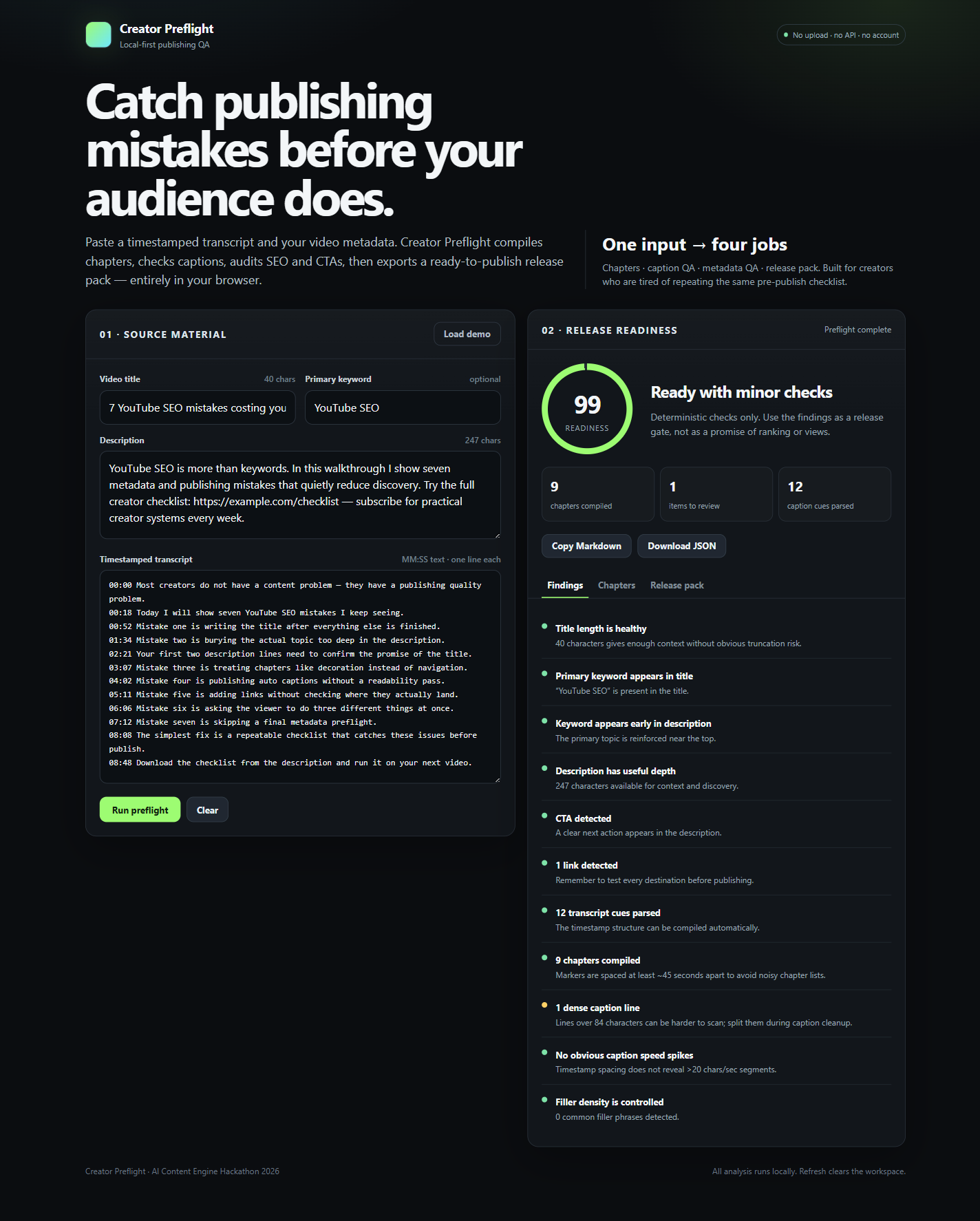
Desktop judge flow: one-click demo compiles chapters, audits captions/metadata, scores readiness, and exposes release outputs.
Inspiration
Creators often finish an edit and then repeat the same last-mile checks by hand: captions, chapters, title, description, CTA, links, and release notes. These checks matter, but they are fragmented and easy to skip under deadline pressure.
Creator Preflight treats that last mile like a compiler/linter: private input, deterministic checks, explainable findings, and release-ready artifacts.
What it does
Creator Preflight accepts a video title, optional primary keyword, description, and either a timestamped transcript or a native .srt / .vtt caption export. It then:
- imports SRT/VTT by file picker, drag-and-drop, or smart paste entirely in the browser;
- parses timestamp cues and compiles chapter markers;
- checks caption line density and possible high-speed segments;
- audits title length, keyword consistency, description depth, CTA, and URL presence;
- produces an explainable 0–100 readiness score;
- generates a copy-ready Markdown release pack;
- exposes a downloadable JSON report.
Nothing is uploaded. There is no backend, account, runtime secret, external analysis API, or paid dependency.
How it was built
The project was built from scratch during the hackathon window using HTML, CSS, and vanilla JavaScript, then deployed as a zero-dependency static app on GitHub Pages.
metadata + transcript/captions → local parser → deterministic checks → readiness model → chapters/findings → Markdown + JSON
The scoring rules are inspectable and deliberately do not claim to predict rankings, views, or recommendation-algorithm performance.
Challenges
The first challenge was making the output useful without pretending to know platform algorithms. Every score change therefore maps to an explicit workflow check and a visible finding.
The second was supporting real creator caption exports without introducing a transcription provider or upload step. The SRT/VTT importer normalizes cue timestamps and text locally, including comma-decimal SRT timestamps, hour-long timestamps, cue tags, file input, drag/drop, and caption paste.
The third was keeping the app small while making it robust. Edge cases include empty input and malicious HTML-like input; rendered findings are escaped before insertion into the UI.
Accomplishments
- Working end-to-end tool, not a mockup.
- Native SRT/VTT import with local conversion and no upload/API.
- One-click deterministic demo: 12 cues → 9 chapters → 99/100 → 1 actionable review item.
- Live SRT acceptance case: 4 cues → 4 chapters → 100/100.
- Markdown and JSON release outputs.
- Desktop and 390×844 mobile acceptance tested.
- Public HTTPS deployment with zero console errors in the final live regression.
- Independent browser audits: Accessibility 100, Best Practices 100, SEO 100, Agentic Browsing 100; 45/45 audits pass on desktop and mobile.
- Mobile performance trace: LCP 152 ms, TTFB 3 ms, CLS 0.00 with no throttling.
- Temporary headless-Chromium regression harness: 26/26 assertions passed across baseline, import, edge-case, and XSS checks.
- Public QA evidence in the repository.
Why it fits the judging criteria
Functionality (30%): native SRT/VTT import, real transcript parsing, chapter generation, caption-density calculations, metadata checks, deterministic scoring, Markdown output, and JSON export.
Creativity (20%): a private, deterministic transcript-to-release compiler with inspectable rules and zero-upload handling of unreleased creator material.
Technical execution (30%): zero-dependency static deployment, responsive UI, safe output escaping, no backend/runtime secrets, clean final console, measured browser quality, and documented regression evidence.
Real-world usefulness (20%): targets the repetitive gap between “edit finished” and “publish,” while accepting the caption files creators already export from editing tools.
What it replaces
On the built-in 12-cue demo, Creator Preflight compiles 9 chapter markers and runs 11 deterministic publish checks in one pass, then emits a Markdown release pack and JSON report. It replaces repeated manual work such as drafting chapter timestamps, scanning captions for readability risks, checking metadata/CTA/link presence, and assembling release notes.
What we learned
Creator tooling does not always need another generative layer. A small deterministic quality gate can remove repeated publishing work while preserving privacy and making every recommendation explainable.
What's next
- Platform-specific publishing profiles.
- Configurable team/editor rule packs.
- Optional local media-duration metadata.
- Opt-in link-health checks.
Judge quick test
- Open the live app.
- Click Load demo.
- Confirm 99/100, 9 chapters, 12 caption cues, and 1 item to review.
- Open Chapters and Release pack.
- Click Import SRT/VTT or drag/paste a caption export to test the real-file path.
- Try Download JSON to inspect the machine-readable release report.

Log in or sign up for Devpost to join the conversation.