-
-
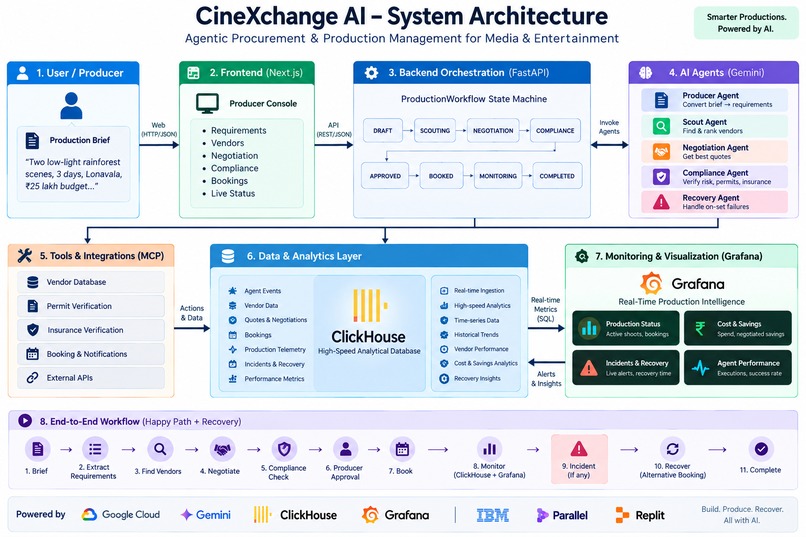
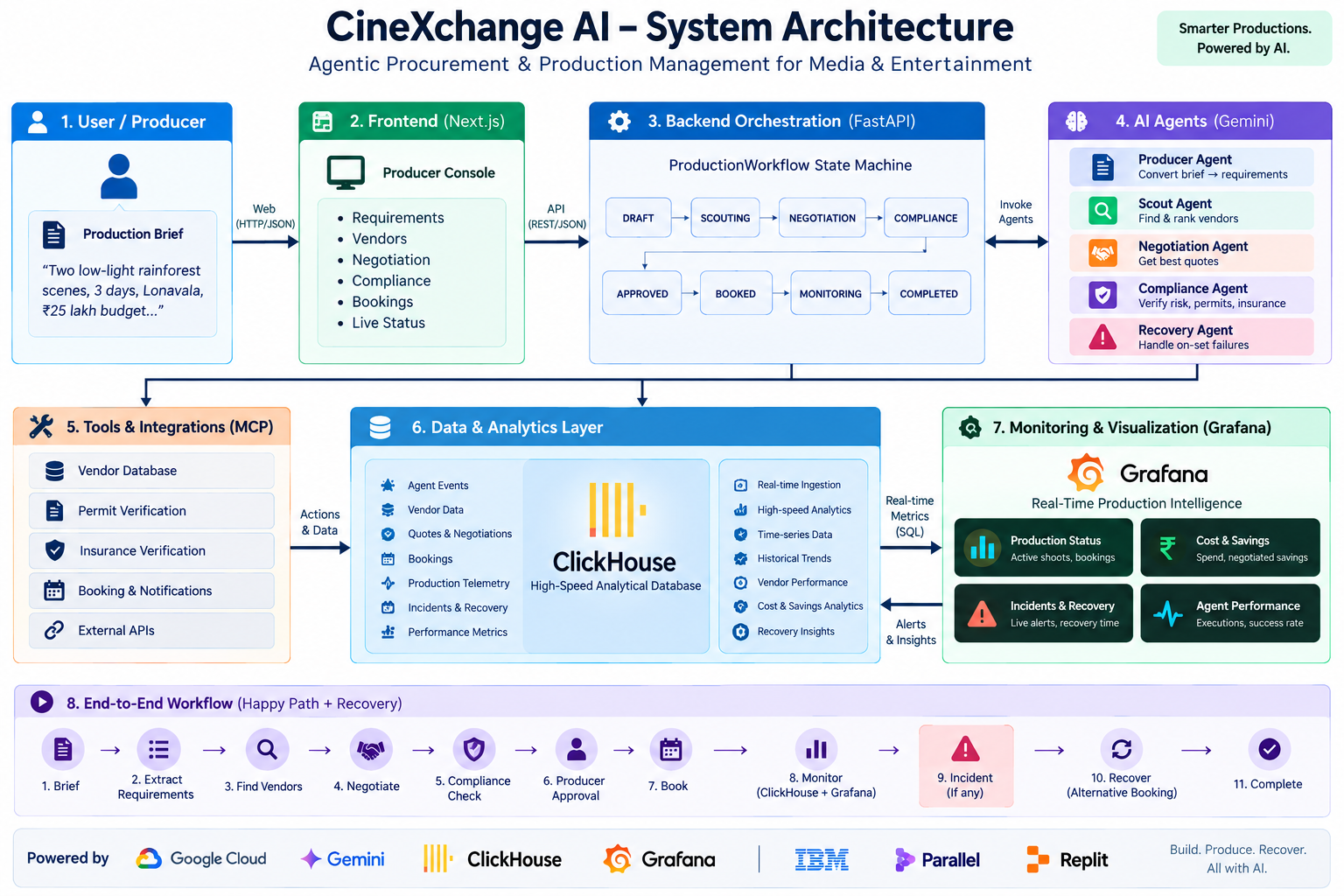
System Architecture
-
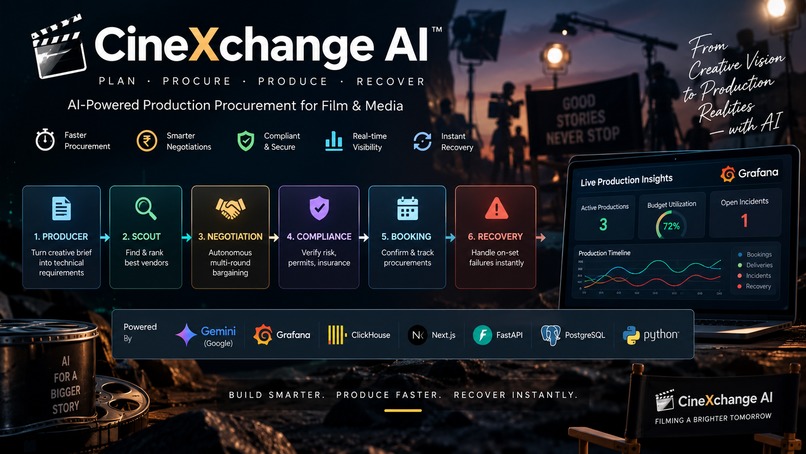
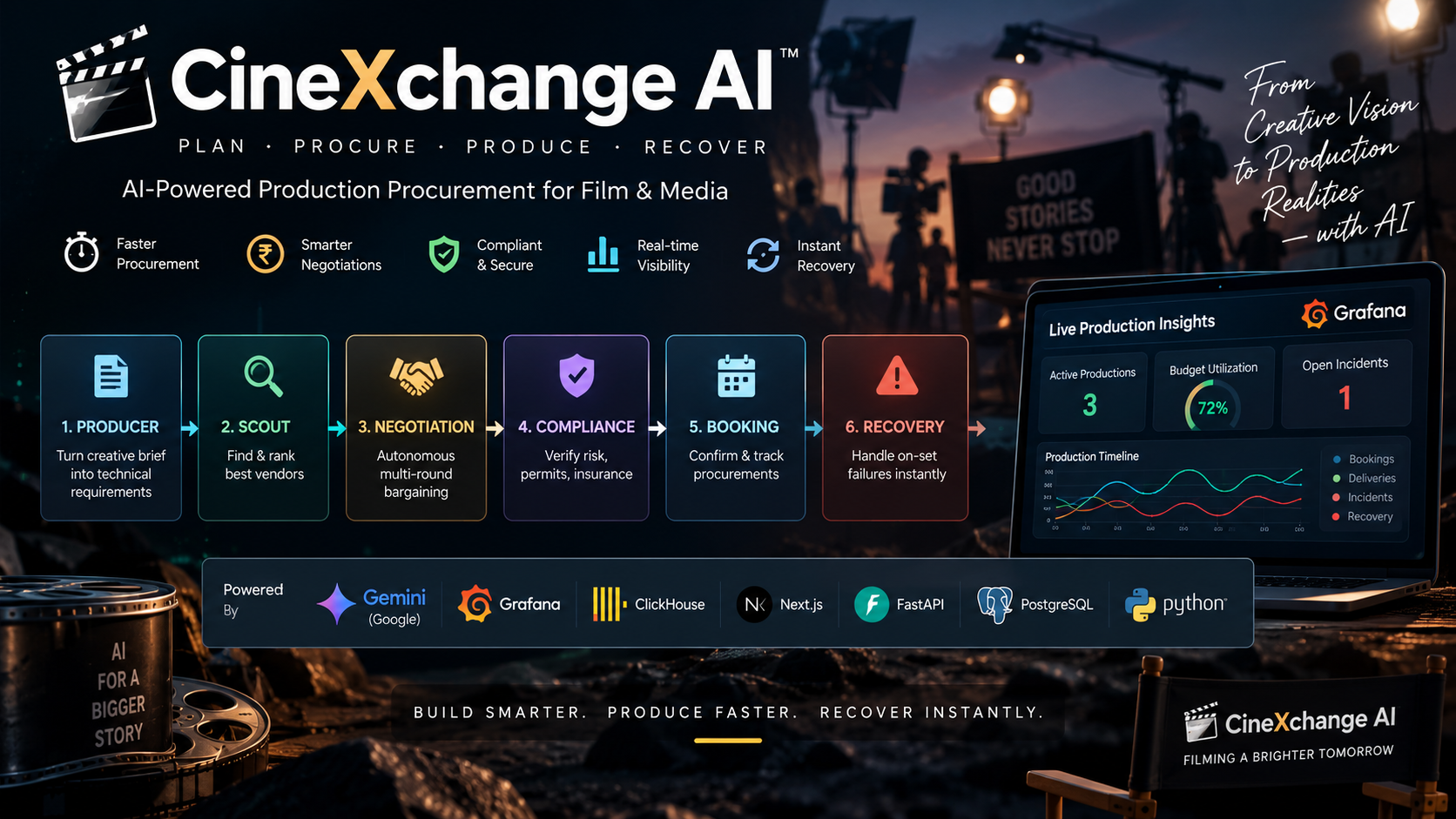
Thumbnail
-
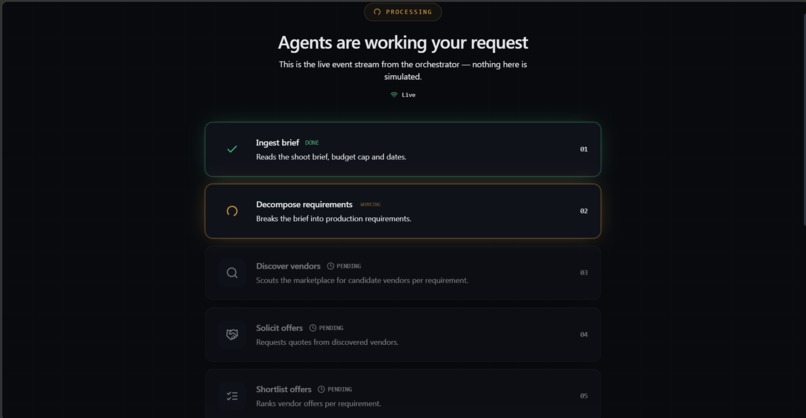
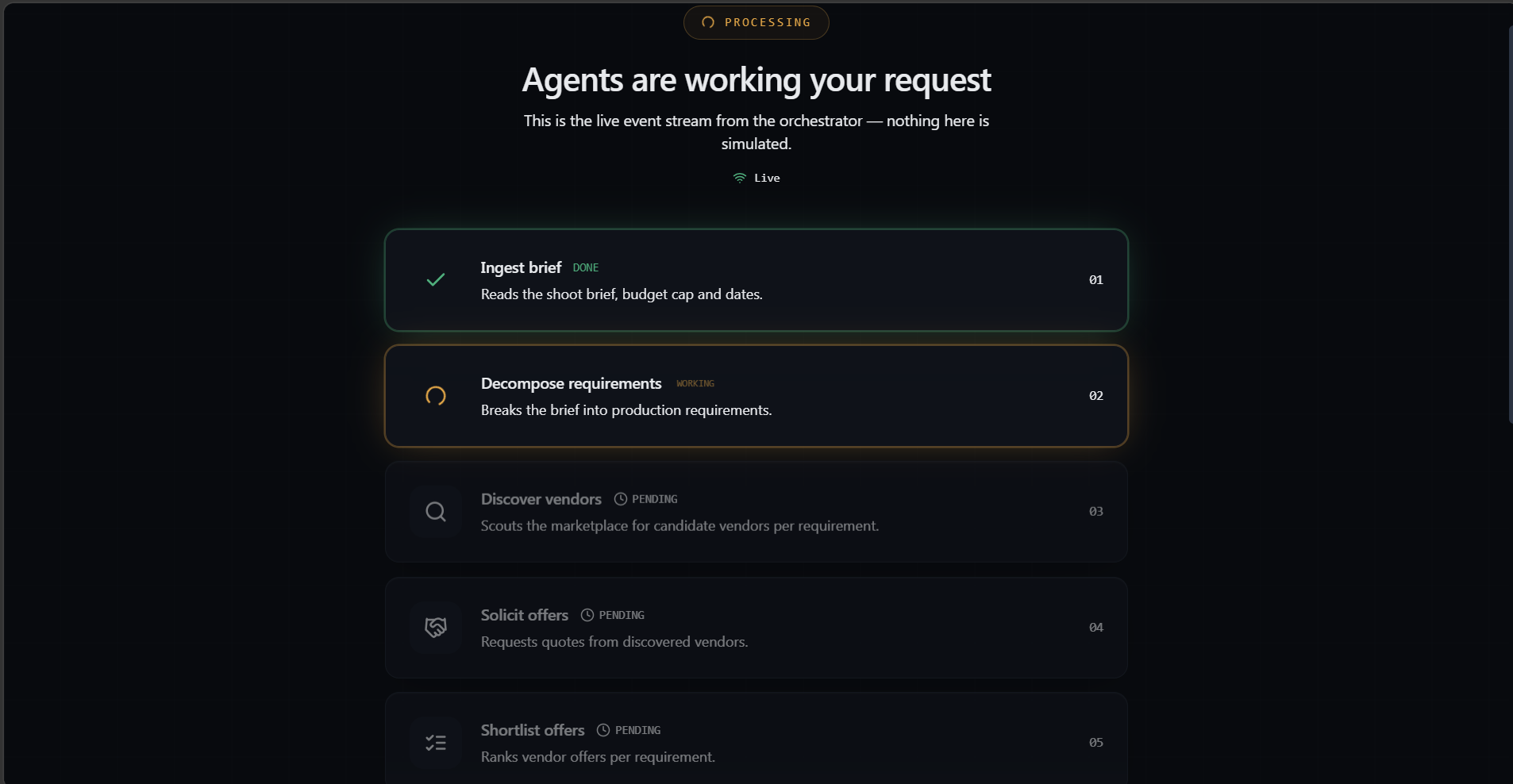
Agents Working
-
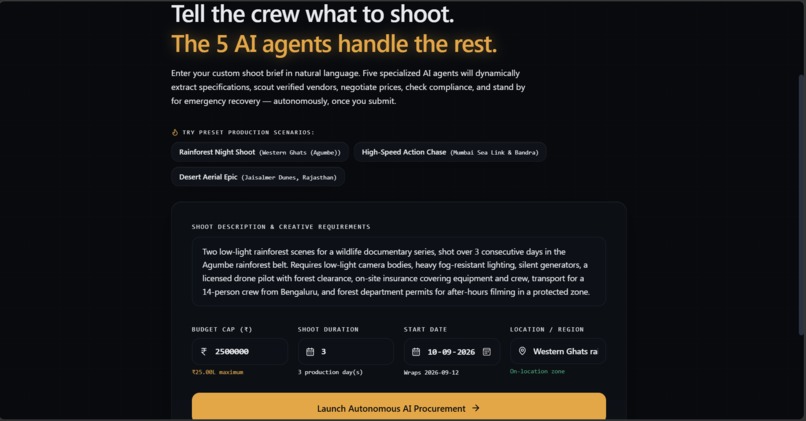
User Interface
-
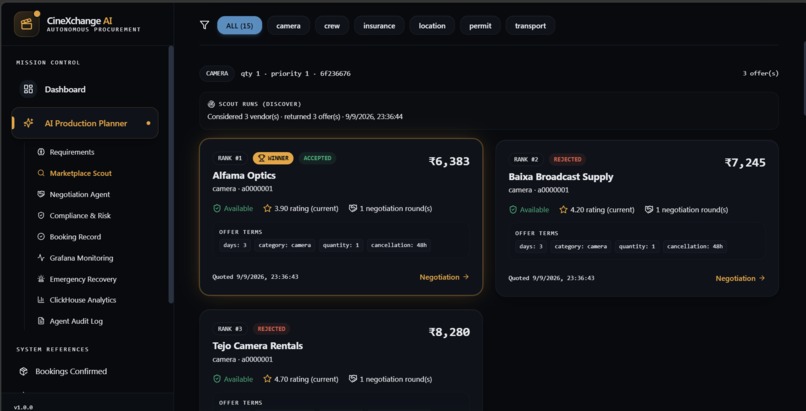
Marketplace Scout
-
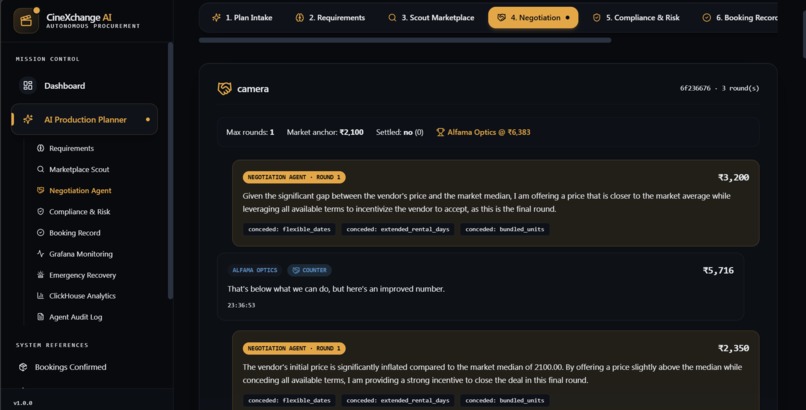
Negotiation
-
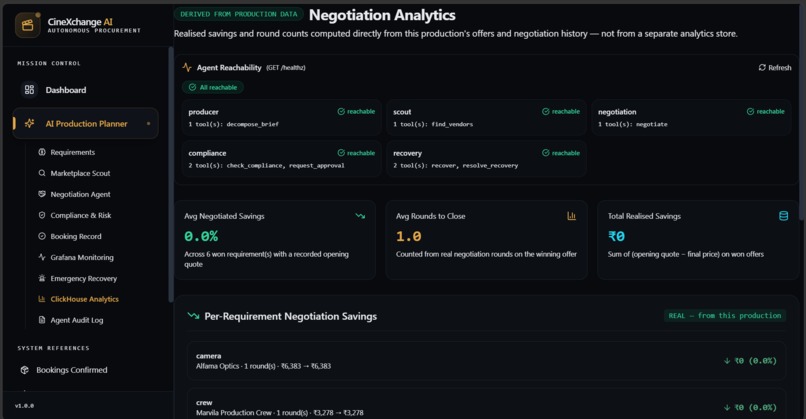
AI Production Planer
-
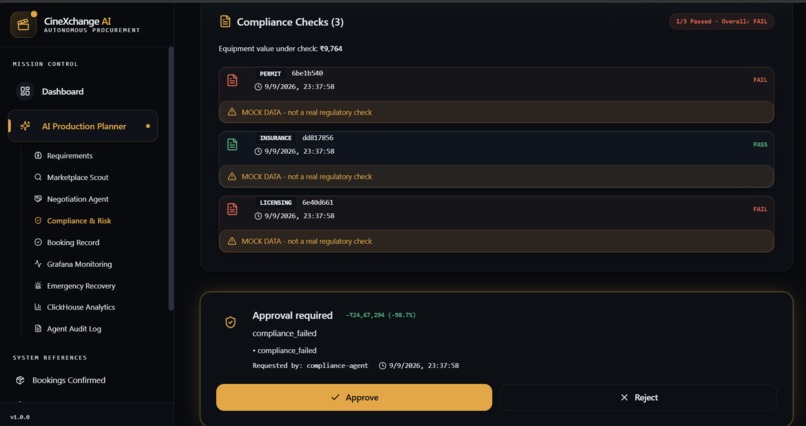
Compaliance And Risk
-
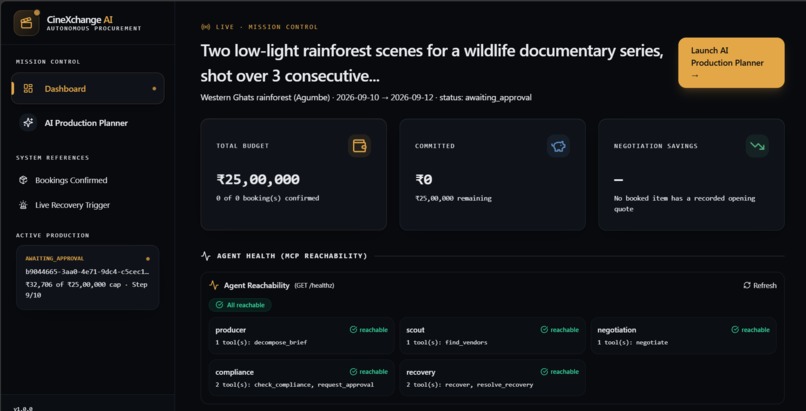
Dashboard
Inspiration
Film production doesn't usually fail because the required resources don't exist. It fails because coordinating them is difficult.
A producer may need cameras, lighting, generators, drone crews, transportation, insurance and permits — often from completely different suppliers. Finding the right resource is only the beginning. The producer still has to compare vendors, negotiate prices, verify compliance, get approvals, coordinate bookings and continuously monitor whether everything will actually arrive on time.
The hardest moment comes when something changes.
A camera becomes unavailable. A delivery is delayed. A vendor cancels. A replacement costs more. A production schedule is suddenly at risk.
We wanted to build an AI system that doesn't simply recommend a vendor, but continuously manages the production procurement lifecycle and reacts when reality changes.
That became CineXchange AI.
What it does
What it does
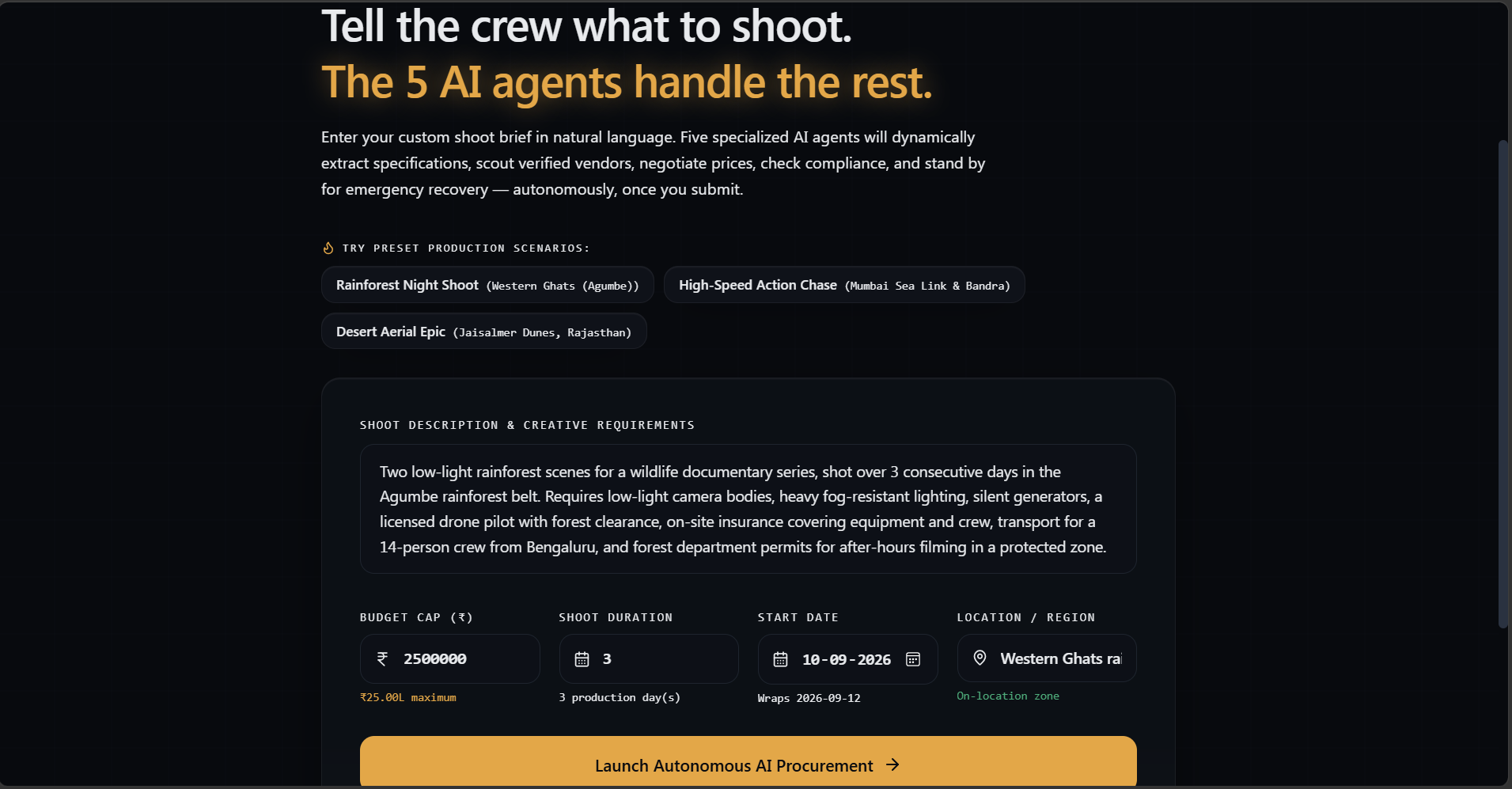
CineXchange AI is an autonomous AI production procurement and recovery platform for film and media.
Instead of making producers manually coordinate vendors, negotiate prices, verify compliance, track deliveries, and react to production failures, CineXchange connects the entire workflow through specialized AI agents.
🎬 1. Give it a production brief
A producer provides a single request describing the production requirements, budget, timeline, location, equipment, crew, insurance, and applicable permissions.
Creative Brief → CineXchange AI
↓
🧠 2. Understand the production
The Producer Agent, powered by Gemini, converts the creative brief into structured procurement requirements such as:
Camera • Lighting • Generator • Drone • Crew • Transport • Insurance • Permits
↓
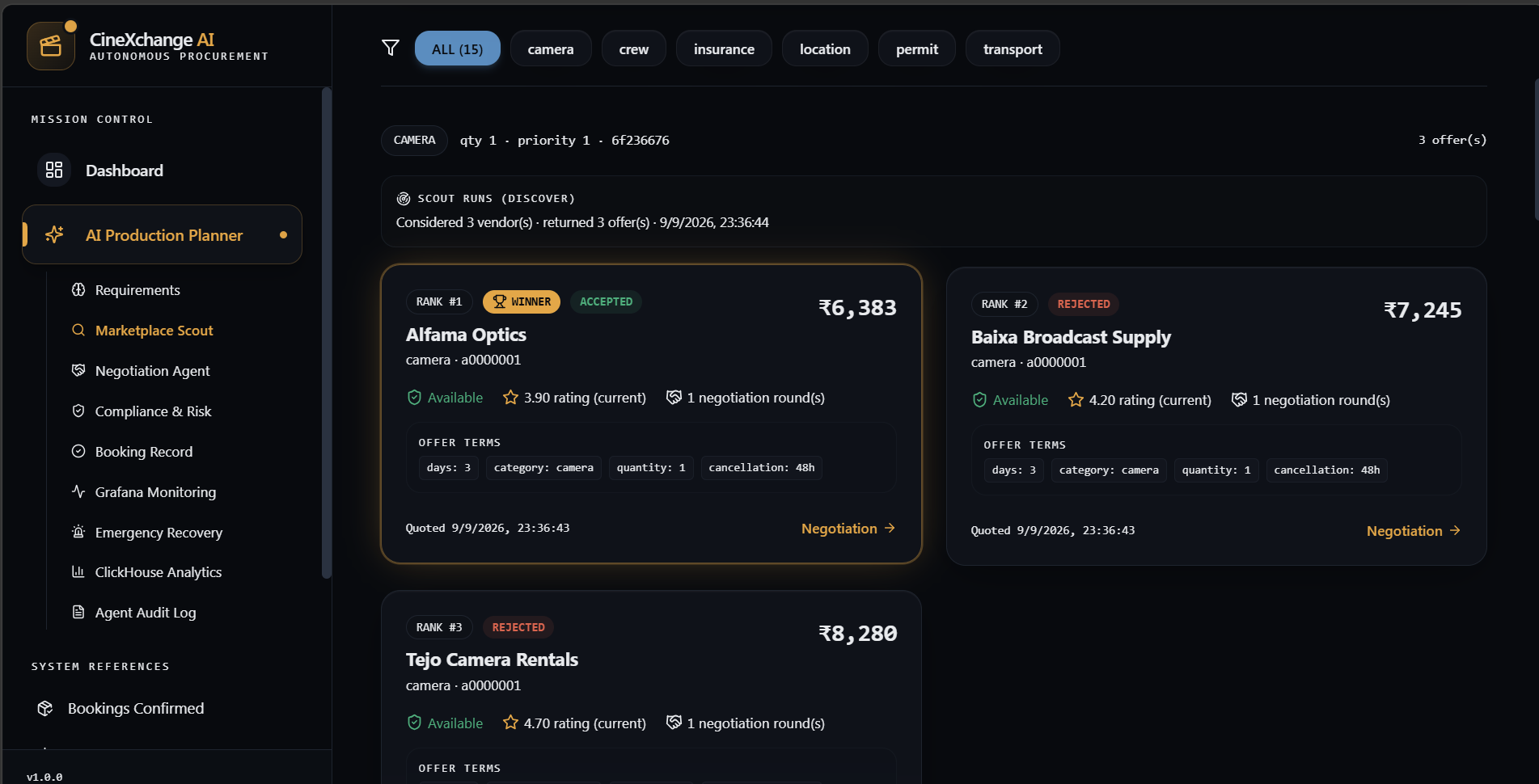
🔎 3. Find the best suppliers
The Marketplace Scout Agent searches available resources, removes suppliers that violate hard constraints, and ranks the remaining options using:
Price + Technical Suitability + Reliability + Proximity + Insurance + Compliance
The goal is not simply to find the cheapest option.
It finds the best production-ready option.
↓
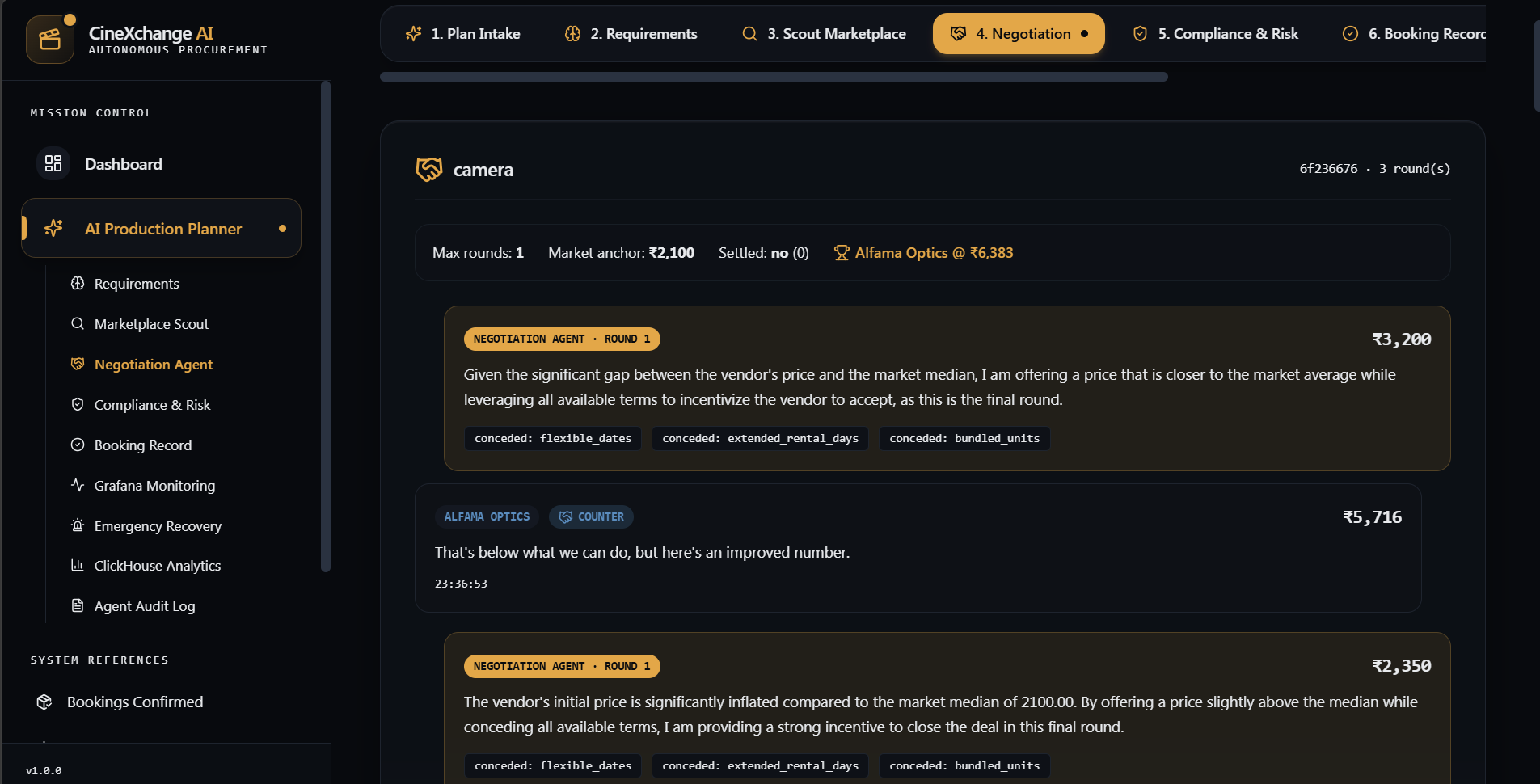
🤝 4. Negotiate automatically
The Negotiation Agent compares competing offers and negotiates:
Price • Bundles • Delivery • Warranty • Insurance
Negotiations remain controlled by deterministic policies such as:
Maximum 3 rounds • Target 8% savings • Mandatory insurance • Budget ceiling
↓
🛡️ 5. Verify before booking
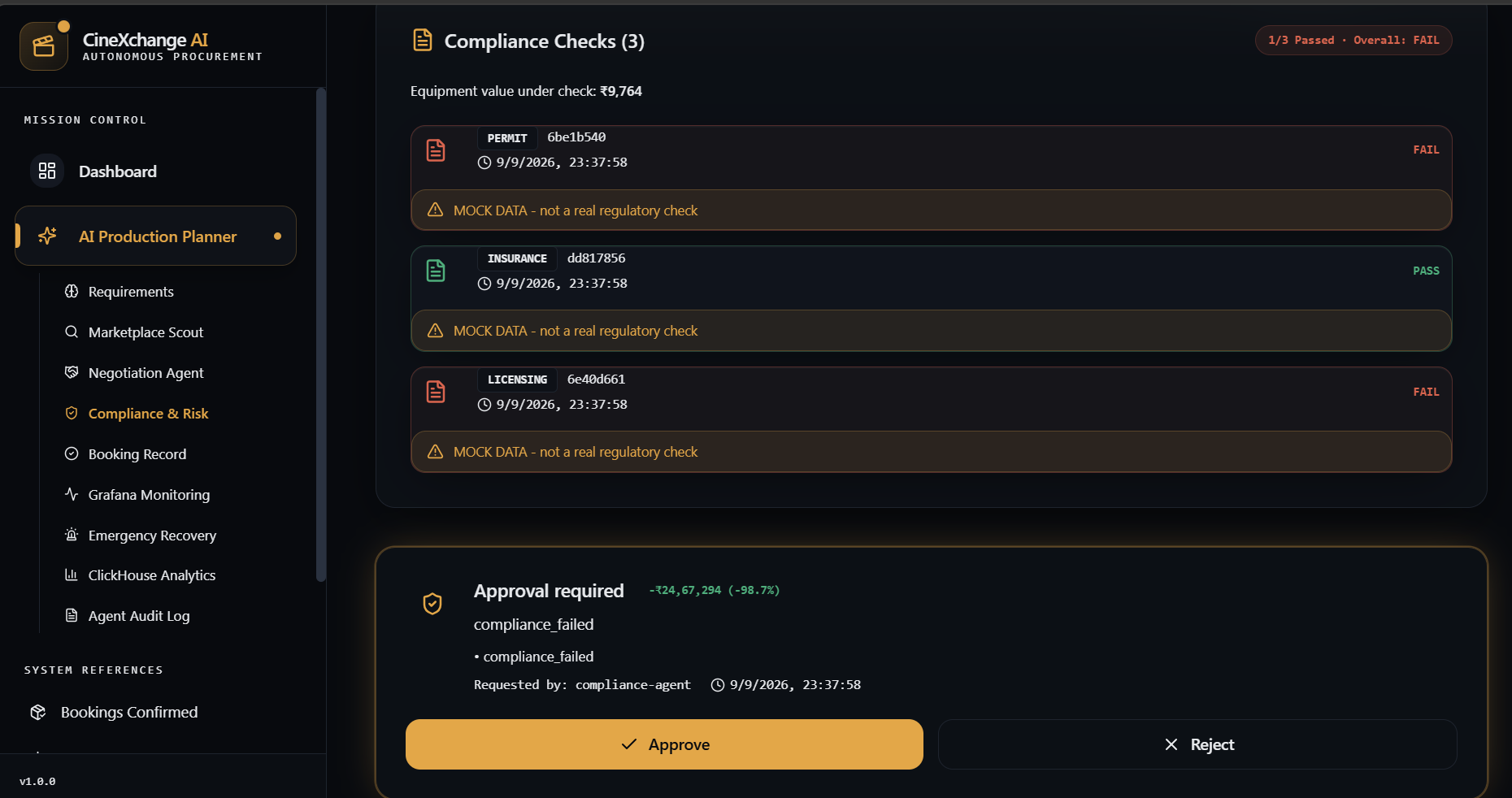
The Compliance & Approval Agent evaluates:
Vendor • Contract • Insurance • Permits • Financial Exposure
Low-risk decisions can proceed automatically, while high-value or high-risk decisions are routed to the producer for approval.
↓
📦 6. Book & monitor production
Once approved, the system books the selected resources and continuously tracks:
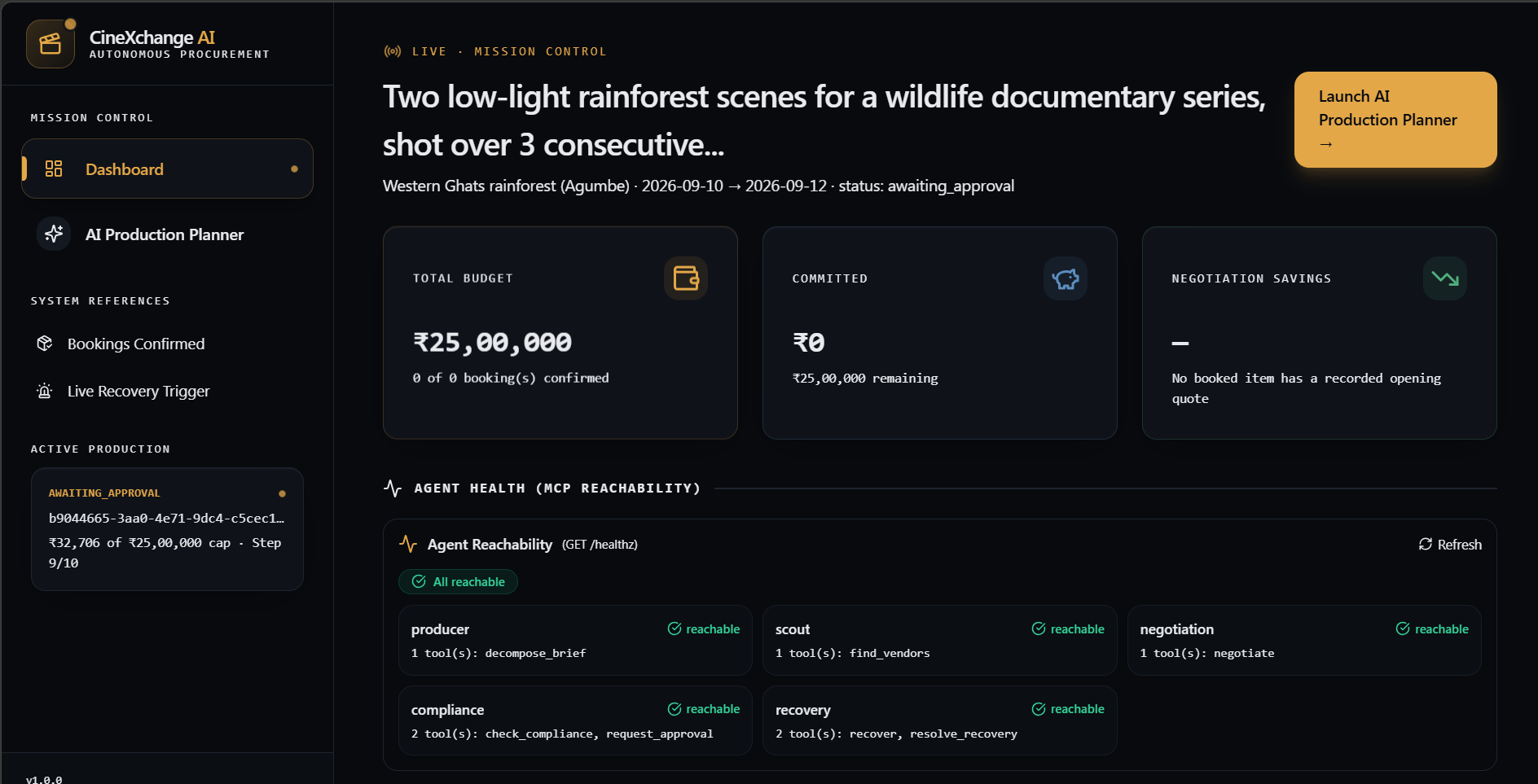
Bookings • Deliveries • Budget • Vendor responses • Agent activity • Risk • Incidents
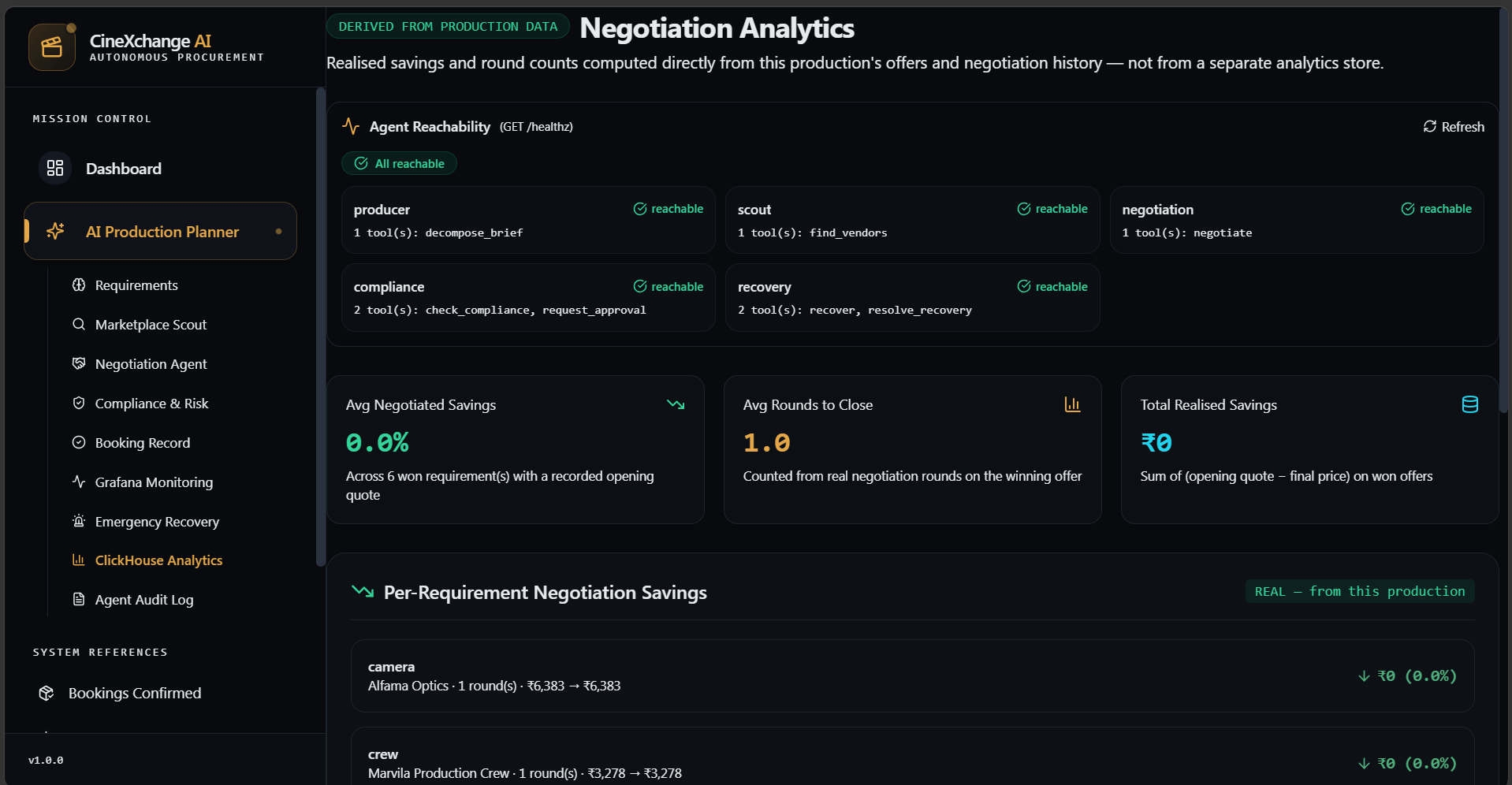
📊 7. ClickHouse — Production Memory
Every important production event flows into ClickHouse, creating an operational memory of the production.
It stores:
Vendor history • Price history • Negotiations • Agent events • Savings • Risk • Incidents • Recovery outcomes
This allows CineXchange to learn from what happened and make better future decisions.
📡 8. Grafana — Production Control Tower
Grafana provides real-time visibility into what is happening during production.
The producer can monitor:
Production Health • Active Bookings • Deliveries • Budget • Agent Activity • Incidents • Recovery Status
ClickHouse asks: What happened and what can we learn?
Grafana asks: What is happening right now?
Gemini asks: What should we do next?
🚨 9. Recover when production fails
This is where CineXchange becomes different from a traditional marketplace.
Imagine:
Camera #04 becomes unavailable two hours before the shoot.
Instead of starting the search manually again:
Camera Failure ↓ Incident ↓ Grafana ↓ Emergency Recovery Agent ↓ Find Alternatives ↓ Check Compatibility + Availability + Cost + Schedule + Compliance ↓ Negotiate Replacement ↓ Producer Approval if Required ↓ New Booking ↓ Continue Production
The Recovery Agent does not simply select the cheapest replacement.
It evaluates the total production impact:
Rental Cost + Transit Cost + Crew Idle Cost + Schedule Impact + Compliance Risk + Technical Compatibility
🔄 The CineXchange AI Loop
                    🎬 CREATIVE BRIEF
                           │
                           ▼
                  🧠 PRODUCER AGENT
                           │
                           ▼
                   🔎 SCOUT AGENT
                           │
                           ▼
                🤝 NEGOTIATION AGENT
                           │
                           ▼
              🛡️ COMPLIANCE & APPROVAL
                           │
                           ▼
                       📦 BOOK
                           │
                           ▼
                    🎥 PRODUCTION
                           │
              ┌────────────┴────────────┐
              ▼                         ▼
       🗄️ CLICKHOUSE                 📡 GRAFANA
      Operational Memory          Real-Time Control
              │                         │
              └────────────┬────────────┘
                           ▼
                       🚨 INCIDENT
                           │
                           ▼
                 🚑 RECOVERY AGENT
                           │
             ┌─────────────┼─────────────┐
             ▼             ▼             ▼
           🔎 SCOUT    🤝 NEGOTIATE   🛡️ COMPLIANCE
             │             │             │
             └─────────────┼─────────────┘
                           ▼
                  ✅ RECOVERY DECISION
                           │
                           ▼
                     📦 NEW BOOKING
                           │
                           ▼
                    📡 MONITOR AGAIN
                           │
                           └───────↺
⚡ In one sentence
CineXchange AI turns film procurement from a manual coordination process into a closed-loop autonomous system that can plan, negotiate, monitor, and recover.

How we built it
CineXchange AI is built as a multi-agent production procurement system where specialized AI agents work together through a shared production workflow.
The system uses Gemini + Google ADK for agent intelligence, FastAPI for orchestration and workflow management, and Next.js + TypeScript for the producer command center. A deterministic Python Policy Engine governs budget, quality, insurance, SLA, negotiation, and approval constraints, while MCP/APIs enable operational actions such as vendor search, availability, quotes, compliance checks, and booking.
Five specialized agents form the core of the system:
Producer Agent — Converts creative briefs into structured production requirements. Marketplace Scout Agent — Finds, filters, and ranks suitable suppliers. Negotiation Agent — Negotiates pricing, bundles, delivery, warranty, and insurance. Compliance & Approval Agent — Evaluates compliance, risk, and approval requirements. Emergency Recovery Agent — Handles failures by finding compatible replacements and minimizing production impact.
We designed the workflow as explicit production states rather than an unstructured chain of LLM calls.
For operational intelligence, ClickHouse stores agent events, vendor history, pricing, negotiations, bookings, savings, incidents, and recovery outcomes. Grafana provides real-time production observability, including production health, deliveries, budget, agent activity, incidents, and recovery status.
The resulting loop is:
Observe → Understand → Decide → Validate → Act → Measure → Recover
Challenges we ran into
The biggest challenge was not simply connecting an LLM to tools. It was making multiple autonomous agents operate reliably under real production constraints.
- AI reasoning vs. deterministic rules
LLMs can generate plausible decisions that violate business constraints. We solved this by separating AI reasoning from deterministic governance.
Gemini proposes → Policy Engine validates → MCP executes.
- Maintaining shared production state
Five agents need to understand the same production context. We created a shared state containing requirements, candidates, quotes, negotiations, compliance results, bookings, incidents, and recovery information.
- Making recovery decisions intelligently
A replacement cannot be selected based only on rental price. The Recovery Agent considers:
Price + Compatibility + Availability + Distance + Transit Time + Crew Idle Cost + Schedule Impact + Compliance Risk
This allows the system to choose the option with the lowest overall production impact.
- Making observability actionable
We did not want Grafana to be a decorative dashboard. Production events flow through the analytics and observability layer so operational signals can influence the recovery workflow.
Accomplishments that we're proud of
- Five agents working as one system
Instead of building five independent chatbots, we created specialized agents that share production state and capabilities.
- Autonomous negotiation
The Negotiation Agent can compare supplier offers and negotiate within explicit business constraints.
- Policy-controlled autonomy
Gemini cannot bypass budget limits, quality thresholds, insurance requirements, SLA constraints, negotiation limits, or approval thresholds.
- ClickHouse operational memory
Production events become reusable intelligence, allowing the system to learn from vendor performance, pricing, negotiations, incidents, and recovery outcomes.
- Grafana-driven production awareness
Grafana provides real-time visibility into production status, deliveries, budget, agent activity, incidents, and recovery.
- Autonomous emergency recovery
When a production resource fails, the workflow does not restart from scratch. The failure creates a new decision cycle through the Recovery Agent.
- Explainable decisions
Instead of simply saying:
“Camera A is better.”
CineXchange can explain the trade-off:
“Camera A costs more but avoids a two-day delay and associated crew idle costs.”
This makes autonomous decisions easier for producers to understand and trust.
What we learned
We learned that an agentic system is much more than an LLM connected to tools.
The real engineering challenge is building a reliable closed-loop system where agents can:
Observe → Understand → Decide → Validate → Act → Measure → Recover
We also learned that governance and observability must be part of the architecture from the beginning.
Gemini provides reasoning and planning, while the Policy Engine provides deterministic control. ClickHouse gives CineXchange historical operational intelligence, while Grafana provides real-time production visibility.
Together, they move the system from:
“Something happened.”
to:
“Something is happening, and here's what the system should do about it.”
What's next for CinexChange AI
- Predictive failure detection
Use historical production and vendor data to predict resource and supplier failures before they affect a shoot.
- Learned vendor intelligence
Use historical ClickHouse data to continuously improve vendor ranking, reliability scoring, and negotiation strategies.
- Dynamic production scheduling
Automatically adapt production schedules when resources, locations, vendors, or delivery timelines change.
- Automated logistics optimization
Optimize transportation routes, delivery windows, resource movement, and crew coordination.
- Production cost forecasting
Predict total procurement and recovery costs before final booking decisions are made.
- Cross-production intelligence
Learn from historical productions to make future procurement, negotiation, and recovery decisions smarter.
- Expanded production ecosystem
Integrate more marketplaces, operational tools, and partner technologies while keeping the multi-agent architecture modular.
Built With
- adk
- agent
- agentic
- ai
- clickhouse
- cloud
- fastapi
- gemini
- grafana
- mcp
- next.js
- orchestration
- platform
- postgresql
- pydantic
- python
- typescript


Log in or sign up for Devpost to join the conversation.