Inspiration
InspirationOur journey began with a sobering reality: in rural India, 600 million people live more than 30 kilometers away from a qualified medical professional. We were inspired by "Priya," a mother in a Jharkhand village who, at 11 PM, faces an agonizing choice: spend a week’s food budget on an auto-rickshaw to a distant hospital, or wait and pray her child's fever isn't fatal.With India facing a shortage of roughly 600,000 doctors and over 70% of rural households in states like Bihar traveling over 10 km for basic consultations, we realized these families don't need a complex diagnostic app—they need a "Health Companion." Inspired by Dario Amodei’s Machines of Loving Grace, we built SehatSathi to extend the reach of medical knowledge to those who have never had it
What it does
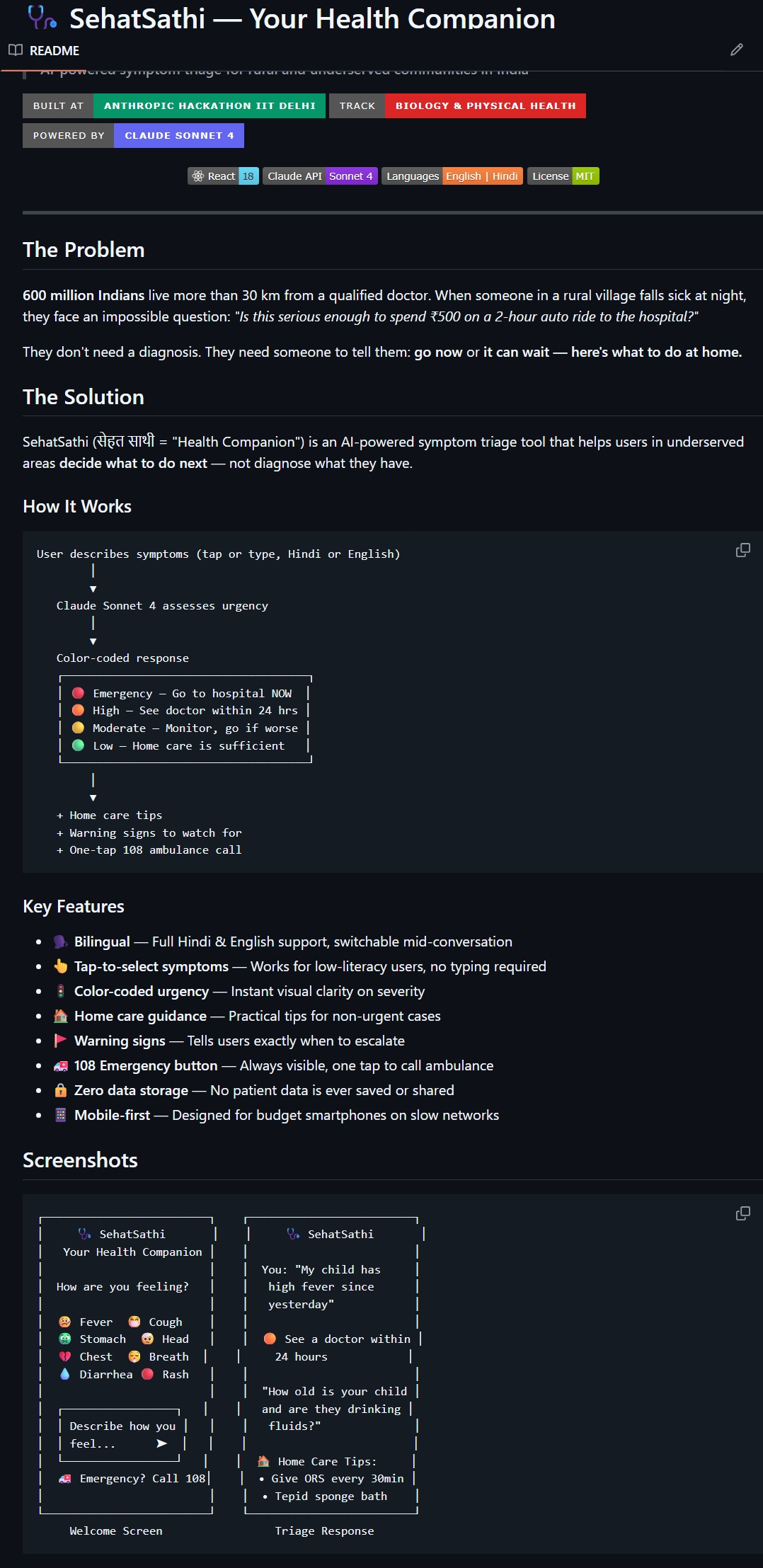
SehatSathi is a bilingual symptom triage assistant designed for underserved areas. It is explicitly not a diagnostic tool; instead, it helps users decide on their next step. Users describe their symptoms in Hindi or English, and the app provides:Color-coded Urgency Levels: Ranging from "Emergency" (call 108 immediately) to "Low" (home care).Follow-up Questions: Gathering critical context like the duration of a fever.Home Care Tips: Practical advice for non-urgent cases, such as using ORS solution.Warning Signs: Specific "red flags" that indicate a situation has become urgent.
How we built it
We designed SehatSathi as a mobile-first, single-page React application. The core intelligence is powered by the Anthropic Claude Sonnet 4 API. To ensure the UI could reliably render data without confusing free-form text, we used advanced prompt engineering to force the AI to return a strict, structured JSON schema.The Math Behind TriageTo ensure safety, we treated triage as a decision function where $x$ represents symptoms and context:$$S(x)=\arg\max_{c\in{E,H,M,L}}P(c|x)$$We applied an asymmetric risk weighting to our cost function:$$Cost(\hat{c},c)=\begin{cases}\alpha&if\hat{c}>c\ 1&if\hat{c}<c\end{cases}$$By setting $\alpha \gg 1$, we ensured that the "cost" of under-triaging (telling someone to stay home when they are in danger) is mathematically much higher than over-triaging.
Challenges we ran into
The "Reassurance Trap": Early versions were too "polite," sometimes downplaying symptoms that required a doctor. We had to tune the prompt to be aggressively cautious for vulnerable groups.Reliable JSON Output: Getting an LLM to consistently return pure code without conversational "fluff" took multiple iterations and a custom regex safety net.Language Nuance: Medical terms like "Nausea" don't always translate directly; we had to ensure the model understood colloquial Hindi like "जी मिचलाना".Low-Literacy Design: We realized our first UI had too much text. We stripped it back to large icons, emoji-labeled buttons, and high-contrast colors.
Accomplishments that we're proud of
Safety First: In all tests, the system correctly escalated high-risk symptoms (like chest pain or infant fevers) to "Emergency" status with zero false negatives.True Bilingualism: The AI doesn't just translate labels; it "thinks" and responds in Hindi, allowing a user in rural UP to describe their pain naturally.Privacy by Design: We built this with zero backend servers and zero data storage. No patient data is ever saved, making it inherently secure.Rapid Development: As a team of beginners, we learned React, API integration, and prompt engineering to build a functional tool in just 8 hours.
What we learned
Prompt Engineering is Product Design: The prompt isn't just code; it’s the ethical framework of the app.
Bias Toward Safety is a Feature: Unlike traditional ML that optimizes for 100% accuracy, health triage must optimize for not missing emergencies.
Simplicity is Accessibility: On a ₹5,000 smartphone with a 2G connection, a big green button beats a fancy animation every time.
AI Should Know Its Limits: The most vital thing SehatSathi can say is "I don't know, please see a doctor".
What's next for creative solution
We want to bridge the gap further by implementing voice input for users who are more comfortable speaking than typing. We are also planning an offline mode with a cached decision tree for areas with no internet. Long-term, we aim to expand into more regional languages like Tamil and Bengali and integrate with India's ASHA worker network, providing them with a digital tool to support their life-saving work in the field.


Log in or sign up for Devpost to join the conversation.