Inspiration
Creative Crew started from a simple frustration: generative AI can already write a script, suggest a visual direction, or create production ideas, but the filmmaker still has to coordinate all of those pieces.
We wanted to explore a different question: what if the filmmaker gave the system the creative intent, while the system coordinated the creative work?
The goal became to make AI feel less like a collection of chatbots and more like a small creative organization working from the same brief.
One brief. One AI creative crew. One production-ready pre-production package.
What it does
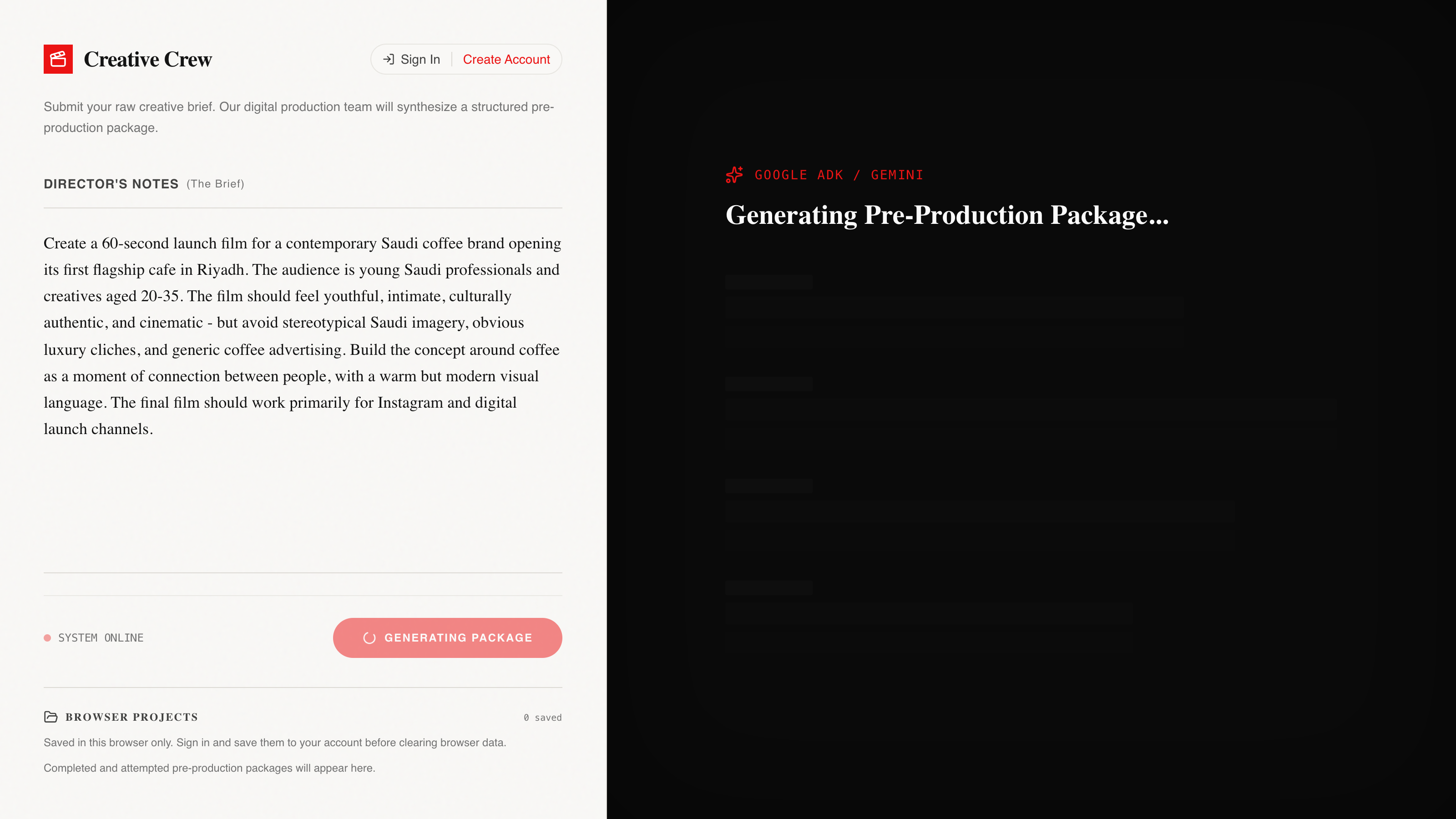
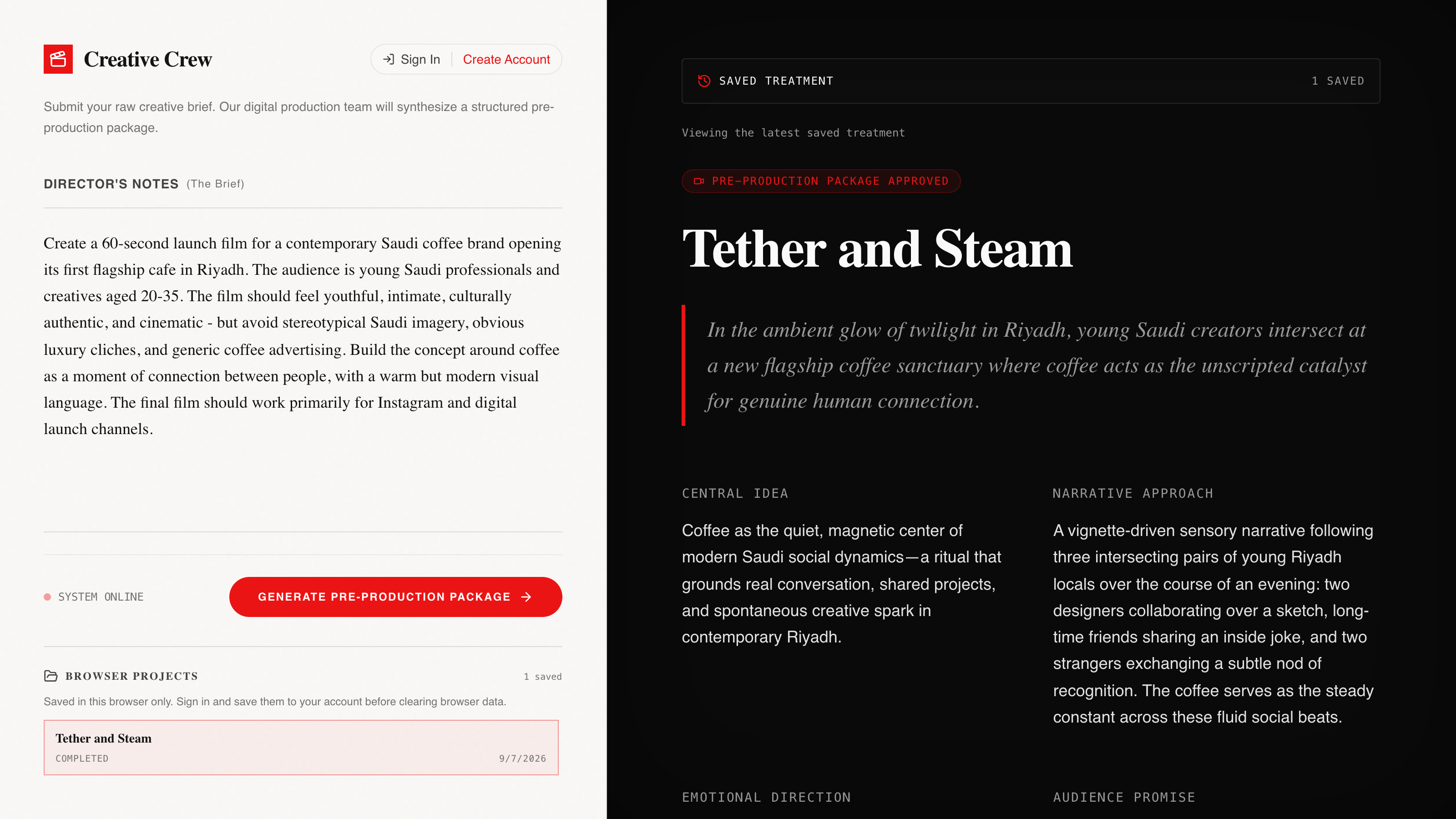
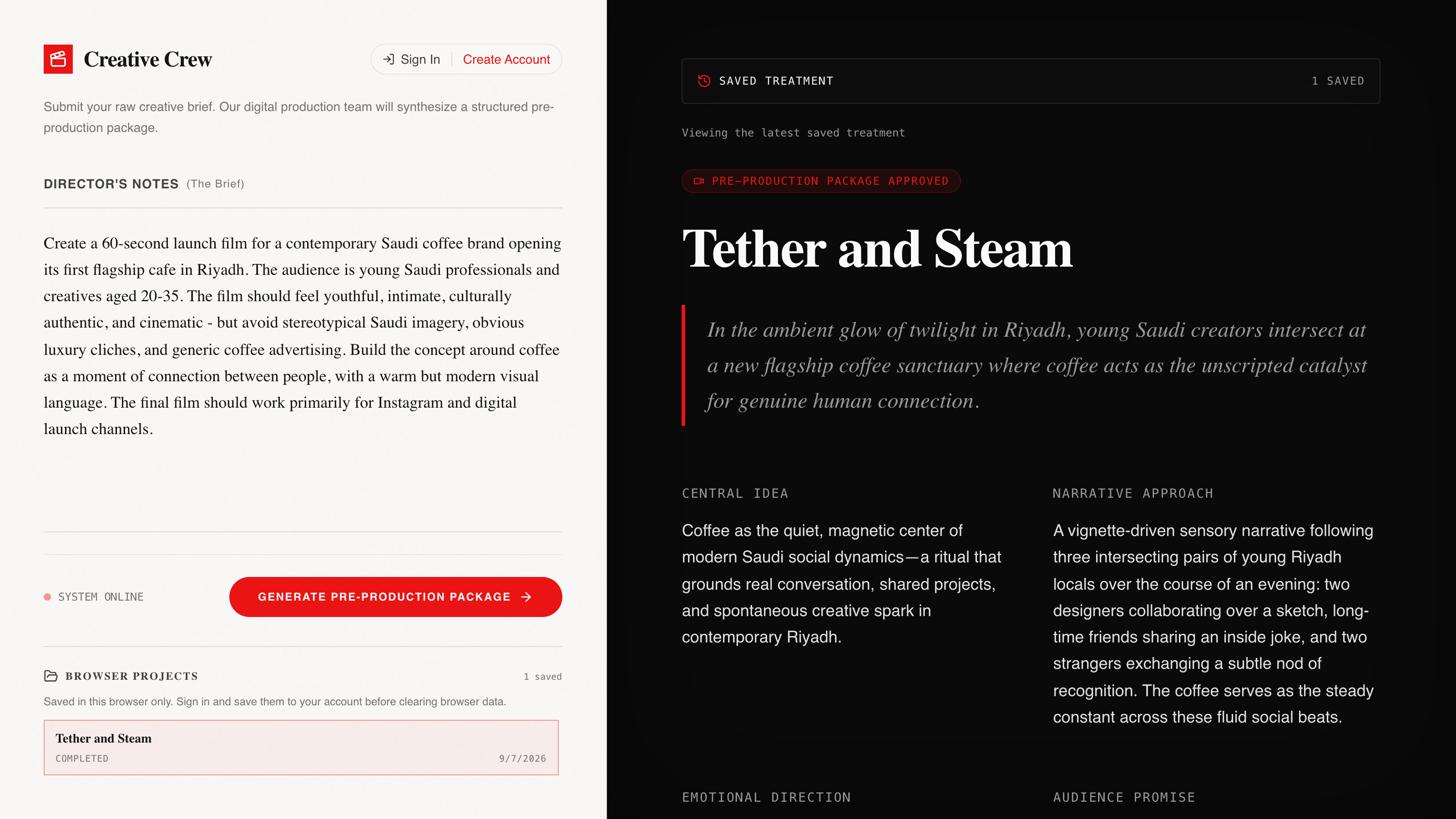
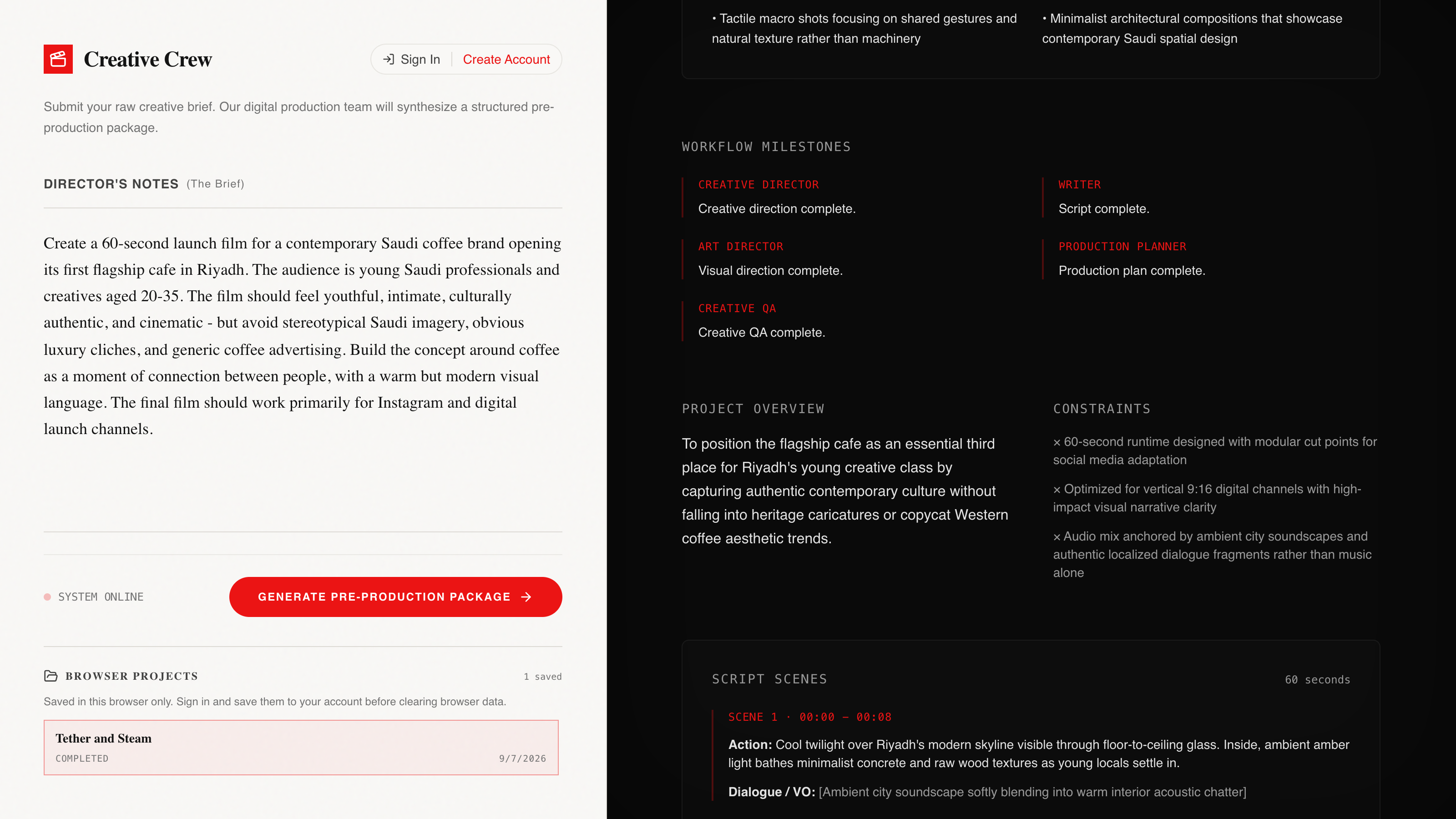
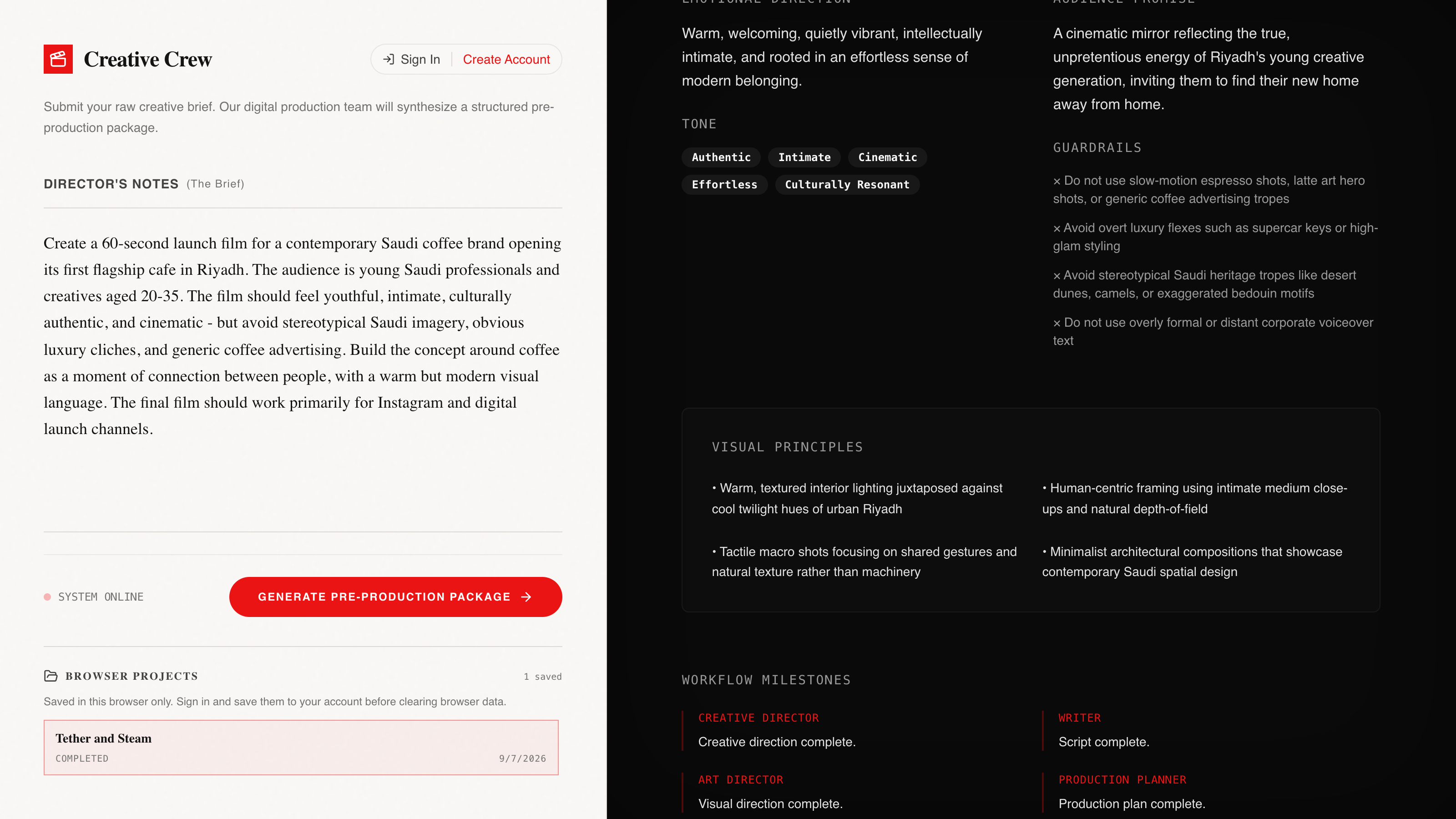
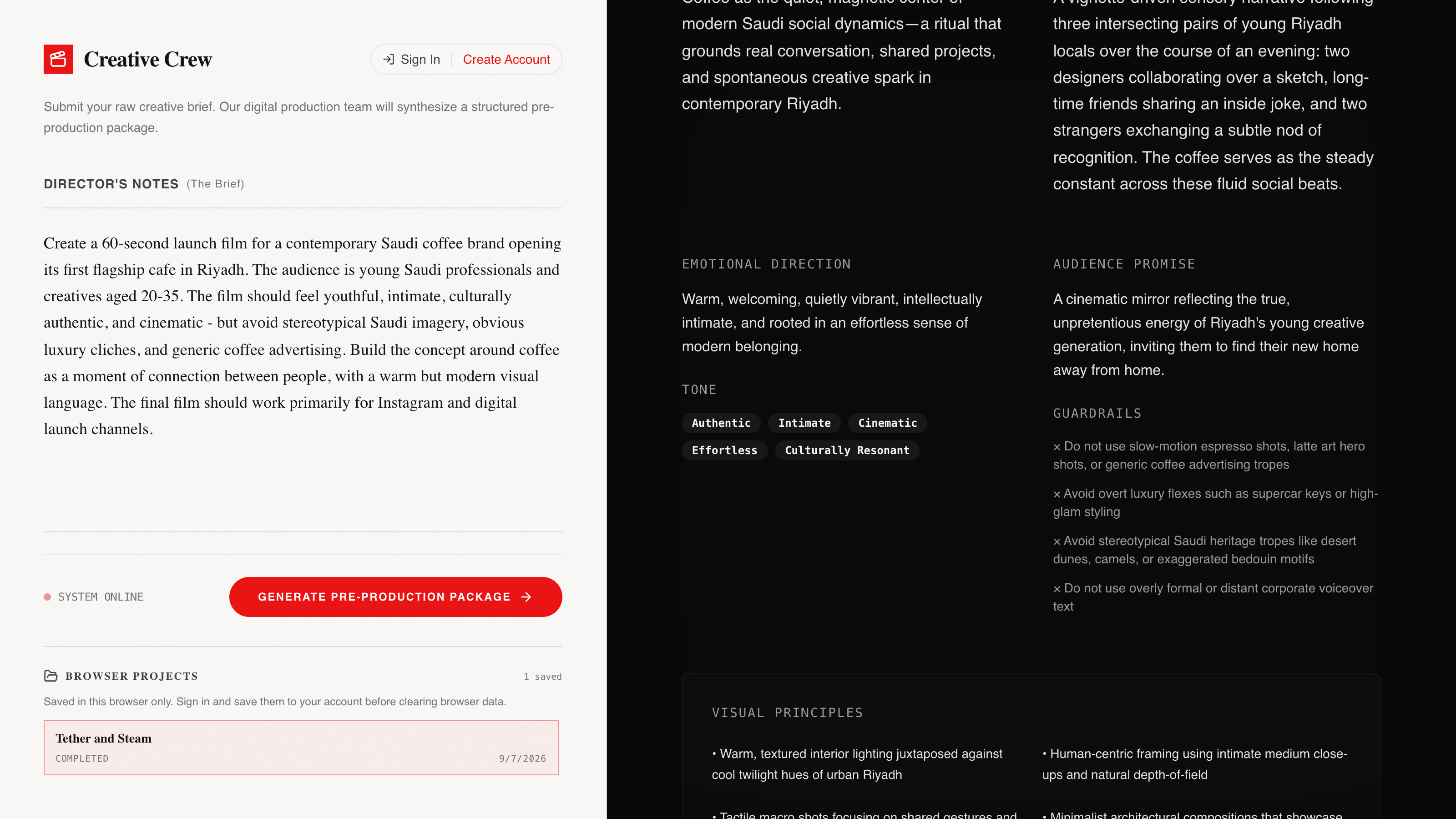
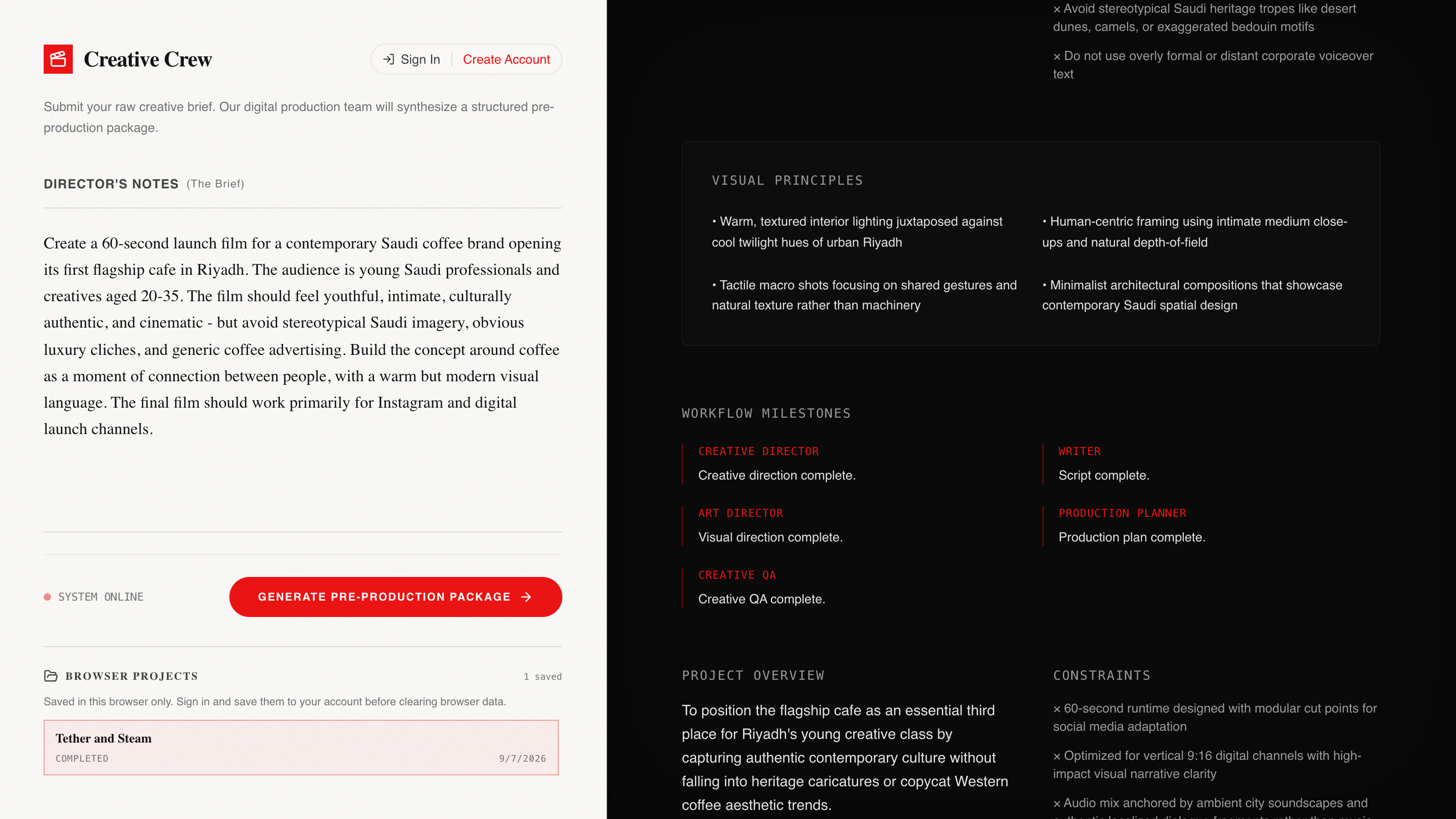
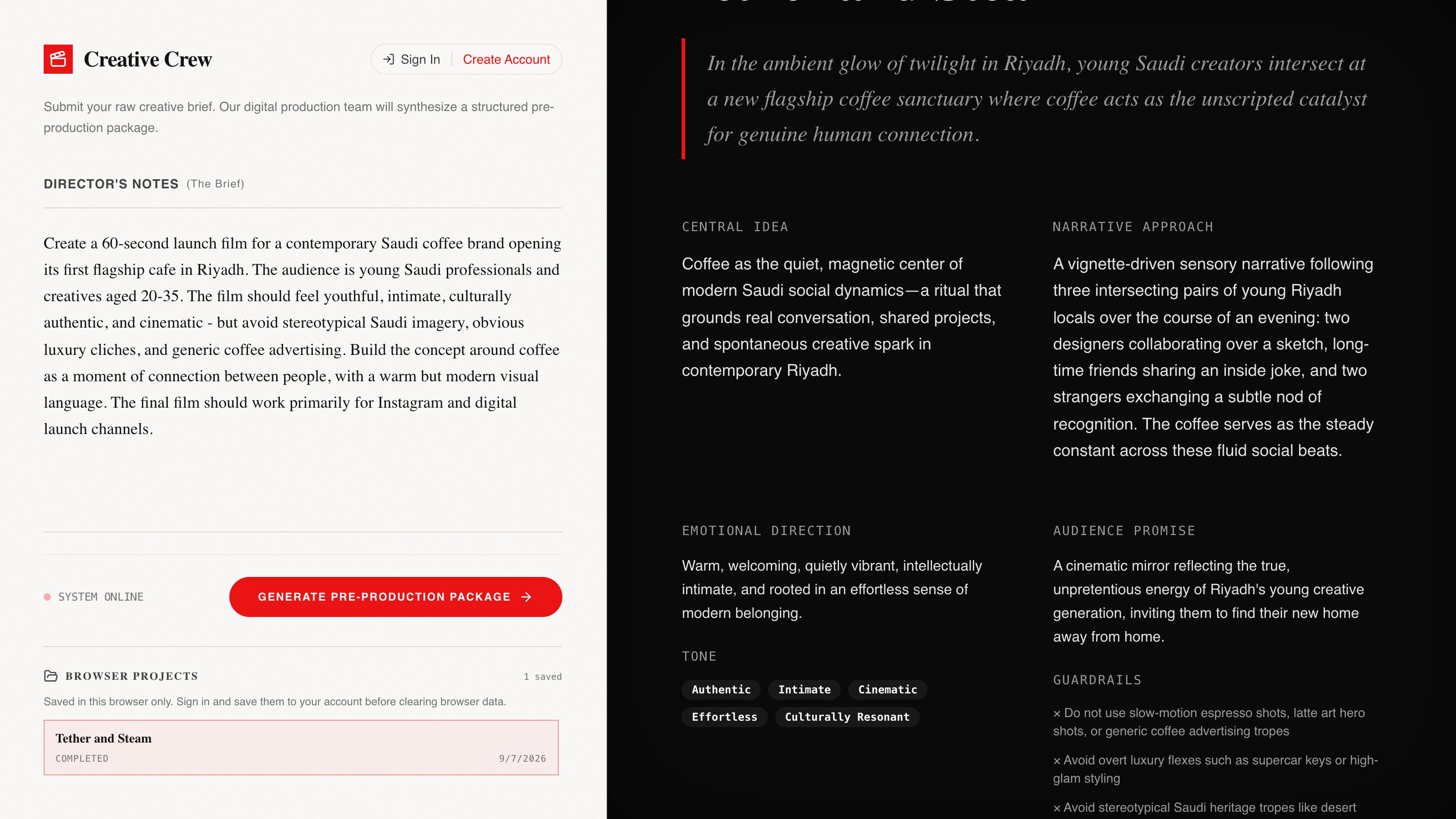
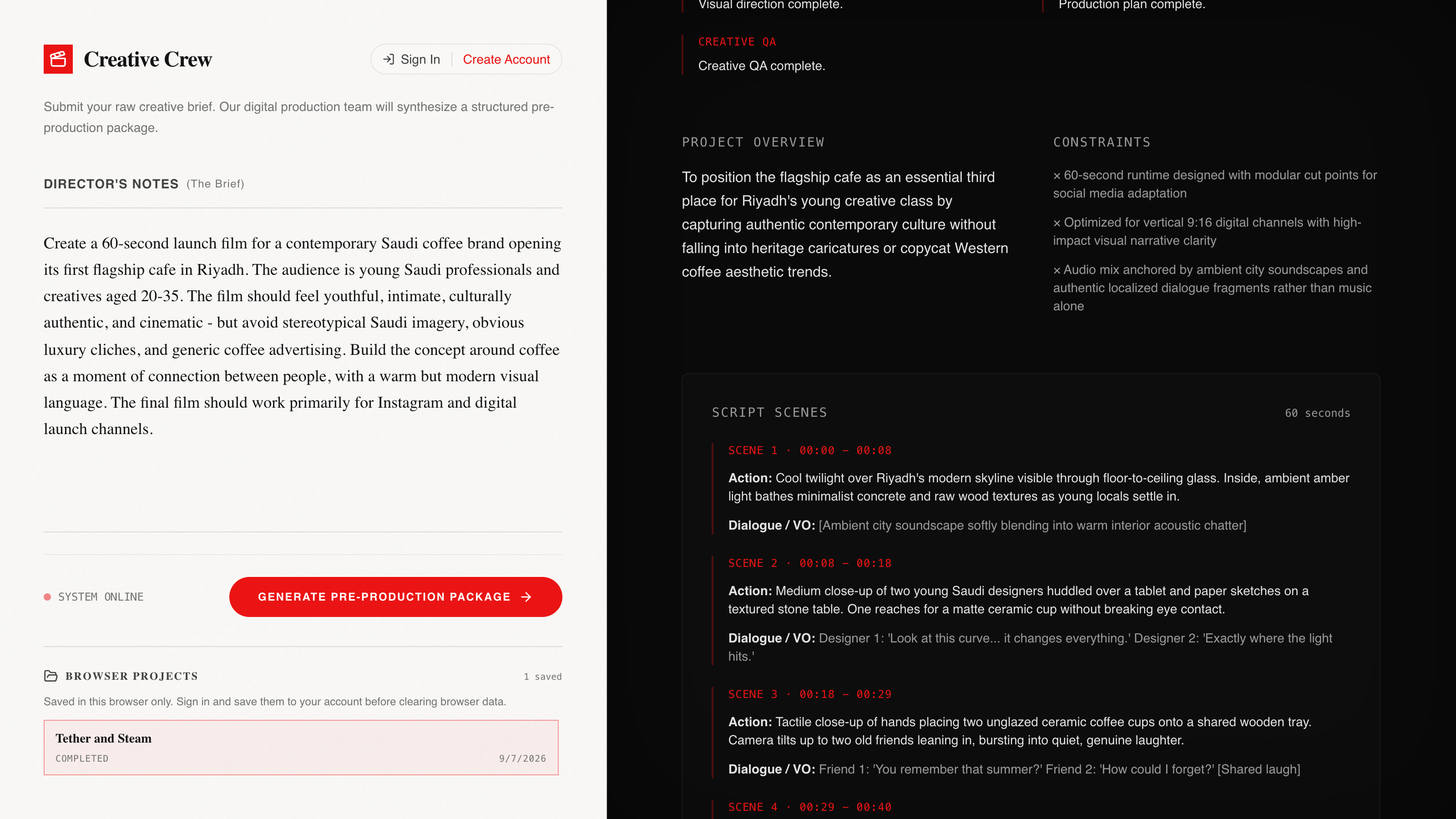
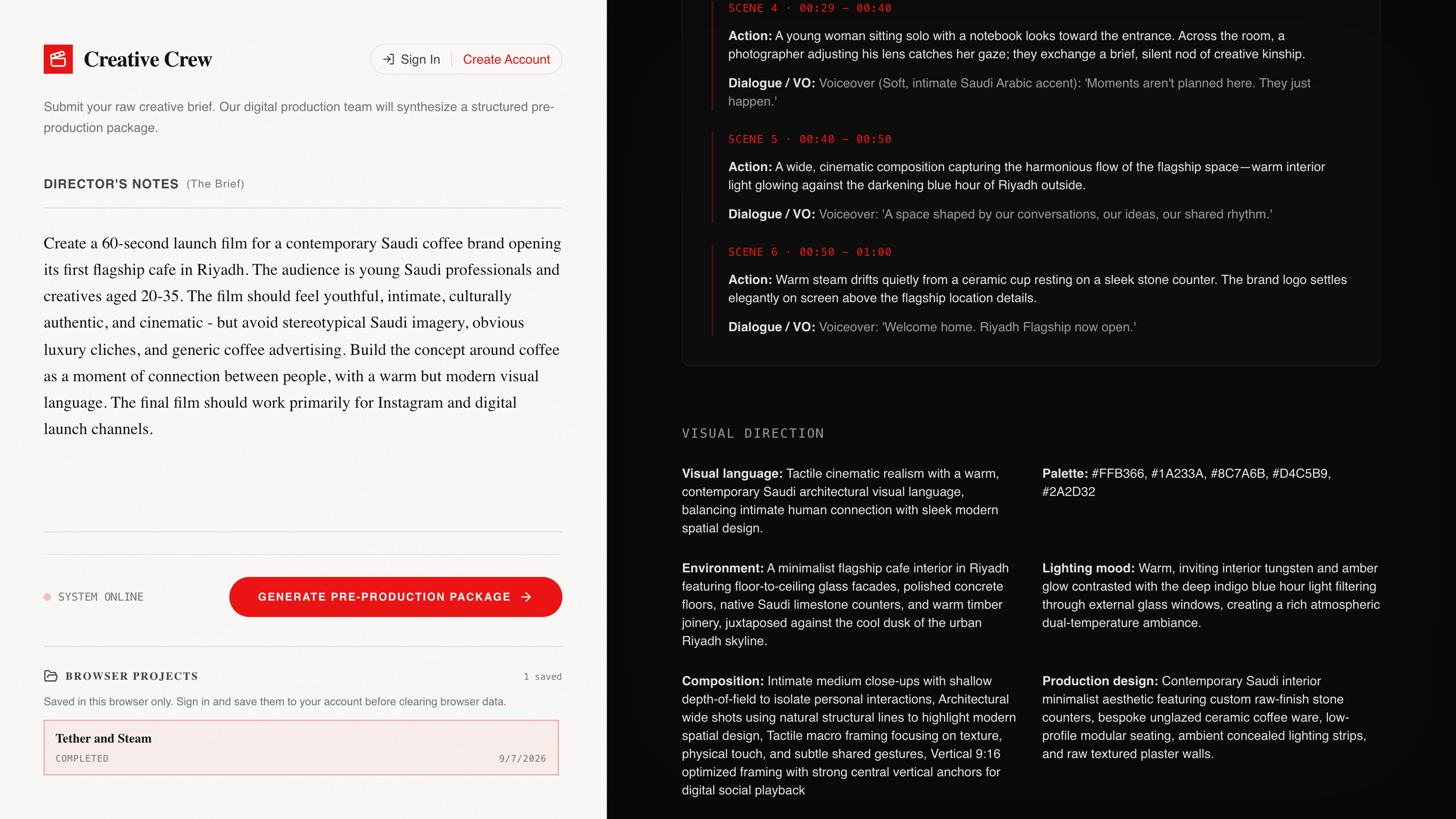
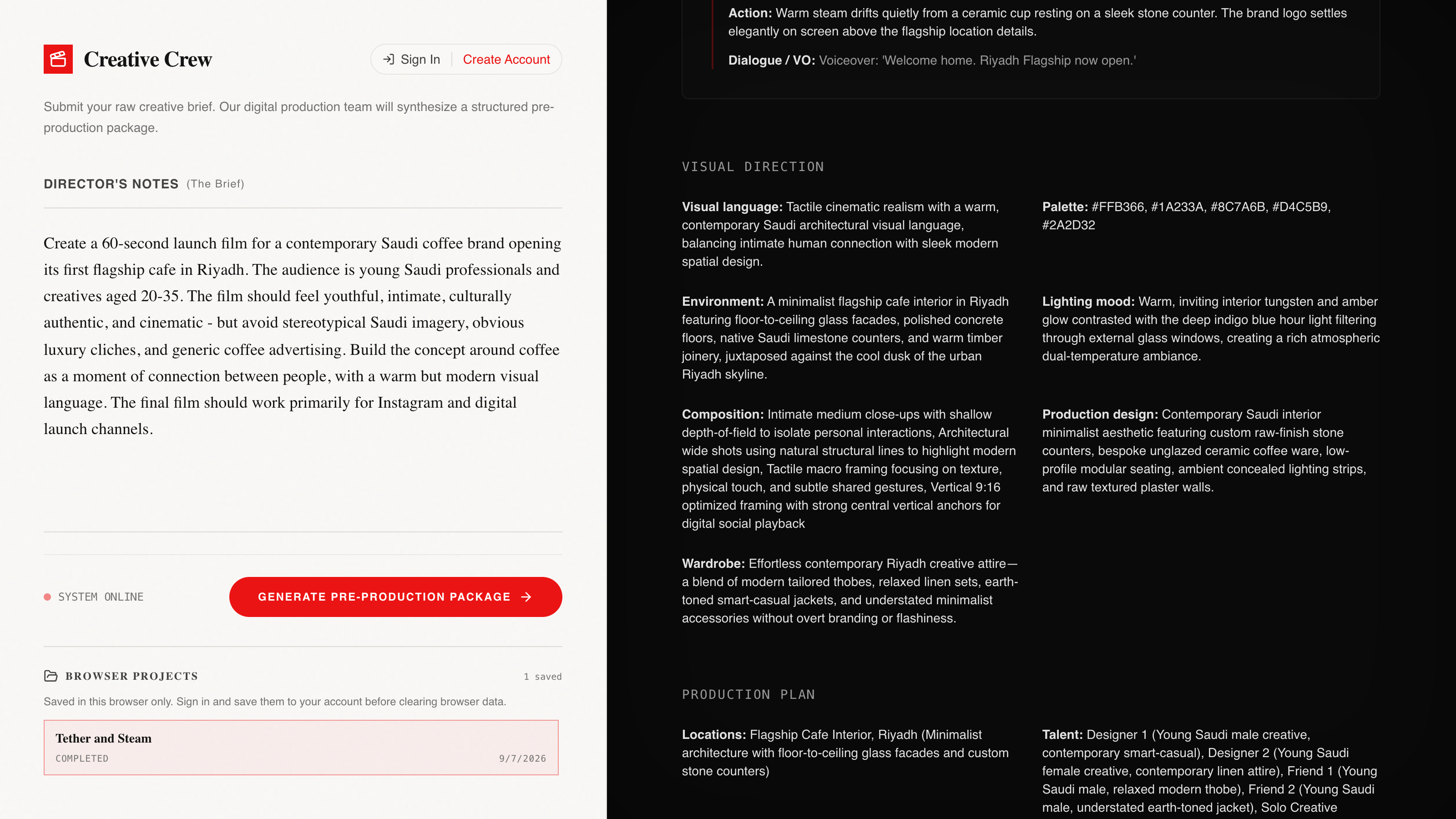
Creative Crew takes a filmmaker’s brief and turns it into a structured pre-production package through a coordinated sequence of specialized AI roles.
The current workflow includes:
- Creative Director — establishes the treatment, central idea, emotional direction, tone, and creative principles.
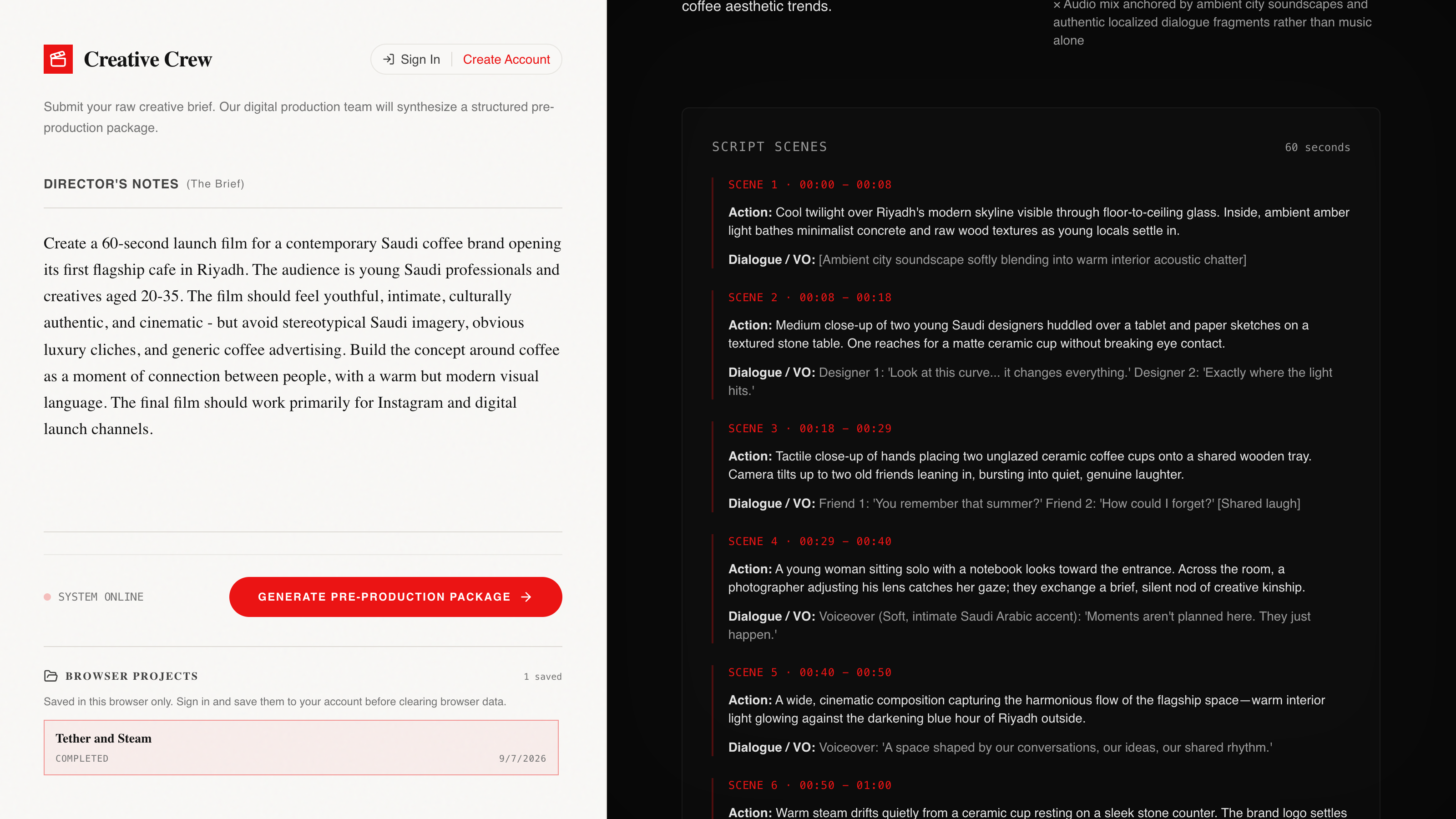
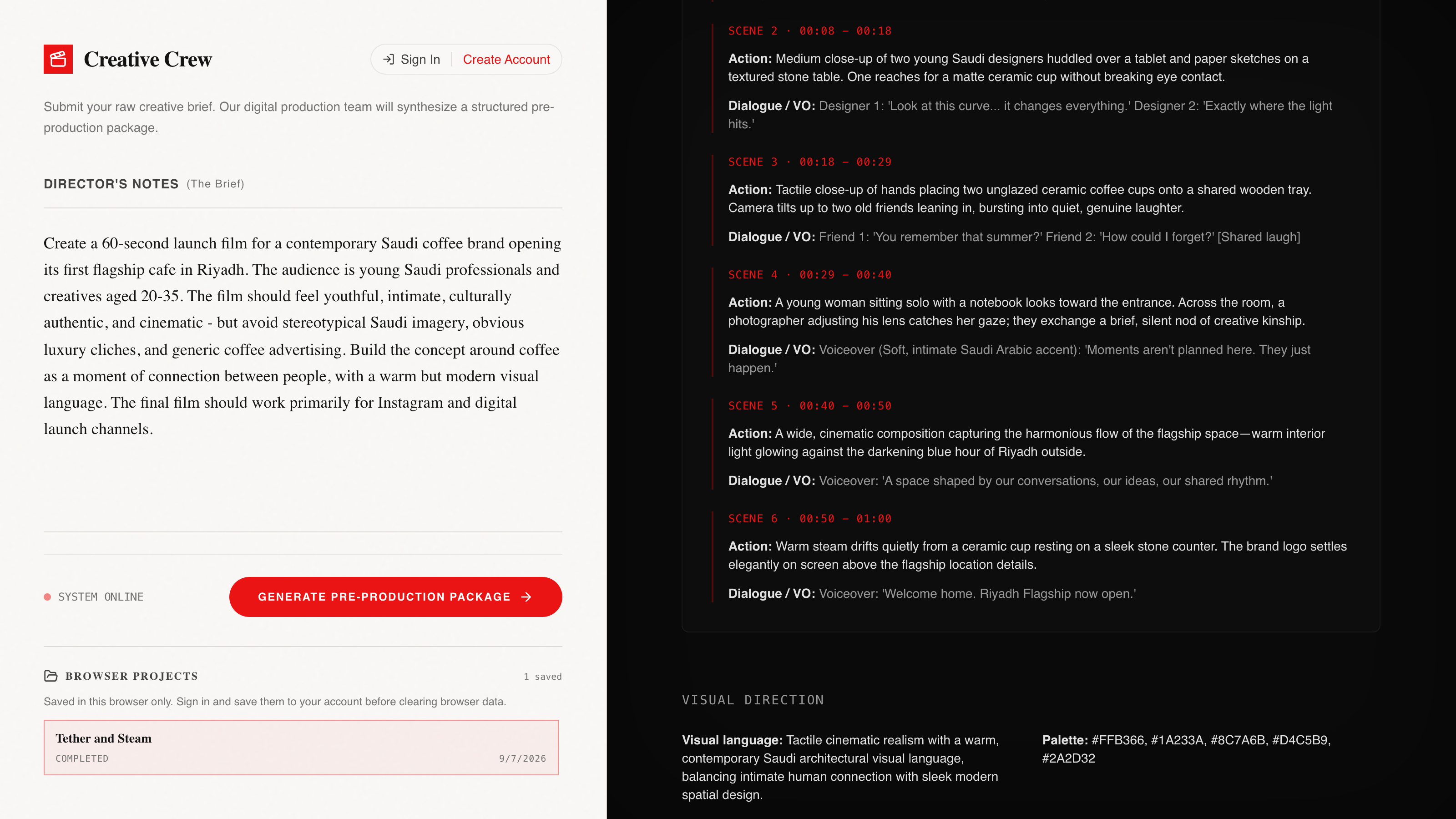
- Writer — turns that direction into a duration-aware scene structure with action, dialogue, and voiceover where appropriate.
- Art Director — defines the visual language, palette, environments, lighting, composition, production design, and wardrobe direction.
- Production Planner — translates the creative work into practical production requirements, locations, talent, props, dependencies, and a scene-linked shot list.
- Creative QA — evaluates the package for consistency, completeness, feasibility, and alignment with the original brief.
The resulting work is assembled into one coherent package rather than presented as disconnected AI responses.
Creative Crew does not currently generate the finished film. The current product deliberately focuses on moving from creative intent to production-ready pre-production.
How we built it
Creative Crew is a web application built and deployed using Replit Agent for the Replit partner track.
The AI workflow uses Google Agent Development Kit (ADK) with Gemini. Each specialist operates as a distinct sequential ADK/Gemini stage with structured outputs passed downstream.
Instead of allowing multiple agents to freely converse, we designed the system around a deterministic workflow:
Brief → Creative Director → Writer → Art Director → Production Planner → Creative QA → Final Package
Outputs are structured and validated before the package is persisted. This gives the system an explicit definition of progress and completion instead of treating a successful model response as a finished job.
The application also includes persistent projects and authentication, including Google sign-in through Clerk, while keeping Gemini and application credentials server-side.
The finished application is deployed publicly on Replit:
Creative Crew live application
https://quanta-crew.replit.app/
Challenges we ran into
The biggest challenge was learning that multi-agent does not automatically mean coordinated.
It is easy to create several AI personas and call the result an agent system. It is much harder to make each specialist receive the correct upstream context, produce predictable structured output, and hand useful work to the next stage.
Structured model output was another practical challenge. During real Gemini testing, one Production Planner response exceeded its expected structured-output allowance and produced malformed JSON. Instead of accepting partial output or showing false success, the workflow failed safely. We adjusted the stage-specific allowance and reran the real workflow successfully.
We also had to make difficult scope decisions. Storyboard generation, finished video generation, autonomous correction loops, sophisticated revisions, and exports would all make Creative Crew more impressive, but implementing everything would have weakened the reliability of the core workflow.
The priority became: make the orchestration real before making the feature list large.
Accomplishments that we’re proud of
We’re proud that Creative Crew became more than a UI wrapped around a single Gemini prompt.
A real end-to-end acceptance test produced a complete pre-production package through five Google ADK/Gemini specialist executions, including a six-scene script, scene-linked production planning and shot list, structured QA checks, and final package assembly.
We’re also proud of what we deliberately did not fake. If a specialist fails or produces malformed structured output, the system does not silently substitute placeholder content and call the project complete.
The product is deployed as an actual web application rather than only existing as an architecture diagram or technical prototype.
Most importantly, the experiment demonstrated the experience we wanted to test: the user provides creative intent while the system handles the orchestration.
What we learned
Our biggest learning was that the interesting part of agentic creative software is not simply giving different names to multiple model calls.
The real value comes from orchestration, structured state, specialization, handoffs, validation, QA, and completion criteria.
We also learned that deterministic architecture and generative creativity are not opposites. Structure can give creative agents clear responsibilities while Gemini provides flexibility inside those boundaries.
Finally, building Creative Crew reinforced an important product principle for us:
Generation is not completion.
An AI system becomes substantially more useful when it takes responsibility for moving work toward an outcome instead of returning an answer and leaving the user to coordinate everything that comes next.
What’s next for Creative Crew
The current version stops intentionally at pre-production.
The natural next step is to extend the same execution architecture further into production:
Brief → Pre-production → Storyboard → Generated Shots → Voice/Audio → Assembly → Creative QA → Film
That could include storyboard generation, visual continuity across scenes, image and video generation, voiceover, audio, stronger dependency-aware revisions, and eventually production assembly.
We also want revisions to become dependency-aware. If a filmmaker says, for example, “keep the concept, but make it younger and less luxurious,” Creative Crew should understand which approved decisions changed, identify which downstream work is now outdated, rerun only the affected specialists, perform QA again, and update the package.
The larger direction is not to build another AI tool that filmmakers have to operate.
It is to build a creative system where filmmakers express intent, make the decisions that matter, and let the creative machinery coordinate the rest.
Built With
- agenticai
- clerk
- express.js
- gemini
- generativeai
- google-cloud
- googleadk
- googlesign-in
- multi-agentsystems
- postgresql
- react
- replit
- replitagent
- typescript

Log in or sign up for Devpost to join the conversation.