-
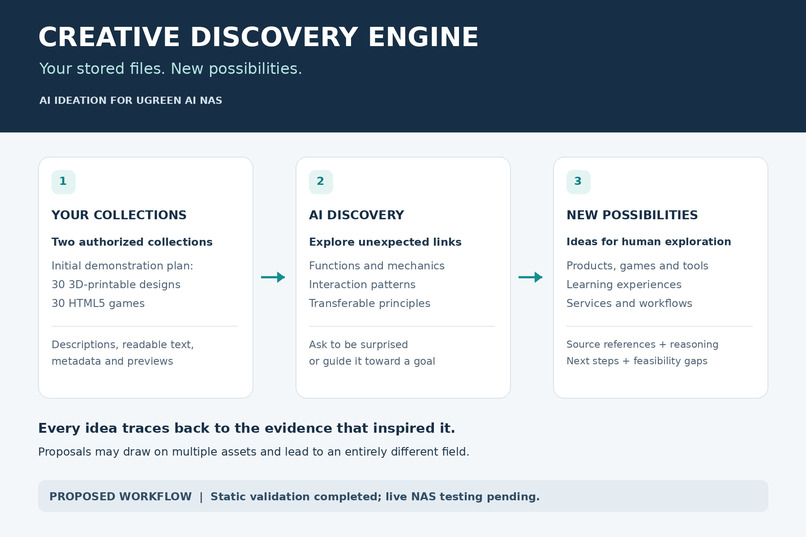
Proposed workflow: AI explores two authorized collections to suggest source-linked creative ideas. Live NAS testing pending.
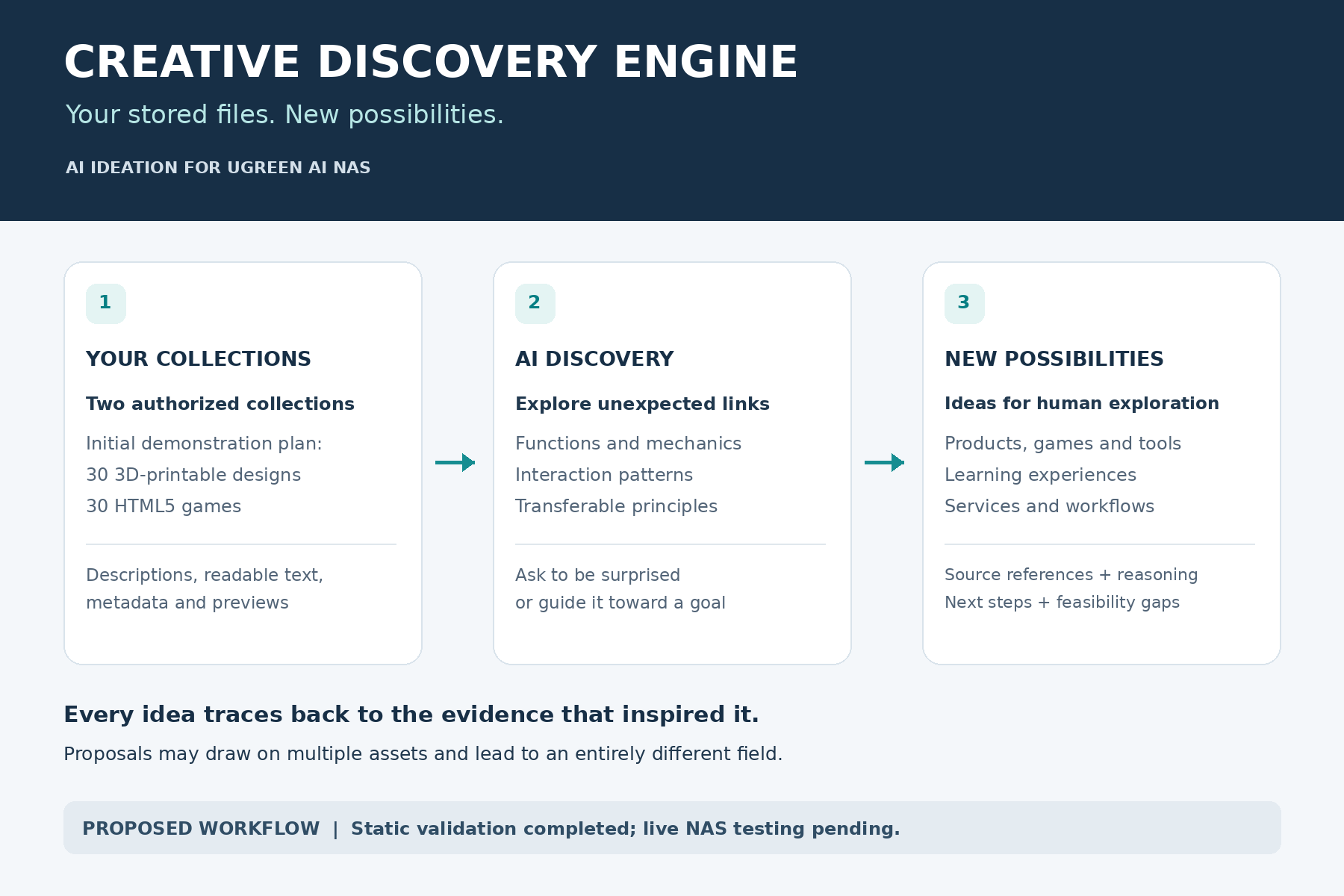
Inspiration
People accumulate collections of digital assets—3D-printing designs, games, photographs, creative projects, and other resources. Much of that material eventually sits forgotten in storage.
What if AI could discover new possibilities within those collections?
That question inspired Creative Discovery Engine.
Our guiding idea is simple:
Understand what I already have. Discover what I haven't imagined.
What it does
Creative Discovery Engine is an AI Skill designed for UGREEN AI NAS. It explores two user-authorized collections, discovers unexpected relationships, and proposes creative ideas grounded in the available source information.
Our planned demonstration uses 30 printable-design candidates and 30 HTML5-game candidates. These are starting points for discovery: the resulting idea could be a physical product, game, software tool, learning experience, business workflow, or something in an entirely different field.
The Skill examines available descriptions, supported readable content, metadata, and previews. It looks for transferable functions, mechanics, interaction patterns, and constraints across multiple assets.
Each proposed idea explains:
- Which files and documented characteristics inspired it.
- How those characteristics connect.
- What useful application or experience might result.
- What a person would need to investigate or develop next.
Users can ask to be surprised or guide discovery toward a particular problem, audience, industry, or outcome. They can request a number of ideas, receive manageable batches, and explore selected concepts more deeply.
The output is a set of creative starting points for human exploration. The Skill does not automatically build or validate the proposed products.
How we built it
We authored a read-only Uliya Skill using UGREEN's official Uliya/UGOS developer kit v0.7.3.
The workflow delegates authorized file discovery and evidence retrieval to registered file, document, and photo agents, with optional knowledge-agent support. The parent Uliya AI performs the creative reasoning using the returned evidence.
Every idea must retain its source references. The Skill separates documented observations, interpretation, creative proposals, and unverified feasibility.
It also reports what it actually examined, including missing information and partial coverage. Larger collections require bounded exploration rather than a promise to compare every possible pairing.
The initial package passed static validation. Live UGREEN NAS operation remains untested.
Challenges we ran into
The central challenge was encouraging unexpected, useful ideas while keeping them grounded in source evidence.
We needed to avoid repetitive suggestions, arbitrary combinations, and assumptions that unrelated assets already work together.
Another challenge was respecting the platform's documented capabilities. Our approach uses retrievable information without requiring game execution, CAD manipulation, or direct interpretation of unsupported binary formats.
We also developed a balanced selection methodology for the planned demonstration so the collections would not be deliberately paired to produce attractive results.
Accomplishments that we're proud of
We developed an initial Skill that passed static validation and established a traceable workflow for discovery across different collections.
We also conducted offline AI ideation exercises using 120 individually written hypothetical design descriptions and 120 hypothetical game descriptions. Open, guided, and deeper exploration produced different concepts with valid inventory references.
These exercises tested reasoning over descriptions. They did not demonstrate actual NAS retrieval, independent market novelty, technical compatibility, or production readiness.
The progress so far gives us a concrete foundation for testing the complete workflow.
What we learned
Creative discovery does not require literally merging two files. A mechanism described in one collection and an interaction pattern in another may inspire a new application elsewhere.
Descriptions, previews, and supporting documents can provide useful evidence, while leaving important technical questions unresolved.
We also learned that discovery needs freedom and direction. Open exploration encourages unexpected outcomes; guided exploration focuses attention on a user's goals.
What's next for Creative Discovery Engine
Our next steps are to complete and verify the planned 30-design and 30-game demonstration inventory, evaluate source grounding and idea diversity, and compare inventory-informed discovery with conventional brainstorming.
If selected as a finalist, we will test the complete workflow on UGREEN's assigned NAS: authorized discovery, evidence retrieval, open and guided requests, follow-up exploration, and handling incomplete information.
The initial collections provide a focused demonstration. The broader opportunity is discovery across many kinds of authorized digital collections.
Your stored files. New possibilities.
Built With
- agents
- ai
- discovery
- markdown
- ugos
- ugreen
- uliya

Log in or sign up for Devpost to join the conversation.