-
-
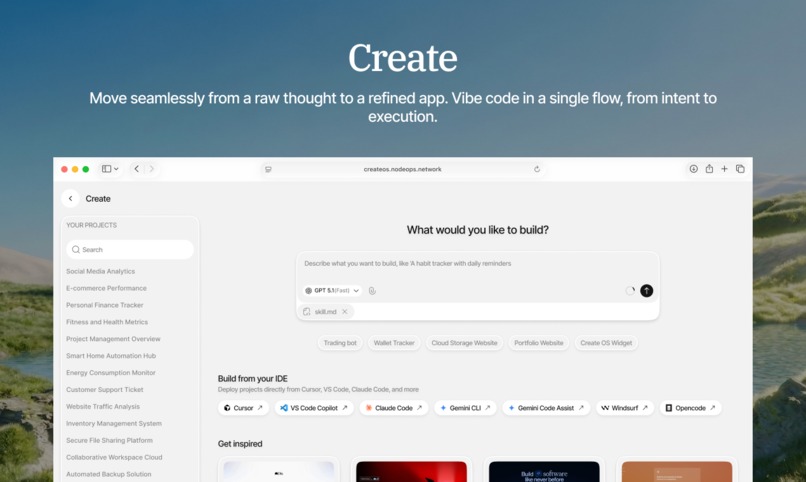
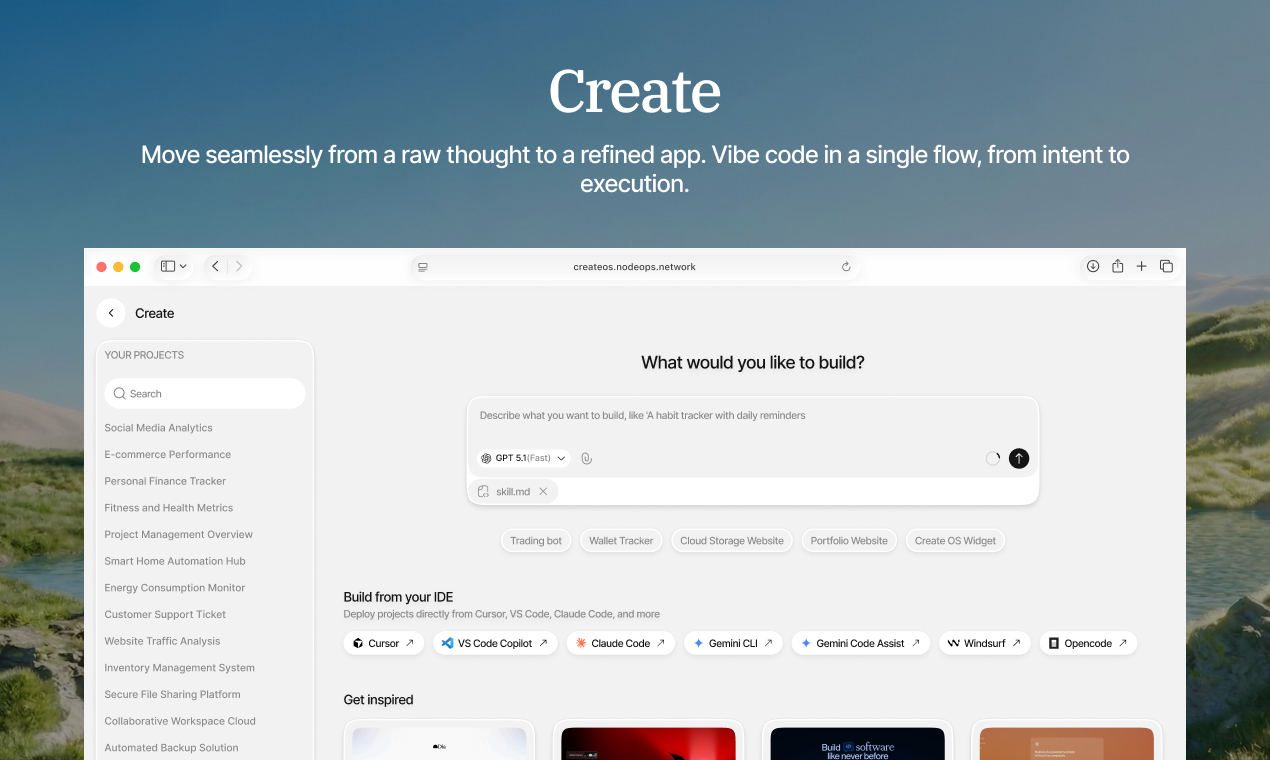
From raw thought to running app. Describe what you want. CreateOS builds it.
-
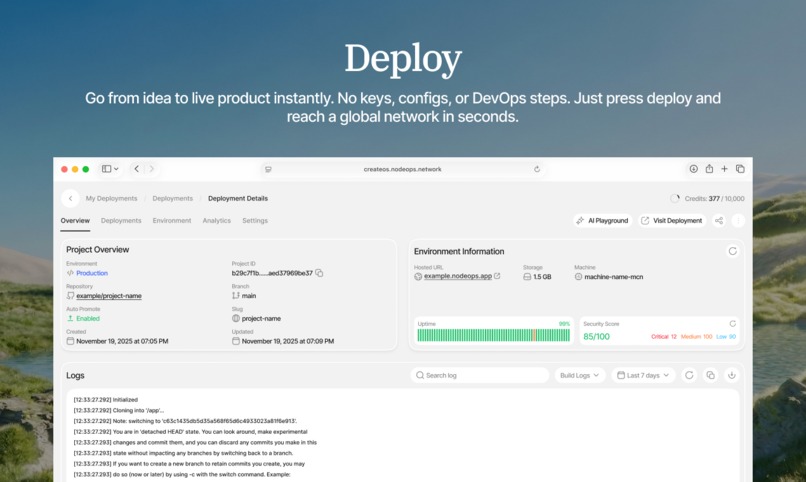
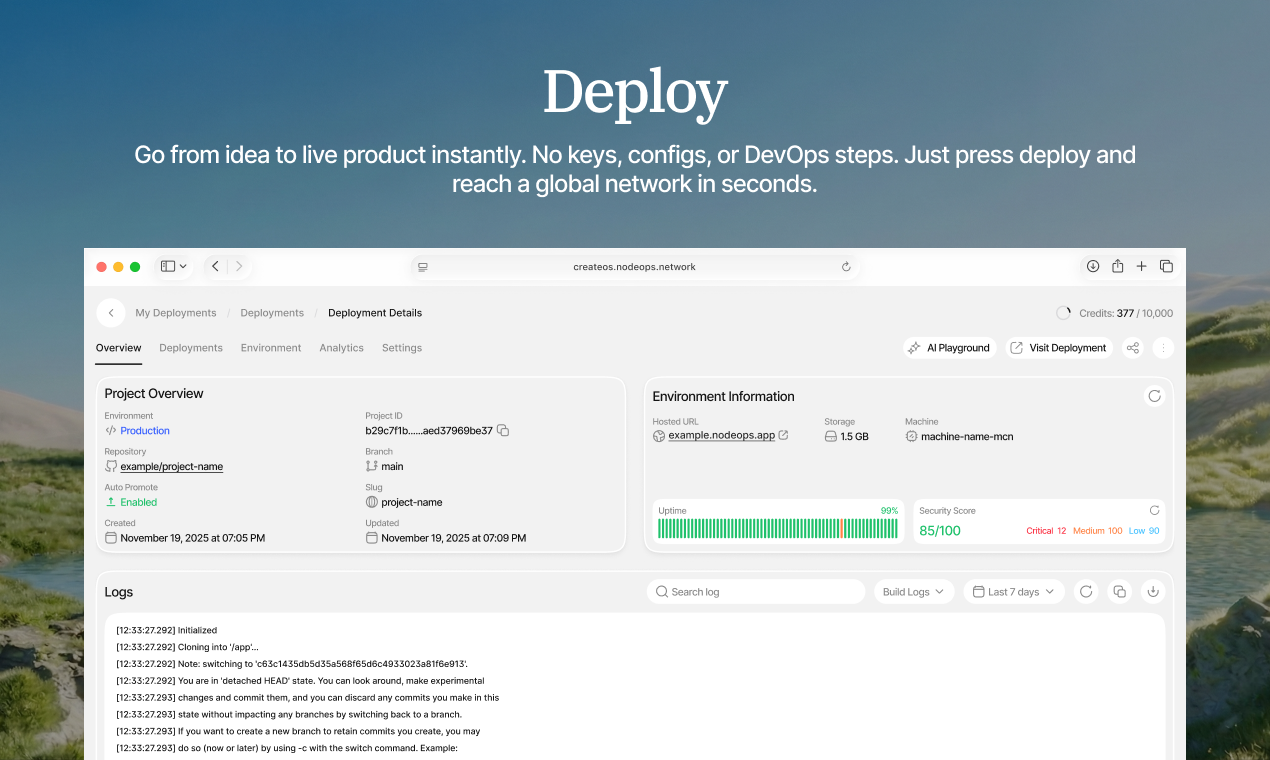
99% uptime. One click. No DevOps. Your app live on 89K+ machines.
-
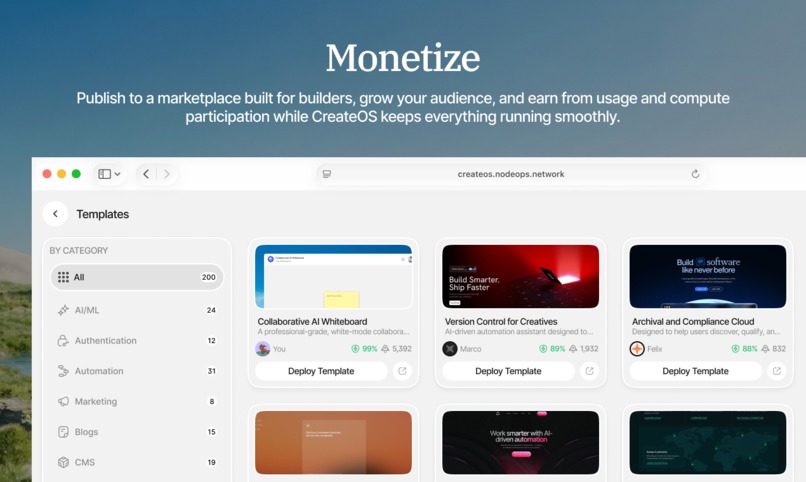
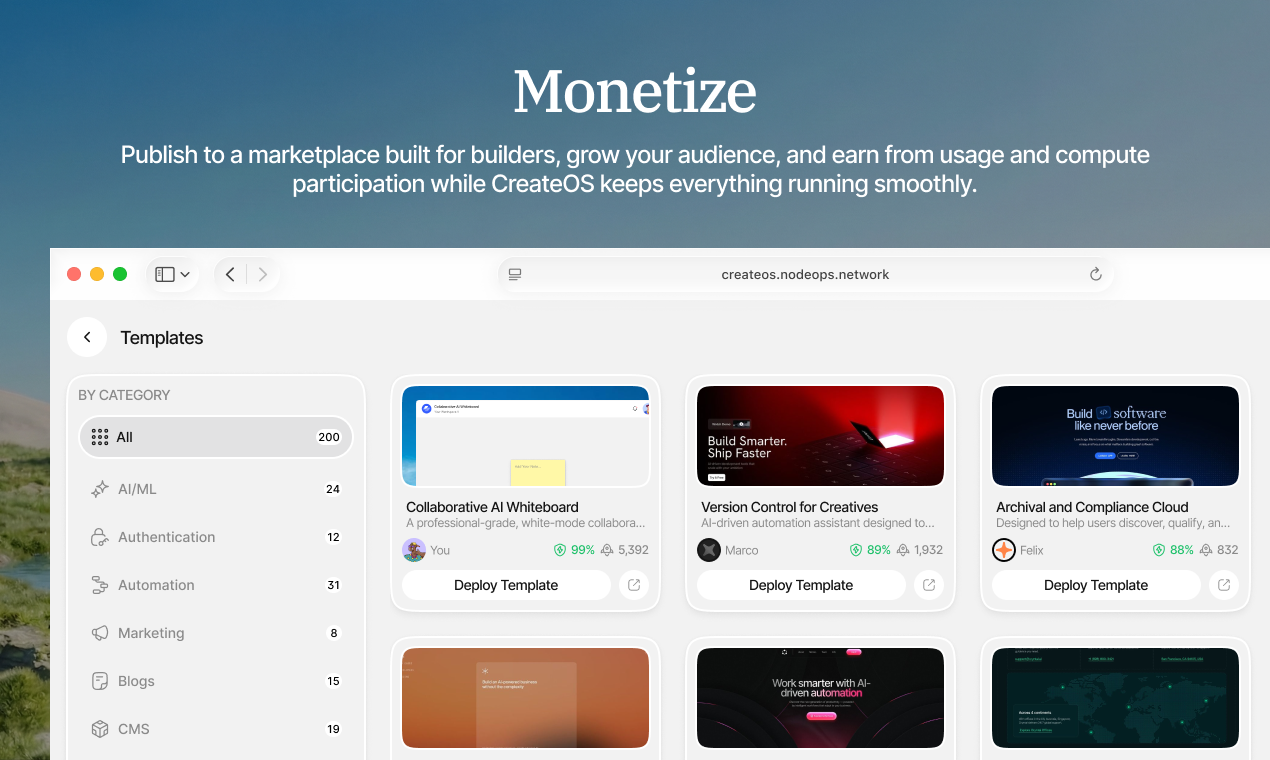
200+ templates. Deploy, earn from usage. Your app, our infrastructure.
-
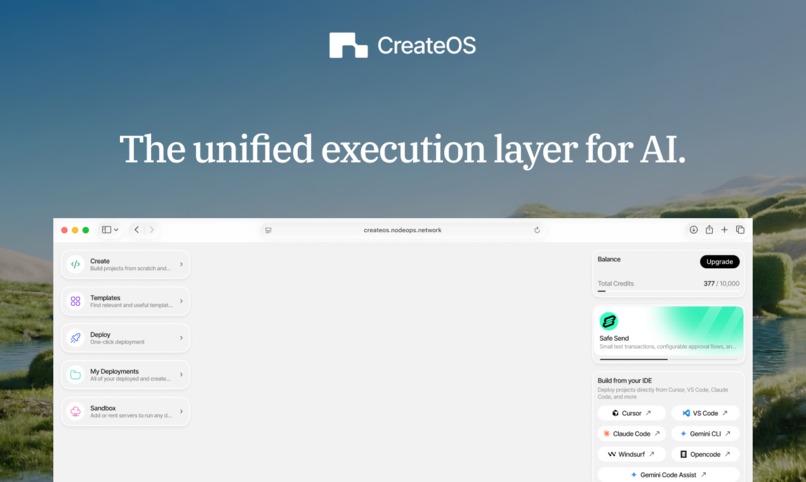
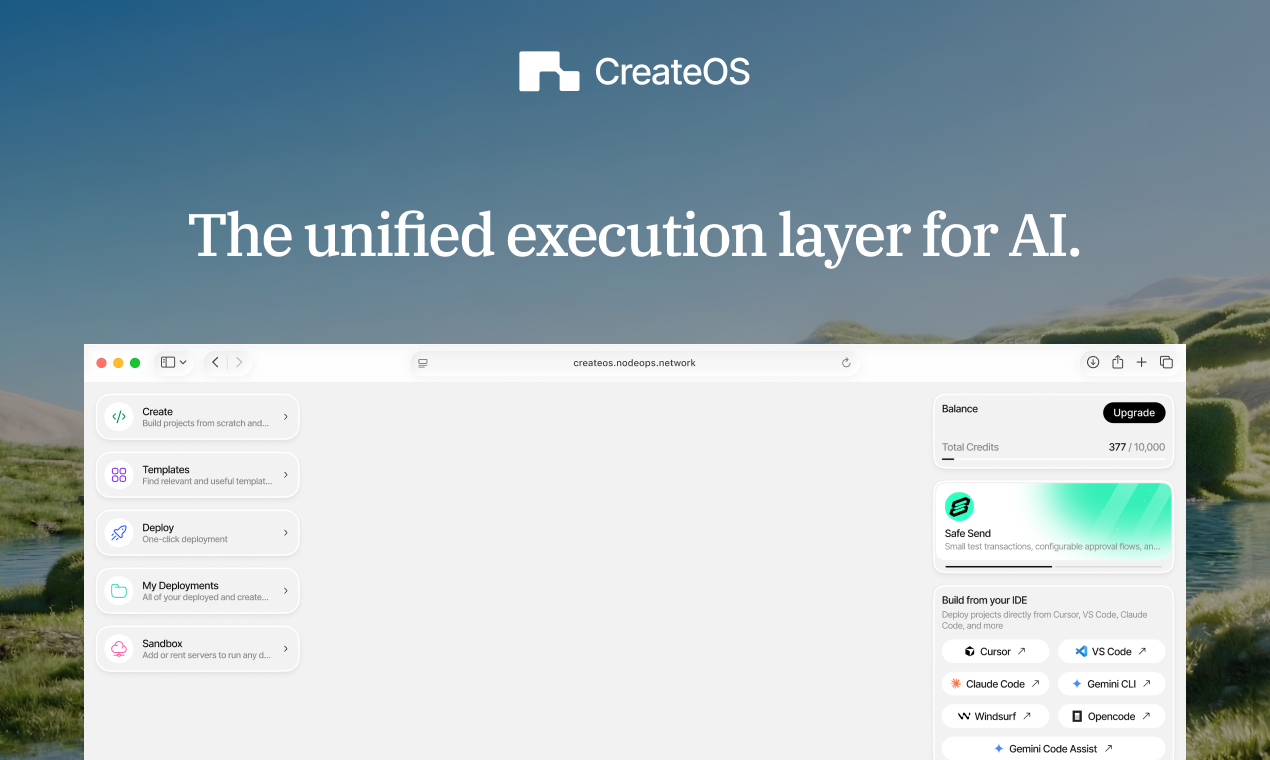
One execution layer. Build, deploy, scale, monetize. No extra tools.
The problem that led us here
We kept seeing the same operational pattern while helping teams deploy AI systems into production environments.
The models themselves were improving quickly, but the infrastructure surrounding them still felt fragmented by default. Compute provisioning happened in one environment, model access in another, deployment pipelines somewhere else, and operational visibility usually depended on stitching together multiple disconnected services. As workloads became more complex, infrastructure coordination started consuming more engineering time than the application itself.
We initially tried solving the problem incrementally. More integrations, more orchestration layers, more deployment abstractions. In practice, each additional layer introduced new operational surfaces to maintain and made production systems harder to reason about once workloads started scaling across providers and environments.
That experience eventually shaped how we approached CreateOS.
CreateOS was built as a unified execution environment for AI applications and agents. The platform handles compute provisioning, workload orchestration, deployment, scaling, routing, observability, and monetization within the same operational surface so teams spend less time coordinating infrastructure and more time shipping products.
The architectural decision that changed the platform
One design decision ended up influencing almost everything else: separating orchestration from execution.
NodeOps operates underneath as the orchestration layer responsible for workload coordination across distributed infrastructure providers. CreateOS sits above it as the execution environment where applications, agents, and workloads actually run.
Keeping those responsibilities distinct solved several operational problems simultaneously. Builders could access distributed compute infrastructure without needing to manage distributed systems directly, while the platform itself retained enough visibility into workload placement, routing behavior, deployment continuity, and scaling coordination to handle infrastructure complexity internally.
That distinction also made the system easier to reason about operationally once workloads started running continuously across heterogeneous environments.
We also kept the deployment model intentionally container-first. Teams can deploy directly from repositories, Docker images, or AI-assisted coding environments without being forced into opinionated runtimes or infrastructure constraints. That flexibility mattered because most production environments already operate across mixed tooling and deployment patterns.
What did not work initially
Our earliest versions leaned heavily on additional orchestration abstractions layered on top of existing infrastructure tooling.
At first the approach felt reasonable because it allowed us to move quickly without rebuilding large parts of the operational stack. Over time, though, the abstraction layers themselves became part of the complexity problem. Debugging became slower, infrastructure observability fragmented across too many surfaces, and operational failures became harder to isolate once workloads scaled under production conditions.
One of the more important things we learned while building CreateOS is that operational simplicity cannot be added afterward through interface design alone. The underlying infrastructure model has to reduce coordination overhead structurally or the complexity eventually reappears somewhere else in the workflow.
That realization forced us to rethink the platform architecture much more deeply than we originally expected.
Technical challenges
One of the more difficult engineering problems involved balancing flexibility with operational simplicity.
Most teams wanted provider portability, workload-level control, deployment flexibility, and compatibility across heterogeneous infrastructure environments. At the same time, very few teams wanted to manually manage routing coordination, failover behavior, scaling logic, deployment continuity, or infrastructure observability themselves.
A large part of the engineering effort went into making those operational layers feel mostly invisible during the building experience while still remaining observable and controllable under production conditions.
Observability across distributed infrastructure environments became another major challenge. Because workloads can operate across multiple providers and regions simultaneously, monitoring and deployment continuity needed to remain coherent from the application layer even when infrastructure underneath changed dynamically.
Those problems became significantly more important once the platform started operating inside real production environments rather than isolated demos.
One deployment that shaped many of our infrastructure decisions integrated directly into an existing industrial workflow using CCTV systems already operating inside a cotton processing facility. Instead of redesigning the infrastructure environment, the system processed operational footage continuously, generated real-time alerts for floor managers, and integrated into workflows already in place. That deployment reinforced how important operational reliability becomes once systems move beyond controlled environments and into continuous real-world usage.
Stack and infrastructure choices
The infrastructure stack behind CreateOS was shaped less by preference and more by operational constraints we kept encountering repeatedly while deploying AI workloads.
NodeOps handles workload orchestration across distributed infrastructure providers because coordinating compute across heterogeneous environments became increasingly important as workloads scaled.
The deployment architecture remained container-first because portability mattered more than forcing teams into tightly coupled runtime assumptions.
The routing layer was built to support workload-aware model orchestration, fallback handling, and provider coordination directly inside the platform because routing logic became one of the largest sources of operational overhead in production AI systems.
Deployment, scaling, observability, and monetization were integrated directly into the execution environment because operational fragmentation kept reappearing whenever those systems lived across separate tooling surfaces.
Over time, the broader goal became less about reducing DevOps work in the abstract and more about reducing the amount of infrastructure coordination builders need to maintain between idea, deployment, and production reliability.
Operational outcomes
As the platform matured, several operational outcomes became important validation points for the architecture itself.
The infrastructure now coordinates workloads across a globally distributed provider network while maintaining high uptime across heterogeneous deployment environments. Production systems operate continuously across distributed compute infrastructure without requiring teams to manage provider coordination manually.
One of the metrics we pay closest attention to internally is not simply deployment volume but reduction in operational coordination overhead for builders shipping production systems. In practice, that usually matters more than raw infrastructure scale alone.



Log in or sign up for Devpost to join the conversation.