-
-

Candy AI clone
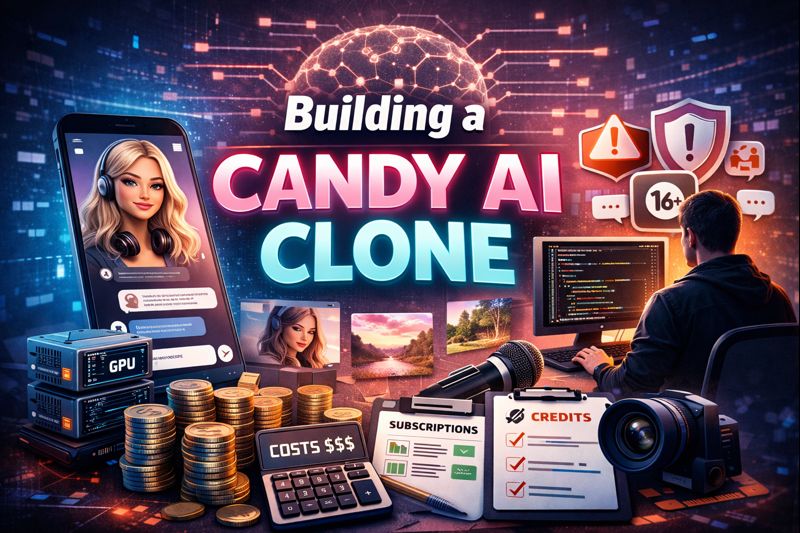
I didn’t start this project because I wanted to build another AI app. I started because I wanted to understand why platforms like Candy AI feel so simple to use and yet are so difficult to replicate. On the surface, it looks easy: chat interface, AI responses, avatars, maybe some voice, some images. A weekend project, right? It took me four months to build a working Candy AI Clone. And most of that time had nothing to do with AI. This is the real story of what it takes to build a platform like Candy AI, the actual engineering, architecture, hidden costs, and business mechanics nobody talks about.
The First Mistake: Thinking This Was an “AI Project”
When I began, I assumed this would be about prompts, models, and fine-tuning. It wasn’t. A Candy AI Clone is 80% product engineering, 15% infrastructure, and only 5% prompt engineering. Intelligence is the easy part. The system around it is what breaks you. You quickly realize you’re not building a chatbot. You’re building:
- A real-time chat system
- A character memory engine
- A content safety layer
- A payments & subscription system
- A GPU-heavy media generation pipeline
- A scalable architecture that doesn’t burn money per user
And all of these must feel instant and effortless to the user.
The Core Problem: Making AI Feel Persistent
Users don’t want to “talk to a model.” They want to talk to a character that remembers them. This is where most Candy AI Clone attempts fail. The model forgets. The experience resets. The illusion breaks. So I had to build a memory architecture before even worrying about chat quality:
- Short-term conversational memory (last 20–30 messages)
- Long-term personality memory (facts the character “knows”)
- Emotional state tracking
- User preference embeddings
- Context compression so tokens don’t explode
This memory system took longer to build than the chat itself. Because if the character forgets your name after 10 messages, the whole product collapses.
The Hidden Beast: Real-Time Infrastructure
A Candy AI Clone is deceptively expensive to run. Here’s why. Each user session involves:
- Model inference (LLM calls)
- Memory retrieval (vector DB queries)
- Safety moderation (before and after generation)
- Optional image generation
- Optional voice synthesis
- WebSocket streaming for real-time feel
Now imagine 1,000 concurrent users. This is no longer a chatbot. This is a distributed system problem. I had to redesign the architecture three times because costs were spiraling. A naïve setup can cost $3–$6 per active user per day. That’s business suicide. Optimizing this is where most of the real engineering happens in a Candy AI Clone.
The Content Moderation Nightmare
No one tells you this part. A platform like this lives and dies by content safety. You can’t just pass user input to the model and return the output. You need:
- Pre-generation moderation
- Post-generation filtering
- Prompt sanitization
- Dynamic guardrails based on context
- Abuse detection systems
Without this, you either get banned by providers or expose yourself to legal risk. This part alone required building a layered moderation pipeline that runs faster than the chat feels.
The Media Layer (Where Costs Explode)
Text chat is cheap. Images and voice are not. Users expect:
- Character selfies
- Contextual images
- Voice messages
- Realistic avatars
Each of these hits GPU inference.
This is where the Candy AI Clone Cost becomes very real. A single image generation can cost more than 50 chat messages.
So I had to build:
- Credit systems
- Queue systems for media tasks
- Async processing pipelines
- Rate limits
- Caching for repeated assets
Otherwise, a handful of users could burn through your entire monthly budget in hours.
The Illusion of Personality
Here’s something fascinating I discovered. Users don’t actually care if the AI is “smart.” They care if it is consistent. So instead of making the model more advanced, I focused on:
- Personality prompts that never change
- Emotional baselines for each character
- Response style constraints
- Memory reinforcement loops
This made the experience feel far more “real” than upgrading the model.
A key lesson in the development process of Candy AI like platform: stability beats intelligence
Payments, Subscriptions, and Abuse
Another surprise: payments are not an add-on. They’re core architecture. You must design:
- Token / credit consumption logic
- Tiered subscription plans
- Hard limits tied to inference cost
- Abuse detection for heavy users
- Fair usage algorithms
This is directly tied to how Candy AI makes money. Because without strict usage economics, the platform cannot be profitable no matter how many users you have.
The Real Candy AI Clone Cost (Time, Not Just Money)
People ask about infrastructure cost. The bigger cost is time spent optimizing tiny inefficiencies:
- Reducing tokens per message
- Compressing memory data
- Batching moderation calls
- Streaming partial responses
- Pre-generating character assets
Every small optimization compounds.
Without them, your per-user cost is fatal.
With them, the platform becomes viable.
What I Learned About How Candy AI Makes Money
After building this, the business model became obvious. It’s not subscriptions alone. It’s a layered system:
- Subscriptions cover baseline chat usage
- Credits monetize high-cost features (images, voice)
- Emotional engagement drives daily active use
- Consistent personalities create retention
- Retention makes acquisition affordable
The entire system is engineered around cost control + emotional stickiness. That’s the secret.
Final Realization: This Is a Systems Engineering Problem Disguised as an AI App
Going in, I thought I was building an AI experience. Coming out, I realized I had built:
- A distributed memory system
- A real-time inference architecture
- A safety-critical moderation pipeline
- A media processing backend
- A usage-based revenue engine
The AI model was the smallest piece of the puzzle. That’s why most Candy AI Clone attempts fail. They focus on the chatbot, not the system. And that’s what it really took.
Contact Us-
Still if there is guidance or help required for building candy ai style platform, direct contact to the experienced AI experts for consultation, development and cost estimations.

Log in or sign up for Devpost to join the conversation.