Inspiration
The inspiration for Crave Scanner stemmed from the need to alleviate worries about cultural or dietary conflicts when people dine in new environments. A core goal was promoting inclusivity and supporting newcomers by helping them navigate local food landscapes while respecting religious and dietary restrictions and breaking language barriers. A critical motivator was also identifying non-obvious hidden ingredients, such as gelatin in marshmallows or rennet in Parmesan cheese, to ensure compliance and health for all users.
What it does
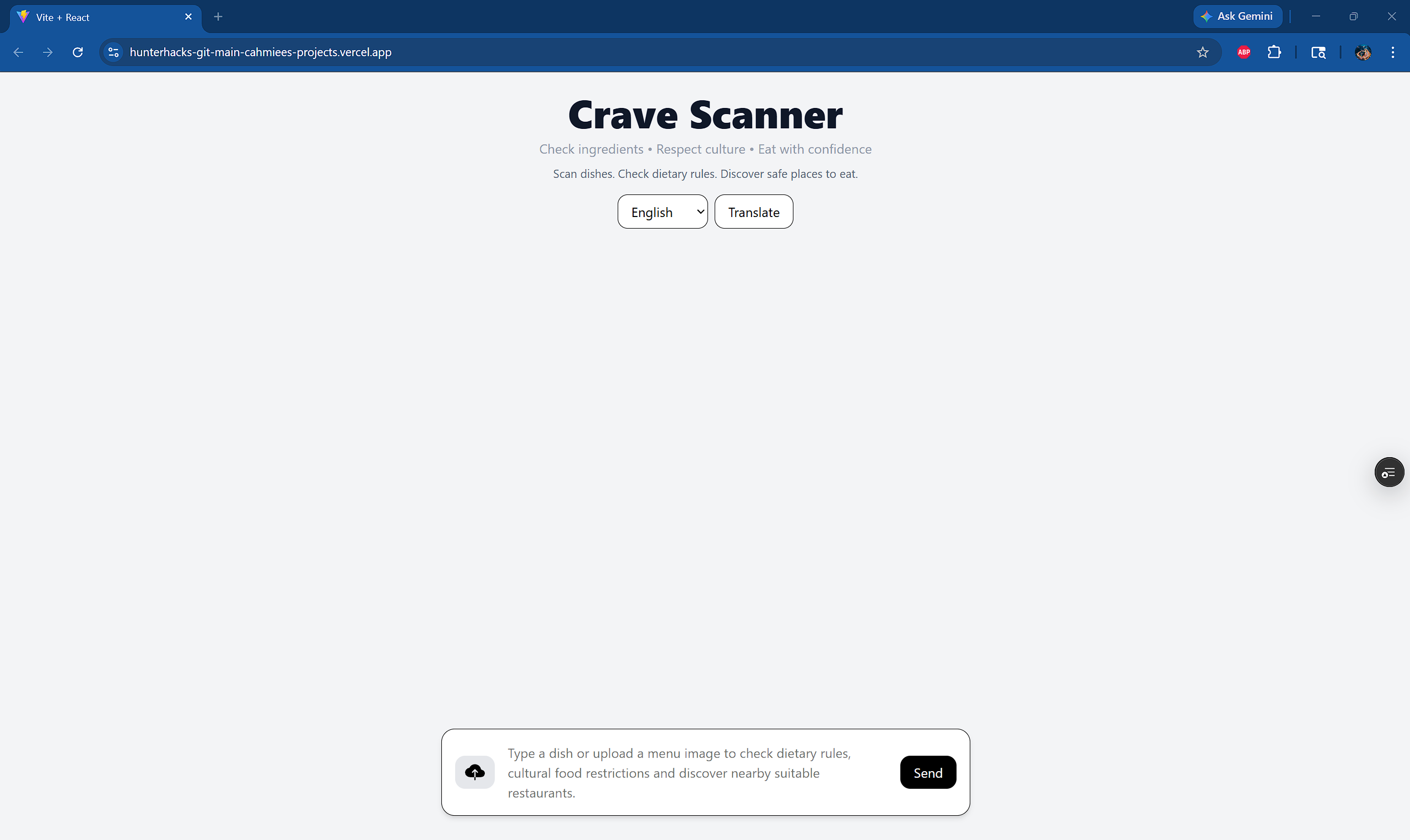
Crave Scanner functions as an AI-powered Cultural Gastronomic Interpreter. The tool takes photo uploads or text inputs of a dish and instantly analyzes the ingredients for conflict or hidden foods, providing detailed explanations, religious restriction warnings, and translated explanations. Crucially, it suggests safe, compliant, and locally available alternative food options in the user's geographical area. It supports key languages including Spanish, English, French, and Arabic, and features a simple, responsive chat-style interface with a dedicated translation button for seamless use.
How we built it
The application was built for scale using a modern stack, featuring a frontend developed with React and Tailwind CSS for a responsive, intuitive chat-style UI, and a Python/Flask backend to organize complex requests and handle API integration. The AI reasoning involves integrating the Gemini API for explanation translation and religious restrictions warning/cultural logic, grounded search, structured output, and "thinking mode" to diminish hallucination. Data sources include Open Food Facts for ingredient data, the Google Maps API for checking nearby food availability, and a local JSON file for storing specific food rules (like conflict foods). Process efficiency was enhanced by implementing a decision point to check a DB cache for existing translations before calling the AI model, and the output is validated using Pydantic and jsonschema.
Challenges we ran into
A primary challenge was ensuring the AI's interpretations were accurate and not based on speculation, which was mitigated by implementing thinking mode, structured output, and grounded search in the Gemini 2.5 Flash lite calls. Another significant challenge involved complex API orchestration, requiring a robust Flask backend to integrate and manage the flow of data between multiple external services: Open Food Facts, Google Maps, and Gemini, alongside geographic data. Finally, efficiently managing multilingual data required setting up a database cache and defining clear logic for when to call the AI model versus retrieving a cached result.
Accomplishments that we're proud of
We are proud of successfully creating a web app that actively breaks language barriers and aids immigrant support, serving as a powerful cross-cultural bridge. Furthermore, we accomplished a complete full-stack integration, moving from a modern React frontend through a Flask backend, successfully leveraging multiple complex APIs (Gemini and Google Maps) to deliver a seamless service. This effort resulted in achieving support for four major languages (Spanish, English, French, and Arabic), which ensures high inclusivity.
What we learned
We learned the critical importance of using grounded search and structured output (via Pydantic/jsonschema validation) to ensure that the AI's responses about complex cultural and dietary restrictions are factual and reliable. Implementing a caching mechanism for translations proved necessary for improving responsiveness and minimizing redundant API calls. Additionally, we understood that effectively addressing dietary compliance requires integrating diverse data needs from multiple sources: general ingredients (Open Food Facts), cultural logic (Gemini), and local availability (Google Maps).
What's next for Crave Scanner
1) Meal Planning & Nutrition: Integrating personalized health profiles to suggest balanced weekly meals based on cultural cravings and dietary goals. 2) Community Sharing Hub: A social layer allowing users to upload family recipes and cultural food stories to expand our grounded AI knowledge base. 3) AR Grocery Assistant: Real-time AR overlays to identify "hidden" ingredients on physical packaging while shopping in international markets.


Log in or sign up for Devpost to join the conversation.