Inspiration## Inspiration
Some nights, deciding what to eat and what to watch takes longer than either should. You scroll through shows, ask what everyone wants for dinner, and somehow end up with the same meal and another half hour of browsing.
I built Crave Frame to bring those two decisions together. Pick something worth watching, find a meal that goes with it, and make a night of it.
Fire TV felt like a natural place to start. It’s already where people gather to decide what to watch.
What it does
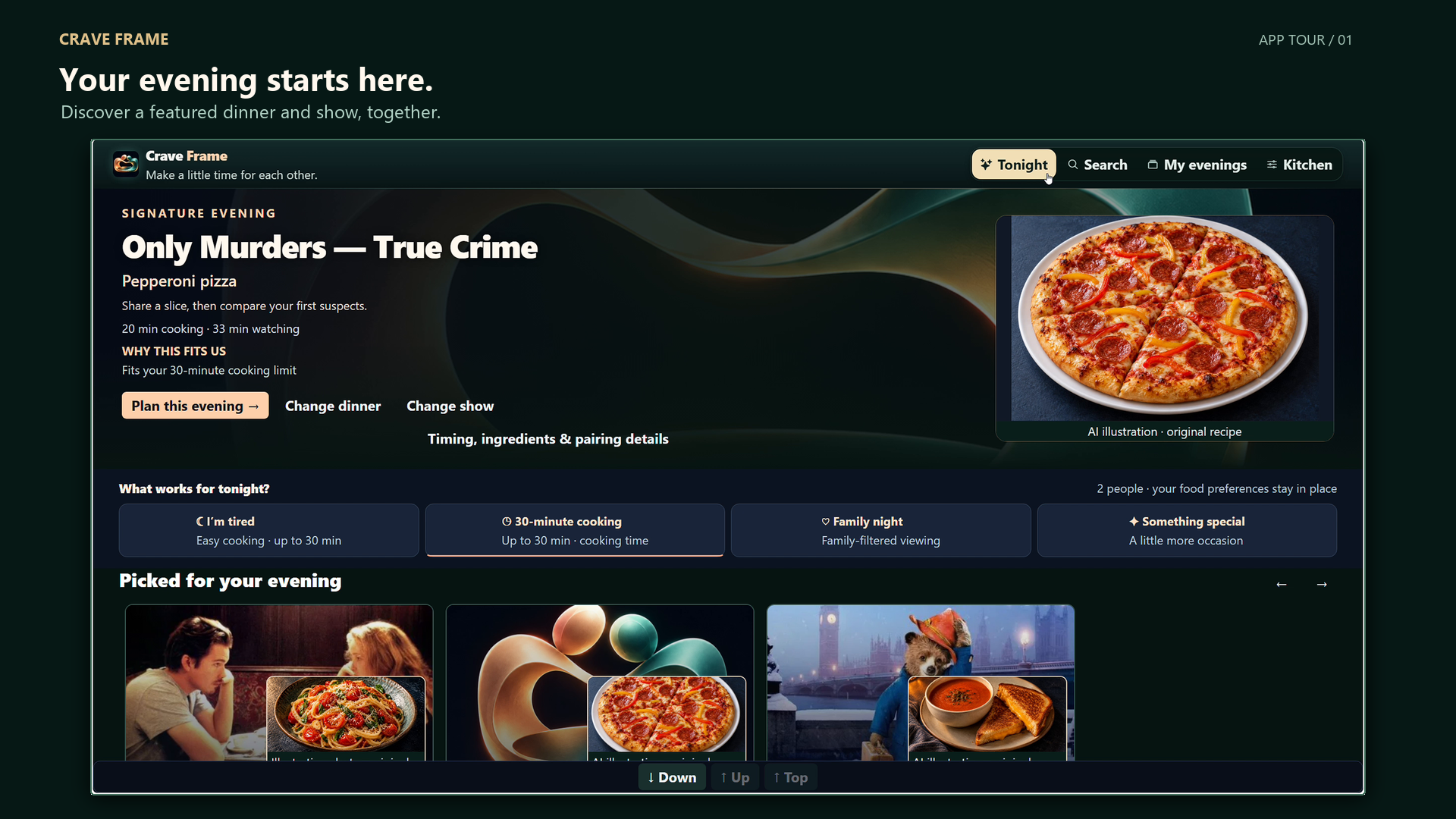
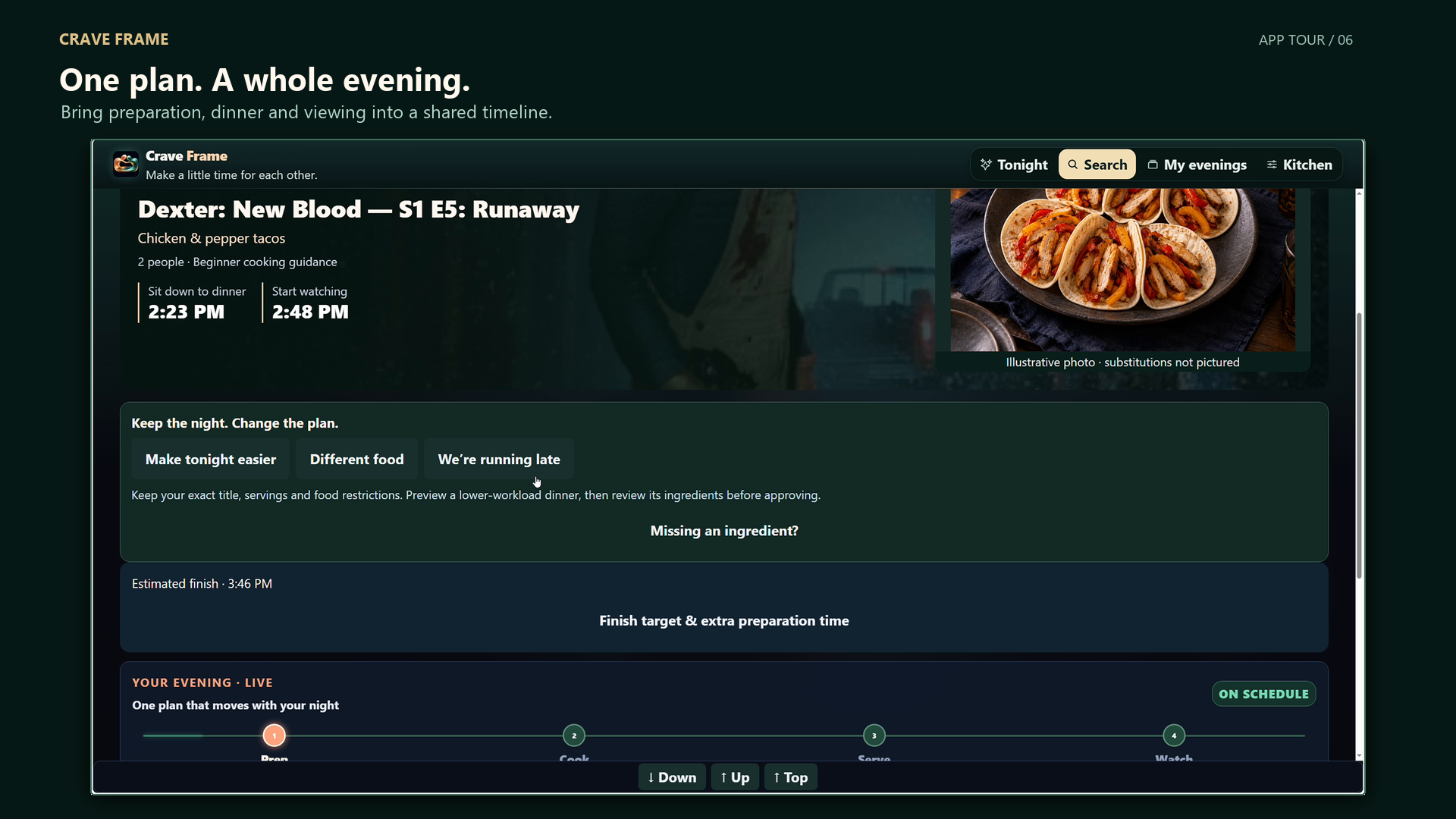
Crave Frame pairs movies and TV shows with meals, taking your available time, food preferences, and cooking experience into account. You can explore the pairing, choose your evening, and follow a plan that brings dinner and watching together.
The TV helps you choose. Your phone helps you cook. A QR handoff brings cooking instructions into the kitchen without trying to read everything across the room.
There’s also an “I’m delayed” action, because dinner rarely runs exactly on schedule. Instead of making you start over, it adjusts the evening’s timing.
The point is simple: spend less time deciding and more time enjoying the night.
How we built it
I developed Crave Frame with help from Codex, working through the interface, backend, tests, and deployment in small iterations.
The project includes a browser planner, a TV experience, a phone cooking interface, and an Android build for Fire TV. The AWS deployment uses CloudFront and private S3 storage for web assets, API Gateway and Lambda for the backend, and Aurora PostgreSQL for application data. Runtime secrets are managed through AWS Secrets Manager.
The matching system supports AI-assisted recommendations alongside a catalog fallback. The experience needs to remain useful when an AI service isn’t available.
A big part of development happened in the living room. I opened the app on a real TV through Silk, took photos from the couch, and used those to identify what was too small, too crowded, or difficult to navigate.
Challenges we ran into
Making something look good on a computer did not mean it worked well on a TV.
Text that seemed readable at a desk was too small from the couch. Remote scrolling needed repeated fixes. Food images competed with movie artwork, and adding more features sometimes made the home screen harder to use.
Matching was another challenge. Recommending the same dishes for different titles made the experience feel generic. But overly unusual meals weren’t helpful either. The pairings needed personality while still sounding like something someone would actually make on a weeknight.
Moving the backend to AWS also meant adapting database access, private media storage, and request security while preserving the existing deployment as a fallback.
Accomplishments that we're proud of
I’m proud that Crave Frame grew beyond a recommendation screen into a plan you can use.
Choosing an evening on the TV, taking the cooking steps to your phone, and adjusting the timing when you’re running late gives the product a practical purpose.
I’m also proud of the changes driven by actual couch-distance testing. Bigger text, clearer focus, simpler choices, and more visible dishes mattered more than adding another animation.
The AWS deployment is another milestone, with working application routes, a readiness endpoint, deployment version tracking, and security headers.
What we learned
A TV app needs to be designed from the couch.
People need to understand what’s selected, what happens next, and how to get back without thinking about the interface. A beautiful screen still fails if the remote can’t comfortably navigate it.
I also learned that a creative pairing needs to earn its place. The connection should make sense, the meal should be appealing, and the cooking effort should fit the evening.
Most of all, adding features isn’t always progress. Crave Frame became clearer when the featured evening stayed at the center and the extra options moved out of the way.
What's next for Crave Frame
The next step is testing complete evenings with households: choosing a pairing, cooking the meal, adjusting the schedule, and finding out whether they want to use it again.
I want to improve recipe reliability through kitchen testing, make recommendations more responsive to feedback, and keep refining remote navigation and phone synchronization.
The goal is for Crave Frame to become something people reach for when they say, “Let’s stay in tonight.
Built With
- amazonfire
- cloudfront
- javascript
- lamda
- node.js
- openai
- react
- typescript


Log in or sign up for Devpost to join the conversation.