-
-
-
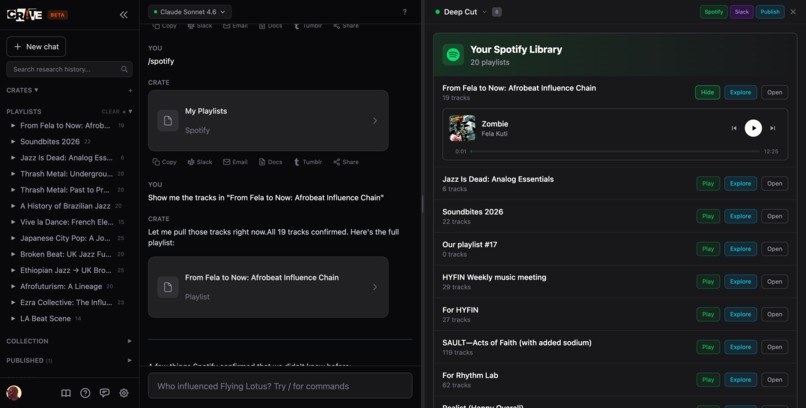
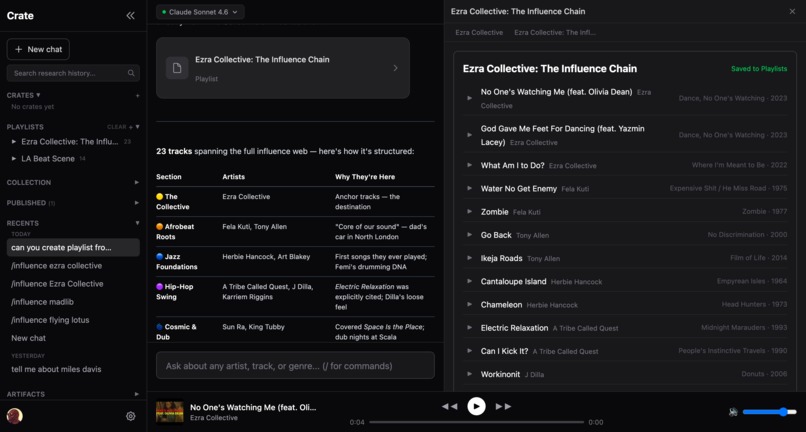
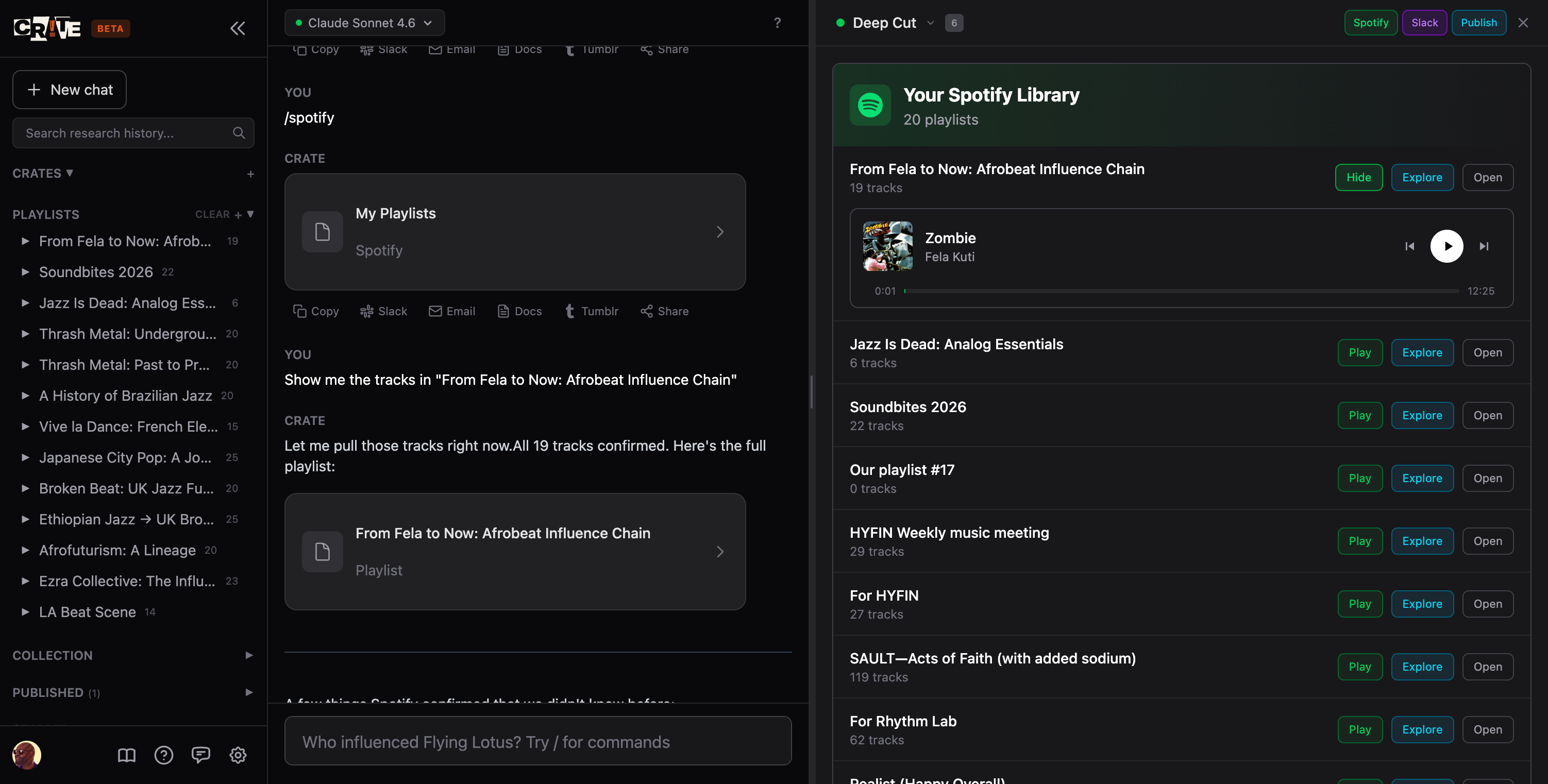
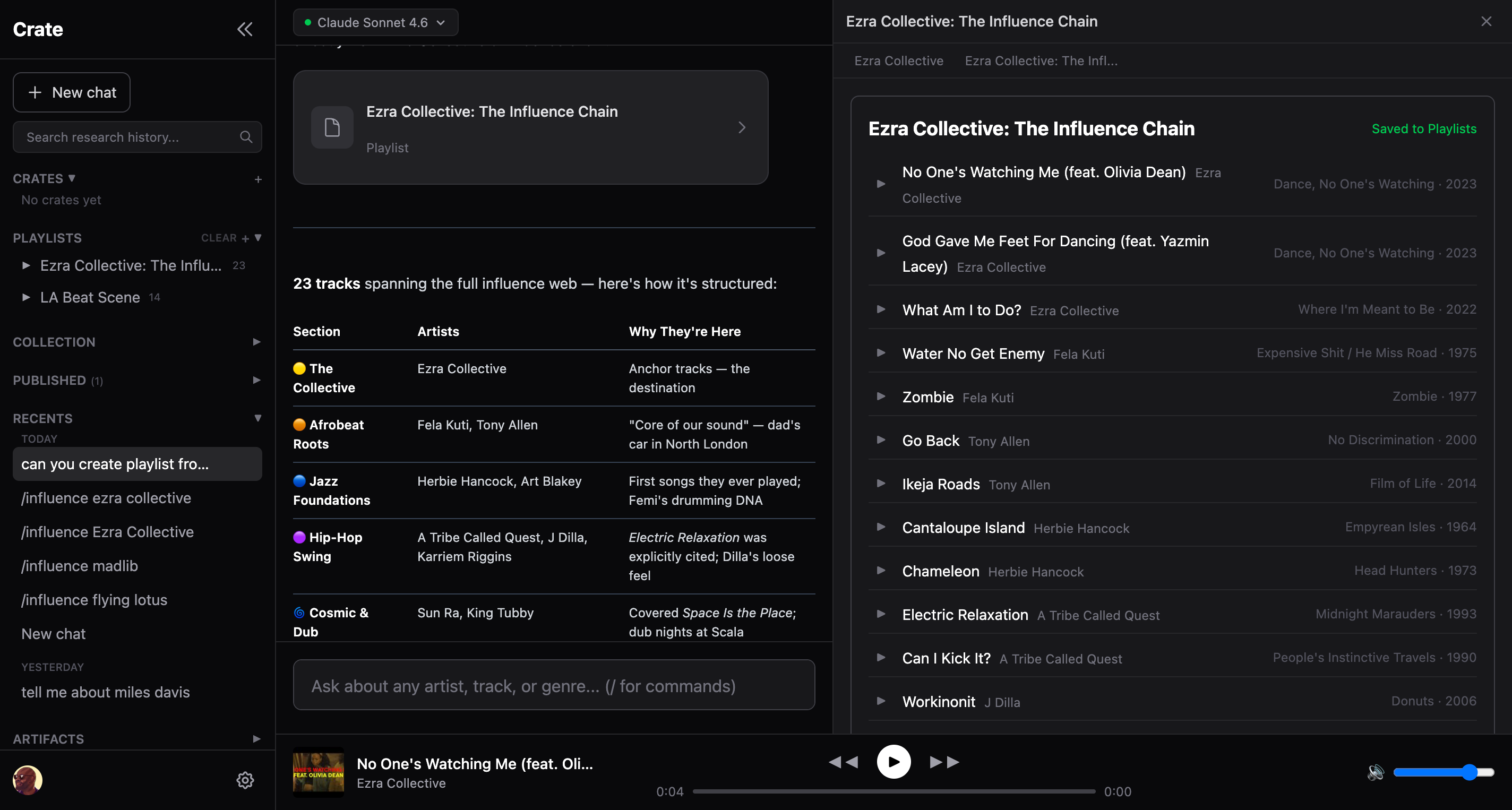
Spotify integration displaying users playlists
-
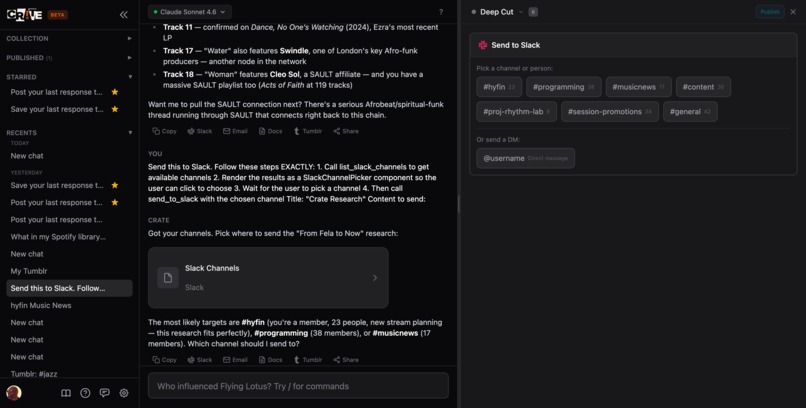
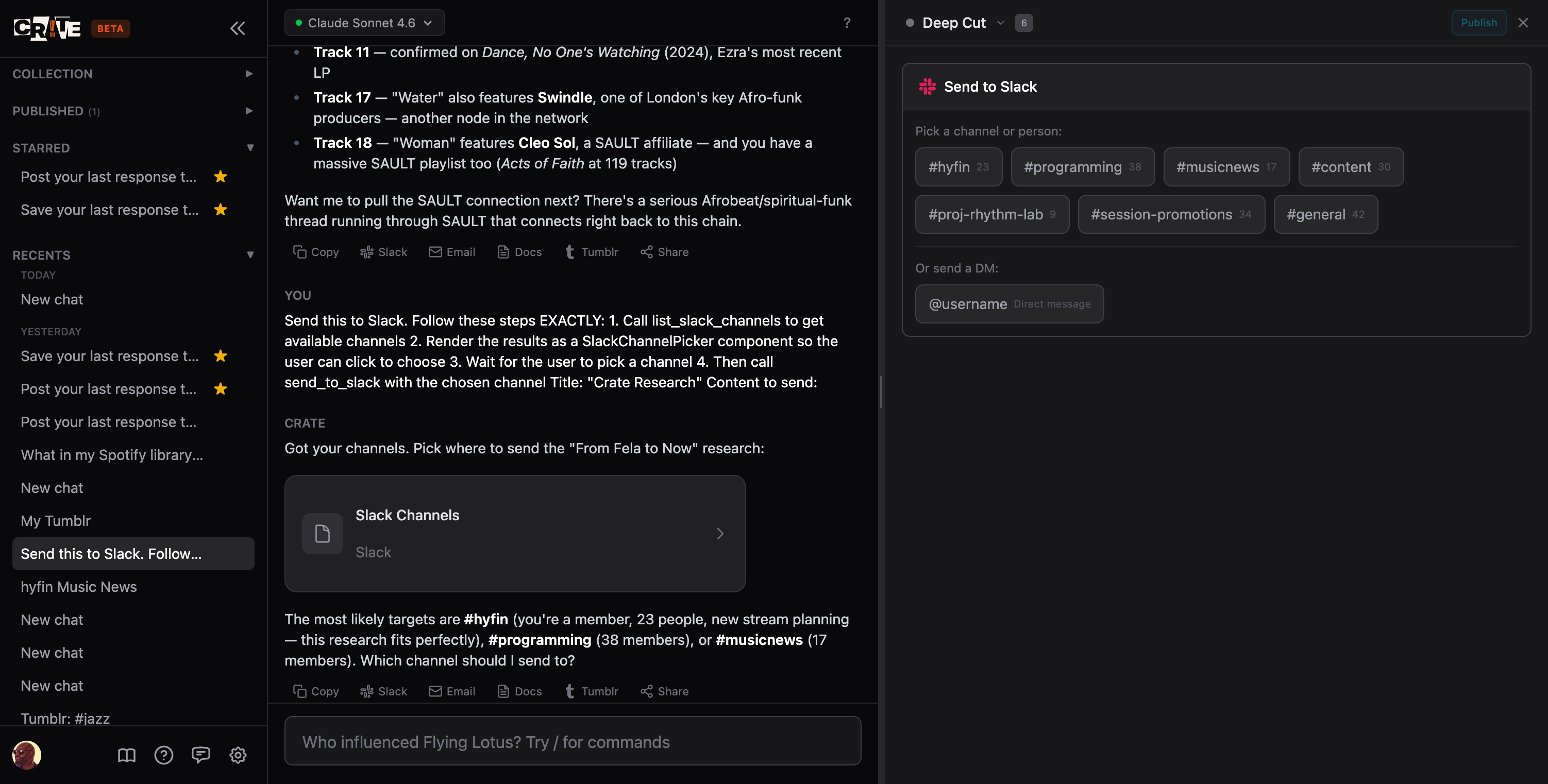
Slack integration dispaly channels
-
-
-
Auth0 Hackathon Submission — Crate
Inspiration
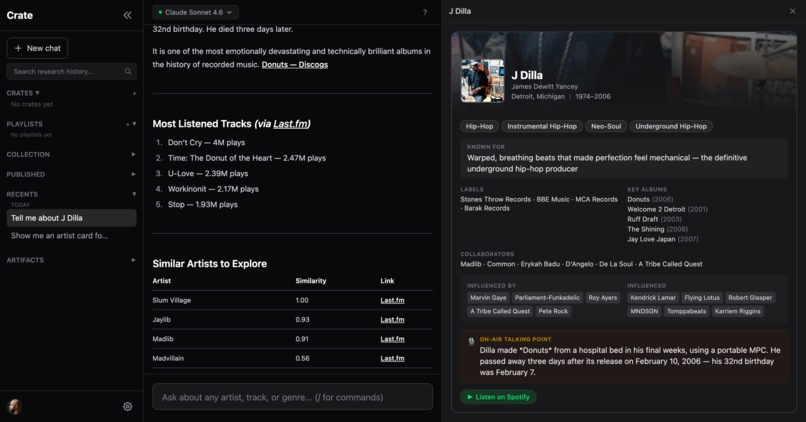
I've been a radio DJ at Radio Milwaukee for 20 years. Every show requires hours of research — tracing how artists connect across genres, building playlists, writing show prep, then getting all of that to my team on Slack, archiving it in Google Docs, and sharing it on my blog. That workflow touches a dozen tabs and four different services, each with its own login.
When Auth0 announced Token Vault for AI agents, I saw the missing piece. I was already building Crate — an AI music research agent that searches 19 sources in one conversation. But research is only half the job. The other half is getting it where it needs to go. Token Vault meant my AI agent could finally reach into Spotify, Tumblr, Slack, and Google Docs on my behalf — with one OAuth layer handling everything.
What it does
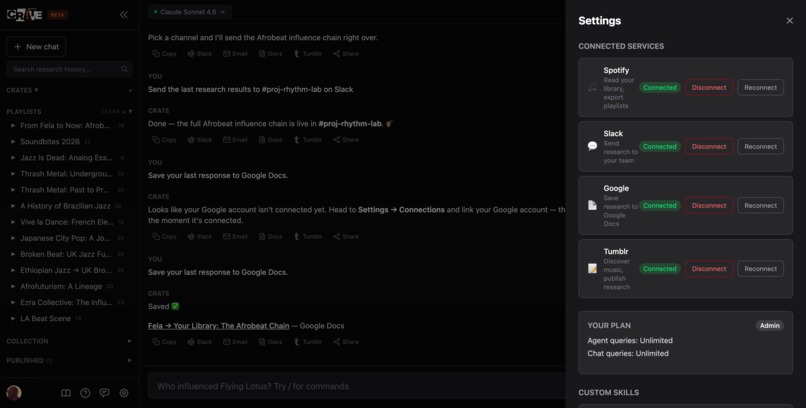
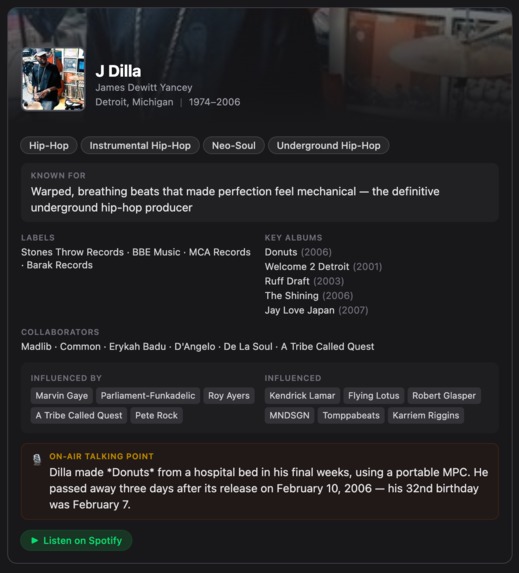
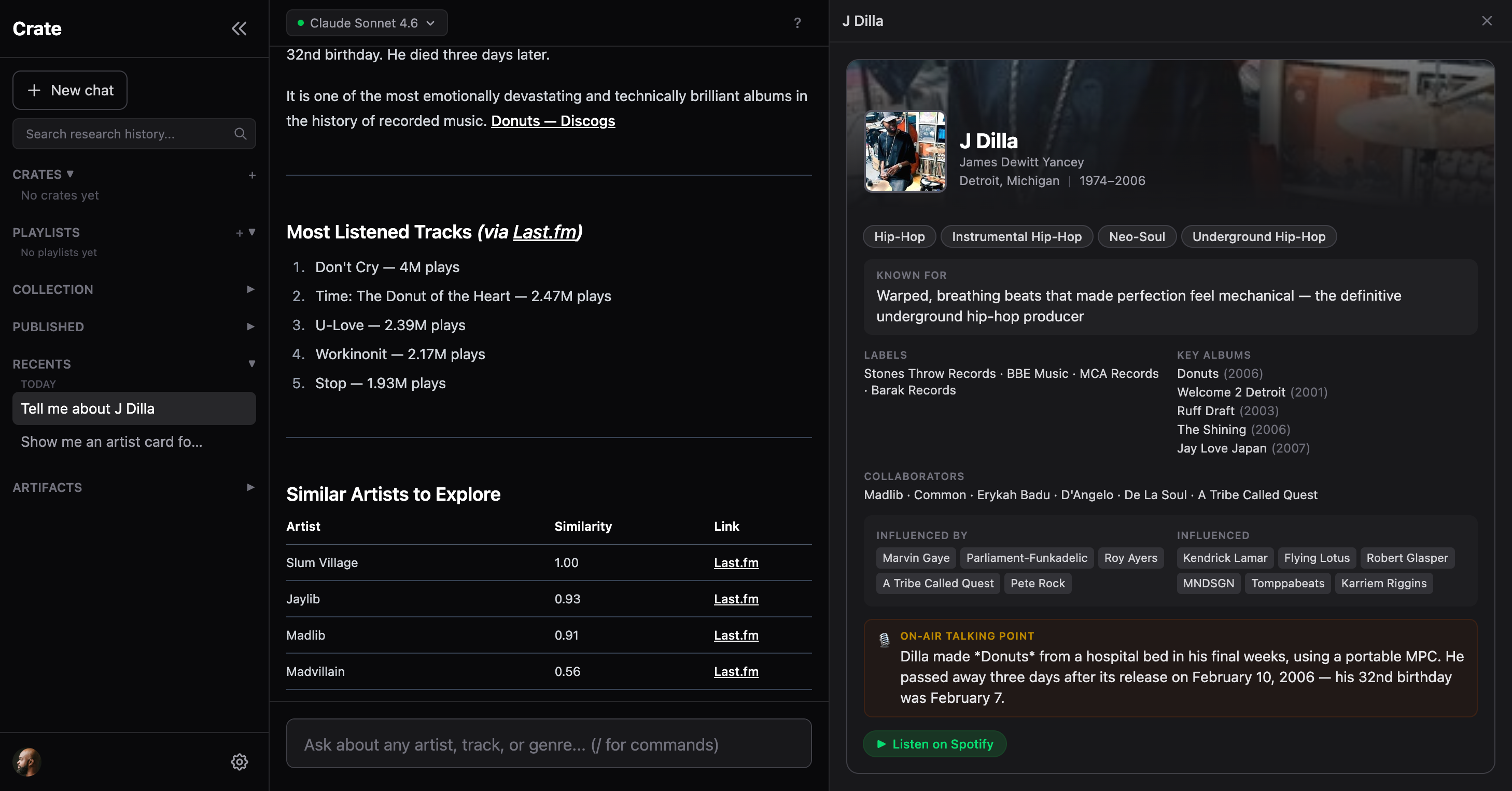
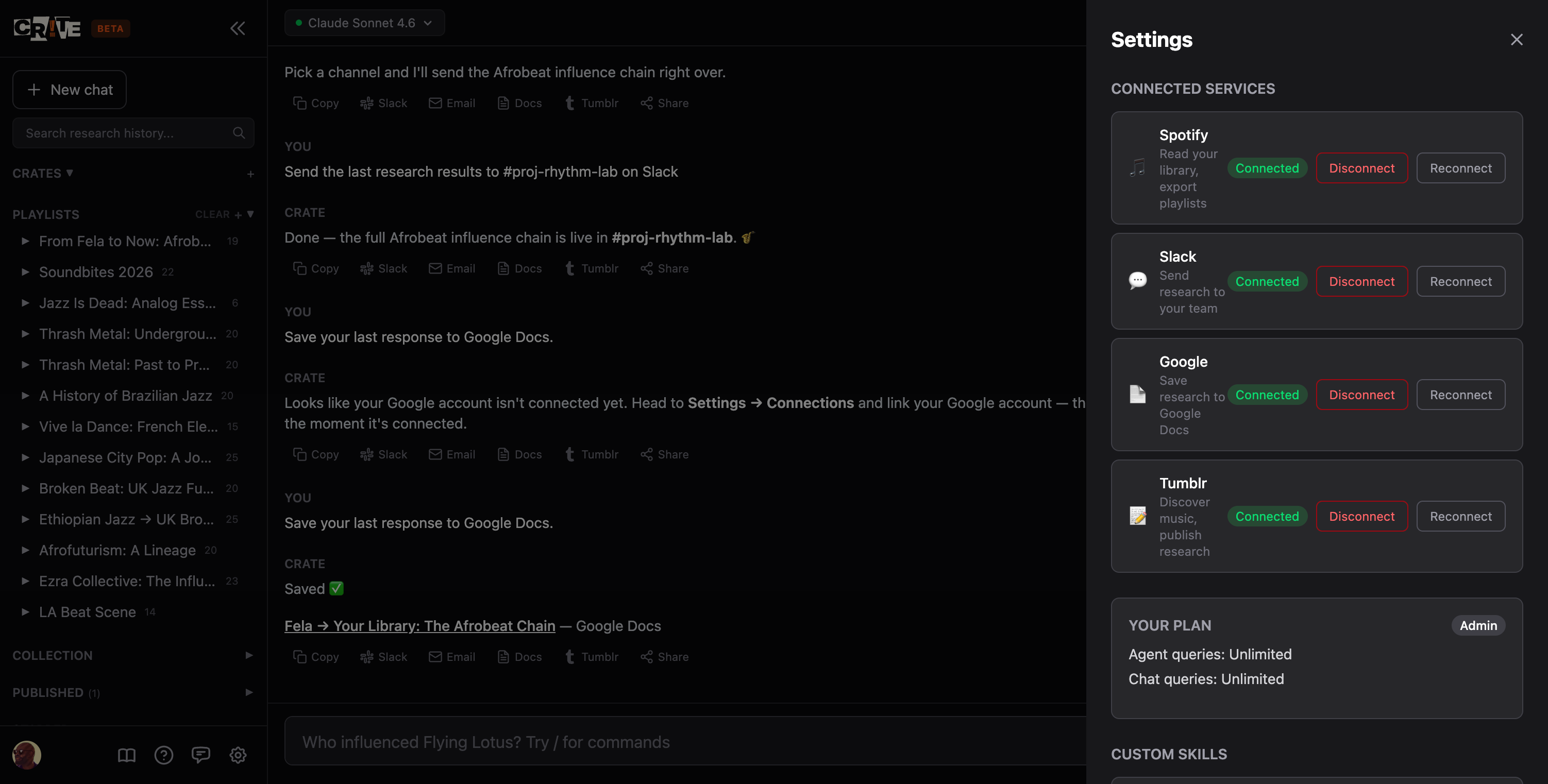
Crate is an AI music research agent for DJs, producers, and serious music lovers. Through Auth0 Token Vault, a single agent connects to four OAuth services:
- Spotify — reads your library, finds genre connections, exports influence chains as playlists
- Tumblr — publishes research to your blog, discovers music by tag across all of Tumblr
- Slack — sends show prep to your team channel with rich Block Kit formatting
- Google Docs — saves research as permanent, searchable documents
Each service is one click to connect. The agent chains tools autonomously — read library, build influence chain, create playlist, publish to blog, send to team, save to docs — all from natural language.
How we built it
Auth0 Token Vault integration:
- Each connected service (Spotify, Tumblr, Slack, Google) is configured as an Auth0 social connection with Token Vault enabled
- User clicks "Connect" in Crate's Settings → Auth0 handles the OAuth popup → token stored in Token Vault → per-service cookie maps the user to their Auth0 identity
- When the AI agent needs to call a service, it retrieves the OAuth bearer token via Auth0's Management API (
getTokenVaultToken("spotify", auth0UserId)) - Token refresh is automatic — Auth0 handles it transparently
The connect flow (/api/auth0/connect):
- HMAC-signed CSRF state cookie for security
connection_scopeparameter passes service-specific OAuth scopes to the IdP- Separate handling for Slack's
user_scope(comma-separated) vs standard space-separated scopes - Per-service cookies (
auth0_user_id_spotify,auth0_user_id_tumblr, etc.) so multiple services don't conflict
Tumblr custom social connection:
- Auth0 doesn't have a built-in Tumblr connector, so we built a custom social connection
- OAuth 2.0 with
https://www.tumblr.com/oauth2/authorizeandhttps://api.tumblr.com/v2/oauth2/token - Custom Fetch User Profile script that calls Tumblr's
/v2/user/infoendpoint - Markdown-to-NPF converter for publishing rich posts (headings, bold, italic, links, lists, blockquotes)
Tech stack:
- Next.js 14 (App Router) + TypeScript
- Auth0 Token Vault (OAuth token management for all 4 services)
- Convex (real-time database)
- Anthropic Claude Sonnet 4.6 (AI agent with tool use)
- Clerk (user authentication)
- Vercel (deployment)
- OpenUI Lang (interactive component rendering in chat)
Challenges we ran into
Tumblr OAuth 2.0 setup was undocumented territory. Auth0's built-in Tumblr connection uses OAuth 1.0a, but Token Vault needs OAuth 2.0 bearer tokens. We had to build a custom social connection from scratch — discovering that Tumblr requires the "OAuth2 redirect URLs" field to be set separately from the default callback URL, and that the Fetch User Profile script needed the 2-argument signature (accessToken, callback) instead of 3.
Tumblr post IDs are 64-bit integers. JavaScript's JSON.parse() truncates them because they exceed Number.MAX_SAFE_INTEGER. Posts created successfully but returned 404 links because the ID was wrong. Fix: parse the ID from raw response text with regex instead of JSON.parse.
Tumblr's NPF format rejects unicode. Markdown tables, arrow symbols (→), filled circles (●), and emoji all cause 400 errors from Tumblr's API. We built a sanitizer that converts unicode to plain text equivalents and transforms markdown tables into list items (NPF has no table block type).
Scope separation for Auth0 authorize URL. Auth0 treats the scope parameter as OIDC-only (openid, profile, email). Service-specific scopes like Spotify's streaming or user-library-read must go in connection_scope, which gets forwarded to the IdP's OAuth endpoint. This took debugging to discover.
AI agent hallucination. When the Tumblr tool returned a "choose blog" action instead of posting directly, the agent fabricated fake success responses instead of asking the user. Fix: hardcode the blog name in the action button flow and add explicit anti-hallucination instructions ("If you respond without calling the tool, you are hallucinating").
Model routing for action buttons. The Docs/Tumblr/Slack action buttons send natural language messages that were routing to Haiku (the fast, cheap model) instead of Sonnet (which has the tools). Haiku would claim it didn't have the tools and hallucinate. Fix: pattern match action button messages to force Sonnet routing.
Accomplishments that we're proud of
Four OAuth services through one integration pattern. The same
getTokenVaultToken(service, userId)call works for Spotify, Tumblr, Slack, and Google Docs. Adding a new service is ~10 lines of config.Custom Tumblr OAuth 2.0 connection. Built from scratch when the built-in Auth0 connector didn't support Token Vault. Full OAuth 2.0 flow with bearer tokens, custom profile script, and NPF publishing.
One-click action buttons. Under every Crate response, users can click Tumblr, Slack, Docs, or Copy to instantly route research to any connected service. The agent handles everything.
Real, live results. Every demo moment is real — the Spotify playlist exists, the Tumblr post is published, the Slack message lands in the channel, the Google Doc is saved. No mocks, no fakes.
Markdown-to-NPF converter. Converts the agent's markdown output to Tumblr's Neue Post Format with headings, bold, italic, links, lists, blockquotes, and code blocks — plus unicode sanitization and table-to-list conversion.
What we learned
Token Vault is the right abstraction for agentic OAuth. Instead of each tool managing its own token lifecycle, Token Vault centralizes it. The agent just asks for a bearer token and calls the API. Refresh, storage, consent — all handled by Auth0.
Custom social connections unlock services Auth0 doesn't cover. Tumblr isn't in Auth0's built-in list, but the custom connection framework let us add it with full Token Vault support. Any OAuth 2.0 service can be added this way.
AI agents need guardrails around tool use. The biggest challenge wasn't the OAuth plumbing — it was preventing the agent from hallucinating tool calls. Explicit instructions, model routing, and hardcoded parameters were all necessary to make the agent reliably call real tools.
The
connection_scopeparameter is essential. Without it, service-specific scopes never reach the IdP. This is easy to miss and hard to debug because Auth0 doesn't error — it just doesn't pass the scopes.
What's next for Crate
Apple Music via MusicKit JS — Apple doesn't use OAuth for music access (it uses a proprietary Developer Token + Music User Token system), so it can't go through Token Vault. We'll integrate MusicKit JS client-side as a parallel path.
Inline Slack channel picker — Currently the agent lists channels as text. We want a dropdown picker form inline in the chat, similar to the show prep form.
More connected services — SoundCloud, Bandcamp, Discord, Notion. Each one is ~10 lines of Token Vault config plus a tool file.
Cross-service workflows — "Find what's trending on Tumblr #jazz, add the best tracks to my Spotify playlist, and send a summary to my team on Slack." Multi-service chains that show the full power of agentic Token Vault.
Token Vault for team workspaces — Radio stations have teams. Token Vault could manage shared OAuth connections so the whole team's agents access the same Spotify, Slack, and Docs without individual setup.
Bonus Blog Post
The Moment I Stopped Managing Tokens
There's a specific moment during this hackathon that changed how I think about building AI tools.
I was debugging why Tumblr kept returning 400 errors. The markdown-to-NPF converter was choking on Unicode arrows and filled circles from the influence chain output. I'd spent an hour on it. And then it hit me, I was debugging content formatting, not authentication. Not a token refresh. Not OAuth scopes.
That's the whole point of Token Vault. I never once debugged a token expiry. Never wrote a refresh flow. Never stored a credential in my database. I just called getTokenVaultToken("tumblr") and got a bearer token back. Same call for Spotify, Slack, and Google Docs. Four services, one pattern, zero token plumbing.
The wildest challenge was Tumblr itself. Auth0 has a built-in Tumblr connector for Token Vault but there was issues, so I built a custom social connection from scratch, an OAuth 2.0 authorize URL, a token endpoint, and a custom profile script. The Fetch User Profile script required a specific two-argument function signature, which took three attempts to get right. And Tumblr post IDs are 64-bit integers that JavaScript silently truncates, so every post link was a 404 until I parsed the ID from raw text instead of JSON.
But through all of that, the OAuth layer just worked. Token Vault earned its name. I spent my time on the product. influence chains, show prep, music discovery, instead of reinventing auth infrastructure. For a solo developer building an AI agent that touches four different services, that's everything.
Log in or sign up for Devpost to join the conversation.