
Inspiration
We were sickened by the lack of news coverage on road accidents; such tragedies are so common that they aren't newsworthy despite how so many people around us have loved ones who have been injured or killed in vehicle crashes, and how many could have been saved or better-recovered by faster ambulance response times.
The frequency of road accidents in the world became the driving force behind our project: CrashCast. It's a car crash prediction system designed for extensive use by ambulance companies to know where accidents may be before they occur.
What it does

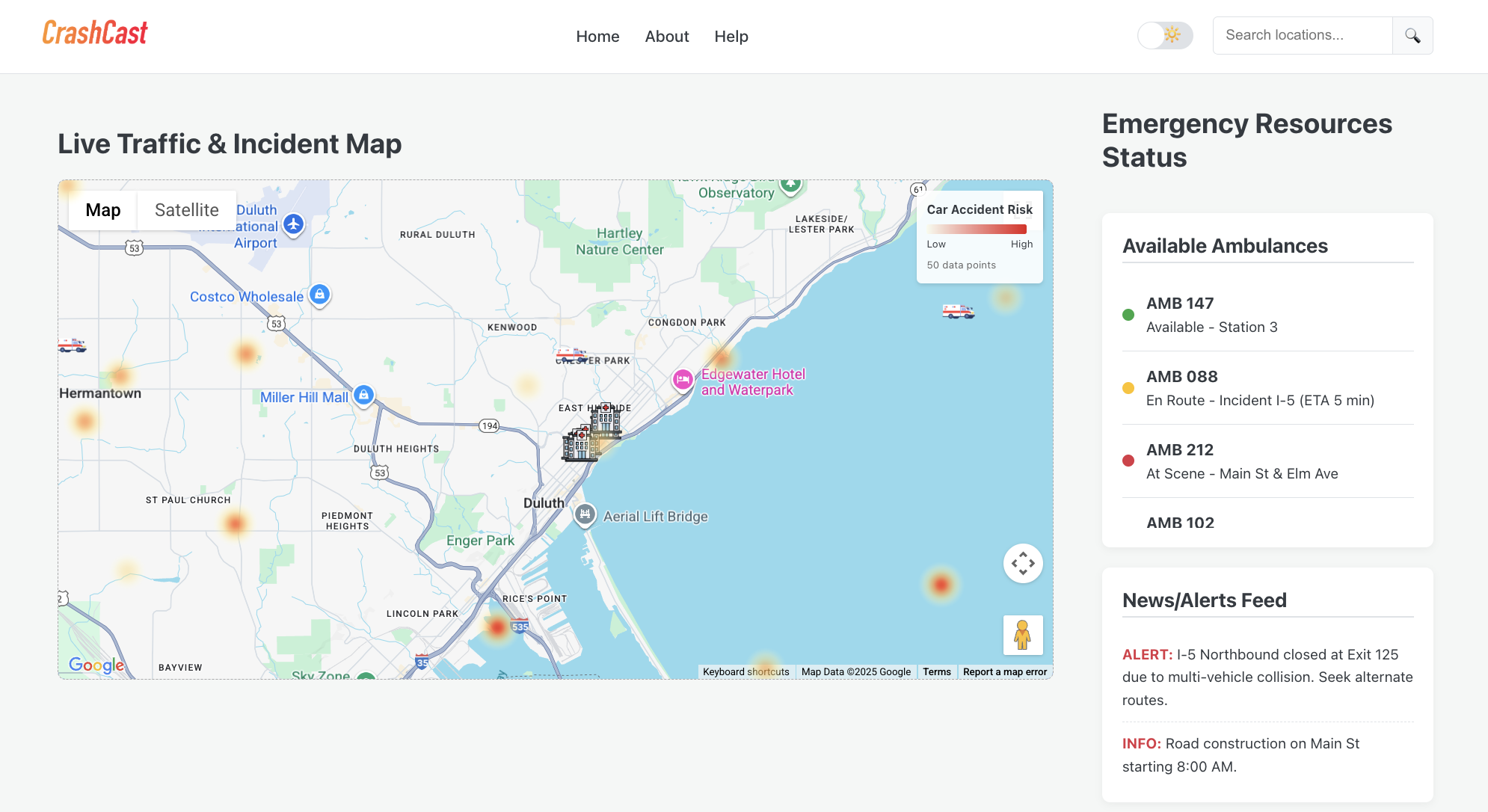
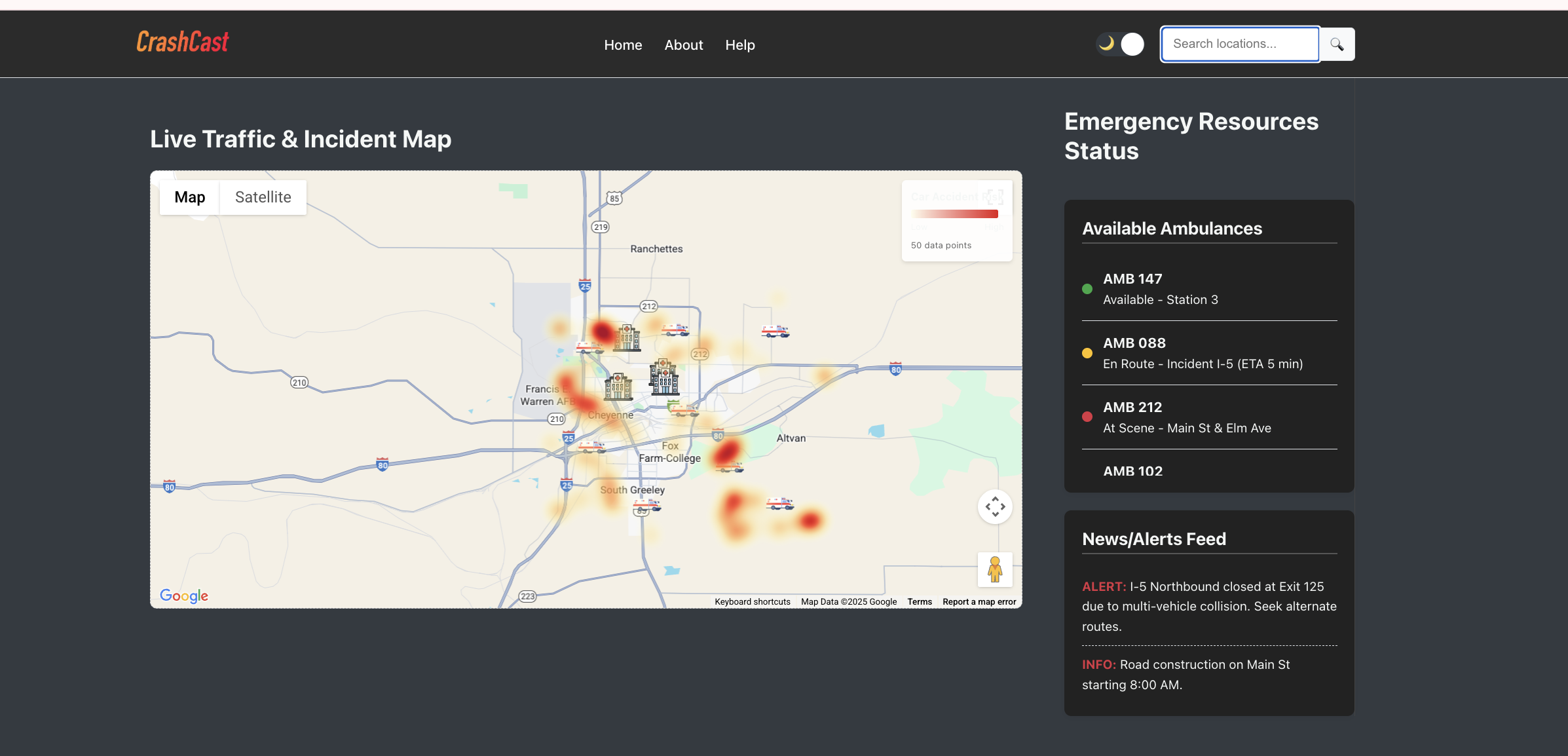
CrashCast (portmanteau of "crash" and "forecast") aggregates data on weather, traffic, time of day, and road conditions in order to mark regions at high-risk of traffic accidents. These zones give ambulance companies crucial intel on which routes they should deploy patrols to minimize the time it takes for an ambulance to reach collision victims and bring them to hospitals, saving precious life-saving minutes.
How we built it
We utilized several services, tools, and frameworks. For the frontend we used React in JSX files, as well as Vite to run the server, and Node to connect the backend. And of course, CSS for styling. For the backend, we used tools like EC2, Lambda, Nginx, Certbot, API Gateway, and OpenStreetMap API. All backend code was written in Python.
Challenges we ran into
The learning curve was steep, as we had to combine a variety of technologies that none of us had used together before. Integrating real-time data from multiple APIs (like weather, traffic, and mapping) while keeping latency low was especially challenging. Setting up the AWS backend, particularly configuring EC2 instances, managing SSL certificates through Certbot, and properly routing traffic via Nginx and API Gateway, took significant trial and error, and of course, time. Additionally, building a predictive model required careful data cleaning, feature engineering, and tuning to ensure accuracy and response time.
Accomplishments that we're proud of
We’re proud that CrashCast went from a rough concept to a functioning prototype that successfully visualizes real-time accident risk zones. We managed to deploy a working full-stack application, integrate multiple APIs, and implement a trained prediction model that outputs meaningful insights. Our team also learned how to collaborate across both software and data science domains effectively.
What we learned
We learned a tremendous amount about cloud infrastructure, data pipelines, and predictive modeling. This project taught us how critical, and often complex, it is to connect the frontend and backend, especially when handling live data. We also looked deep into the societal impact of technology, how predictive analytics can literally help save lives by improving emergency response systems.
What's next for CrashCast
Next, we plan to enhance the accuracy of our prediction model by incorporating more granular datasets, such as live camera feeds or vehicle telematics. We would also like to add some proper machine learning models to avoid false positives, as this prototype does not have full capability to be super accurate. We also want to build a mobile dashboard for ambulance drivers that offers routing suggestions based on predicted accident zones. In the long term, we would even consider collaborating with local governments and emergency services to deploy CrashCast citywide, pushing on our mission to reduce response times and save more lives...all over the world.
Built With
- css
- fastapi
- javascript
- react
- vite


Log in or sign up for Devpost to join the conversation.