Inspiration
Most people can't tell whether a repair quote is fair, or whether the car is even safe to drive to the shop. A chatbot that guesses isn't much help, and an AI that can spend your money is worse. We wanted an agent you can check at every step: it shows its reasoning on the car itself, and it can't move a cent without you.
What it does
Crankwell is an AI mechanic for two cars, a Toyota Corolla and a Honda CR-V, each a detailed 3D model built entirely in code.
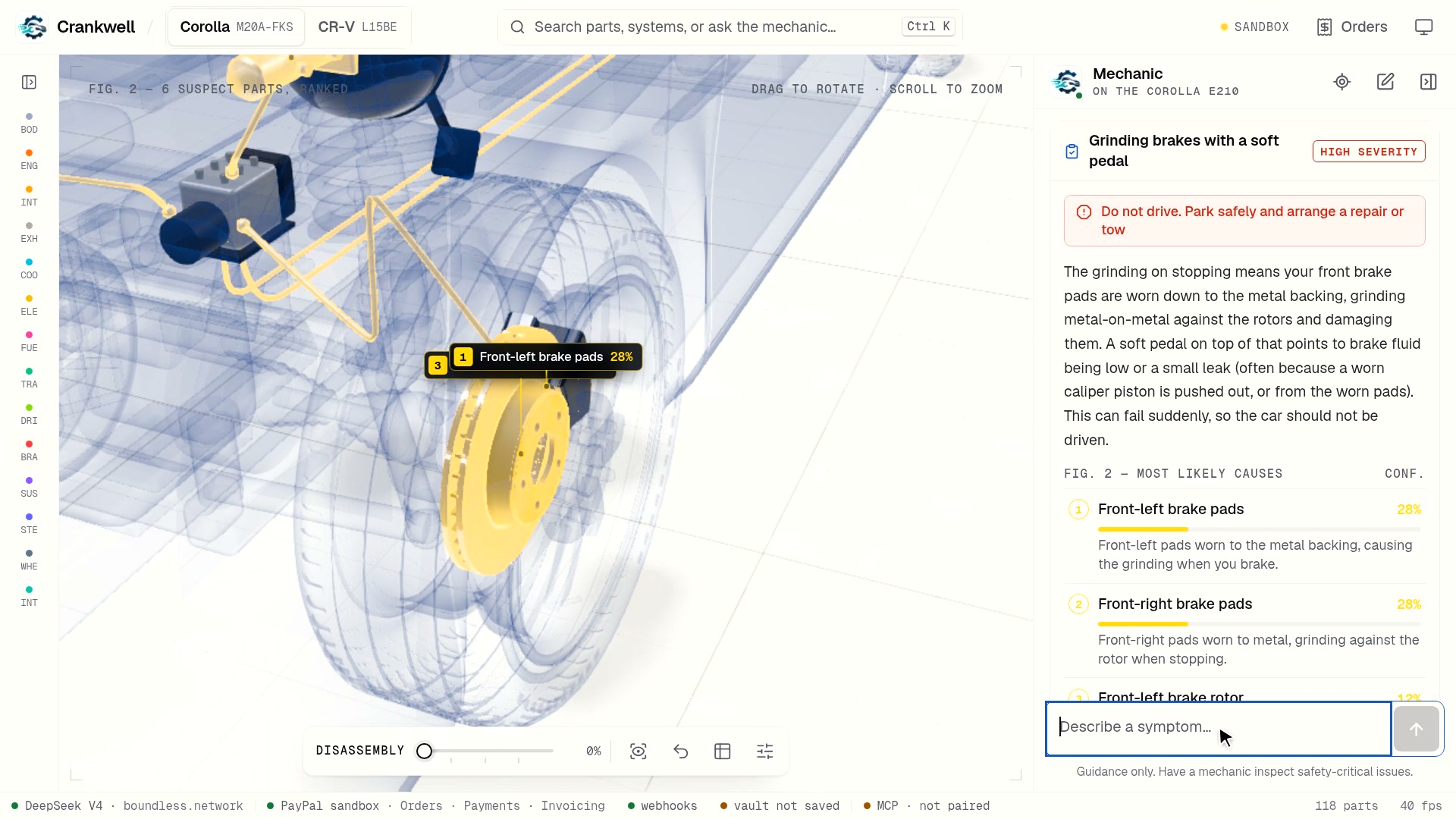
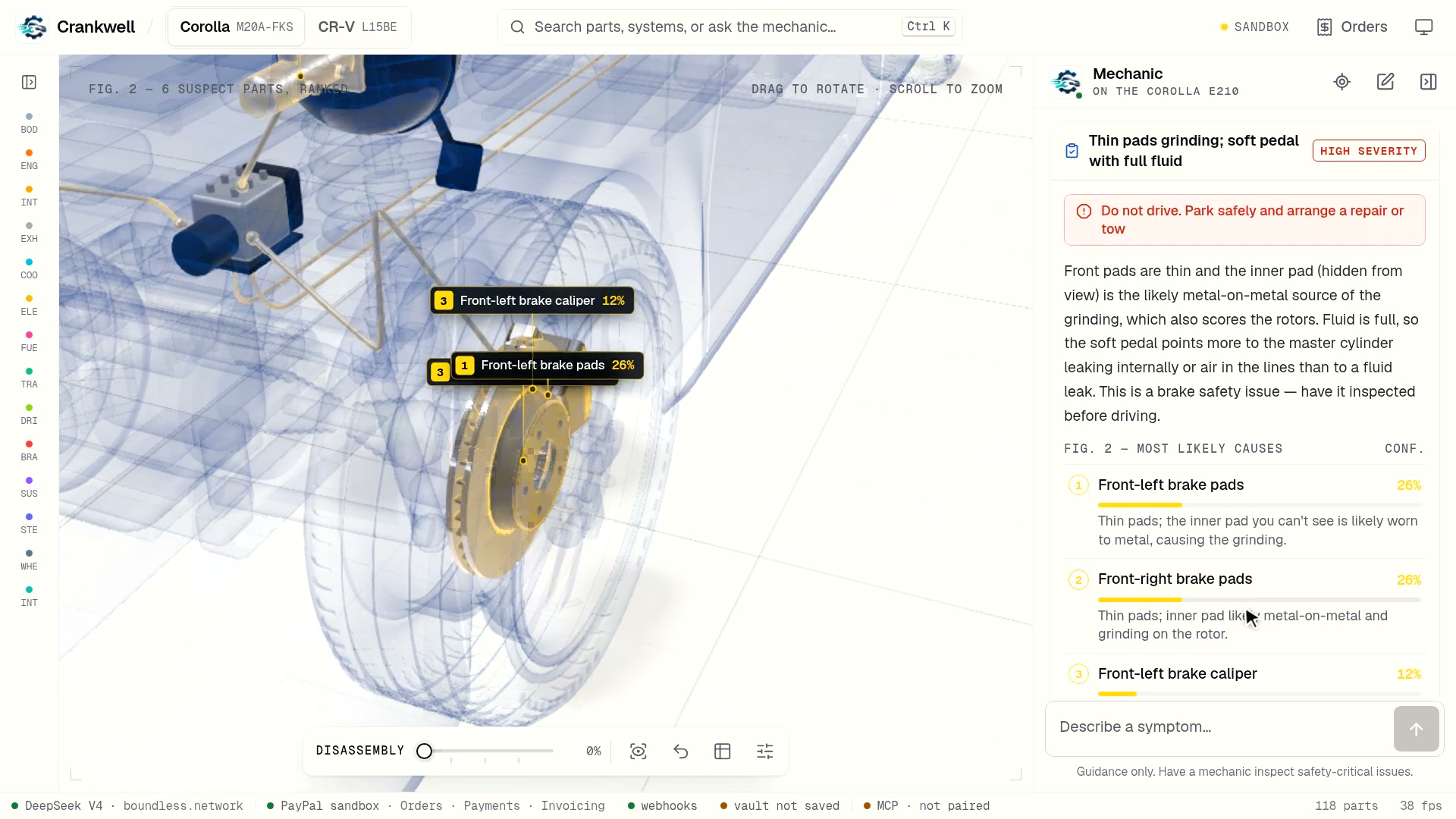
- Diagnose. Describe a symptom in plain words. The agent x-rays the car, flies the camera to the suspect parts, ranks them by confidence, and says whether it's safe to drive.
- Check safely. It asks for checks you can do in the driveway (engine off, nothing under the car). Your answers re-rank the suspects.
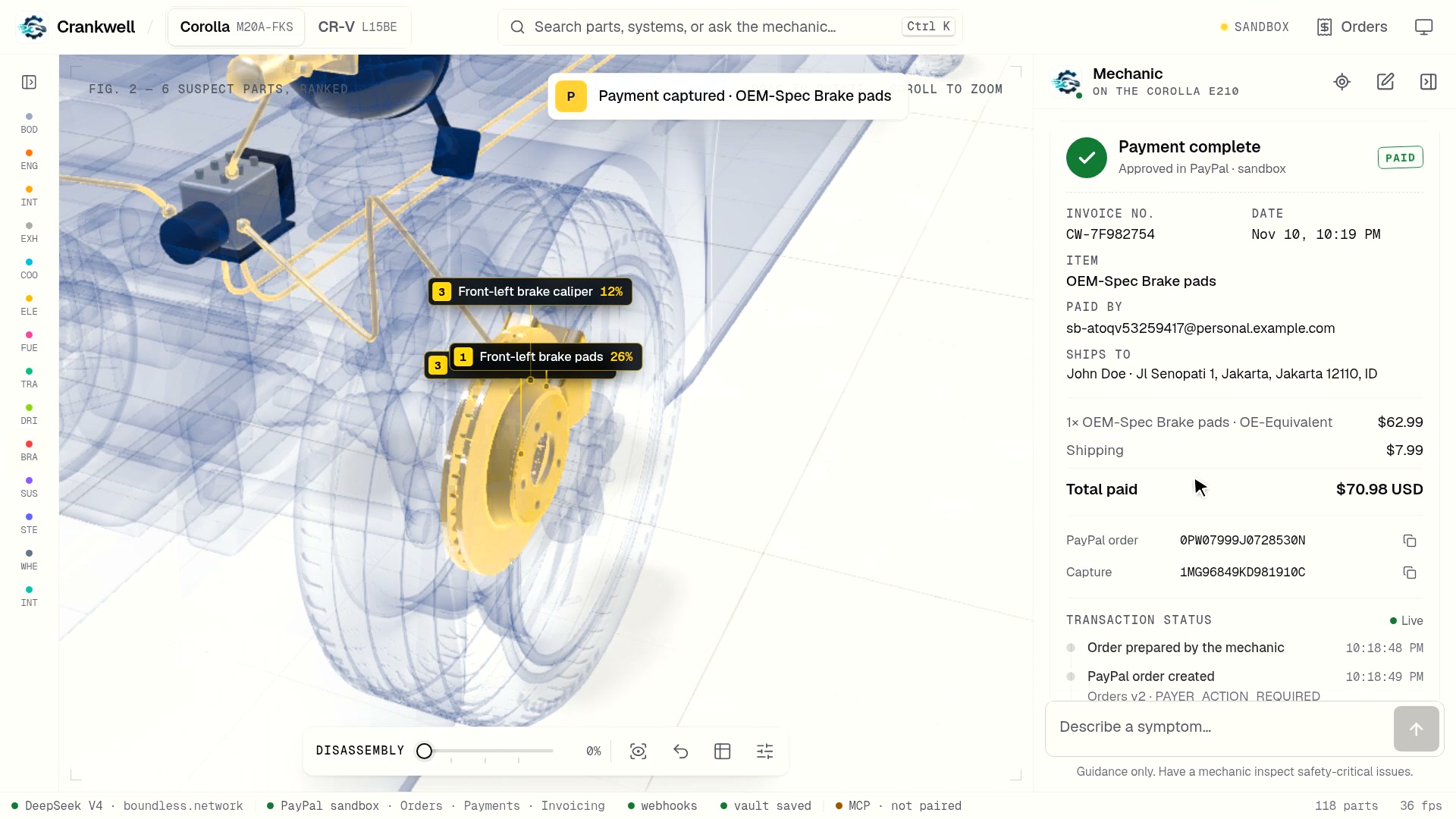
- Fix and pay. It offers a DIY fix, a spare part, a mobile technician or a repair-shop slot, and prepares the PayPal checkout. Prices come from the server catalog, never from the model.
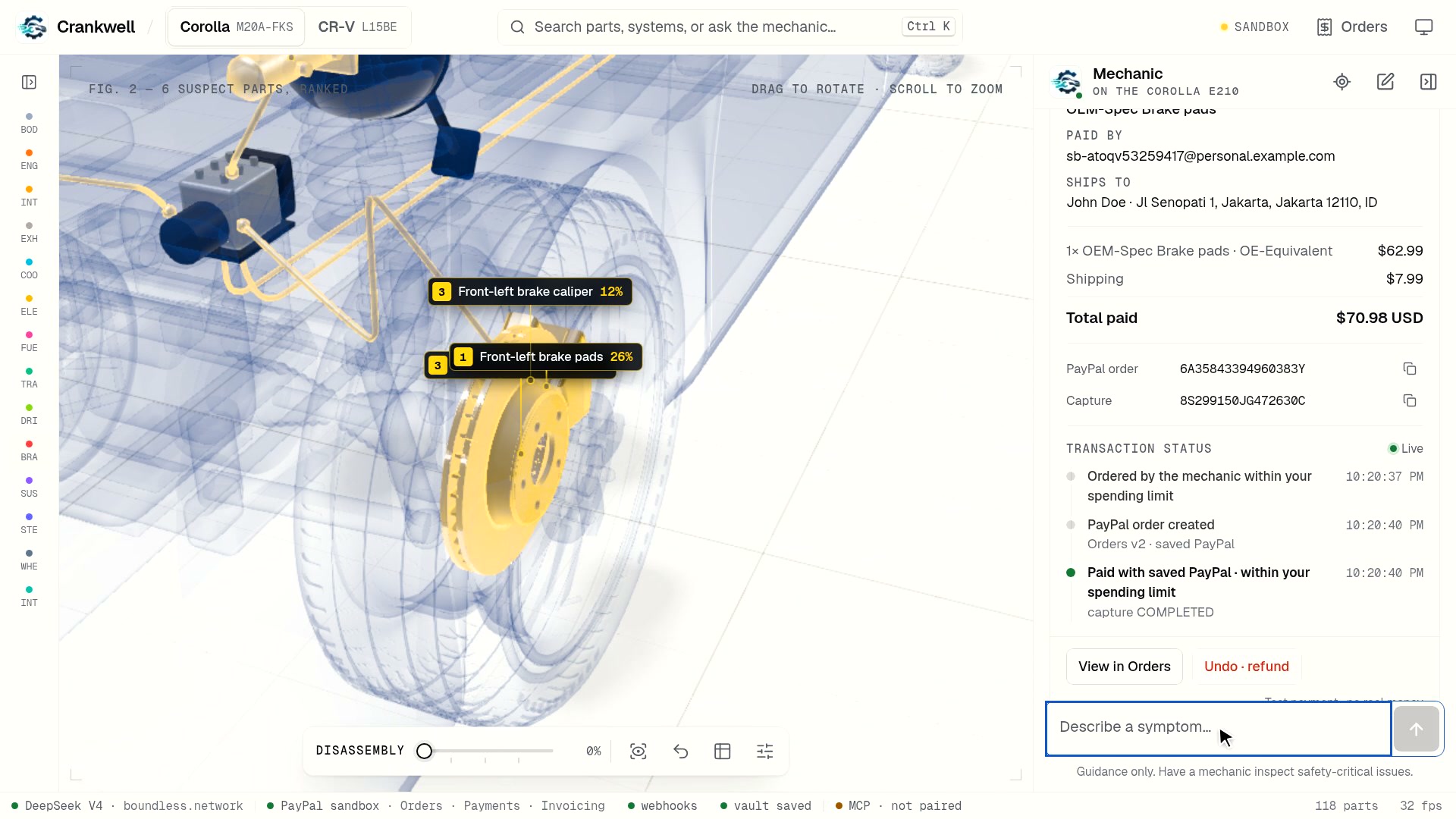
- Three levels of trust. Approve in PayPal the first time. After that, one tap with saved PayPal (Vault), capped per order and per day. Or approve a spending limit, signed on the server, and the mechanic buys within it on its own; every purchase comes with a receipt and an Undo that refunds it.
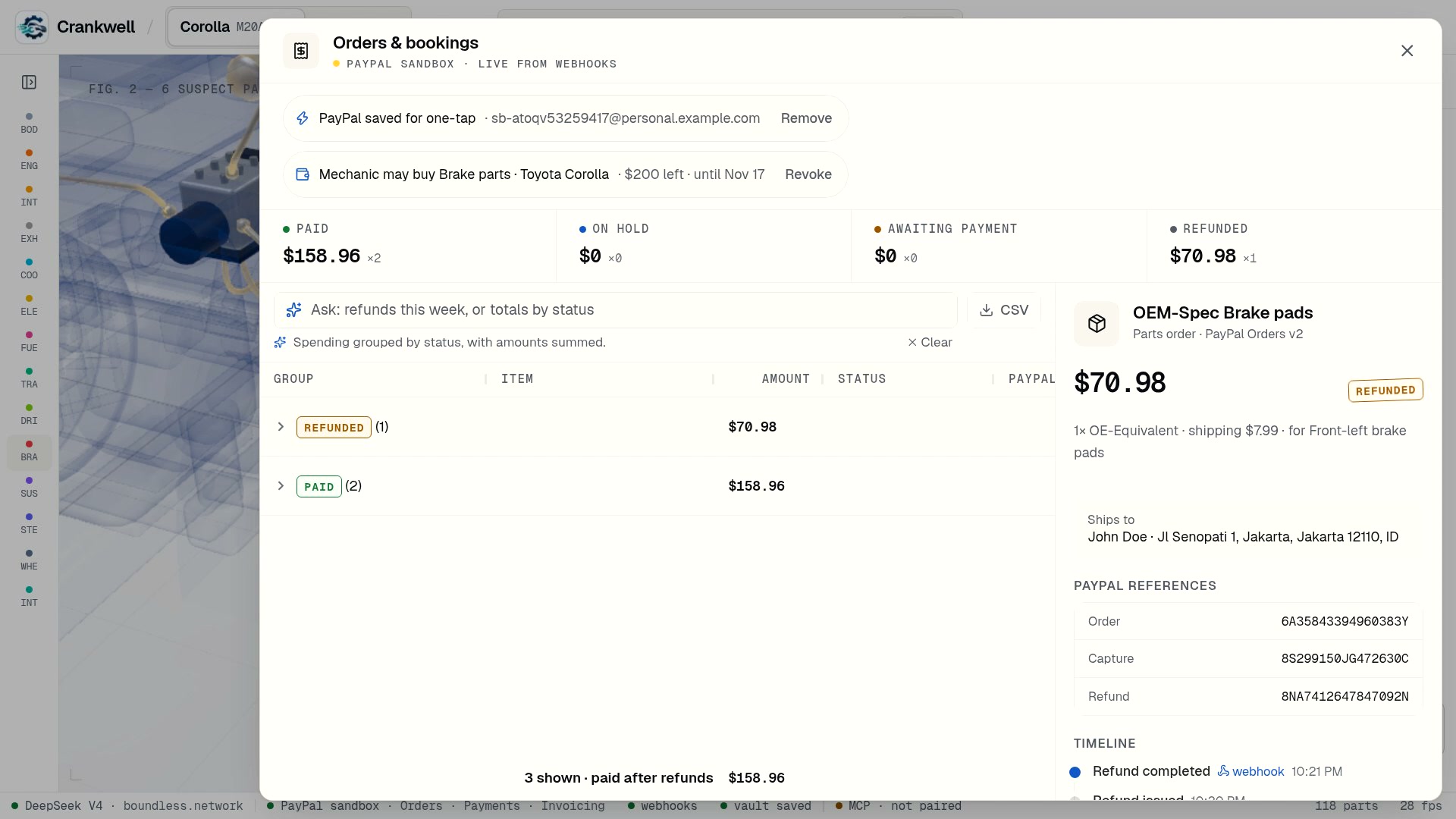
- After the sale. It tracks the shipment, checks a payment or a dispute with PayPal, refunds, checks you in at the shop, and settles the technician's job (refunding unused labor and paying the technician out).
- Inside Claude. The same mechanic is an MCP connector with in-conversation cards. Claude can prepare a checkout but can never press pay.
How we built it
- Agent: DeepSeek V4 on Boundless inference, in a streaming tool loop with zod-checked tools, provider failover, a daily token budget and a trace for every turn.
- PayPal (sandbox), eight products in one conversation: Orders v2 (capture, authorize, shipment tracking), Payments v2 (capture, void, reauthorize, full and partial refunds), Vault, Invoicing v2, Payouts, Pay Later, Webhooks (signature-verified, deduplicated, pushed to the browser live) and the PayPal Agent Toolkit, scoped so the model can only look up the user's own orders.
- 3D: Three.js and React Three Fiber. No downloaded models: a lofted body surface and about 70 parametric part builders give 118 and 125 parts per car, each with a purpose note, price range and DIY difficulty.
- Data views: AG Grid for the price guide (linked to the 3D model) and the orders ledger (master/detail money flow, grouping, totals), both with an Ask box that turns a question into grid filters and groups.
- App: Next.js 16, React 19, SQLite, and an OAuth 2.1 + MCP server for the Claude connector.
Challenges we ran into
- Letting an AI near money safely. We ended up with one rule everywhere: the agent creates a priced, expiring proposal, and only a human tap (or a limit the human signed) executes it. A compare-and-set on every action means a double tap can't pay twice.
- Staying in step with PayPal. Buyers close tabs mid-approval and webhooks arrive late or out of order. Webhooks can complete an approved order on their own, never downgrade a status, and a reconciler re-checks anything left open.
- Keeping the agent honest about safety. Our first eval run scored 38/41 because loose steering got "caution" instead of "do not drive". That led to an explicit do-not-drive list.
- A car made of code that still looks like a car, at roughly 2 million triangles, at a usable frame rate.
Accomplishments that we're proud of
- A 41-scenario eval with deterministic scoring: 41/41 passed, 100% do-not-drive recall on safety-critical cases, zero payments without a tap, 5/5 adversarial prompts turned away.
- A real end-to-end money flow in the sandbox, from first approval to refund and technician payout, with every PayPal reference visible in the ledger.
- The same agent and the same guardrails working in the app and inside Claude.
What we learned
Agentic commerce is mostly a question of where the human stays in the loop. Price on the server, make every action a proposal, keep the payment provider as the source of truth, and measure the agent before trusting it.
What's next for Crankwell
More cars, real parts and shop inventory instead of seeded demo data, VIN and OBD-II input, and moving from the sandbox to live payments.
Try it
Open https://crankwell.xyz and click "Open the garage". No sign-up. Describe a symptom in the chat, for example "My brakes grind when I stop, and the pedal feels soft". When PayPal asks you to log in, use the sandbox buyer shown at the bottom of the landing page. Everything runs in the PayPal sandbox; no real money moves.

