Inspiration
A cranioplasty replaces a missing piece of the skull after trauma, stroke surgery, or tumor removal - and is only custom-made for one person.
Designing that implant is slow. In a study of 83 patients, surgeons and engineers spent 14 days on average just communicating about the design. AI models trained on synthetic defects still need manual fixes on real, irregular ones. Hospitals in low- and middle-income countries add their own barriers: software cost, CT quality, and limited technical staff.
We wanted one workspace where a medical staff and AI agents work together - with the staff taking the lead from agents doing the grunt work.
What it does
A cranioplasty usually follows a decompressive craniectomy or tumor resection by weeks or months, when the surgeon needs a patient-specific implant for the skull defect. [Project name] is a local-first 3D workspace where the surgeon and clinical engineer plan that implant together on one shared case. The design stays human-guided, and the software makes no clinical decisions.
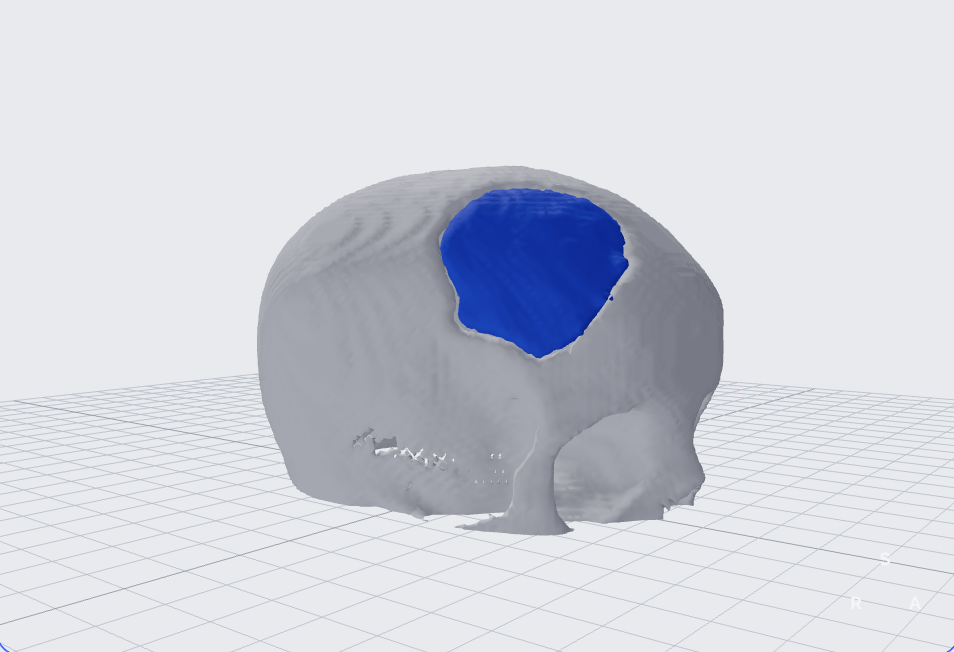
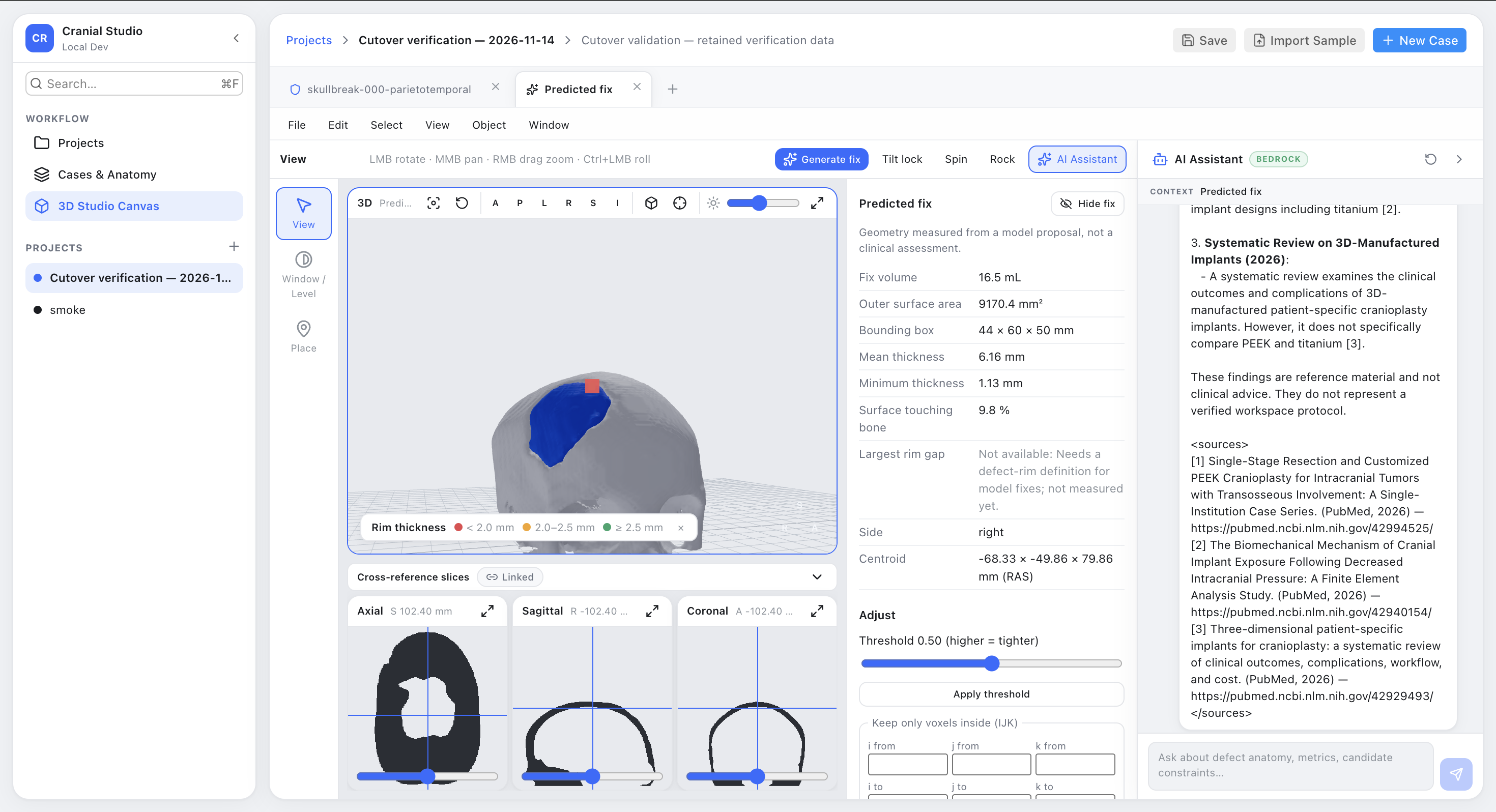
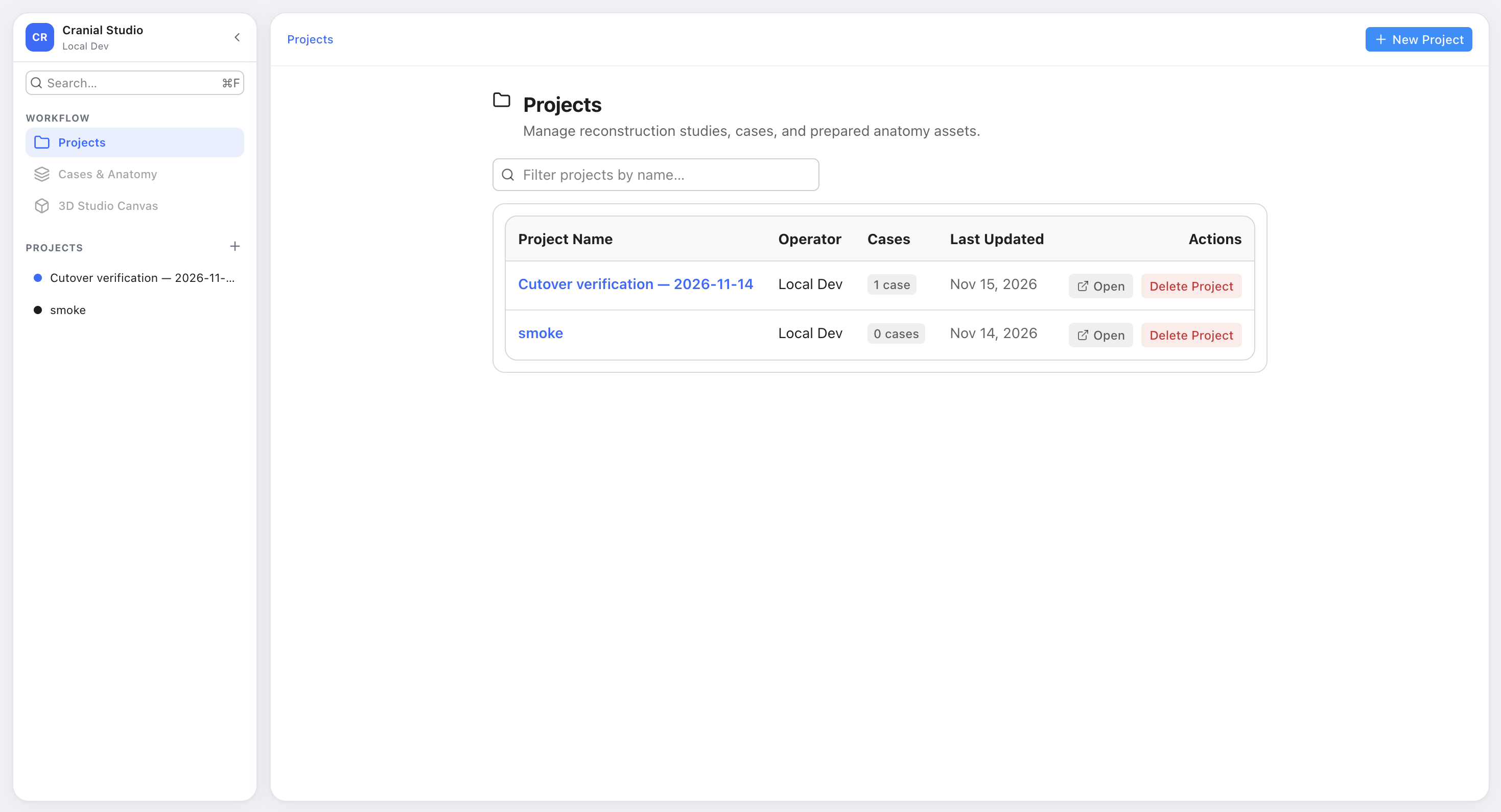
Defect assessment. The team picks a case from the project table. Each case holds a read-only anatomy scan, so no edit can alter the patient’s source data. They inspect the defect in the 3D view and in synchronized axial, sagittal, and coronal slices, adjusting window/level to find the bone edge, then place points and measure distances on the anatomy. Before choosing fixation points, they ask the assistant, “How thick is the bone around the defect?” It runs real measurement tools on the case and answers in millimeters, with the same measurements overlaid on the 3D model.
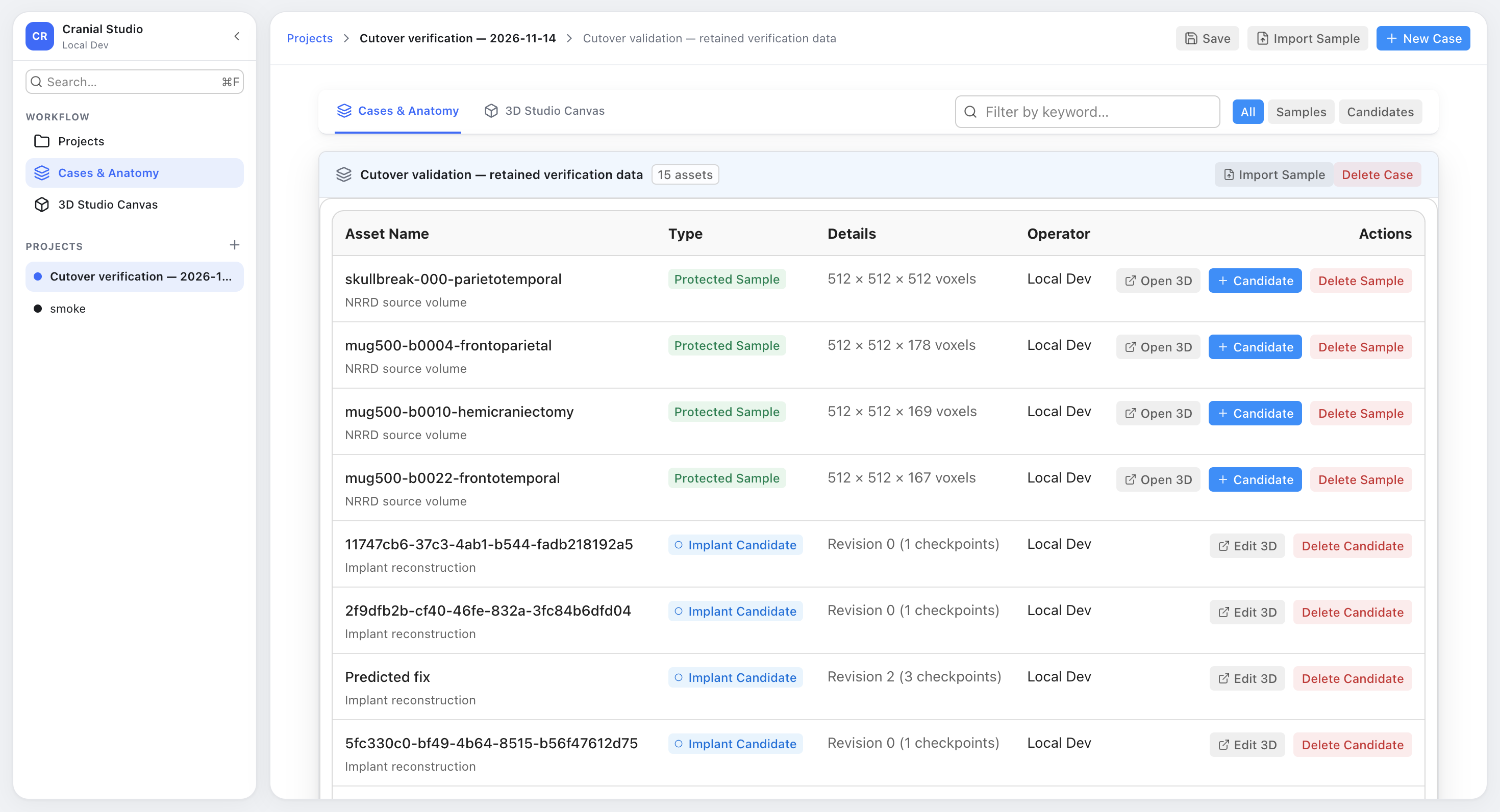
**Designing and revising the candidate. **The engineer creates a candidate implant, moves it into the defect, and measures it against the rim. Every edit saves as a new revision, so the team can compare any two designs or restore an earlier one. Projects, revisions, and source files persist in your data storage for later review.
How we built it
We started with the core data model for projects, cases, scans, candidates, and revisions, then added the React and Three.js workspace for viewing anatomy and editing repair proposals. After that, we connected a FastAPI and SQLite backend for reliable local storage, added measurement and placement tools, and tested each piece as it was integrated.
To scale the platform, we’re adding an agent layer with LangChain Deep Agents and AWS Bedrock, and also developed our own reconstructive Machine Learning Model in AWS SageMaker to generate bone-repair proposals from scan data. The user stays in control: AI can propose, explain, and support decisions, but the final design remains editable and reviewable in the 3D workspace.
What we learned
Working with research papers and real data. We audited SkullBreak/SkullFix (Kodym et al., Data in Brief, 2021) down to 134 usable cases, kept every variant of one skull in the same split, and plan to test on the 29 real MUG500+ defects (Li et al., Data in Brief, 2021).
Designing the agent. We learned that a trustworthy agent depends less on the model than on the limits around it. Letting code decide what the model may claim, and keeping a human in charge of every change, did more for trust than a smarter prompt.
Our first machine learning project. Training taught us that a pipeline can look healthy and still be wrong. Small bugs in data and settings, like a bad augmentation or a mismatched learning rate, can quietly ruin a run, so we learned to check what the model sees and compare against a baseline before trusting any score.
What's next for Crani.o
About 430,000 cranioplasties were performed worldwide in 2025, feeding a personalized cranial implant market of roughly USD 960 million that is projected to reach USD 1.91 billion by 2035. From there, we want to bring the same measure, check, and propose loop to other reconstructive surgery that starts from a CT scan.
