Inspiration
It is the night before an exam, you have forty slides and no time, and the thing you need is not a chatbot — it is the one slide that answers your question, plus proof it really said that.
Every on-device LLM demo this year runs on a Snapdragon 8 Elite or an iPhone 17: silicon with i8mm or SME2 matrix extensions. Those chips are a small minority of the world's Arm devices. We wanted to know what is actually achievable on the phone a student in Dhaka is holding — so we built on a Poco M2 Pro: Snapdragon 720G, 2× Cortex-A76 + 6× Cortex-A55, Armv8.2-A, no i8mm, no SVE, no SME, no NPU, 6 GB RAM, released 2020.
Then Arm's own acceleration library turned out to do nothing on it, and that became the more interesting project.
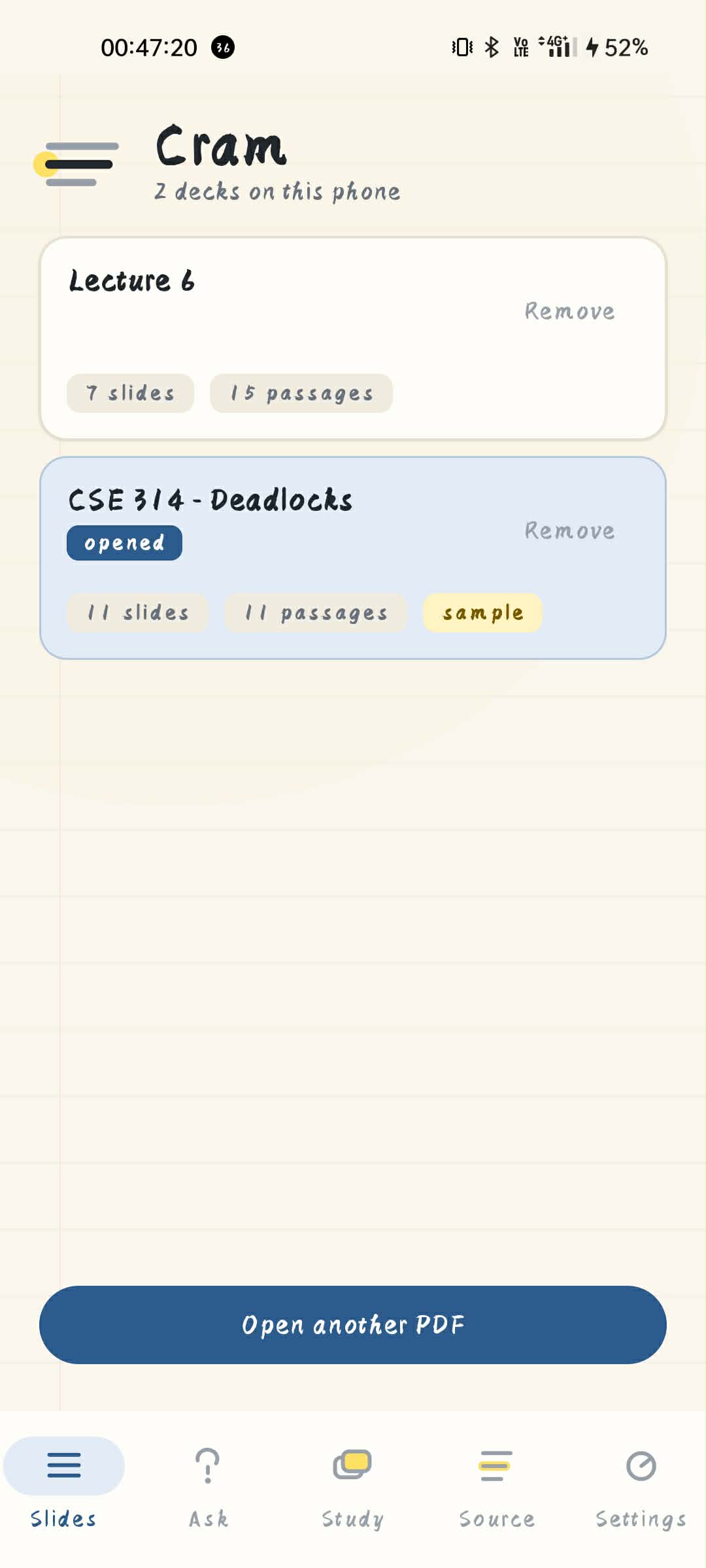
What it does
Open a lecture PDF. Ask it anything.
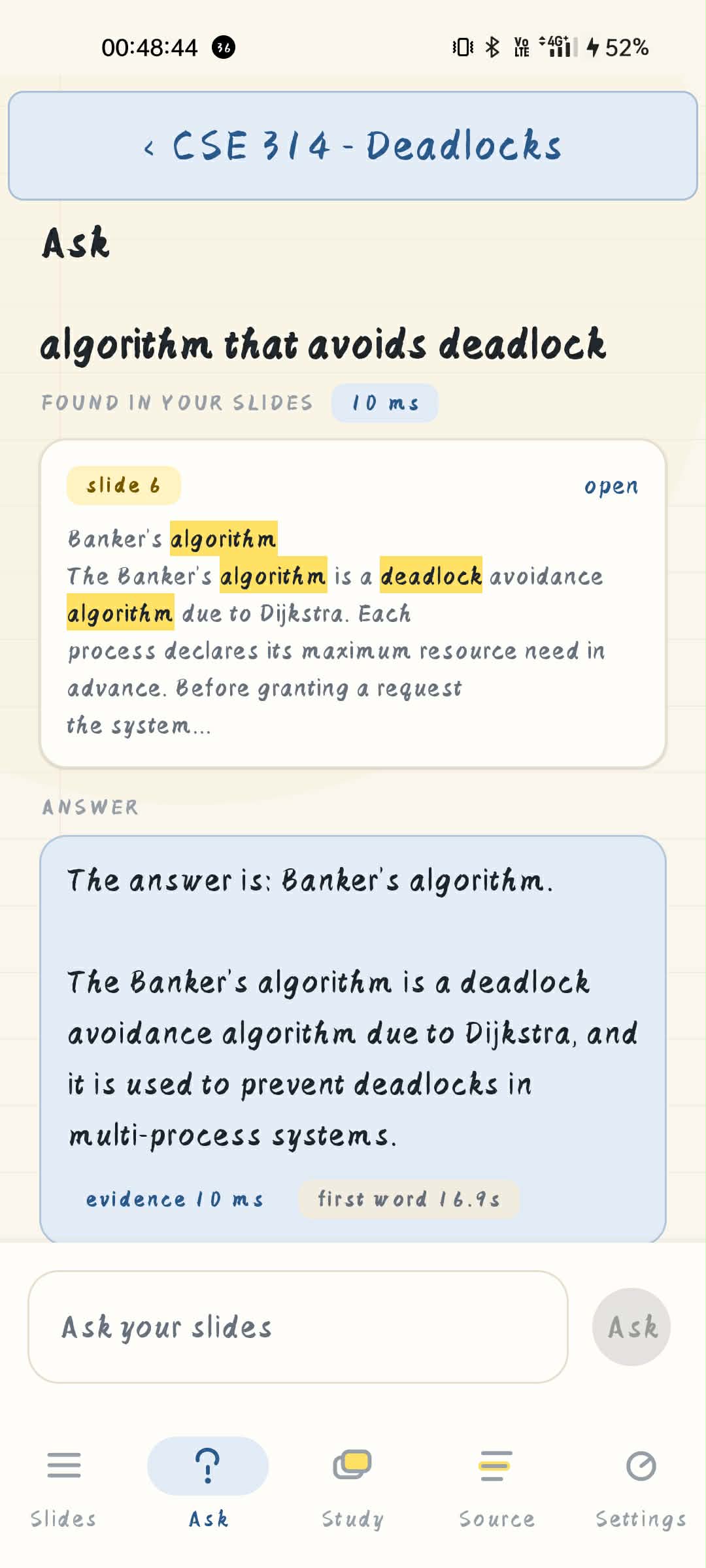
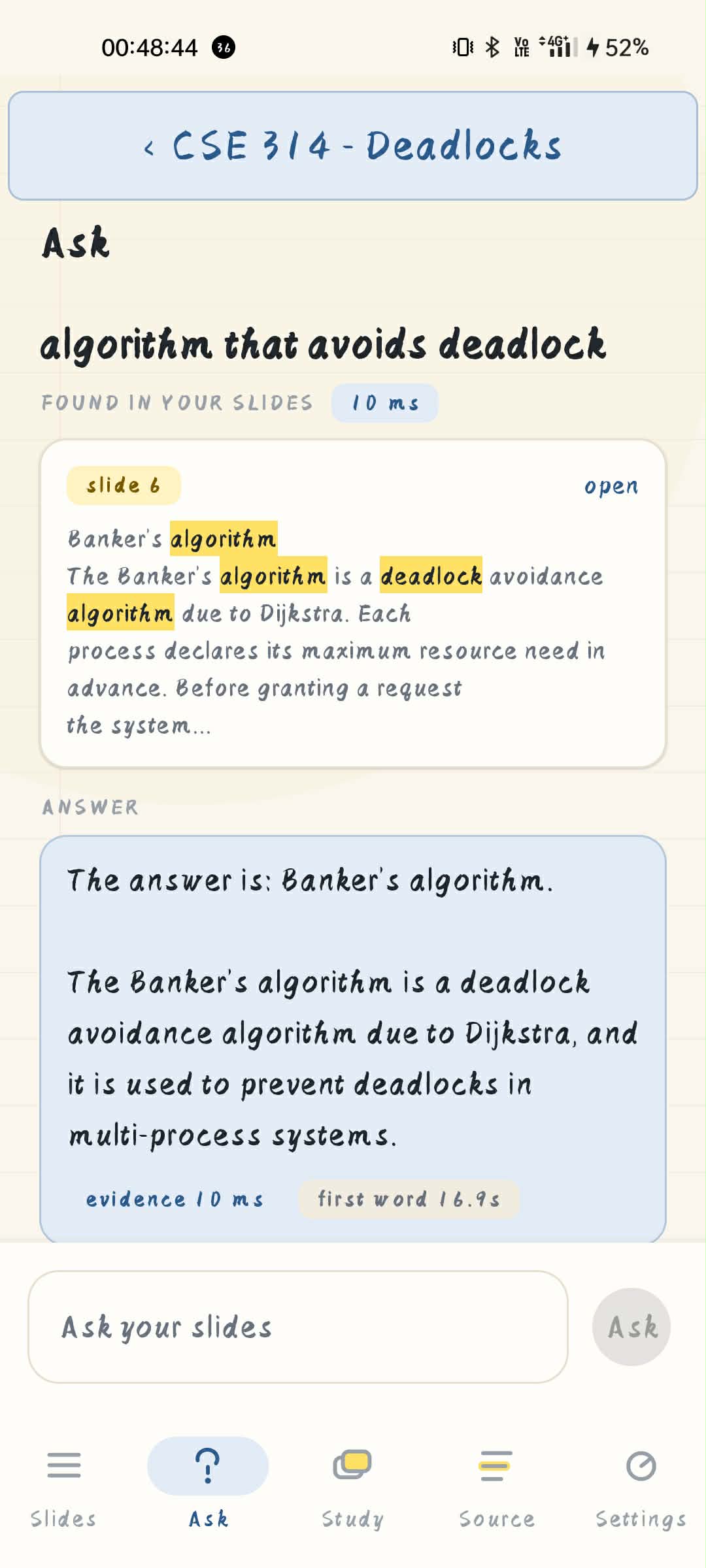
- Ask — BM25 ranks every passage in the deck in 1–7 ms, the matching slide appears before the model writes a word, and the answer cites the slide it came from.
 /
/
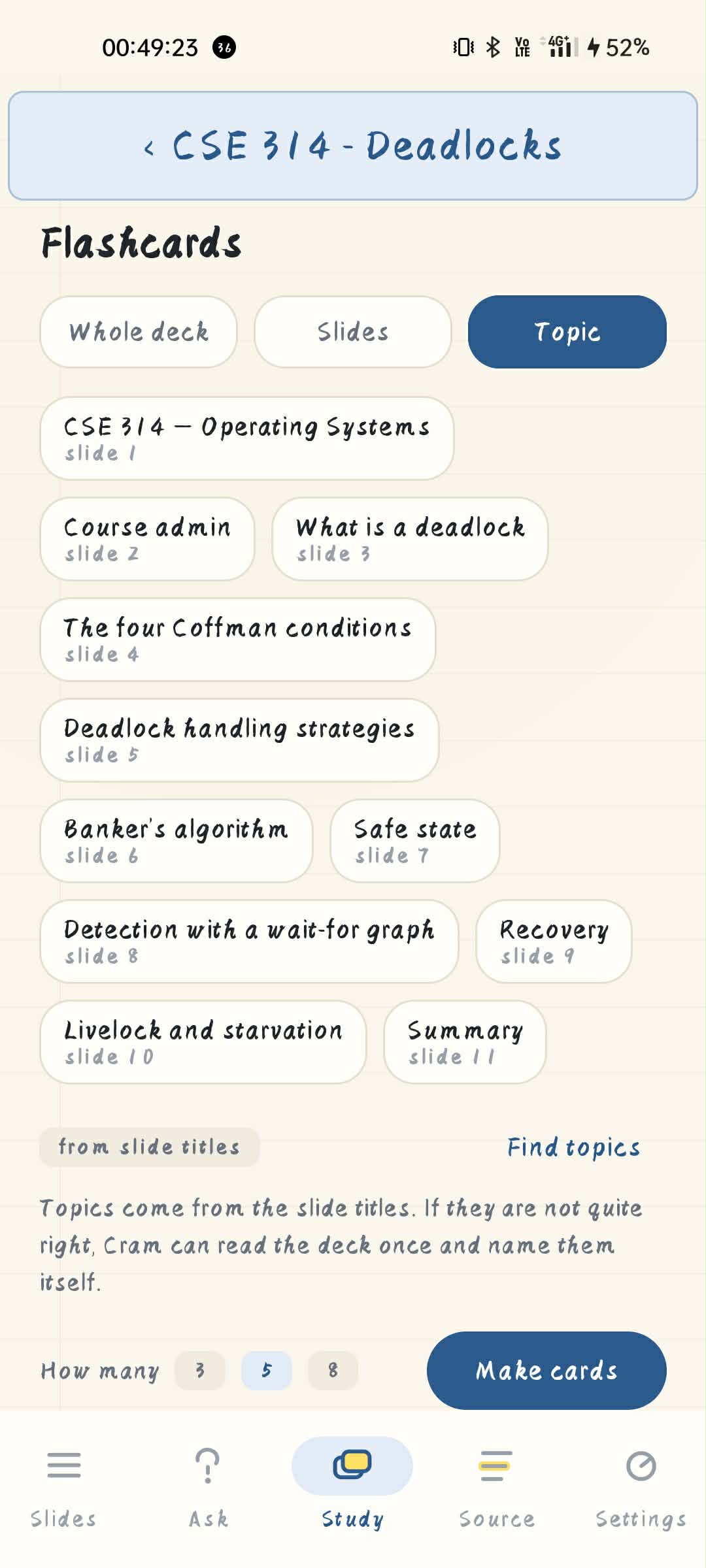
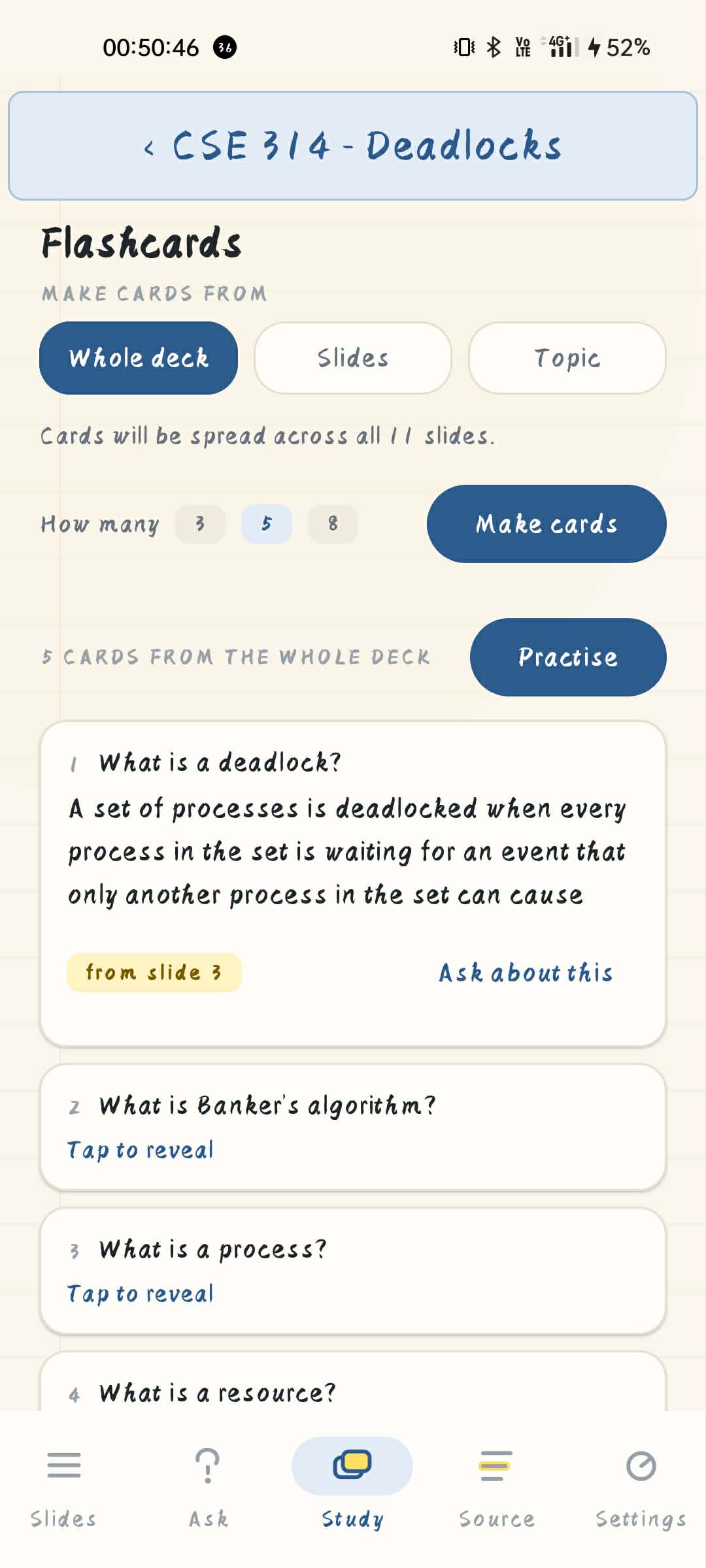
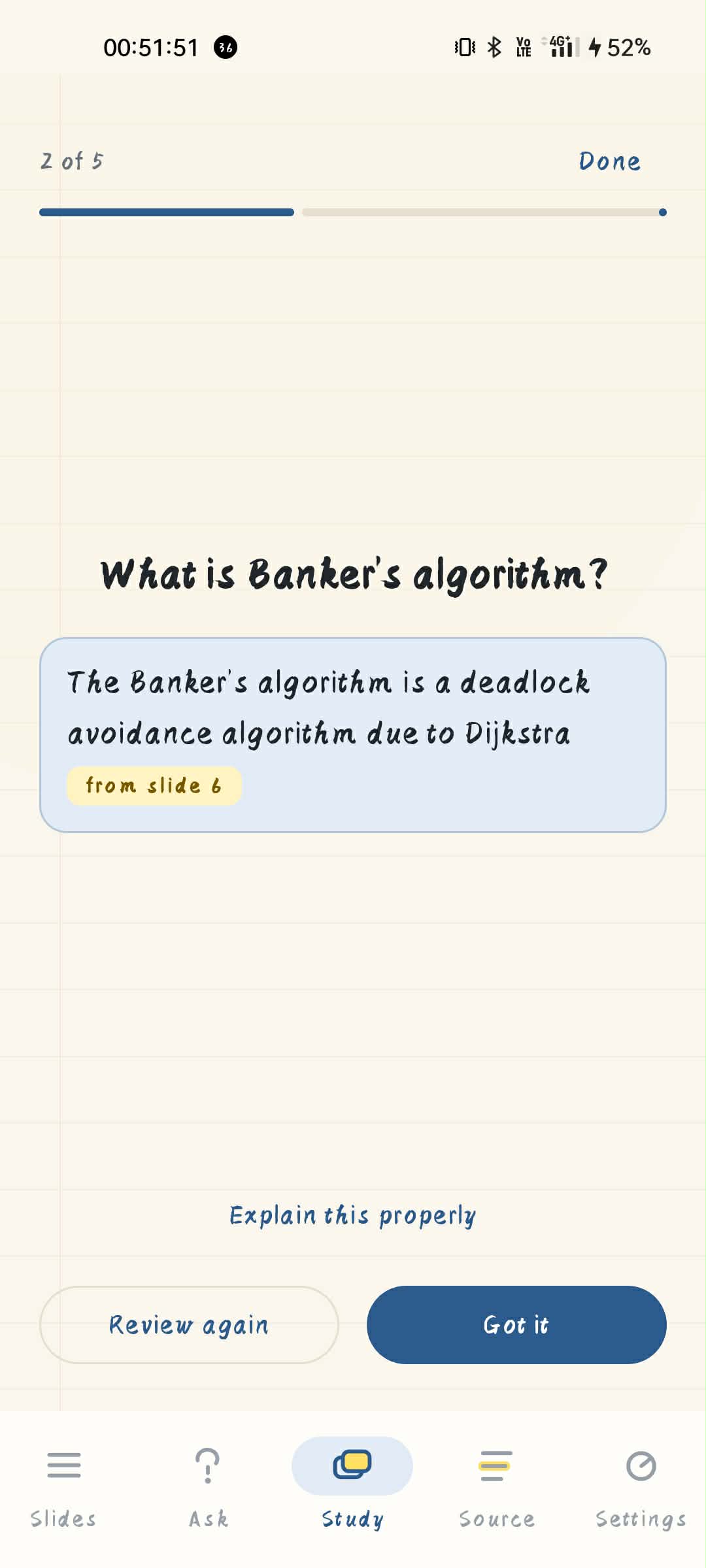
- Study — turn the same slides into flashcards, scoped by whole deck, page range, or a topic picked from the deck's own headings. Every card names its source slide.
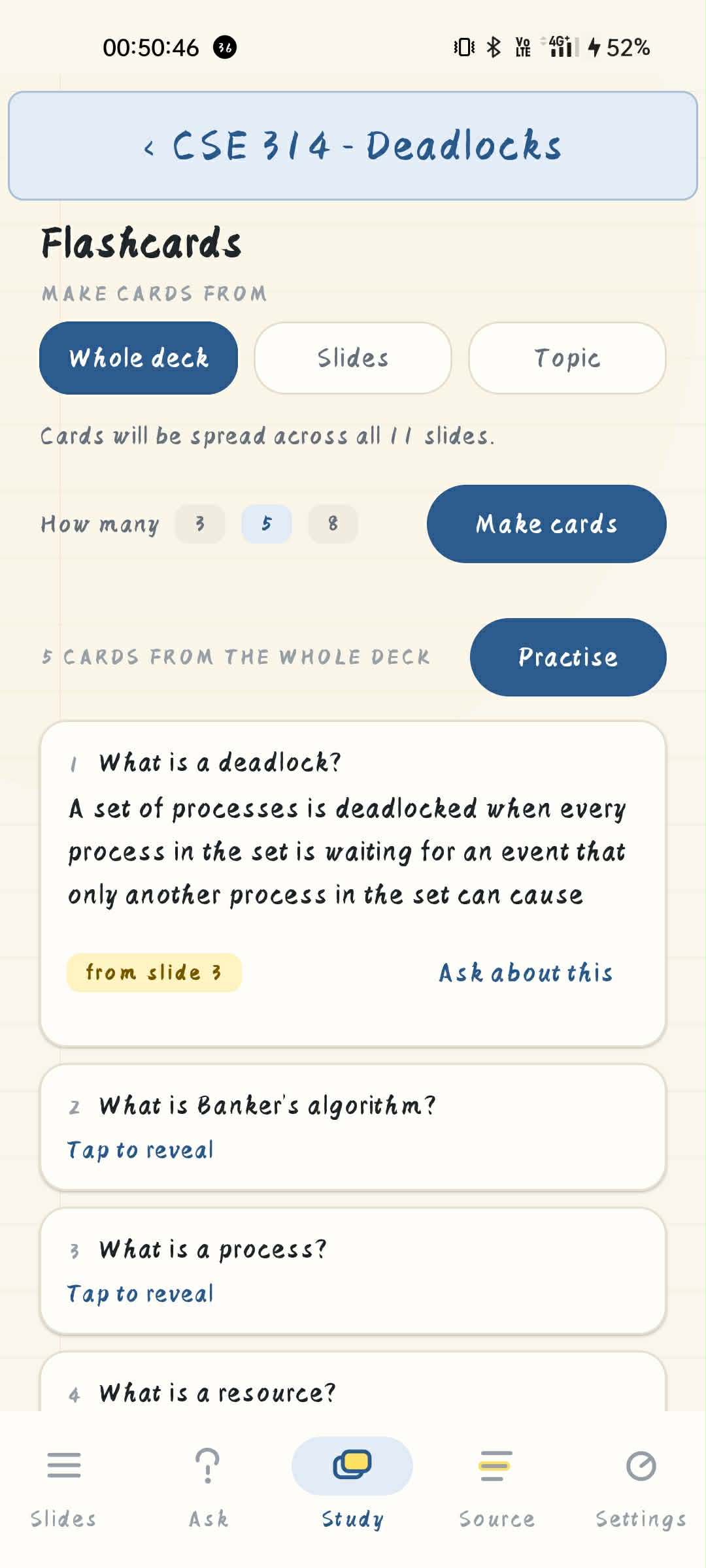
Practise — self-grade, then "Drill the 3 I missed". It remembers what you got wrong across sessions.
Where you are — "5 of 11 slides covered. Not looked at yet: 1, 2, 4, 7, 8, 10." Cramming's real question is not "what is X" but "what have I still not opened".
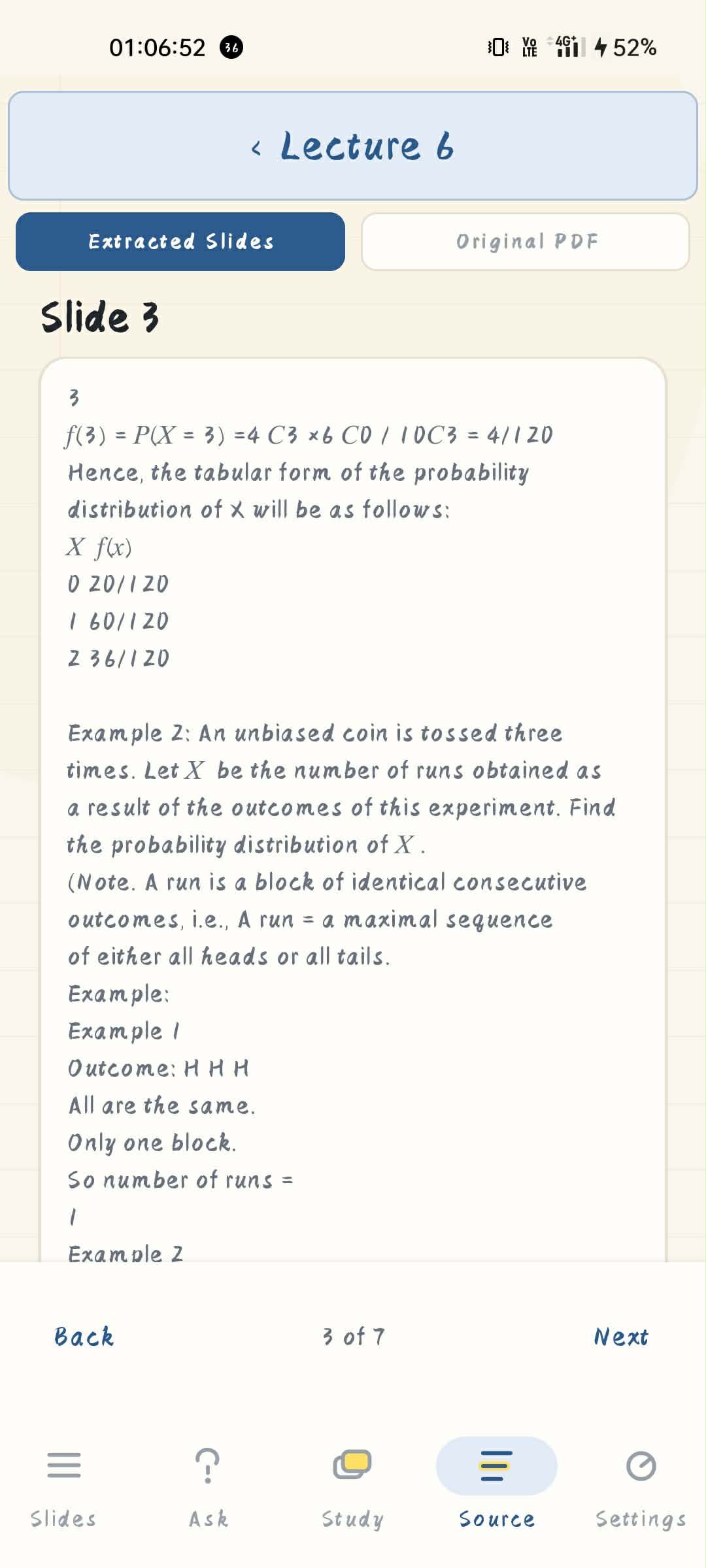
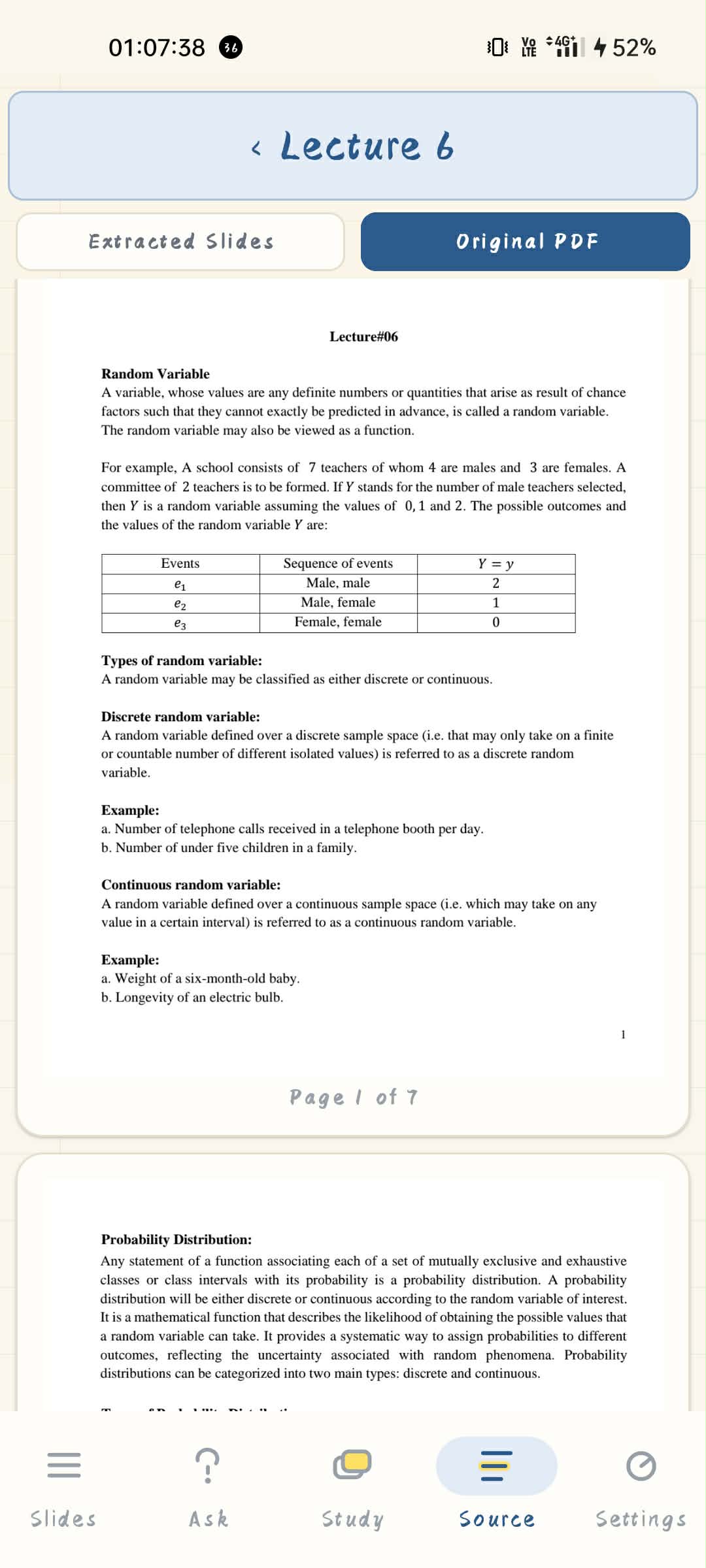
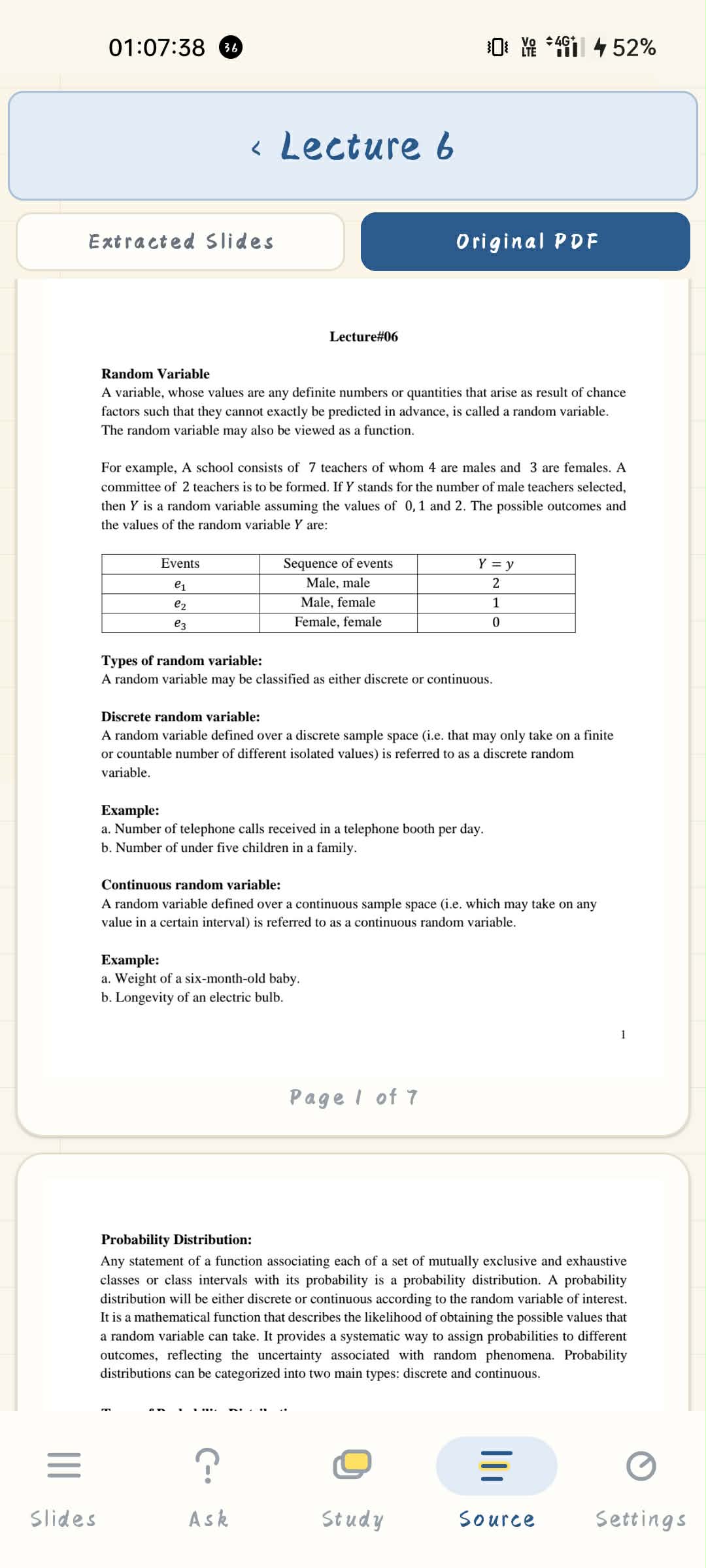
Source — read the original PDF or the extracted text, so you can check the working.
No network. No account. Nothing uploaded — the app declares no INTERNET permission
at all, which you can verify in App info or in a manifest that contains no
<uses-permission> line of any kind.
The setup screen offers a download button that hands the URL to your browser — the fetching happens there, so the app still declares no permission of any kind.
The finding: KleidiAI is inert on Armv8.2-A
Arm markets KleidiAI as CPU acceleration for on-device AI. Its int4 microkernels require i8mm or SME. Armv8.2-A has dotprod and neither — so GGML silently falls back to generic kernels and nothing is accelerated.
The library says so itself, in a log line nobody reads:
kleidiai: no compatible q4 kernels found for CPU features mask 1
kleidiai: SME disabled
We did not stop at the log. We built the same binary twice, with the library on and off, and ran both back to back on the same phone:
| Q4_0 weights | prefill tok/s | decode tok/s |
|---|---|---|
| KleidiAI ON | 18.75 | 8.82 |
| KleidiAI OFF | 17.48 | 9.17 |
Seven percent apart with no consistent sign — decode is marginally faster with it switched off. That is run-to-run noise, not acceleration.
This cliff runs straight through the mid-tier install base. If you are shipping to
Armv8.2-A phones, KleidiAI will not save you, and the gains have to come from somewhere
else. The app shows this about your phone on its Settings screen rather than asking
anyone to take our word for it, and docs/REPRODUCE.md tells you how to disprove us.
Scope, stated honestly: the Q4_0/Q8_0 guidance is correct on i8mm or SME hardware.
We are not saying KleidiAI doesn't work — we are saying it does not engage here, and
"here" is a very large number of phones. Even a "Q4_0" GGUF carries q6_K embedding and
output tensors, so coverage would be partial even with i8mm.
How we built it
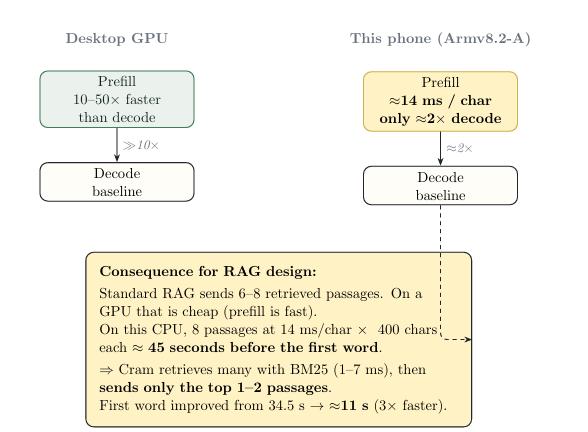
The measurement that shaped everything. On a desktop GPU, prefill runs 10–50× faster than decode, and every "just stuff more context in" RAG design assumes it. On this CPU prefill is only about twice decode — roughly 14 ms per character of prompt. Sending eight retrieved passages would cost half a minute before the first word. So Cram inverts the usual design:
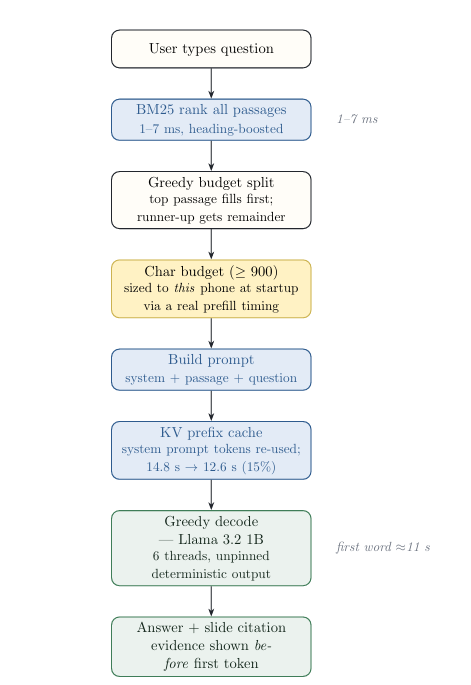
- Retrieve many, send few. BM25 ranks the whole deck in 1–7 ms; only the best one or two passages are ever paid for in tokens.
- Greedy budget allocation. The top passage takes what it needs and the runner-up gets the remainder — an even split truncated the winner to make room for a passage that went unused.
- Evidence first. The matching slide renders while the model is still writing. The retrieval is the answer for most questions; the model only phrases it.
- KV prefix cache. The system prompt is identical every time and about a hundred tokens — a quarter of the prefill. Keeping it resident and re-sending only the question took first word from 14.8 s to 12.6 s.
First word overall: 34.5 s → ~11 s, with retrieval never exceeding 7 ms.
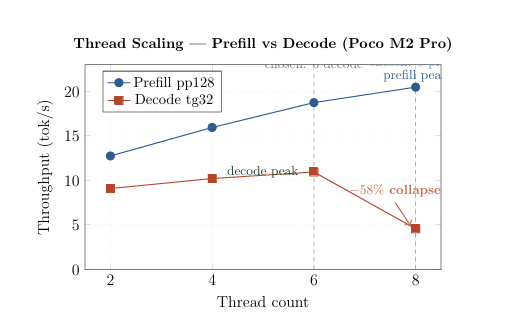
Threads, measured across 24 cells:
| threads | prefill pp128 | decode tg32 |
|---|---|---|
| 6 | 18.74 | 10.95 |
| 8 | 20.48 | 4.57 — a 58% collapse |
Using all 8 cores makes decode 58% slower than using 6: every layer ends in a barrier, so the two fast A76s sit waiting on the six slow A55s. Prefill and decode want opposite thread counts, so we run 8 and 6 respectively — and derive both from the device's own core split rather than hard-coding ours.
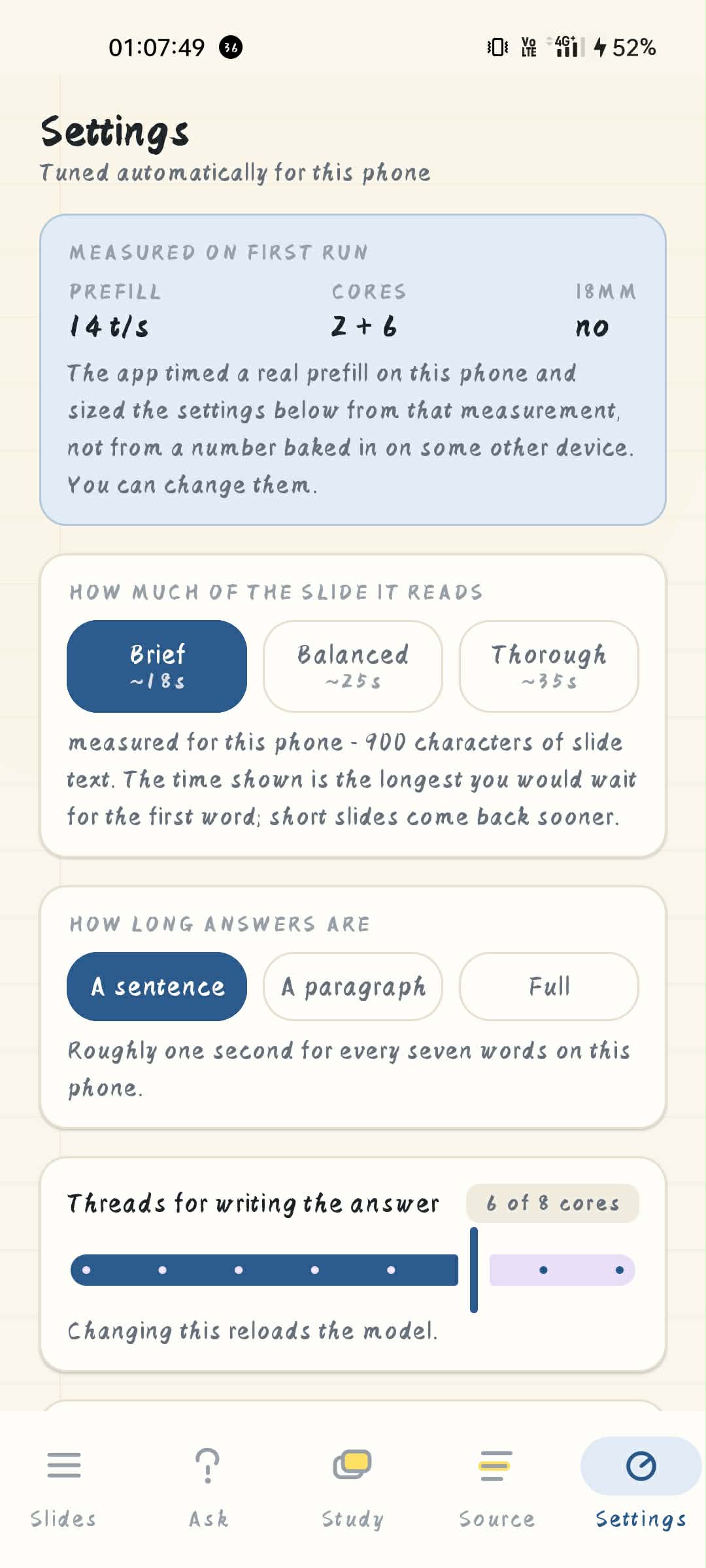
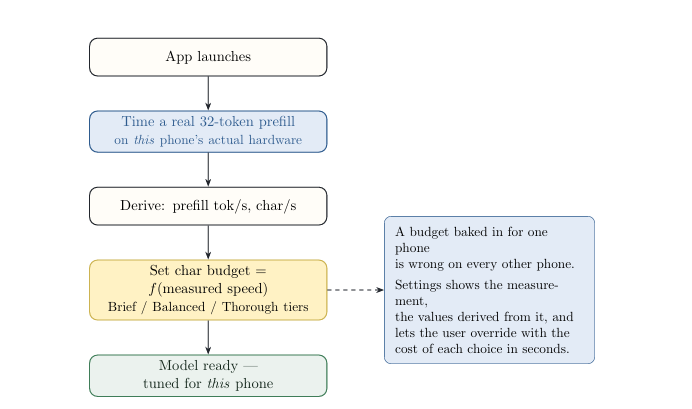
It sizes itself to the phone it is on. At startup Cram times a real prefill and derives its prompt budget from the result. Settings shows the measurement, the values chosen from it, and the cost in seconds of overriding them.
Q4_0 over Q4_K_M — for the right reason. +15% prefill (18.1 vs 15.7), and it holds
with KleidiAI disabled in both. The gain is GGML's own aarch64 weight-repack path
(use_extra_bufts), not KleidiAI. Most write-ups get the recommendation right and the
reason wrong — our own earlier draft did too, until the A/B disproved it.
Stack: llama.cpp (GGML) · Llama 3.2 1B Instruct Q4_0 · n_ctx 2048 · BM25, no
embeddings and no vector DB · PdfBox-Android for text extraction · Kotlin + Jetpack
Compose. One JNI translation unit, ~440 lines.
Technical diagrams:
End-to-End System Overview. Everything runs on the phone CPU. The PDF is extracted once; BM25 retrieval takes 1–7 ms; the LLM phrases the answer from the retrieved passage only.
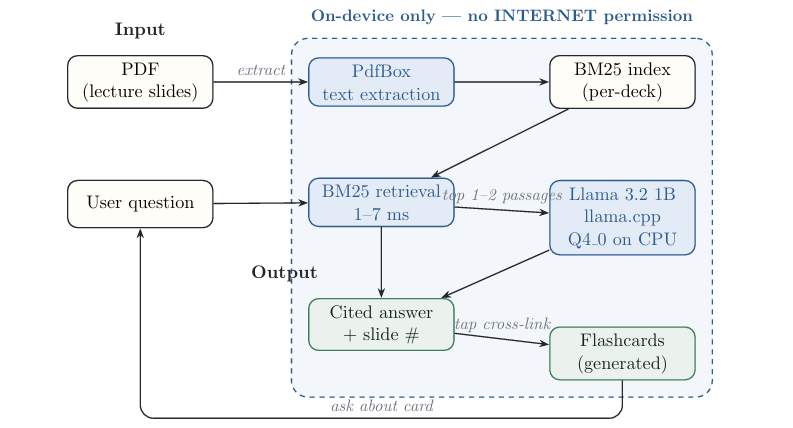
Query Pipeline. BM25 evidence appears instantly; the model only phrases what the slide already says. The budget floor (900 chars) was raised after the model invented two of the four Coffman conditions when the context was truncated to 400
The Prefill Ratio Changes Everything. On a GPU, prefill is 10–50× faster than decode, so sending many passages is free. On this CPU, prefill runs at only ≈2× decode speed (≈14 ms/char), making the standard “stuff the context” RAG approach unusably slow.
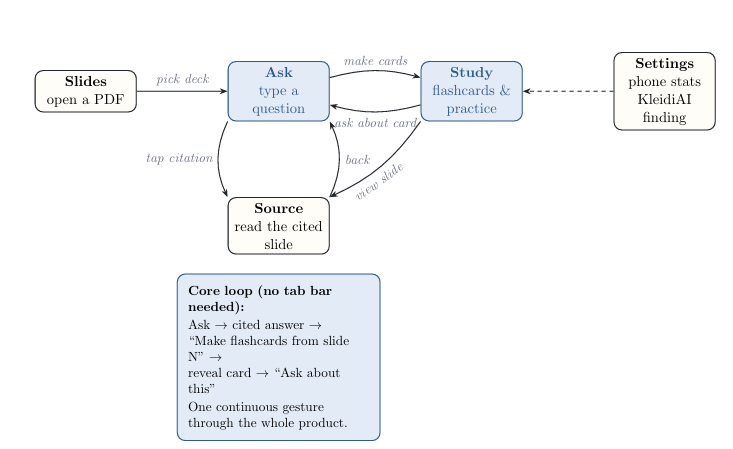
App Screen Flow. The five tabs are connected by cross-links so the user never needs to navigate manually. Ask is the front door; Study is the payoff; Source is the proof. Settings is judge-facing — it displays the KleidiAI finding on the judge’s own phone
Startup Calibration. At first launch, Cram times a real prefill pass and sets its own prompt-budget to match this specific phone’s throughput. A budget measured on a Snapdragon 720G would be wrong on a Dimensity 920 — so the app measures rather than assumes.
Thread Scaling. Prefill (reading the prompt) is compute-bound and scales to 8 threads. Decode (writing the answer) is memory-bandwidth-bound and collapses 58% at 8 threads because the two fast A76 cores spend their time waiting at barriers for the six slow A55 cores.
Challenges we ran into
The same question gave different answers. Sampling used a random seed per call, so
"what algorithm avoids deadlock" returned the Banker's algorithm once and something
else the next time — from identical retrieved text. A study tool you cannot trust twice
is not a study tool. Switching to greedy decoding fixed it and exposed two real
retrieval bugs that randomness had been masking: no stemming, so avoids could never
match avoidance; and a runner-up threshold loose enough that the "Deadlock handling
strategies" slide out-voted the slide that actually names the algorithm. Retrieval was
never wrong — it was drowned out.
Optimizing for speed produced confident lies. Calibrating purely on latency drove the character budget to ~400, which truncated a four-item list — so the model answered fast and invented two of the four Coffman conditions. The budget is now floored at 900 and the Settings ladder only climbs from there. Speed that costs correctness is not a saving.
A 1B model refused to write flashcards. The prompt opened with stacked prohibitions ("Use ONLY the excerpts. Do not invent facts.") and Llama 3.2 1B replied that it could not help with content that may promote illegal activities — terse prohibitions read like a jailbreak to a small, heavily safety-tuned model. Phrasing it as a student's request gets identical grounding and no refusal.
Then it plagiarised our example. Our worked example used deadlock terms, and the model copied the example's answer verbatim into a real card: correct-sounding, and unrelated to the slide it cited. The examples are now about plant biology, which no deck here is about.
MIUI inverted the whole app. Answer text rendered white-on-white, which looked like a Compose bug and was force-dark. One manifest line.
Optimizing for latency broke correctness at both ends of the pipeline. We already knew about the input end: tuning the passage budget purely for speed drove it to ~400 characters, which cut a four-item list in half and made the model invent two of the four Coffman conditions. The output end had the same bug and we did not find it until the day of submission — the answer cap was 80 tokens, so "What are the four Coffman conditions?" stopped mid-word at 4. Circular Wait: there exists a set of. The cap is a ceiling, not a target — generation still stops at end-of-sequence, so short answers cost the same and time to first word does not move at all.
Raising it exposed a second bug underneath. Given room to keep talking, the model filled it: the four conditions came back correct and were then followed by "named after John Coffman, who first described them in 1972" — a name and a date found nowhere in the deck, wrong twice over (it is Edward G. Coffman Jr., 1971), and carrying a slide citation. A fabrication that cites a slide is worse than no answer, because the citation is the part the reader trusts.
Tightening the cap instead was the obvious fix and the wrong one: the conditions run to roughly 125 tokens, so any ceiling low enough to exclude the invented tail also risks amputating condition four — trading a false addition for a false omission. Instead the closing sentence is now checked for names and years the retrieved passage does not contain, and dropped if it invents one. It is the check the flashcard path already ran before showing a card, moved onto answers.
We tried asking the model not to invent, first. It did not remove the fabrication, and it rewrote an unrelated verified answer from "The Banker's algorithm." into "This is the correct answer, as the Banker's algorithm is indeed…" — the preamble the same prompt already forbids two lines earlier. Greedy decoding on a 1B model is steered by what you hand it, not by what you tell it about what you handed it.
Accomplishments we're proud of
A negative result, properly measured — the log line, a same-binary A/B, and a reproduction guide so anyone can falsify it on their own phone. Negative results are rarer than features and harder to fake.
An app that is usable on six-year-old hardware: ~11 s to first word, retrieval in single-digit milliseconds, and a device-adaptive configuration that does not assume our phone.
Privacy that is structural rather than promised. No internet permission, no storage permission. It cannot leak your notes even by mistake.
Two bugs found and fixed on the last day, by testing rather than assuming. The launch path every new install takes crashed before the first frame, because an initializer wrote a Compose state property declared below it — invisible to us because our own phones always had the model already. It is the path every judge takes, and we only saw it by wiping the device and installing the APK as a stranger would.
Setup Instructions:
Install (no build required): download cram.apk from the Releases page and open it on any arm64 Android phone. On first launch the app shows two buttons — Download the model (opens your browser), then Choose the model file. A sample lecture deck ships inside the app, so there is something to ask a question about immediately.
Build from source instead: git clone --recursive … ./gradlew :app:assembleRelease (JDK 21 + Android NDK; scripts/setup.sh provisions the whole toolchain).
What we learned
Vendor acceleration libraries have hardware floors that their marketing does not mention, and the failure mode is silence — a log line and a graceful fallback, not an error. If you have not A/B'd it on your actual target, you do not know whether it is doing anything.
And the profile of a phone CPU is not a small GPU. Prefill being only 2× decode inverts the standard RAG trade-off: on this hardware, retrieval quality is cheap and context is expensive, so the winning move is to retrieve aggressively and send almost nothing.
What's next for Cram
Reproductions on i8mm hardware — where we expect the KleidiAI result to reverse. Disagreeing CSVs from other devices are the useful outcome, not a problem — the whole claim is that one hard-coded configuration cannot be right for every Arm phone. Then caching the passage
prefix for follow-up questions on the same slide, and a KV cache A/B at q8_0.

Log in or sign up for Devpost to join the conversation.