Inspiration
Creating music often begins with a clear idea but gets stuck between imagination and execution.
A video creator may know the mood a scene needs but not have time to search through stock libraries. A songwriter may have a strong chorus but no arrangement. A game developer may need several soundtrack directions before the final production budget is approved.
We built CraftMusic AI to close that gap. Instead of starting from a blank DAW, users can describe the job the music needs to do, shape the creative direction, and quickly hear drafts they can compare.
What it does
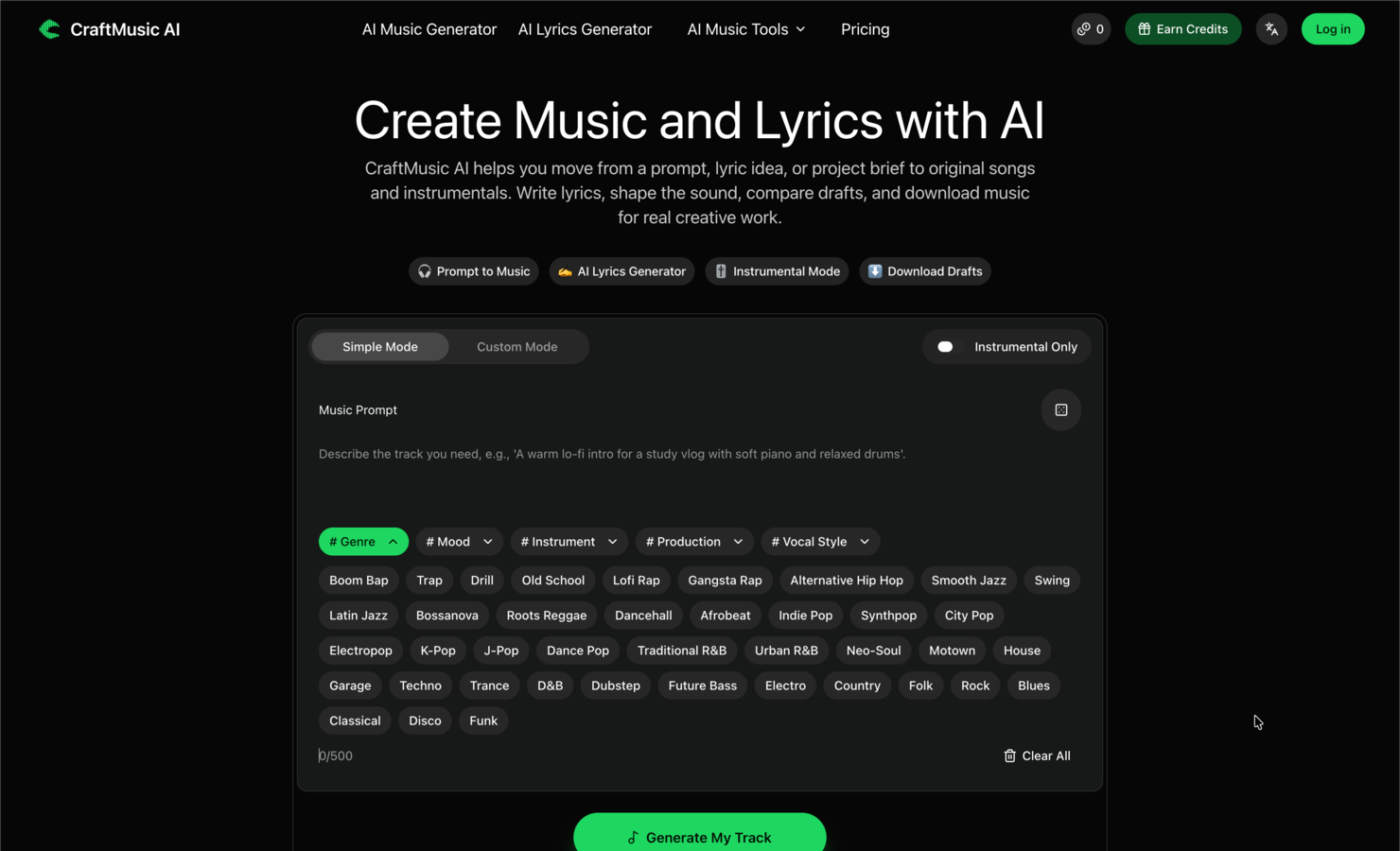
CraftMusic AI turns text prompts, lyrics, moods, genres, and project briefs into original songs or instrumentals.
Users can:
- Describe music in plain language
- Generate complete songs from prompts or lyrics
- Create instrumental music without lead vocals
- Control genre, mood, instruments, production style, and vocal direction
- Compare multiple drafts before choosing a track
- Generate structured lyrics with verses, choruses, hooks, and bridges
- Edit lyric drafts and continue from lyrics into music generation
- Download tracks for editing, testing, sharing, or publishing under the rights included with their plan
CraftMusic AI supports practical use cases such as YouTube videos, podcasts, games, advertisements, social media edits, songwriting demos, background music, and client presentations.
The platform also includes supporting music tools such as AI vocal removal, stem separation, music mastering, singing-voice generation, song covers, BPM and key detection, audio-to-MIDI conversion, a MIDI editor, a drum machine, a virtual piano, and a metronome.
How we built it
CraftMusic AI is a browser-based creative platform built with Next.js and React.
The application combines AI music generation, lyric writing, account management, credits, subscriptions, and downloadable results in one workflow. Cloudflare handles the public delivery layer, while the application is hosted through Zeabur.
The music workflow accepts prompts, lyrics, genre choices, mood, instruments, production details, and vocal direction. It then coordinates asynchronous generation tasks, tracks their status, and presents completed drafts for playback and download.
The lyrics workflow transforms a topic, story, title, mood, structure, and language into editable song sections. Users can keep the strongest lines, revise the draft, and continue into full music generation without leaving the platform.
Challenges we ran into
One of the biggest challenges was turning an open-ended creative request into input that an AI system could understand consistently.
A request such as “make a Pop song” leaves too many decisions undefined. CraftMusic AI needed to help users describe the purpose, mood, instrumentation, vocal style, rhythm, and production texture without forcing them to learn technical music terminology.
Another challenge was managing long-running generation tasks. Music generation does not return instantly, so the product must track progress, handle failures, keep account credits accurate, and deliver playable results without making the workflow feel complicated.
We also needed to separate royalty-free generation from commercial licensing clearly. Users should understand that original AI generation and permission to use a track commercially are related but distinct parts of the publishing workflow.
Accomplishments that we're proud of
We created a workflow that helps users move from a rough idea to a usable music draft without opening a traditional production environment.
A creator can describe what the music is for, guide the genre and mood, choose vocals or instrumental mode, generate several options, compare the results, and download the strongest direction.
We are also proud of the connection between lyric writing and music generation. Users can begin with a title, story, emotional idea, or unfinished line, develop it into structured lyrics, and then hear those words as part of a complete song.
CraftMusic AI is useful for experienced musicians, but it is also accessible to video creators, podcasters, marketers, educators, game developers, and anyone who needs original music without a full production setup.
What we learned
We learned that users get better results when they describe the job of the music, not only its genre.
“Warm Lo-Fi background music for a study vlog” provides more useful direction than simply asking for “Lo-Fi.” The intended use, emotional role, instruments, pacing, and production texture all help the system create a more relevant draft.
We also learned that creators rarely want to accept the first result without comparison. Generating alternatives, judging the hook and emotional fit, and keeping only the strongest direction are essential parts of the workflow.
For lyrics, AI works best as a creative collaborator rather than a replacement for the writer. The strongest results come from combining a specific human idea with generated options and careful editing.
What's next for CraftMusic AI
Next, we plan to give creators more control over song structure, arrangement, instruments, vocal direction, and individual sections.
We also want to improve the connection between lyrics, music generation, mastering, stems, and other editing tools so users can move from an initial idea to a polished track in one workspace.
Future improvements will focus on faster iteration, clearer draft comparison, better project organization, and more precise controls for creators working on videos, songs, podcasts, games, advertisements, and client projects.
Built With
- ai
- cloudflare
- generation
- generative
- music
- next.js
- react
- zeabur
