-
-
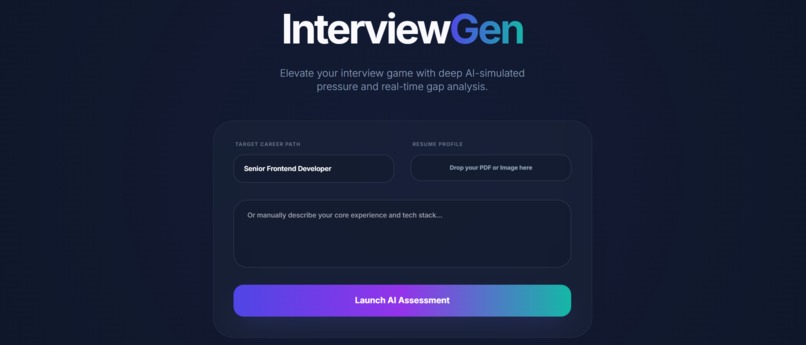
Home Page
-
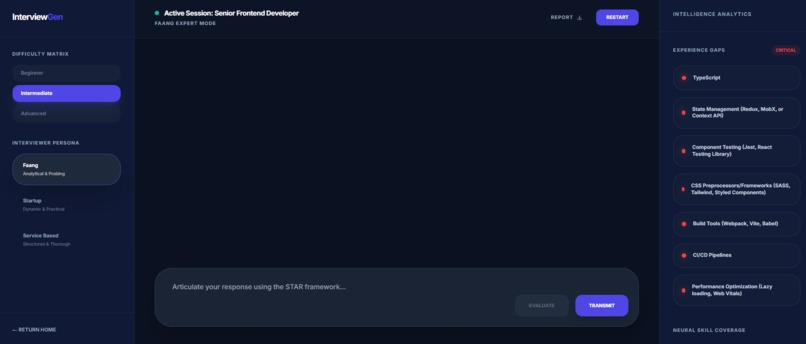
Main Interview Screen
Inspiration
The job market is increasingly competitive, and many candidates struggle to bridge the gap between their resume experience and the specific expectations of high-tier companies. We wanted to build a tool that doesn't just generate generic questions but acts as a high-stakes simulator, providing the "pressure" of a real interview and the "clarity" of expert feedback.
What it does
1.InterviewGen is an AI-powered interview simulator that creates hyper-personalized technical and behavioral assessments. 2.Resume Analysis: It parses PDF or image-based resumes to identify specific experience gaps. Persona-Based Simulation: Users can choose between "FAANG" (analytical), "Startup" (dynamic), or "Service-Based" (methodical) interview styles. 3.Real-time Evaluation: Using the STAR framework, the AI evaluates candidate answers, providing a score out of 10 and a "Elite Benchmark" model answer for comparison. 4.Intelligence Analytics: It generates a visual "Neural Skill Coverage" map across Data Structures (DSA), System Design, and Communication.
How we built it
1.The application is built using a modern React (v19) and TypeScript stack, powered by the Gemini 3 Pro engine. 2.Frontend: Developed with Vite and Tailwind CSS for a responsive, dark-mode-first glassmorphism UI. 3.AI Integration: We utilized the @google/genai SDK to implement structured JSON outputs for resume analysis and interview logic. 4.Dynamic Chat: Implemented a real-time conversational interface with auto-scrolling and typing indicators to mimic a human interviewer.
Challenges we ran into
1.Structured Data Extraction: Ensuring the AI consistently returned valid JSON for complex resume analysis required rigorous schema definition. 2.State Management: Managing the complex transition between landing pages, active interview sessions, and detailed performance reports while maintaining a fluid user experience. 3.File Processing: Converting various resume formats (PDFs and Images) into a format the Gemini model could analyze accurately via Base64 encoding.
Accomplishments that we're proud of
1.Adaptive Reasoning: Successfully implementing an "Interviewer Persona" that changes its tone and intensity based on the selected company style. 2.Performance Signal System: Building a scoring engine that provides actionable "Optimization" tips rather than just a simple pass/fail grade. 3.Visual Analytics: Creating a dashboard that visually represents skill gaps, making it immediately clear what a candidate needs to study next.
What we learned
We gained deep insights into Prompt Engineering, specifically how to use system instructions to maintain a consistent "interviewer" character. We also learned the importance of TypeScript for managing the complex data shapes returned by generative AI models to ensure application stability.
What's next for InterviewGen
1.Video Integration: Utilizing the camera for real-time sentiment and body language analysis. 2.Live Coding Environment: Adding a built-in code editor for real-time DSA assessments. 3.Voice Mode: Implementing speech-to-text and text-to-speech for a completely hands-free interview experience.
Built With
- css3
- google-ai-studio
- google-gemini-3pro
- html5
- node.js
- react
- tailwind
- typescript


Log in or sign up for Devpost to join the conversation.