-
-
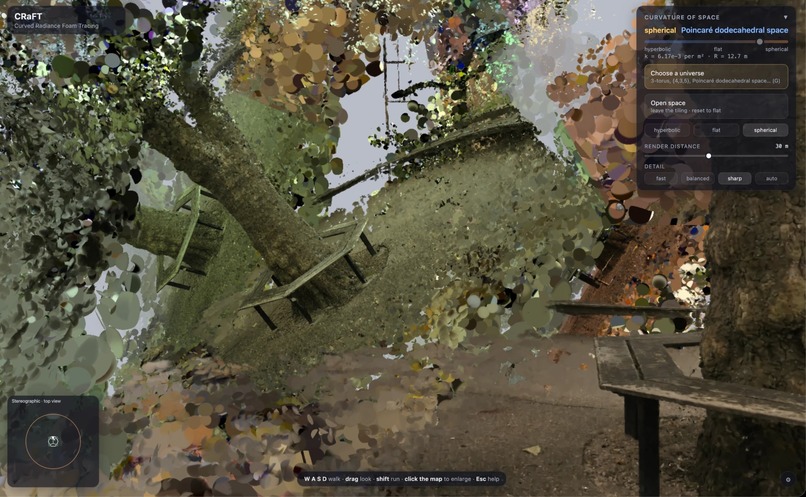
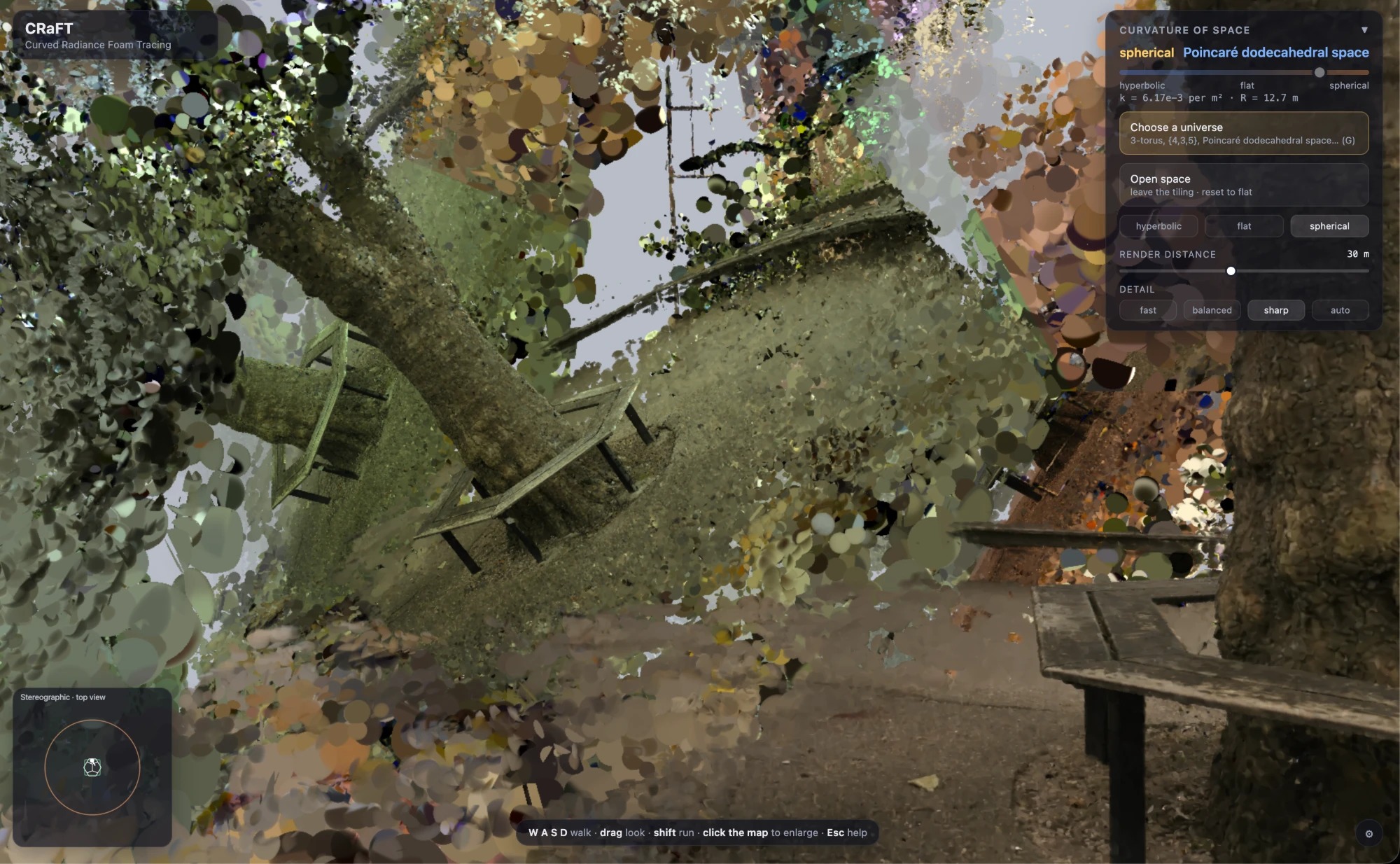
using locally trained radiance field
-
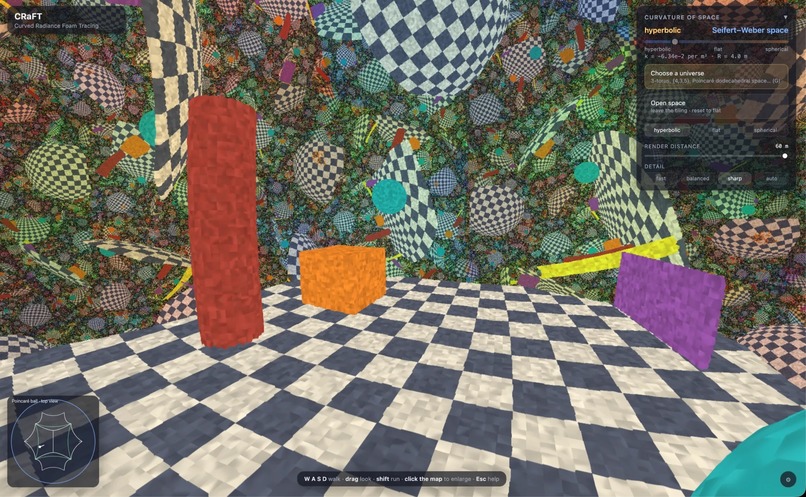
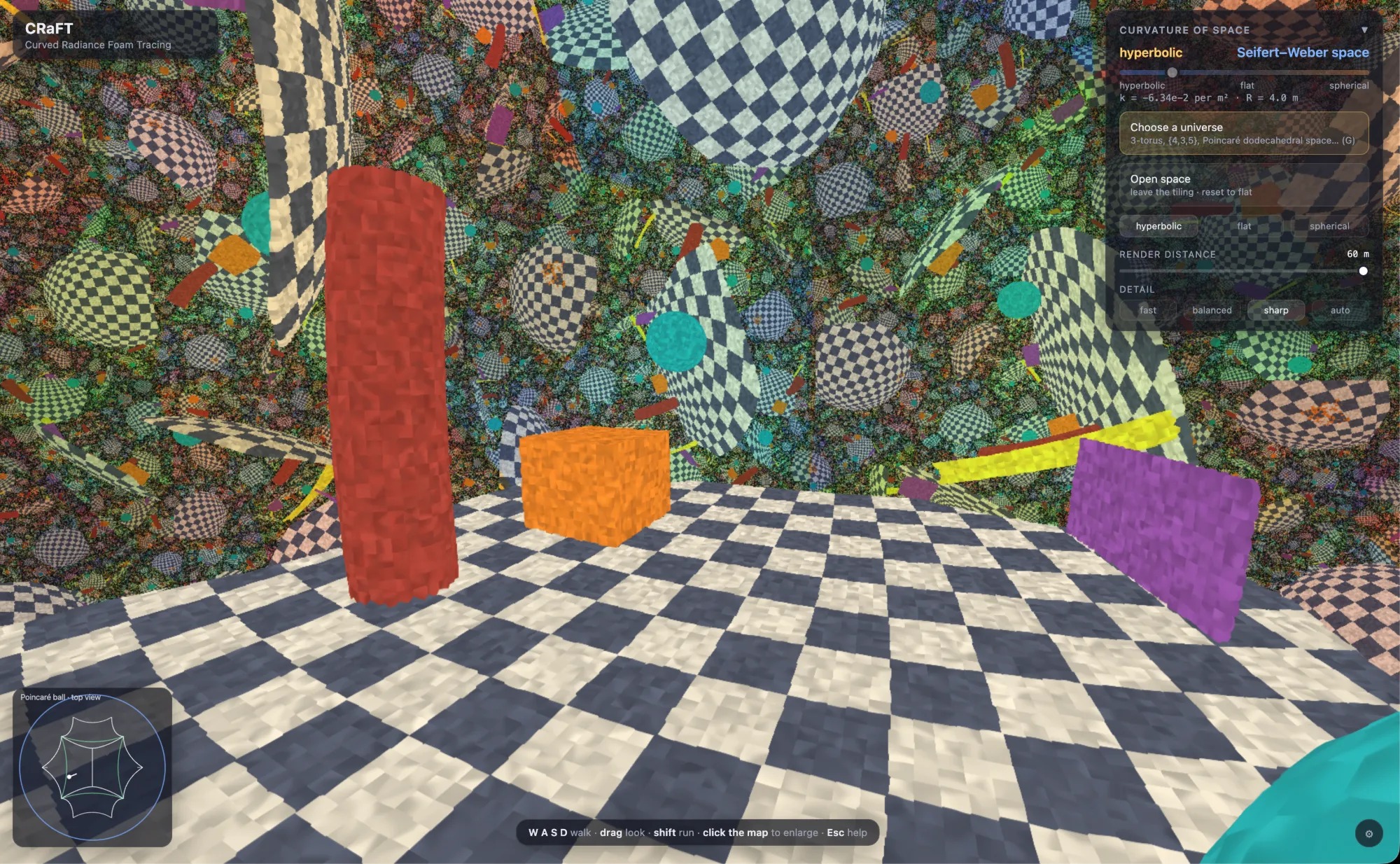
using simulated environment (runs faster)
-

starting screen

CRaFT: Curved Radiance Foam Tracing
Live: https://ajayunnikrishnan.github.io/Stormhacks-CRaFT/ · Code: https://github.com/ajayunnikrishnan/Stormhacks-CRaFT
What it is
An interactive, physically motivated simulation of non-Euclidean geometry, set inside a real photographed scene. A slider makes space hyperbolic or spherical. Pick a closed universe (3-torus, Poincaré dodecahedral space, Seifert–Weber…) and the scene repeats the way that universe dictates. In Guess the universe you're dropped into a random one and have to figure out which by walking around, since the shape of space only shows through how it repeats.
Scene: "Treehill" (Mip-NeRF 360), reconstructed with Power Foam. Every ray is an exact geodesic.
The trick
Power Foam renders by walking a ray cell to cell through a power diagram, where cell walls are flat planes. Embed curved space in 4D and lift each cell to \(a_i = p_i/\mathrm{cs}_\kappa(r_i)\). Then
$$ \mathrm{cell}(x) = \arg\max_i \langle x, a_i\rangle_\kappa $$
and the wall between two cells, \(\langle x, a_j - a_i\rangle_\kappa = 0\), is still a flat hyperplane. So Power Foam's walker runs unchanged in curved space; only the ray becomes a geodesic and a wall hit is the one-line solve \(\tan_\kappa t = -A/B\). At zero curvature it reduces exactly to the flat renderer.
Validation
38–44 dB PSNR against Power Foam's own CUDA ray tracer.
Future additions
The scene was trained in about 30 minutes on a single RTX 4090 at a web-sized budget (300k cells vs the paper's 1.2M), so leaves and gravel are coarser than Power Foam can do. Longer training on a bigger GPU, more scenes, and lighting that obeys the curved geometry (light spreads as \(1/\sin_\kappa^2 d\)) are next.
Power Foam: Govindarajan et al., arXiv:2604.24994, 2026.

Log in or sign up for Devpost to join the conversation.