-
-
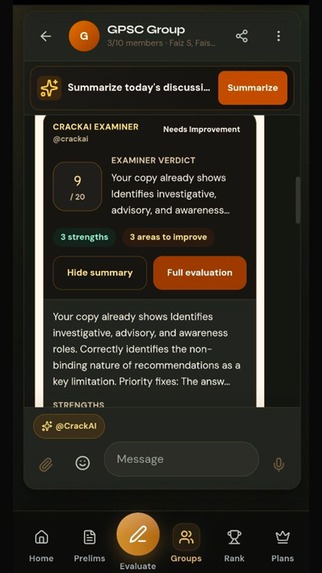
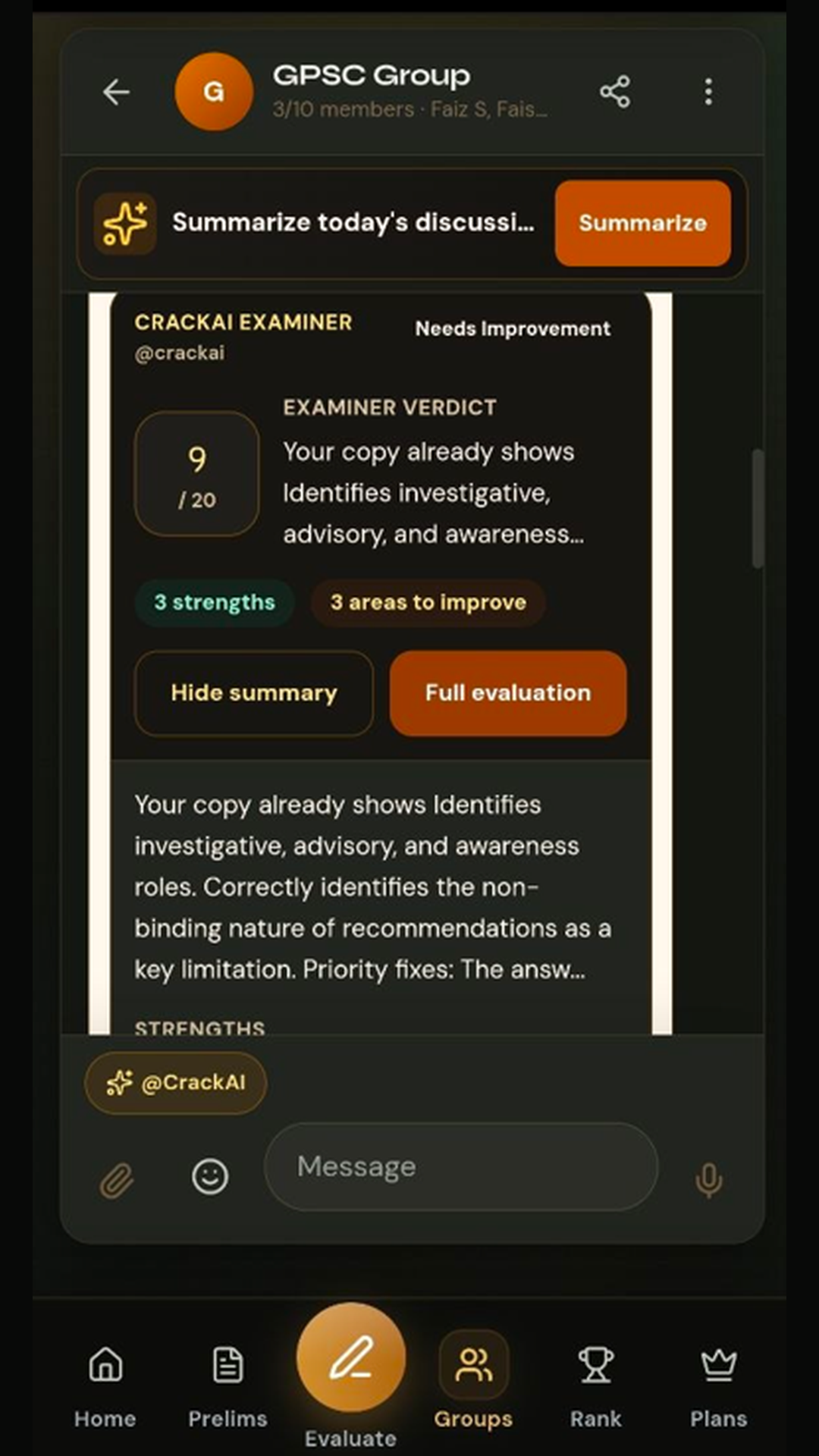
Group Chat Study Feature
-
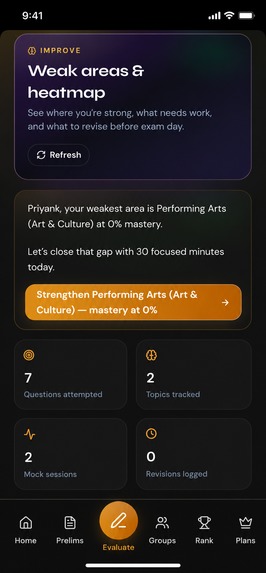
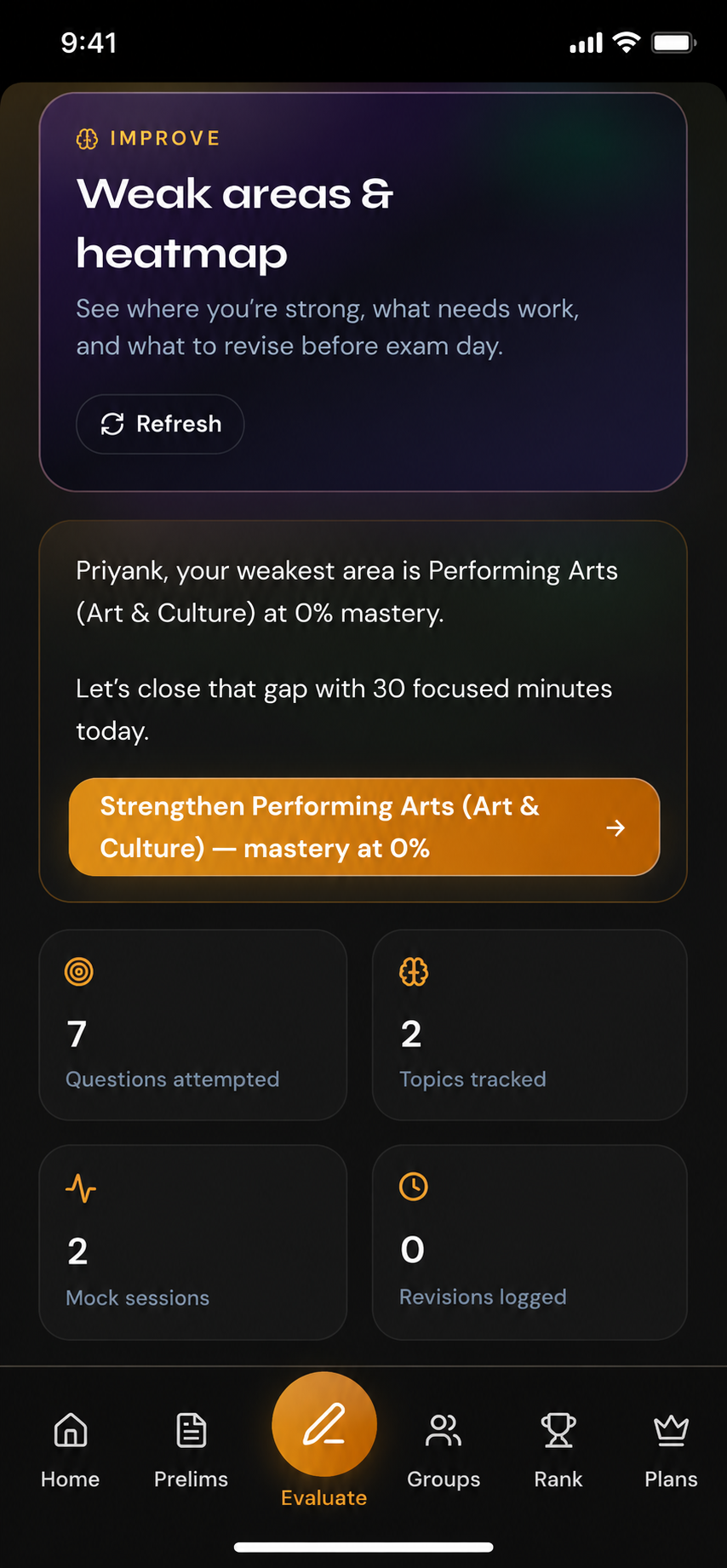
Weak Aread Detection Engine
-
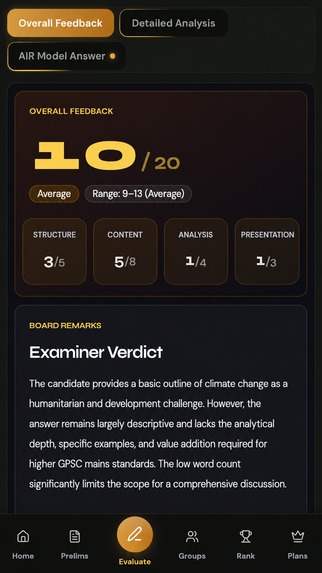
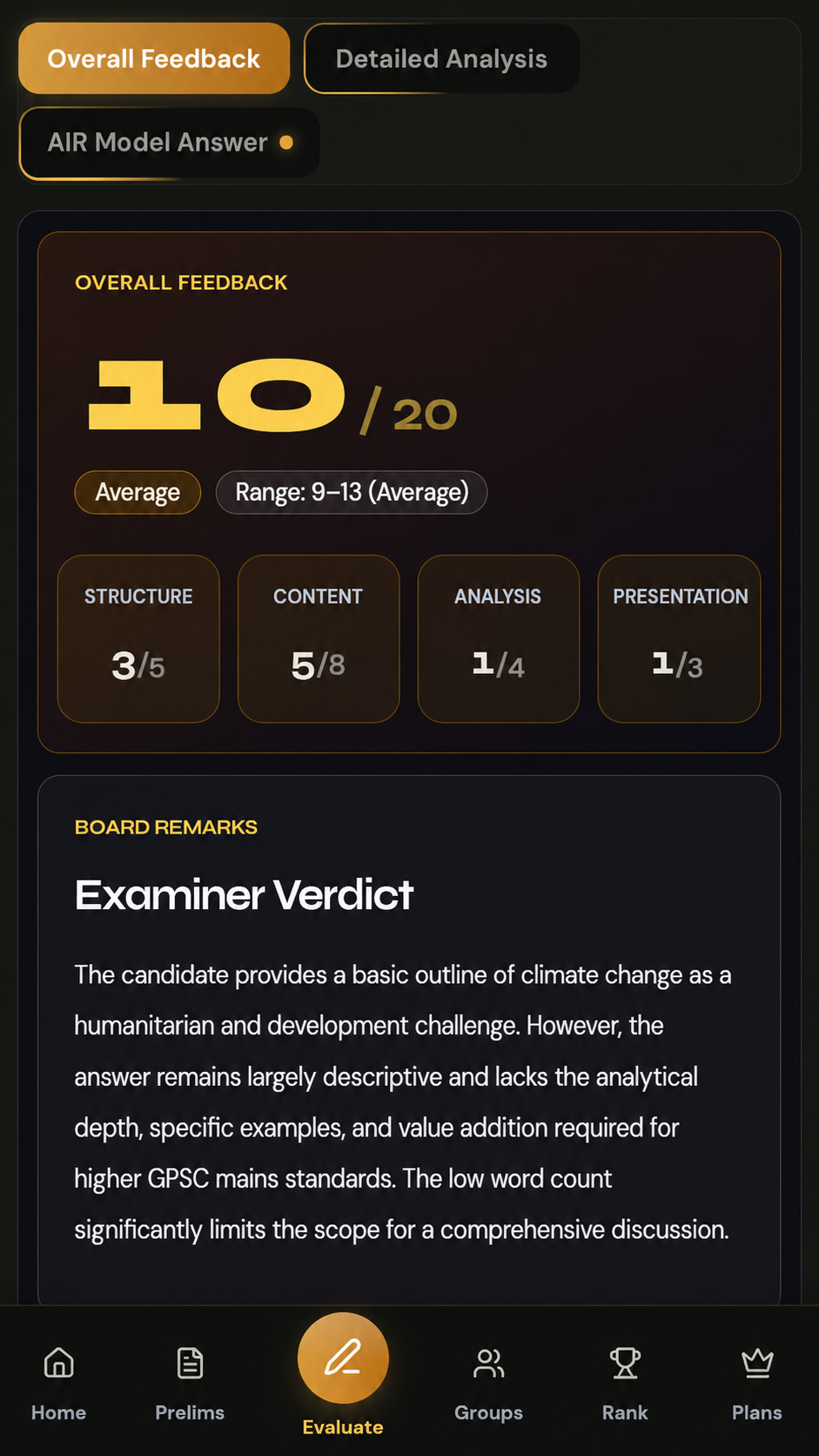
Answer Evalution Score
-
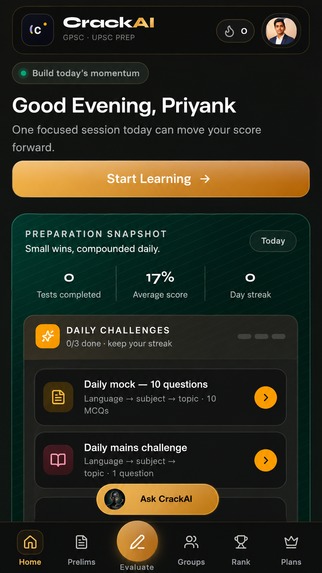
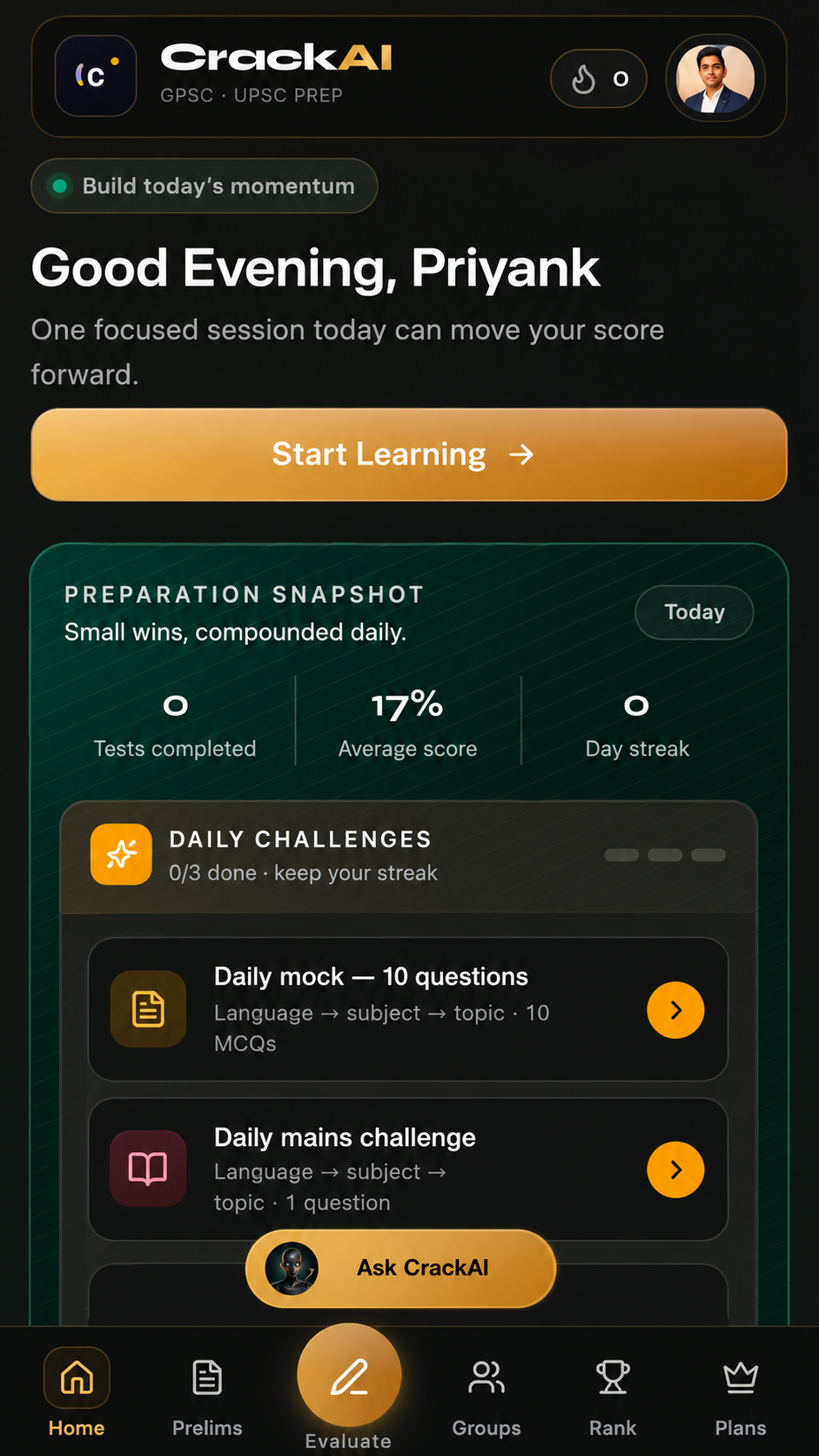
CrackAI Personalized Dashboard for every user
-
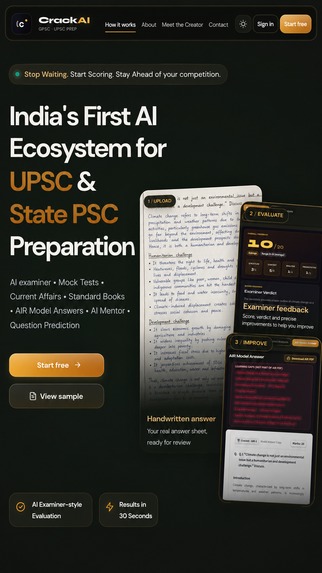
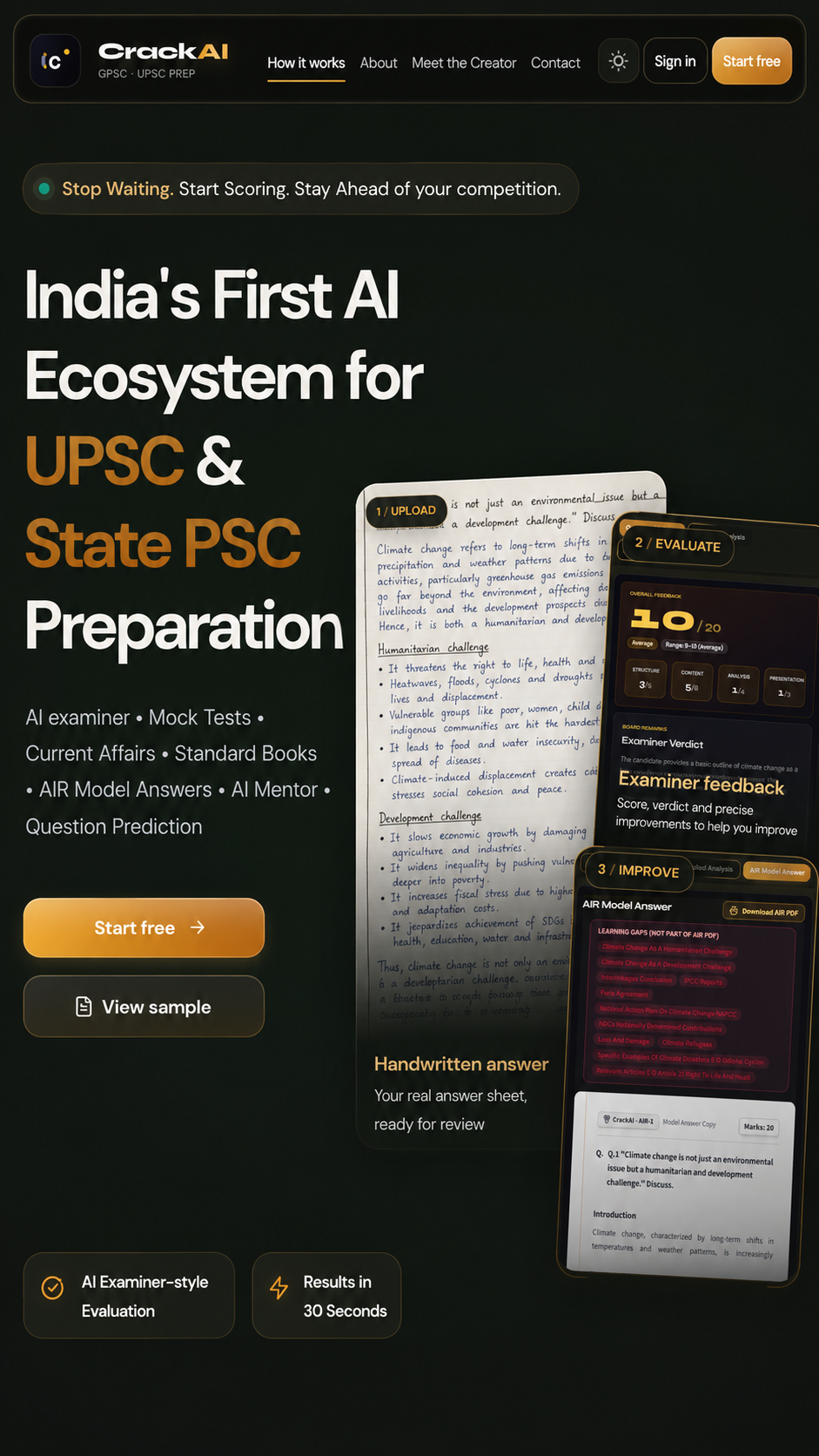
CrackAI Landing Page
-
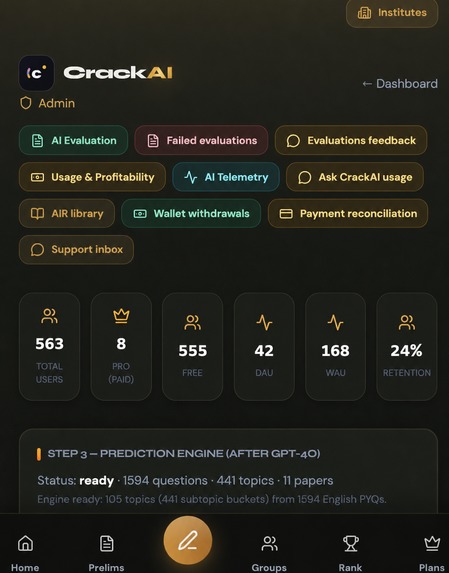
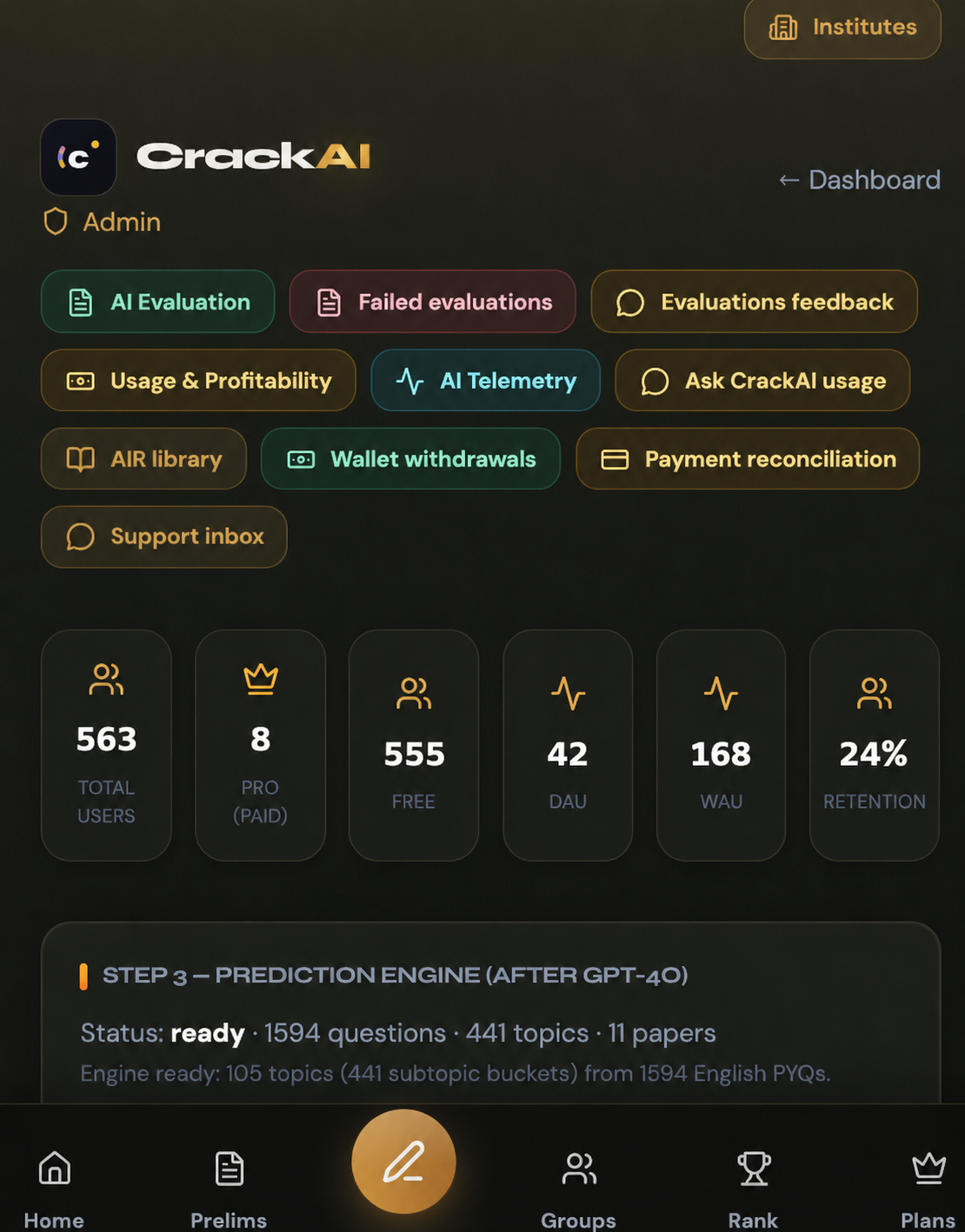
Admin panel user traction
Inspiration
I come from a small town in Gujarat, India, and spent years preparing for the Gujarat State Civil Services (GPSC) while working full-time as a software engineer.
I experienced a problem shared by millions of competitive-exam aspirants across India: Mains examinations are not multiple-choice tests. Candidates must write analytical, handwritten answers, but getting every answer reviewed by an experienced mentor is expensive, slow and difficult to scale.
The problem is even harder outside major coaching hubs and for students writing in regional languages such as Gujarati.
Students can spend months studying without knowing why an answer would receive 6/10 instead of 8/10, what they repeatedly miss, or what they should improve next.
Having experienced this from both sides as an aspirant and an engineer, I started building CrackAI to make high-quality evaluation available on demand.
GPSC is our first market, not our destination. Our ambition is to build the AI evaluation and learning layer for India's broader competitive-exam ecosystem, where millions of aspirants prepare every year across multiple exam categories.
What it does
CrackAI is an AI-native preparation, evaluation and learning platform built for competitive-exam aspirants, starting with State PSC examinations.
A student can photograph or upload a handwritten Mains answer. CrackAI processes the answer and returns an examiner-style evaluation within seconds, including:
- Section-wise scoring
- Strengths and weaknesses
- Missing arguments, facts and examples
- Specific reasons marks were lost
- Actionable improvement suggestions
- A high-quality model answer
- Progress and weakness tracking across subsequent attempts
The important part is what happens after an evaluation.
CrackAI builds a continuously evolving understanding of the student's preparation. Weak areas identified from answers and tests can feed into personalized practice and recommendations, turning individual evaluations into a longer-term learning loop.
CrackAI also integrates Prelims mock tests, current affairs, personalized practice, progress analytics and an AI mentor, creating one connected preparation system rather than isolated AI tools.
Our goal is simple: give an aspirant in a small town access to the kind of continuous feedback previously available mainly through expensive human mentorship.
We are not building another AI study assistant. We are building an AI examiner and learning engine that understands how an aspirant performs over time.
How we built it
CrackAI is built around a multimodal AI pipeline rather than a single chatbot interaction.
When an aspirant submits a handwritten answer, the system moves through several stages:
Handwritten answer → multimodal extraction → question/syllabus context → examiner-style rubric → scoring and reasoning → missing-point analysis → model answer → learner weakness update → personalized next action
Gemini is particularly important at the multimodal and regional-language stages.
Our technology stack includes:
- Gemini: multimodal understanding of handwritten answers and regional-language content
- OpenAI models: selected secondary AI/evaluation workflows
- Retrieval layer: syllabus and exam-context grounding
- Google Cloud: AI/cloud infrastructure
- Next.js + React: web application
- Node.js: backend services
- PostgreSQL/Supabase: application and learning data
- Redis: asynchronous processing/caching
- Razorpay: payments
- Android/PWA: mobile distribution
The architecture separates expensive AI operations from the user-facing request flow so evaluations can be processed asynchronously and scaled while controlling inference cost.
This architecture is designed around a production requirement that a prototype often ignores: the system must remain reliable, responsive and economically viable as evaluation volume grows.
Why Gemini?
A Gujarati handwritten civil-services answer is significantly different from processing clean English text.
The system must interpret handwriting, preserve regional-language meaning, understand the question, reason against an exam-specific rubric and provide useful feedback — not simply transcribe the page.
Gemini's multimodal capabilities make it possible to reason across the submitted answer and contextual information within the same workflow.
This is particularly important for CrackAI because regional-language evaluation is not an optional localization feature; it is part of the core problem we are solving.
For CrackAI, the challenge is not simply “read this image.” The AI needs to understand what the aspirant wrote, what the question demanded, how the answer should be evaluated, what is missing, and how the student can improve.
That makes multimodal reasoning a core part of the product rather than an add-on feature.
Challenges we ran into
The hardest challenge was not getting an LLM to generate feedback.
It was making AI evaluation consistent enough that a student can trust it.
We had to repeatedly improve:
- Gujarati handwriting and language interpretation
- Extraction from imperfect photographs and scanned pages
- Score consistency across similar answers
- Exam-specific evaluation criteria
- Quality of model answers
- Response latency
- AI inference cost
Each of these matters in production. A great answer generated once is not enough - the system needs to evaluate thousands of different answers reliably and economically.
Building and launching the product while working full-time as a software engineer was another major challenge.
As a solo founder, I had to build the product, iterate on the AI pipeline, deploy the infrastructure, improve the user experience and put the system in the hands of real aspirants rather than stopping at a prototype.
Accomplishments that we're proud of
CrackAI has moved beyond a prototype.
We have:
- Built and launched a functioning AI evaluation platform
- Put the product in the hands of real State PSC aspirants
- Reached 500+ users
- Converted early users into paying customers
- Generated our first subscription revenue without a large paid-acquisition campaign
- Built Gujarati and English answer-evaluation workflows
- Integrated Mains evaluation, model answers, Prelims practice, current affairs and learner analytics into one product
- Built web and Android experiences
- Designed the evaluation architecture to support substantially higher evaluation volumes as usage grows
Most importantly, users are submitting real answers to AI for a task that traditionally depends heavily on manual mentor evaluation.
The fact that aspirants are repeatedly using the system and some have paid for it is the validation we wanted to test first.
We started with a focused problem in GPSC, but the underlying technology and feedback loop are designed to expand across State PSCs, regional languages and eventually the broader competitive-exam ecosystem in India.
What we learned
Our biggest learning was that students don't need another chatbot that knows the syllabus.
They need feedback loops.
An aspirant needs to know:
What did I do wrong? Why did I lose marks? Is this mistake recurring? What should I study next? Did I improve when I tried again?
That changed how we think about CrackAI.
The long-term value isn't generated by one AI evaluation. It comes from connecting thousands of evaluations and practice interactions into an evolving model of each student's preparation.
Instead of treating every answer as an isolated AI interaction, CrackAI can use the history of a student's performance to understand recurring weaknesses and determine what they should practice next.
We also learned that AI quality alone isn't sufficient. Latency, consistency, regional-language quality, inference economics and user experience determine whether an AI prototype can become a real business.
The hardest transition is not from zero to one impressive AI response. It is from one impressive response to a system that students can rely on repeatedly.
What's next for CrackAI
Our ambition is to build the AI learning and evaluation layer for India's competitive-exam ecosystem.
We are starting with GPSC, expanding into additional State PSC examinations and regional languages, and ultimately aim to serve the broader competitive-exam market across India, including other high-volume examination categories.
GPSC is our beachhead because it is a problem I personally experienced and understood deeply. But the underlying problem - the lack of scalable, personalized evaluation and feedback exists across India's competitive-exam ecosystem.
Millions of aspirants prepare every year, but high-quality individualized feedback remains difficult to access at scale.
We are working toward making evaluation increasingly personalized and reliable across different exams, subjects and languages.
The next generation of CrackAI will connect:
what a student writes → what they repeatedly get wrong → what they need to learn → what they should practice next → whether they actually improved.
Over time, this creates a longitudinal learning dataset specific to competitive-exam preparation and regional-language answer writing, allowing the system to become increasingly personalized rather than treating every learner as the same.
Our long-term goal is for geography, language and the ability to afford expensive coaching to no longer determine whether an aspirant can receive high-quality personalized feedback.
We believe AI can make the quality of continuous examination feedback dramatically more accessible - starting with one exam in Gujarat and ultimately reaching competitive-exam aspirants across India.


Log in or sign up for Devpost to join the conversation.