-

The notification when the extension detects COVID related content
-
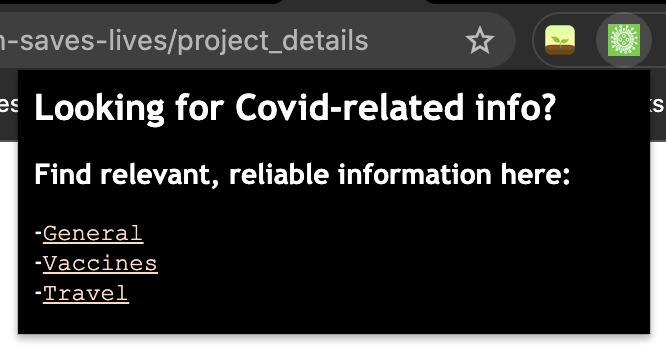
When opened from the extensions list, the extension shows geolocation-based links for commonly asked queries
-
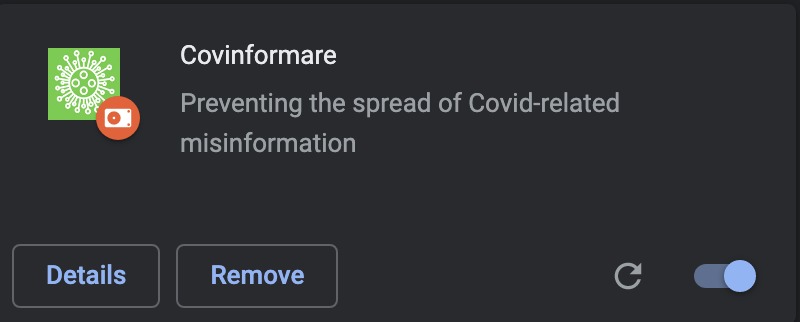
The extension on the Chrome Extensions Menu

Inspiration
As the recent Facebook leaks reveal, misinformation and divisive content are not only often ignored, but it even seems to be good for business. Inspired by this, our team wanted to create a tool to counter the rampant misinformation, to perhaps sway some of those remaining on the fence to stay on the correct side of history, and perhaps even pull some people out of the conspiracy theory vortex.
What it does
While browsing the web, the Chrome extension analyses the body of any website visited and determines if its contents are COVID-related. If this is found to be the case, a text processing algorithm tries to determine whether the contents are about COVID in a general sense, or if they concern themselves with themes of vaccines, masks, or quarantine and self-isolation.
With this information, a call is made to a bespoke in-house API that returns a link to the website of the user's local health authority, determined by the location of the user and the broad theme of the website as described above.
A system notification is then generated, which, when clicked, opens a new tab to the link retrieved from the API.
Apart from this, when the extension gets opened directly in the extensions bar, the user will be provided with links to the local health authority's sites providing information about vaccination, face covering and the virus in general.
How we built it
We began by conducting a search about the feasibility of our idea. After concluding that the task is doable, we divided the project into four main areas: frontend, backend, text processing and keyword search & categorisation.
Frontend
This part consists of HTML, CSS, and JavaScript, and dynamically updates link URLs based on user location. The popup.html also provides a central hub for locally sourced information on a selection of topics in a way that is less invasive than the notifications.
Backend
The backend API written in Flask and deployed via Heroku takes topics and country codes as input, and returns a relevant URL. This means that the sources of information can be updated without the user having to update anything, and makes the process of changing and adding new countries and URLs easier and more flexible.
Text processing and categorization
The processing of text happens on the Frontend, using JavaScript. The DOM-API was used to select text from the body and remove the HTML tags followed by the removal of punctuation and stopwords to make the search easier and more efficient. At first, we searched for the word coronavirus or its synonyms and if enough occurrence were found, we searched for various keywords regarding the 4 main categories described above. By calculating the sum of appearance of keywords corresponding to each category, the algorithm can determine which category fits the text the most.
Challenges we ran into
One of the most difficult parts of the project was navigating the permissions constraints of Google Chrome extensions, as the browser is quite limiting in what it allows its extensions to do.
This improves security of course, but it also makes creation significantly more difficult, especially because a majority of the team has little to no experience with making browser extensions.
Accomplishments that we're proud of
Our team is proud of the fact that we were able to make a custom Flask API in 24 hours, for which team members had to quickly learn and understand a technology that was almost entirely new to them. We also feel delighted that we have developed a piece of software that is designed to counter the spread of misinformation (especially regarding such a crucial topic), one of today's most concerning problems in the online world.
What we learned
As mentioned in the previous section, members of the team had to become acquainted with Flask in order to create an API.
Furthermore, a majority of the team had very little or no experience with hackathons, and gained a great deal of experience when it comes to working as a team and applying the fairly theoretical knowledge gained at university, that we usually only get to do individually of each other, and in what could be described as "clinical conditions".
What's next for COVinformare - Reliable Information Saves Lives
The extension only works for the US, the UK, Canada, Australia, and New Zealand — users from other countries get directed to the WHO website instead of their local government. Potential next steps could include expanding into more countries, or potentially adding compatibility for more languages, as it is only designed to work on websites in English for now. This can be easily done as it would only require adding extra keywords and websites to the extension.


Log in or sign up for Devpost to join the conversation.