Inspiration
The recent COVID19 crisis has brought out a large and emerging demand for protective equipment both for the general public and for the medical personnel. It has been also made clear that the current supplies were not adequate to cover the demand since most of this equipment was not re-usable and offered limited protection against COVID exposure. In this regard, our team envisioned the development of re-usable equipment that can be prepared from conventional fabric materials and is easily produced on a mass scale. Based on this initial inspiration we foresee the development of more advanced equipment with enhanced protection capabilities.
What it does
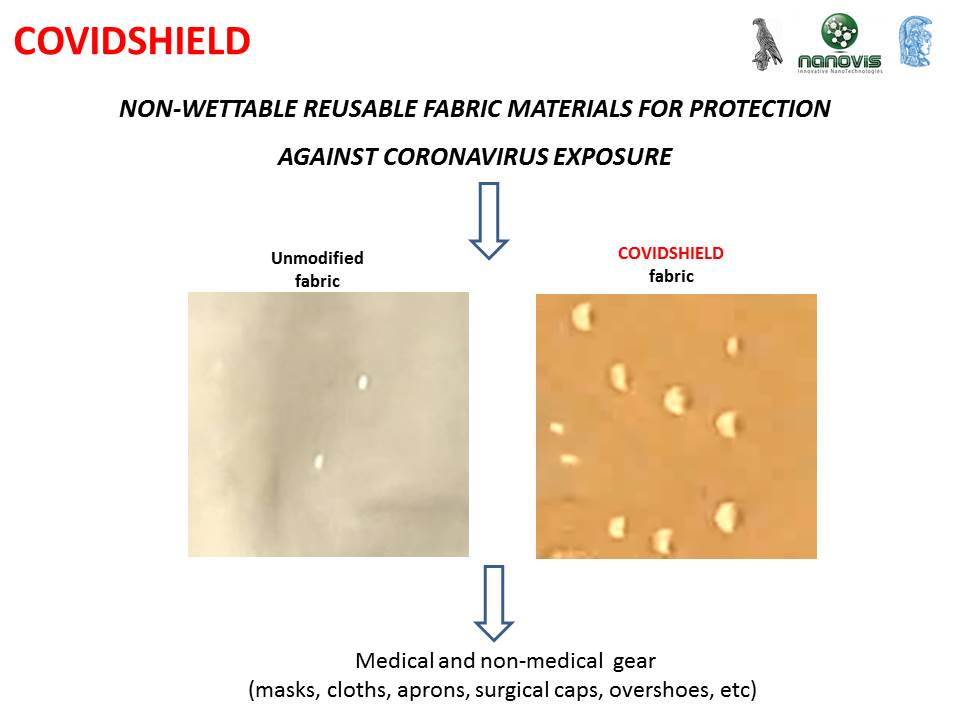
COVIDSHIELD is a new type of coating for fabric materials. It creates a hydrophobic shield on the fabric that repels water and body fluids while creating an environment unfriendly for viruses and bacteria to live in. COVIDSHIELD has also the potential to introduce anti-bacterial and anti-viral coating into conventional fabric materials making them both hydrophobic and self-sanitizing.
How we built it
COVIDSHIELD coating is build-in into the fabric using a fast and facile bottom-up approach to accomplish permanent chemical modification (no post-modification such as spraying of fabric is required). Non-toxic, biocompatible, cheap and readily available materials are used for that purpose alleviating the need for specialized infrastructure capabilities, complex synthetic routes and the use of specialized reagents or materials.
Challenges we ran into
The main challenge we ran into as we were developing COVIDSILED was the use of a bottom-up preparation method which enables the protective coating to be built into the fabric instead of gradually developing protective layers. In this manner there is no need to incorporate different layers of coating or various materials in separate steps. Another challenge is the ability of the COVIDSHEILD-modified fabrics to tolerate a wide range of sanitizing and cleaning methods that include solvent, detergent, heat and UV irradiation compatibility.
Accomplishments that we're proud of
Although COVIDSHIELD fabrics have been developed only as prototypes by an intuitive, experienced-based approach, they are efficient in repelling water-based liquids. They also exhibit good stability to ethanol, propanol or exposure to UV irradiation for sanitation and cleaning. Importantly, COVIDSHIELD can be prepared in different grades or levels of protection proactively targeting the needs of the end-users. COVIDSHIELD fabrics for the general public can be made cheaper offering enhanced protection against daily challenges and exposure routes (as compared to conventional protective equipment) while advanced COVIDSHIELD coatings can be employed by medical staff to ensure maximum protection under demanding conditions.
What we learned
Advanced coatings do not necessarily require complex nanomaterials or intricate synthetic routes to be prepared. Easy procedures, using low cost, abundant materials can be used to fabricate coatings which are in par with more advanced materials.
What's next for COVIDSHIELD
• Optimize procedure for maximum hydrophobicity and homogeneous coverage • Optimize coating composition for enhanced durability/stability, wide detergent tolerance and increased heat tolerance • Build-in self-sanitizing/anti-bacterial/virus inactivation coatings during fabrication (such as Copper, Silver, Zinc oxide, porous materials and combinations of them)


Log in or sign up for Devpost to join the conversation.