-
-
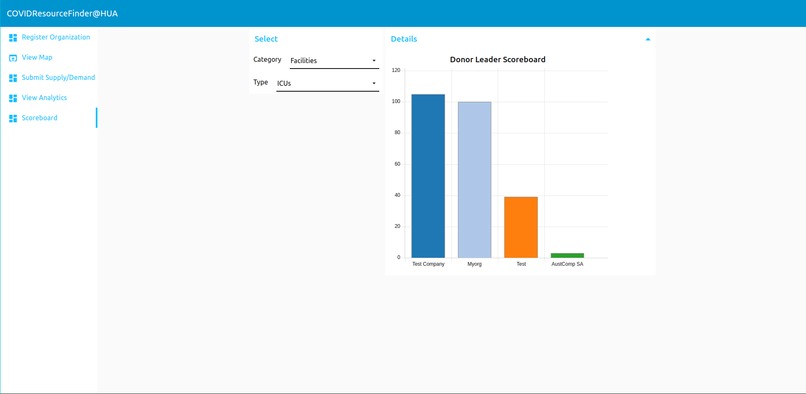
Donor Leaders Scoreboard per resource category
-
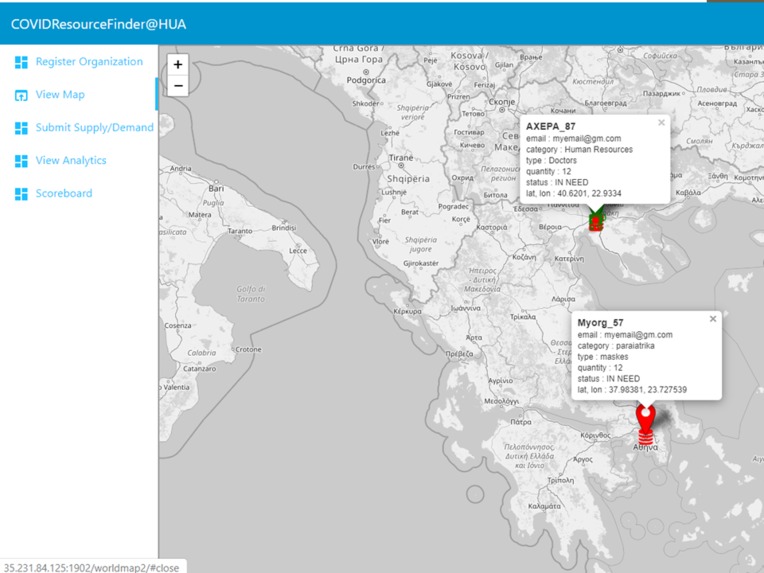
Resources Overview
-
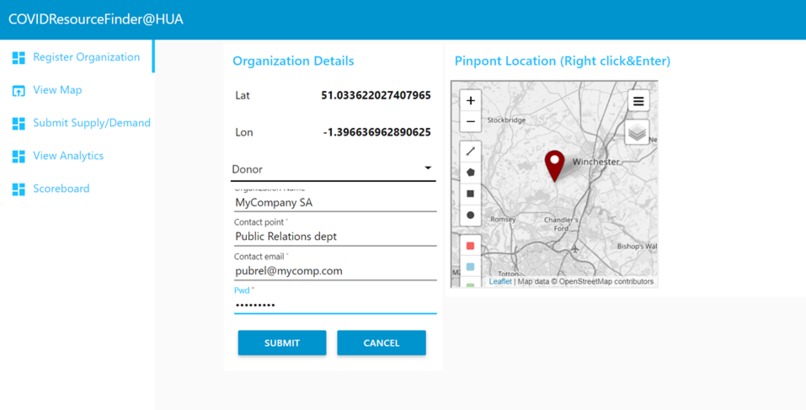
Register organization
-
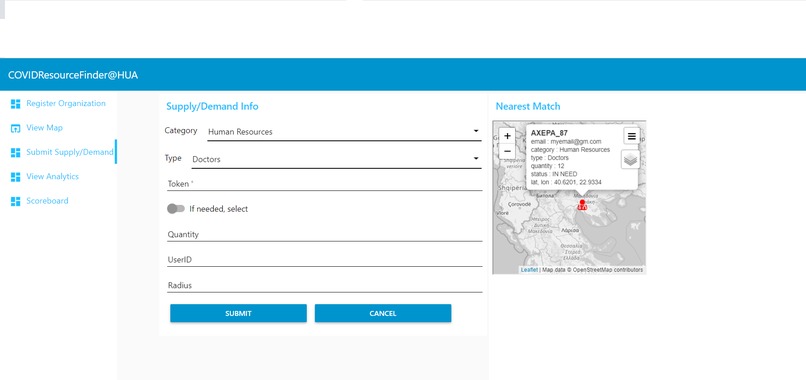
Investigate supply and demand in an area for a given material
-
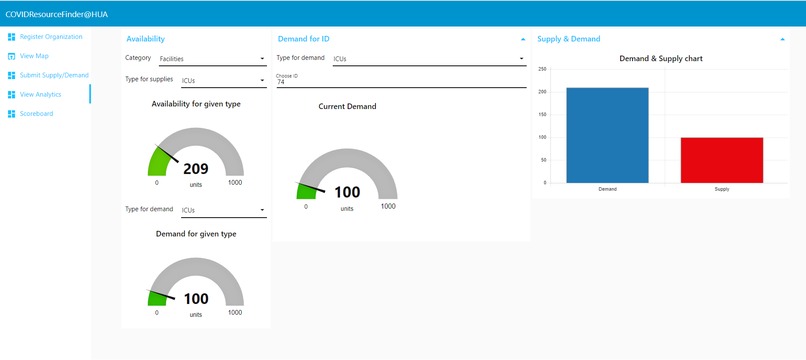
Analytics Dashboard


Inspiration
Reports from all over the world mentioning shortages in various types of resources needed for addressing the outbreak, like masks, respirators and other material, available test kits, human resources (doctors, nurses etc). At the same time a large number of companies/organizations were activated and started to submit donations in the form of materials needed. Thus the main drive of the COVIDResourceFinder platform is to coordinate and inform the community in real time about current needed shortages or local abundance of a resource, that can then be shared or transferred across areas in need.
What it does
COVIDResourceFinder enables users to register, submit resource needs or resource sharing/donation availability, find resources near them or see an overview of the available and needed types of resources mapped on a real time map. Resources are separated in categories (such as materials,human resources, facilities and research data) and types (e.g. masks, respirators, doctors, ICUs, clinical data etc) . Thus parties in need can detect where they can find these resources while donors or supporting institutions (e.g. government agencies) can have a real time view of the needs for mitigating the effects of the outbreak. This way they can optimize the type of resource offered or directed towards a specific area. Furthermore, it emphasizes a Donor Leader scoreboard functionality, in which donating companies are scored and listed to the public, thus enabling them to improve their social responsibility profile and engaging them through a gamification approach of the donation process.
How I built it
The platform exposes a REST API through which all functionalities are implemented. UI parts have also been created in order to visualize the main parts of the platform (organization registration, resource state submission, analytics with relation to availability per category and type of resource). The solution is based on Node-RED, an open source event driven programming platform built on top of Javascript's node.js framework. The server on which the platform is built is on Google Cloud. (http://35.231.84.125:1902/ui/#!/1). Login details are included in the accompanying documentation file uploaded with the submission.
Challenges I ran into
The overall solution was designed and implemented within the days of the hackathon, thus it was really challenging to draw all the necessary details (data model, API definitions, UI building, server backend etc). Complexity of the needed queries as well as the way to publicly expose them was another area that needed specific attention.
Accomplishments that I'm proud of
Implementing a complex prototype in just two and a half days is something that we are proud of, as well as the tight cooperation between our team members. Currently the overall REST functionality is available, UI aspects need some work but in general we think that we are on the right track.
What I learned
Cooperation, drive as well as dedication are enough to produce something that can potentially make a difference and help others in just 2.5 days. Turning it into a full-blown solution will of course require further substantial efforts, however the moment the idea starts getting implemented is always a large step ahead. This is also critical for the motivation of our team and for increasing our determination to help mitigate the outbreak.
What's next for CovidResourceFinder
Next steps include the extension of the analytics queries to cover areas such as clustering mechanisms on the data, extended interfaces including mobile app part that can give real time asynchronous notification mechanisms, tighter integration potentially with inventory systems for automated resource updates, resource reservation functionalities.
Built With
- cloud
- javascript
- node-red
- rest


Log in or sign up for Devpost to join the conversation.