-
-
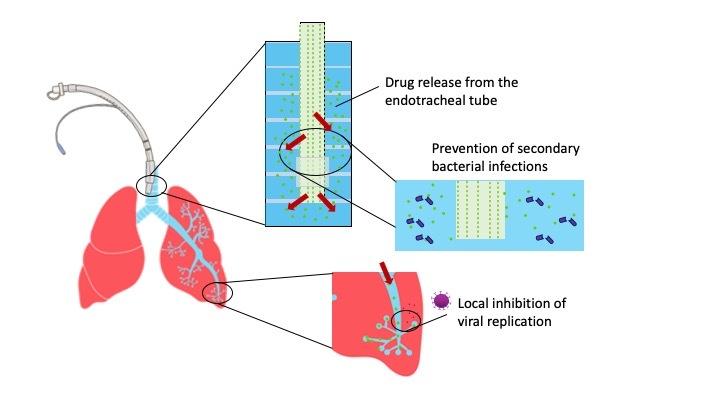
Local sustained release of a repurposed drug from the endotracheal tube
-
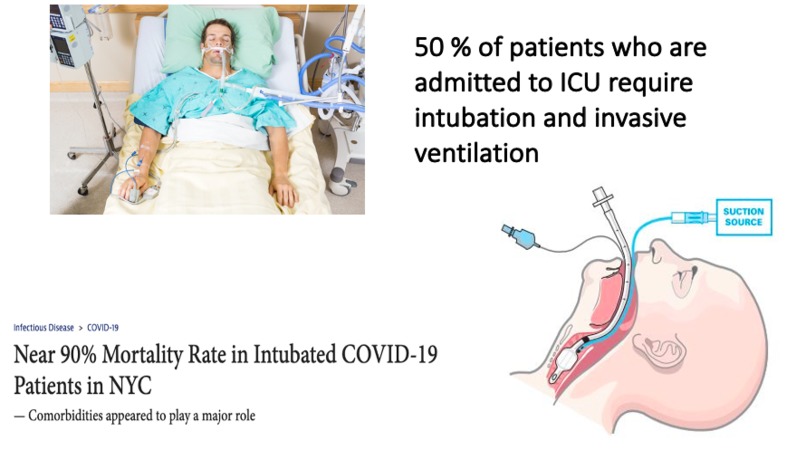
More than half of the ICU patients with COVID-19 requiere intubation and mechanical ventilation


3D printed endotracheal tubes for local drug delivery
The problem
Around 3,2% of the patients infected with sars-cov-2 coronavirus requiere intubation and invasive mechanical ventilation (Meng et al., 2020). Intubated patients are highly susceptible to acquire bacterial pathogens. Early evidence shows that secondary bacterial infections are a major risk factor for adverse COVID-19 outcomes. A recent study from China published in The Lancet found that 27 out of 28 patients with secondary bacterial infections died (96%). Half of the non-survivors experienced a secondary infection (27 out of 54); ventilator-associated pneumonia occurred in 10 of 32 patients (31%) requiring invasive mechanical ventilation (Zhou et al., 2020).
The aim
Our aim is to develop endotracheal tubes incorporating a repurposed drug with antibacterial and antiviral properties. The drug will be released locally in the superior respiratory tract, treating the viral infection of sars-cov-2 coronavirus and preventing bacterial biofilm formation.
Local sustained release of a repurposing drug in the endotracheal tube
We will use an FDA-approved drug that has been showing effective against the sars-cov-2 coronavirus. Previous studies have shown that the drug is able to inhibit viral replication in cell cultures. Moreover, this drug reduces the overproduction of mucus and inflammation in the lungs. The main limitation of this drug is its low absorption and systemic bioavailability. Therefore, we aim to incorporate this drug in the endotracheal tube to obtain a local diffusion into the lungs.
3D printing technology
We will use 3D printing technology to incorporate the drug into the tube. By using 3D printing technology, we can control precisely the drug loading and the drug release kinetics to achieve a sustained drug release into the lungs.
The team
We are a team of researchers (Ph.D. students from different parts of Europe) with different expertise (microbiology, biotechnology, and engineering) with the aim of fighting bacterial and viral infections with additive manufacturing antimicrobial devices. We would like to apply our knowledge and experience to help in the current situation of COVID-19.
References
Meng, L., Qiu, H., Wan, L., Ai, Y., Xue, Z., Guo, Q., ... & Liu, H. (2020). Intubation and Ventilation amid the COVID-19 OutbreakWuhan’s Experience. Anesthesiology: The Journal of the American Society of Anesthesiologists.
Zhou, F., Yu, T., Du, R., Fan, G., Liu, Y., Liu, Z., ... & Guan, L. (2020). Clinical course and risk factors for mortality of adult inpatients with COVID-19 in Wuhan, China: a retrospective cohort study. The Lancet.


Log in or sign up for Devpost to join the conversation.