Inspiration
The Corona outbreak has put significant pressure on imaging departments, to test hundreds of peoples per day. Patients and doctors typically have to wait a few hours to get the CT results, but our system is improving the CT diagnosis speed for each case; and each minute saved is critical to decrease the chance of cross-contamination at the hospital. The shortage of strict laboratory requirements for the use of the RT-PCR detection kit, to confirm the 2019-nCoV diagnosis, is a major problem. Proposed system can help with limited medical resources to immediately screen out suspected Coronavirus-infected patients for further diagnosis and treatment. The battle against this epidemic is one being fought by all clinicians and countries, and We as a part of society is fully committed to support these efforts, wherever needed, and aspires to “Use the most advanced AI technology to serve the most fundamental needs.”
What it does
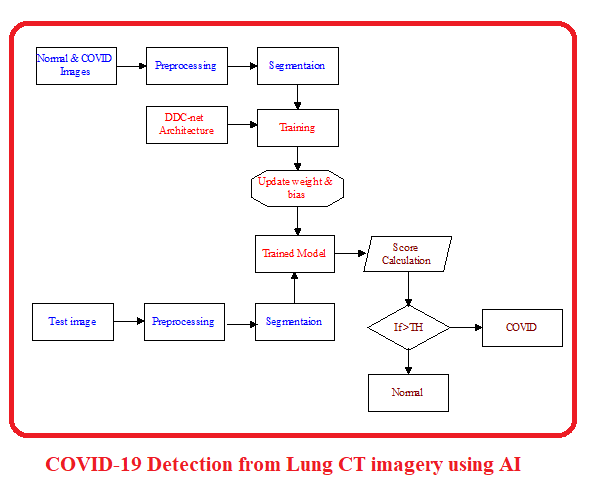
Proposed method takes Lung CT scan as input. It process on input image using median filter. After that it extract the region of interest. Then our deep dense network will look for any symptoms for corona such as glass opacity. If it found any of the trained symptom then it will gives result for COVID costiveness. The accuracy of any Deep Network depends on the training dataset. For our model we used normal Lung CT scan from LIDC Dataset[4] and Corona image are taken from web. As there is privacy issues of corona images. Also in this situation no one is ready to make those dataset public. A new artificial intelligence-powered deep learning model will help radiologists to distinguish COVID-19 from community-acquired pneumonia and other lung diseases in chest CT imaging
How I built it
Necessary Hardware: 1] Laptop or PC or 2] Raspberry Pi
Necessary software: 1] Python or 2] MATLAB
Challenges I ran into
“To develop a system that detect Novel corona symptoms with maximum precision and with minimum processing time.” For NOVEL CORONA Patients CT scan have some symptoms such as, Reticulation, Ground Glass Opacities and Consolidation of lung tissue. To detect such symptoms is challenging. Traditional methods such as segmenting the Region of interest t, then extracting features of those part and then classify using some pretrained classifier is time consuming process. Recent studies on Deep learning change the process of detection by Providing the image to this second generation neural networks which are capable of extracting features and classifying itself. Also CORONA is spreading fast, so this overall development should be completed within few duration.


Log in or sign up for Devpost to join the conversation.