


Context - Even though we have begun to re-open our economy, we still lack contact tracing on public transport, especially during peak hours.
Need - We need a quick-to-deploy, reliable and privacy-preserving solution to contact tracing on public transport.
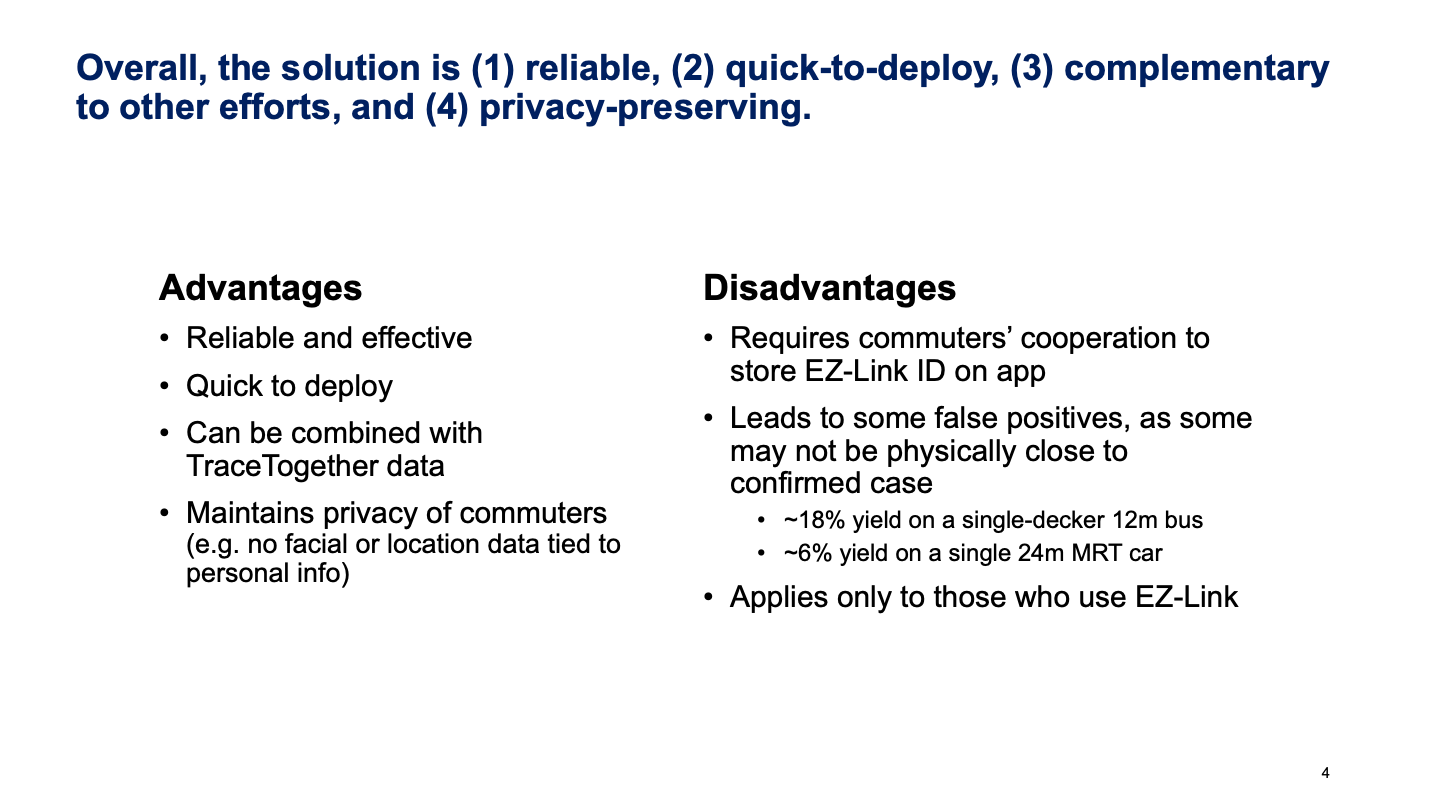
Solution - Using Smart EZ-Link data, we can reliably identify individuals who are exposed to confirmed cases who travel by bus or train for more than 30min. The EZ-Link CAN IDs can be stored locally on devices, so location data is not linked to personally identifiable info.
Details - First, commuters store their EZ-Link ID data on their TraceTogether apps. Second, contact tracers obtain the EZ-Link IDs of confirmed cases and identify the EZ-Link IDs of potential close contacts. Third, the TraceTogether app checks the EZ-Link ID on device against EZ-Link IDs of potential close contacts in an online secure government database and notifies users if there is a match.
Yield - Since EZ-Link data does not inform us about physical proximity, through simulations, this method results in ~18% yield on a single-decker 12m bus and ~6% yield on a 24m MRT car. This is likely a lower bound as it does not account for movement around in trains and buses. Coupled with TraceTogether data, this method can very effective.
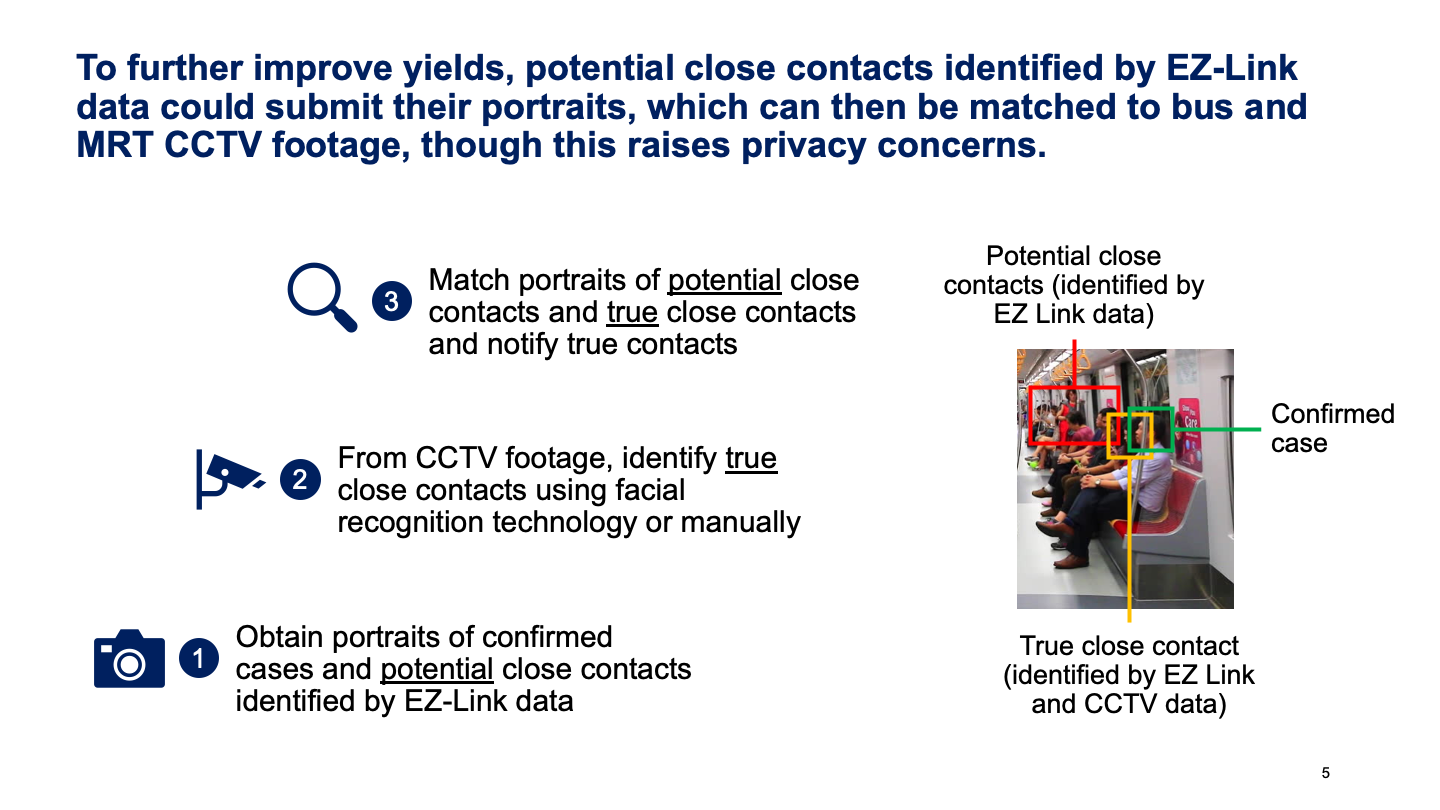
Further Enhancements to Yield - Potential close contacts identified by EZ-Link data can submit their portraits to the government. Using bus and MRT CCTV footage, we can identify true close contacts and match them to the portraits of potential close contacts. This can be done manually or via facial recognition technology.
Next Steps - The government should validate this solution using a real-world trial of actual people who know they are travelling together. If valid, then it should scale the solution.

Log in or sign up for Devpost to join the conversation.