## Inspiration
The veterinary industry is burning out. Vets are drowning in paperwork, and current AI tools only act as digital receptionists or scribes. They record data, but they don't think. As a Professor of Veterinary Medicine and Surgery, I've seen junior clinicians repeatedly miss complex underlying conditions—such as missing hypothyroidism in a dog presenting with refractory ear infections—because they lack real-time, proactive mentorship. I wanted to build an AI that doesn't just digitize records, but actually reasons alongside the doctor.
What it does
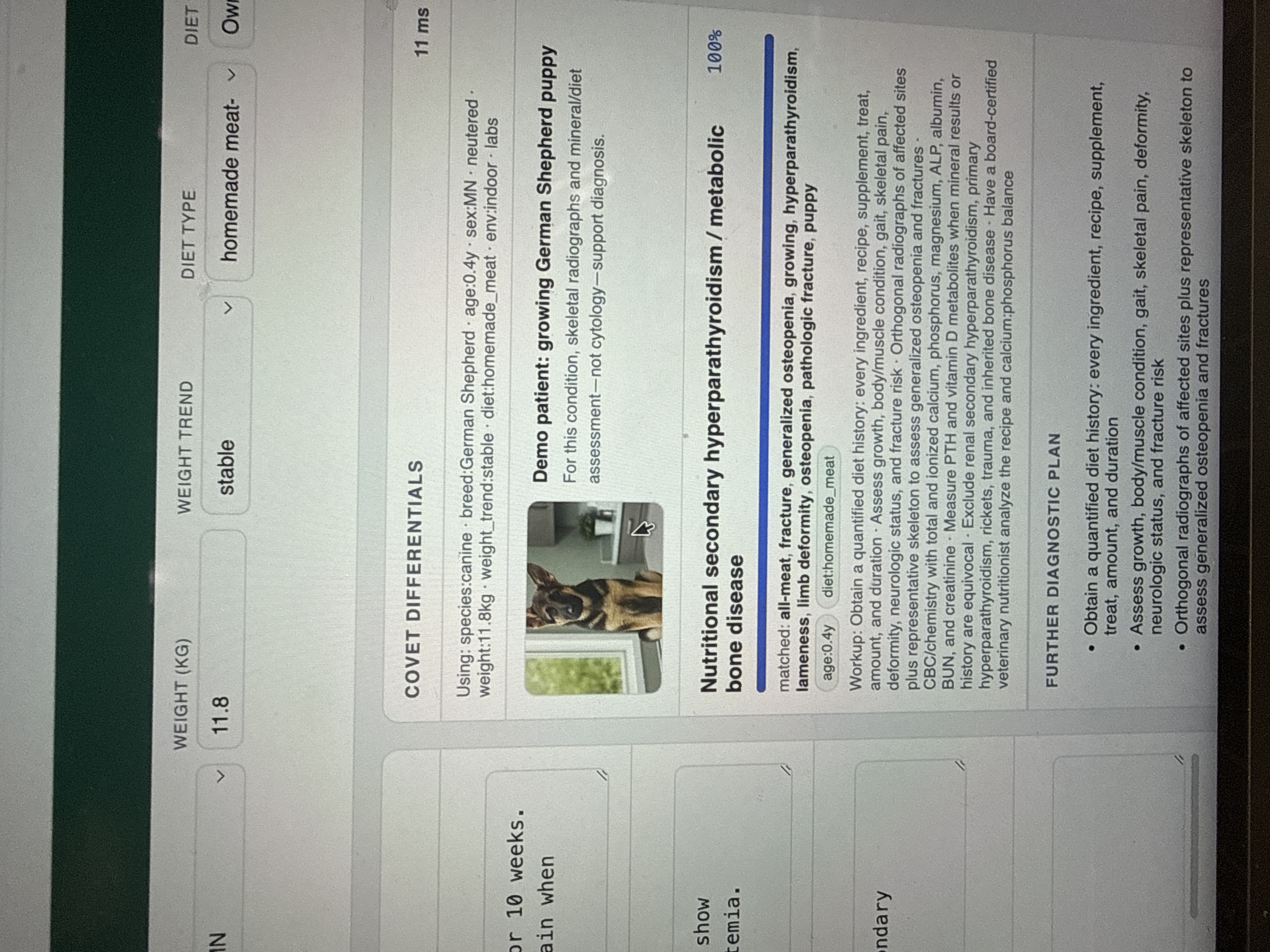
Our platform is a proactive Clinical Intelligence Co-Pilot. Unlike static databases (like Plumb's or VIN) where a vet must manually search for answers, our platform is a "Push" system. It continuously monitors patient data (SOAP notes, lab values) and cross-references it against verified physiological "Ground Truths." If it detects a clinical blind spot, it instantly pushes a differential diagnosis alert to the clinician. Simultaneously, it translates this clinical logic into a frictionless, "Insurance-Ready" report for the pet owner, completely eliminating administrative back-and-forth.
How we built it
We architected a robust Retrieval-Augmented Generation (RAG) system. The core is a modular schema that strictly separates the "Clinical Logic" (our rules-based diagnostic engine) from the UI layer. We fed the RAG pipeline with a "Living eBook" of verified veterinary medical textbooks, journals, and species-specific physiological constants to ensure strict medical accuracy.
Challenges we ran into
The biggest challenge was eliminating AI hallucinations. General LLMs fabricate medical data, which is unacceptable in veterinary medicine. We had to heavily constrain the model to only draw from our verified database and enforce strict species-specific reference ranges (e.g., ensuring the AI understands the clinical difference between normal Total T4 and low Free T4).
Accomplishments that we're proud of
We successfully bridged the gap between passive reference libraries and the active clinical workflow. We created an AI that acts as a true clinical mentor rather than just a clerical assistant, providing specialist-level decision support precisely when the clinician needs it.
What we learned
We learned that the true value of AI in medicine isn't just generating text—it is orchestrating complex clinical logic. The synergy between improving diagnostic accuracy and automating operational efficiency (like generating instant insurance claims) is the key to solving clinic burnout.
What's next for the platform
We plan to expand our "Living eBook" database, integrate the platform directly with major veterinary EMR APIs, and extend our logic engine to cover complex surgical risk assessments and robotic surgical co-piloting. Inspiration
What it does
How we built it
Challenges we ran into
Accomplishments that we're proud of
What we learned
What's next for CoVet Intelligence
Built With
- api
- artificial
- llm
- python
- rag

Log in or sign up for Devpost to join the conversation.