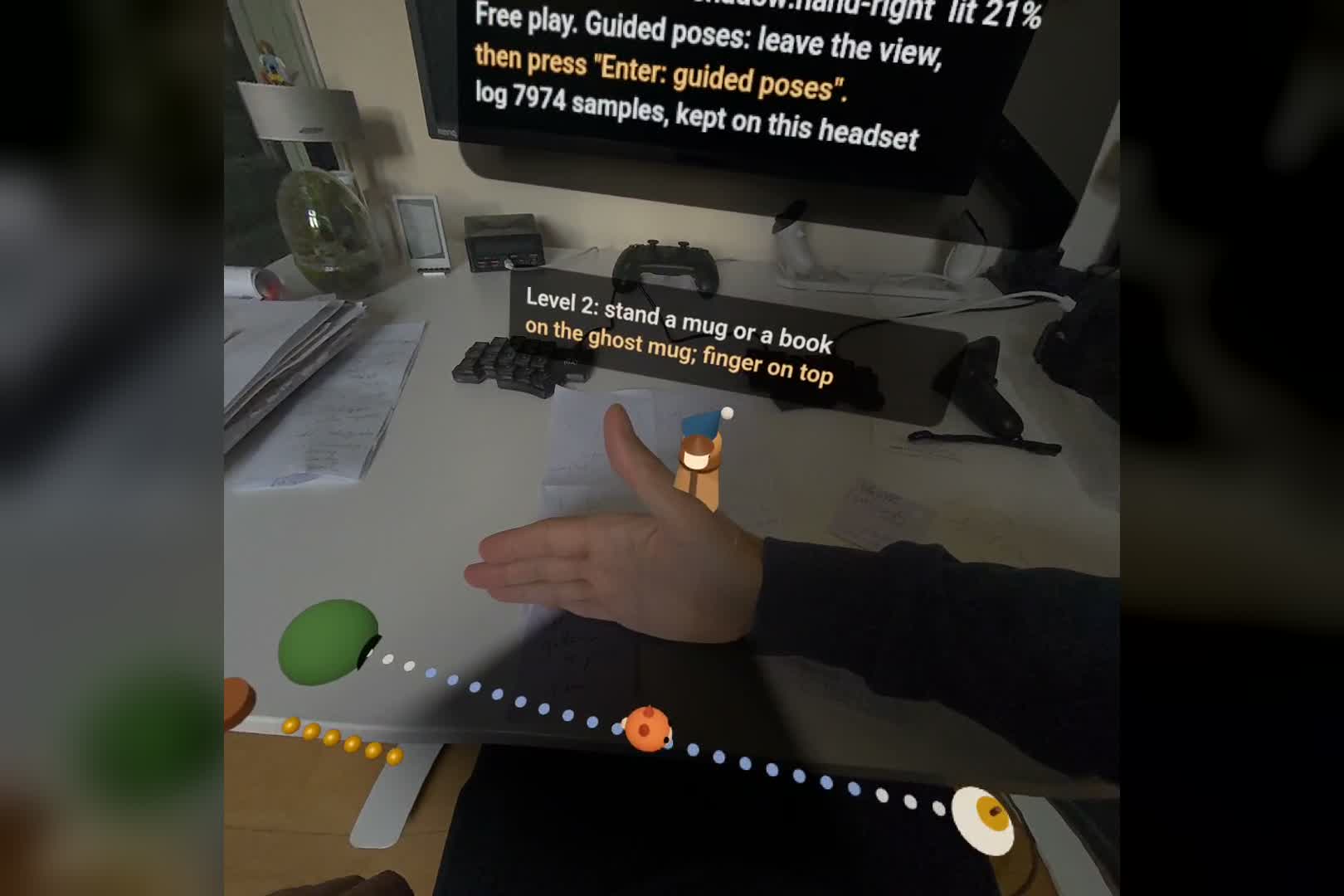
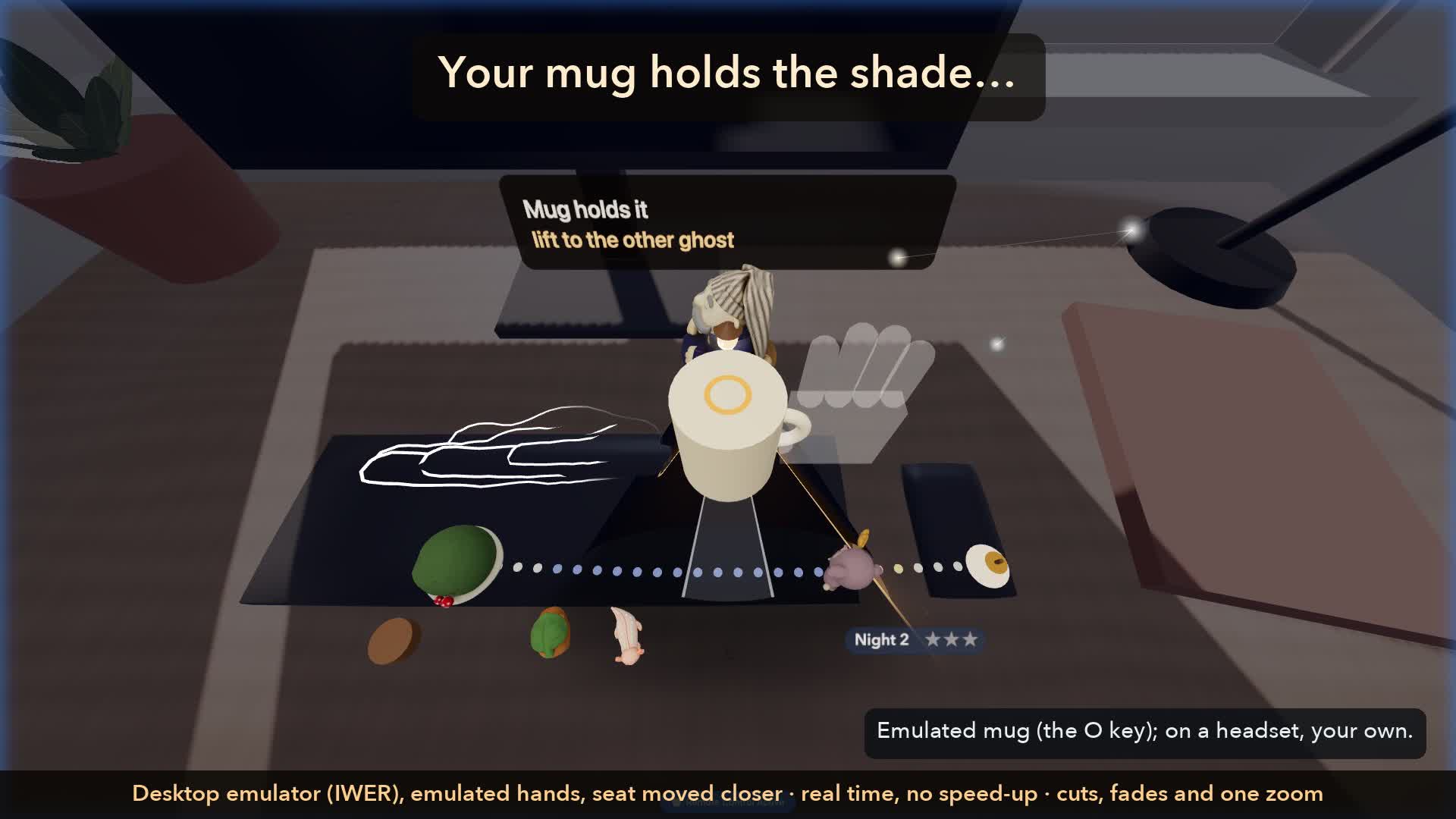
Inspiration. Hand tracking usually turns a hand into a cursor. In Cover your hand is a wall. When you sit down, night falls over your real room. A sleepy keeper's lantern lights a fan of your real desk, and a tiny creature has to cross that light to reach its trinket. You can't steer it. You can only stand your hand like "stop" and let its shadow open a dark lane across the light. The creature dashes into your shade; slide your hand and it follows you home. Lift your hand and the keeper sees it.
It plays in your room, not in a window. The dimmed room is your passthrough; the lantern's light cuts a hole in that night, so inside the light you see your real desk and your real hand at full brightness, and the shade is your real desk left dark. On a headset the game also asks for your Space Setup furniture (a monitor, a lamp, a shelf next to the desk) so it can cast the lantern's shade too (built, awaiting a headset test), and on the second night a real mug or book you touch holds the shade while your hand crosses the keeper's gaze. Sound is spatial: the keeper snores from the lantern's place on your desk.
Seven Nights. Each night has three stars: get home, gather the three fallen stars (each counts only if the star itself is in your shade when the creature passes, so you have to reach further into the light), and never wake the keeper. Every star you gather lights a constellation that hangs over your real desk and stays between sessions. After the seventh night, dawn comes into the room, the keeper blows out the lantern and the creature climbs into your palm.
Three creatures. Tuck (a shy night creature with a felt moon), Lumi (an axolotl with glowing dots) and Bobo (a capybara with a leaf hat). You pick one after the first night by holding a fingertip on it.
How we built it. WebXR with Meta's Immersive Web SDK on Three.js. Every frame the 25 tracked joints of each hand become capsules, registered objects become cylinders and Space Setup furniture becomes rows of capsules; the lantern's light is a 64 × 32 grid computed with the same occlusion test the creature uses, so the shadow you see is exactly the cover that counts. The night is a stencil pass, so it costs almost nothing. 117 unit tests, a labelled line-of-sight case set, mutation checks, and a desktop emulator build (/emu/) that anyone can play with keys.
Art and AI, disclosed. The creatures, the keeper, the burrow and the felt stars are original designs: concept images made with Google's Gemini image model, turned into 3D with Tripo (via Higgsfield), and rigged and animated with Higgsfield 3D Rigging. All code was written with AI coding assistants under our direction.
Where it stands, honestly. A Quest 3 owner played an earlier build on 12 Nov (before the night and the new creatures): 90 fps, the desk anchor restored, the hand mask working, first win in about 30 s; that clip showed the board landing half off the desk, which the game now corrects in code (not yet re-checked on a headset). The night, the creatures and Seven Nights are new since then and have run only in the emulator so far. Their clip opens the video, credited and used with permission.
What's next. Depth-sensed occlusion so the creature hides behind any real object; more nights. Launch: the Quest Browser link is live now; a Horizon Store web app (PWA) is planned for Q1 2027.
Try it
Quest 3/3S: https://chainwright.github.io/cover-desk/ in Quest Browser, sit at a desk, press Enter, hands only. No headset: https://chainwright.github.io/cover-desk/emu/ in desktop Chrome (Enter, then H, hold →, L, C; level 2: ?level=2, then O, H, R). JUDGES.md in the repo has a five-minute path.
Built With
- hand-tracking
- meta-immersive-web-sdk
- passthrough
- quest-3
- three.js
- typescript
- webxr
