Inspiration
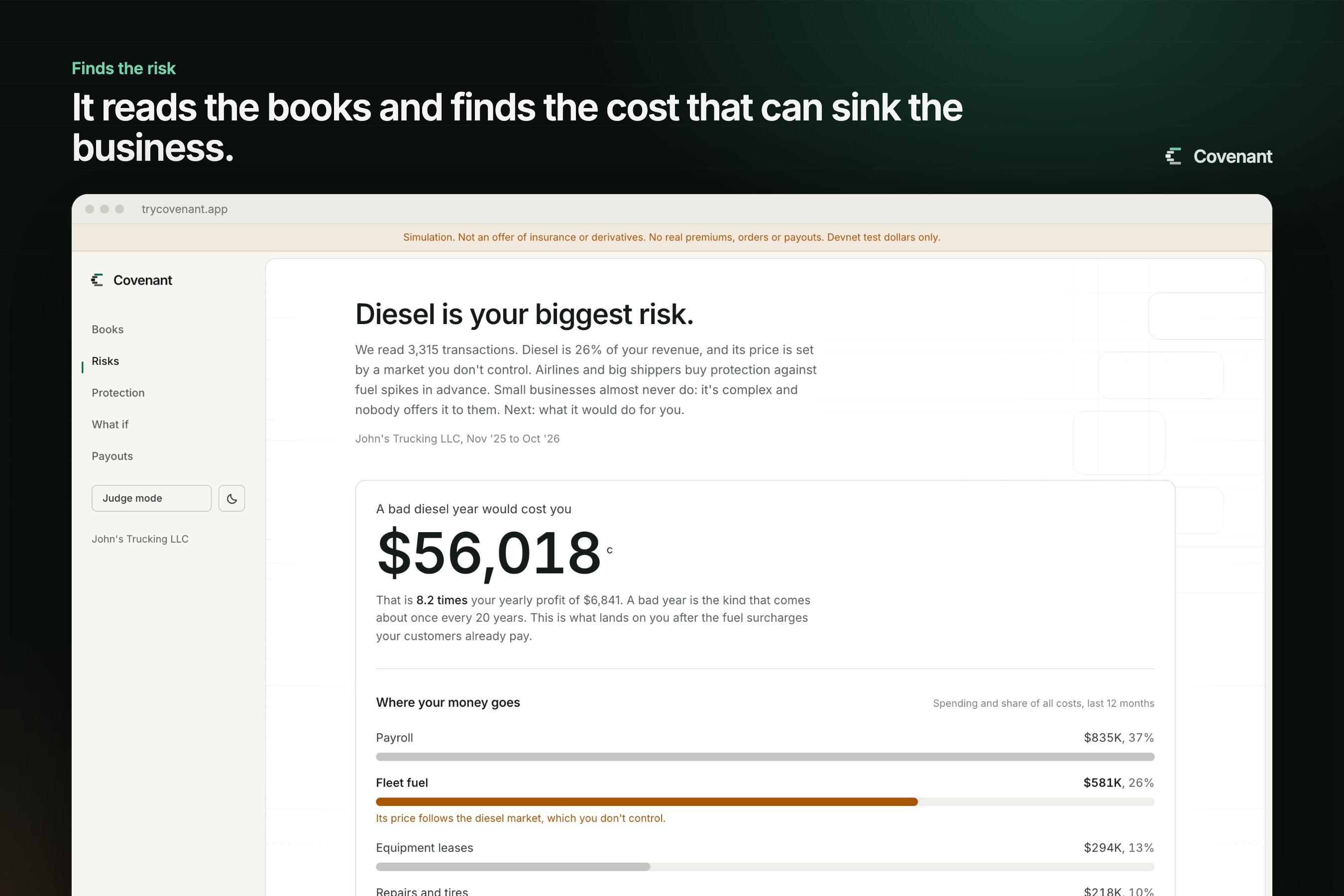
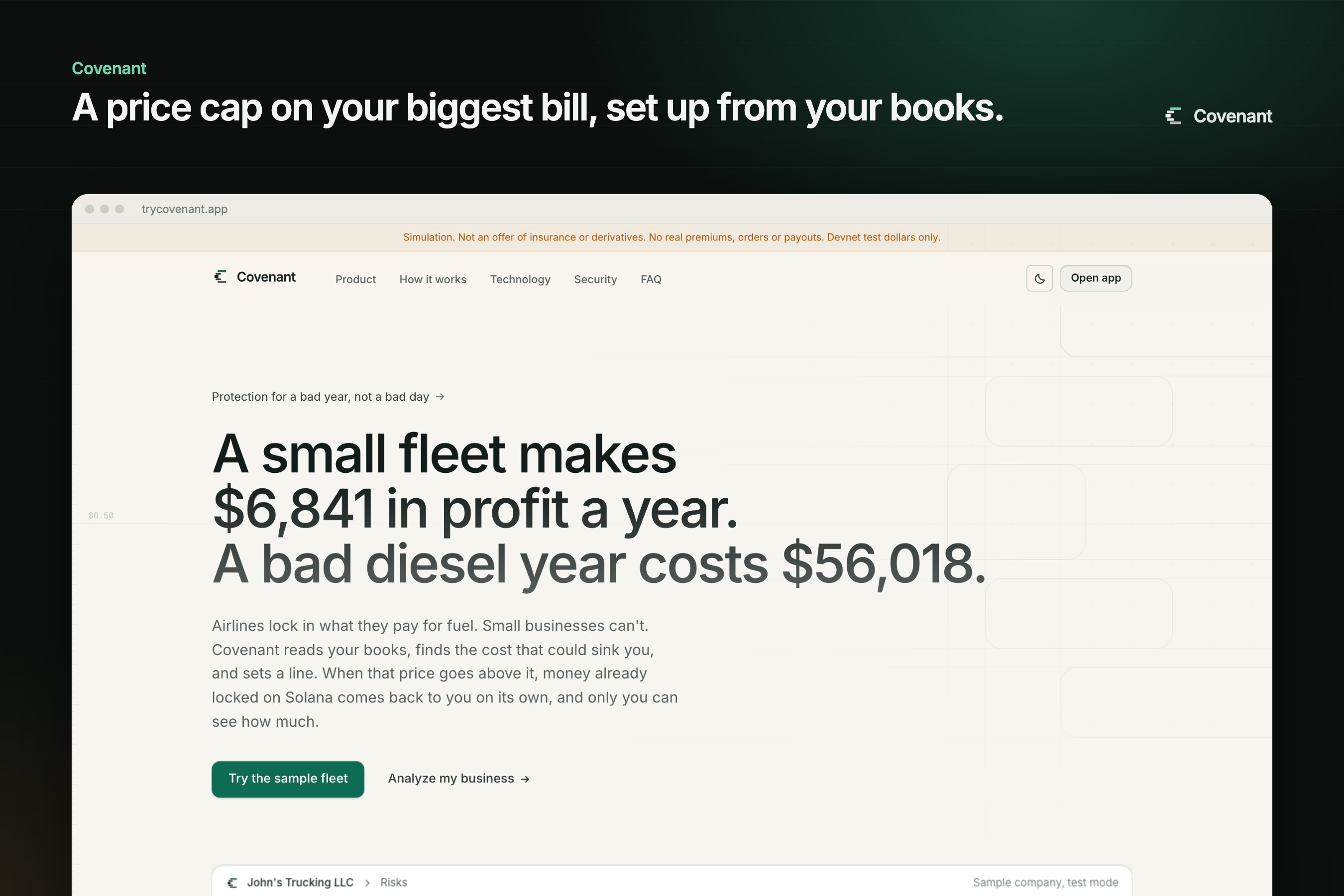
A 10-truck fleet can spend $581,354 a year on diesel and keep just $6,841 in profit. A bad diesel year costs it $56,018, more than eight years of profit. The business could be operating perfectly and still shut down because of a price it doesn't control.
Large companies solved this decades ago. Airlines hedge fuel, manufacturers hedge raw materials, and major shippers lock in costs months ahead. Small businesses rarely have access to those tools. Hedging requires expertise, capital, and contract sizes that don't make sense for a 10-truck fleet.
Most small-business protection covers a bad day. But a single bad day rarely destroys a business. A major operating cost staying high for an entire year can.
We built Covenant to change that.
What it does
Covenant lets small businesses put a cap on the operating cost that could wipe out their profits, starting with the accounting records they already have.
1. Finds the risk in your books. Upload an accounting export, and Covenant identifies market-driven expenses, measures exposure, and accounts for costs already passed on to customers. For our sample fleet, we analyzed 3,315 transactions and identified diesel as the primary risk, representing 26% of revenue. The app also rejects costs like payroll, insurance, and leases that cannot be protected this way.
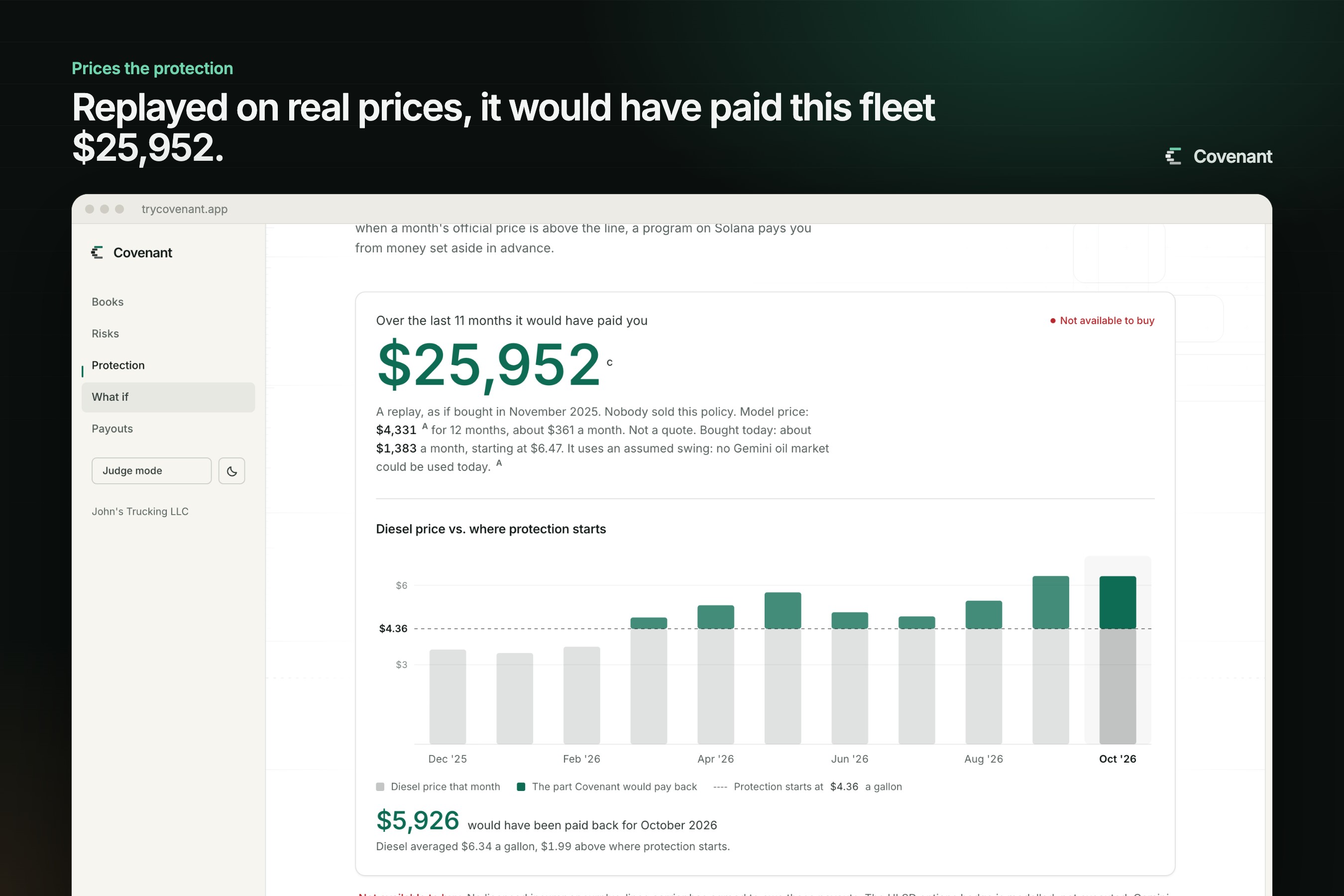
2. Prices protection for that business. Covenant calculates a protection threshold and coverage amount using actual transaction data, historical government prices, and live Gemini Prediction Markets signals. For our sample fleet, it modeled a $4.36/gallon diesel cap for approximately $361/month under November 2025 pricing assumptions. Every number is traceable to a transaction, dataset, calculation, or labeled assumption. No AI invents financial figures.
3. Settles payouts privately on Solana. A backer locks collateral in vaults controlled by our Solana program before coverage begins. Each month, an authorized publisher posts the official regional diesel price with a hash of its source file. When the price crosses the threshold, the business signs once and the program releases the eligible payout. No claim, no adjuster, and no ability for the backer to block settlement.
We use Helius Privacy Rings to encrypt payout amounts. Competitors, customers, and other observers cannot inspect the amounts onchain. The business can share a read-only viewing key with its lender to verify coverage without giving up control of funds.
Our historical replay shows $25,952 in payouts from November 2025 to October 2026. We also funded and settled September 2026 on Solana devnet, paying $5,070 in test dollars across seven protection steps.
Try it live: https://trycovenant.app
This is a working devnet prototype using simulated dollars, not a live financial product.
How we built it
Risk engine (TypeScript). Imports accounting records, classifies transactions deterministically, extracts fuel consumption, and measures exposure against the EIA regional diesel index. We account for fuel surcharge recovery and price the protection using Black-76. Backtested over 131 rolling 12-month periods since 2015, our model triggered payouts in 37 of the 40 historical bad years.
Gemini Prediction Markets. Every analysis calls Gemini's API live. We use the Brent crude price ladder to estimate market-implied movements and inform protection pricing. We also screen related commodity markets for index compatibility, duration, maturity, liquidity, and executable quotes. None currently qualifies as a direct hedge, so Covenant explicitly labels the data as a pricing signal. A fully collateralized backer carries the risk instead.
Solana (Rust, Pinocchio). We deployed a custom program with four instructions: init_step, report_index, release, and reclaim. It enforces authorized price reporting, one-time settlement, business signatures, and restrictions on withdrawing collateral early, with 16 custom errors.
Helius Privacy Rings. Each protection step uses an encrypted balance in a program-derived vault. Our Solana program authorizes private transfers through signed cross-program invocations, keeping payout amounts hidden from public observers.
Frontend and testing. Built with Next.js 15, React 19, TypeScript, and Tailwind CSS. Includes accounting imports, risk analysis, protection pricing, and lender verification. We also built and unit-tested integrations for QuickBooks, Xero, Zoho Books, and FreshBooks, although CSV uploads are the active demo path. 42 Vitest tests pass, alongside devnet validation of unauthorized transactions, duplicate reporting, and payout confidentiality.
Challenges we ran into
Privacy changed the entire contract design. Our original approach calculated payouts directly from the difference between market price and threshold. But encrypted balances prevent the program from performing arbitrary arithmetic on them. We redesigned protection into 25-cent price steps, each with its own private vault. For September 2026, the exact formula gave $5,776 while our step-based implementation paid $5,070. We show both figures transparently.
Getting a program to control private funds. Implementing program-authorized encrypted transfers through Helius Privacy Rings required integrating the alpha SDK, handling WASM dependencies inside Next.js, registering our test asset, and correctly signing transfers from program-derived vaults. This was our hardest technical challenge.
Market data isn't the same as a hedge. Available prediction markets don't match the 12-month protection period or the exact diesel exposure. Rather than forcing an unsuitable hedge, we separated market-based pricing signals from the collateralized party actually carrying the risk.
Measuring real losses. Fuel surcharges recover part of a diesel price increase, and actual pump prices differ from the government index. Modeling both correctly was essential to avoid recommending the wrong protection amount.
What we learned
A technically correct financial contract is useless if it covers the wrong risk, expires too early, or depends on a market too small to meet its obligations.
We learned that privacy isn't a feature you can simply add at the end. It fundamentally changes how collateral, calculations, and settlement work.
Most importantly, small businesses don't need another dashboard telling them their costs are rising. They need a way to turn the financial risks already sitting in their books into protection they can actually use.
What's next
Our next priorities are pooled collateral from multiple backers, independent price publishers with a dispute window, browser-based lender verification, self-custodied wallets, fuel-card integration, and live accounting-provider connections.
We also want to explore working with a licensed carrier or appropriately regulated counterparty to support real-money protection.
Longer term, the same system could protect cafés from coffee prices, bakeries from wheat and butter, and restaurants from beef and natural gas.
Large companies have protected themselves against commodity prices for decades. We want to make that same category of protection accessible to every small business.
