-
-
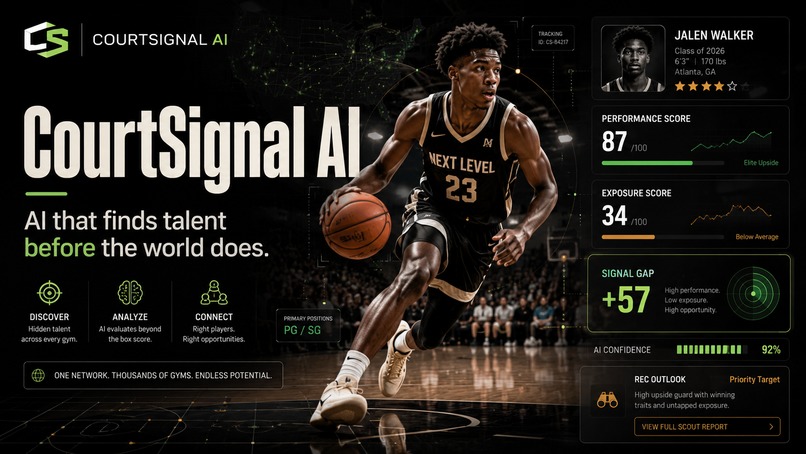
Court Signal AI
CourtSignal AI was created around a simple belief: talent is distributed everywhere, but access to opportunity is not.
Thousands of young athletes compete and train every day in community recreation centers, local gyms and basketball facilities outside the environments most heavily observed by recruiters. Traditional scouting is constrained by geography, time, staffing and existing relationships. As a result, identifying an athlete often depends not only on ability, but on whether that athlete participates in the right program, attends the right event or reaches the right person.
CourtSignal is building an AI-powered talent discovery network designed to reduce that gap.
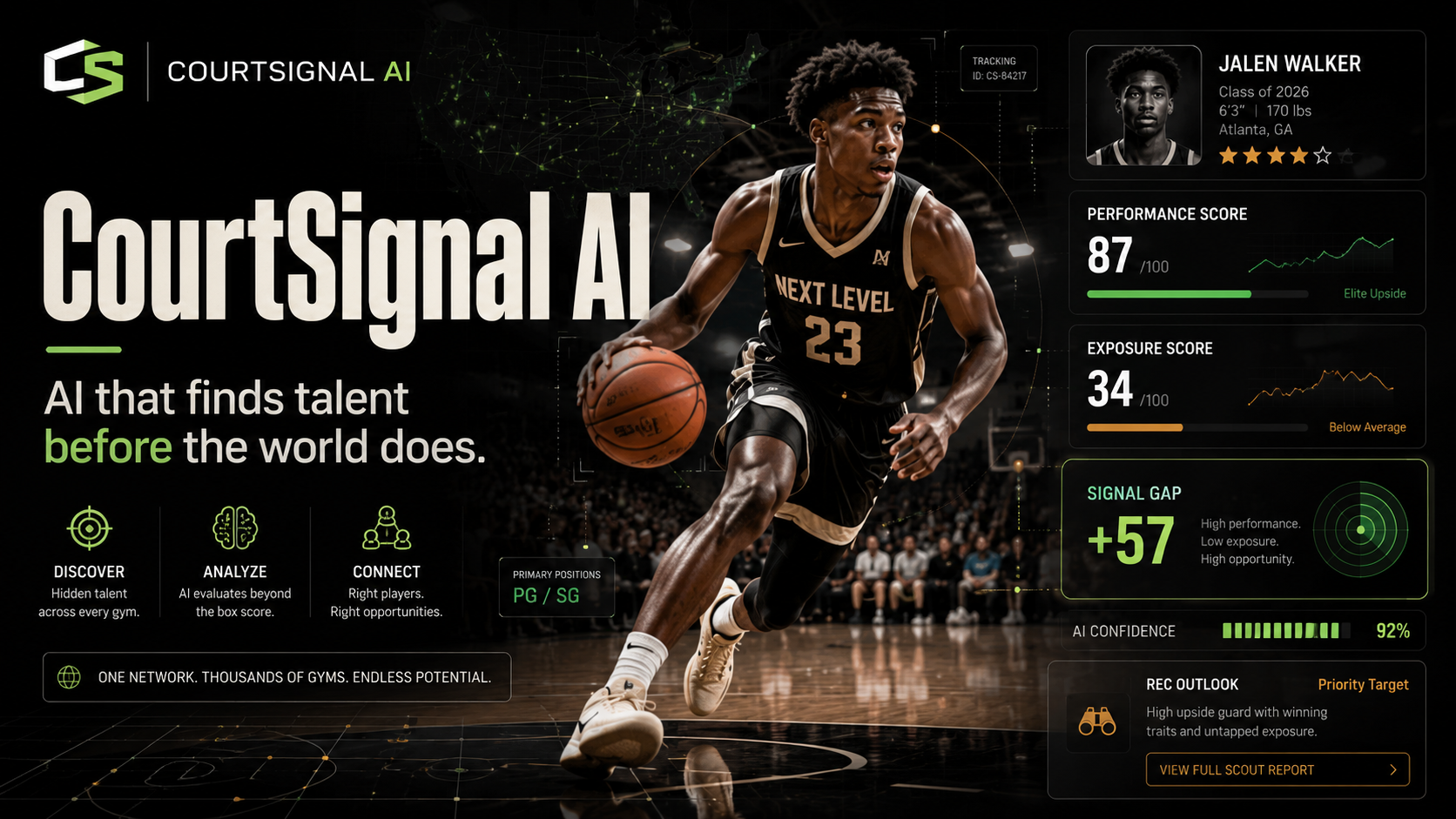
The current product creates persistent athlete profiles from structured performance information, athlete data and uploaded game information. Gemini is used to transform those inputs into structured observations that can assist human evaluators. CourtSignal then compares an athlete's observed Performance Signal with their current Exposure Signal.
We call the difference the Signal Gap.
A large positive Signal Gap does not mean CourtSignal has declared an athlete an elite recruit. Instead, it identifies a potentially important mismatch: an athlete whose observable performance indicators appear substantially stronger than their present level of recruiting exposure. CourtSignal then recommends that athlete for human review.
This distinction is important to how we use AI. CourtSignal is not designed to replace scouts or coaches. It is designed to increase the number of athletes a limited number of human evaluators can discover and evaluate.
AI also operates the business itself.
Our Intake Agent helps normalize athlete information and prepare new profiles. The Scout Agent transforms performance information into structured observations. The Exposure Agent evaluates signals associated with an athlete's current visibility and recruiting access. The Match Agent compares athlete profiles against the requirements entered by recruiters. Finally, our Operations Agent identifies meaningful changes and creates Talent Alerts when an athlete begins matching a recruiter's criteria.
Instead of requiring a recruiter to repeatedly search an athlete database, CourtSignal can continuously evaluate new information and surface athletes that require attention.
Humans retain responsibility for the decisions where judgment matters most. Scouts determine whether an athlete should actually be recruited. Coaches determine fit with a program. Athletes and guardians control participation and consent. Human review is recommended on AI-generated athlete assessments. CourtSignal separates verified statistics from AI-generated observations and does not claim to predict medical outcomes or guarantee recruiting success.
Our business model is intentionally designed so that an athlete's ability to pay does not determine their ability to be discovered.
Athletes can establish a basic CourtSignal identity without paying for recruiting visibility. Facilities can purchase CourtSignal software to understand athlete engagement, court utilization and talent activity within their location. Recruiters, teams and organizations can purchase advanced discovery tools, natural-language athlete search, Talent Alerts and regional intelligence.
This creates several potential forms of economic opportunity beyond the founding team.
Independent gyms and recreation centers can differentiate themselves as CourtSignal-enabled talent development locations. Trainers can use longitudinal athlete information to improve development programs. Human scouts can use AI to increase the territory and number of athletes they are capable of evaluating rather than being replaced by automation. As the network grows, CourtSignal can also create opportunities for local evaluators, sports data specialists, facility partners and athlete-development professionals.
The long-term vision extends beyond uploaded information.
CourtSignal is designed to eventually connect with existing wearables, gym-management platforms, camera systems and performance technologies. Rather than forcing facilities to replace systems they already use, CourtSignal can become an intelligence layer across them.
Basketball is our starting point because the problem is immediately visible: there are far more athletes and courts than there are qualified people capable of scouting them consistently.

Log in or sign up for Devpost to join the conversation.