-
-
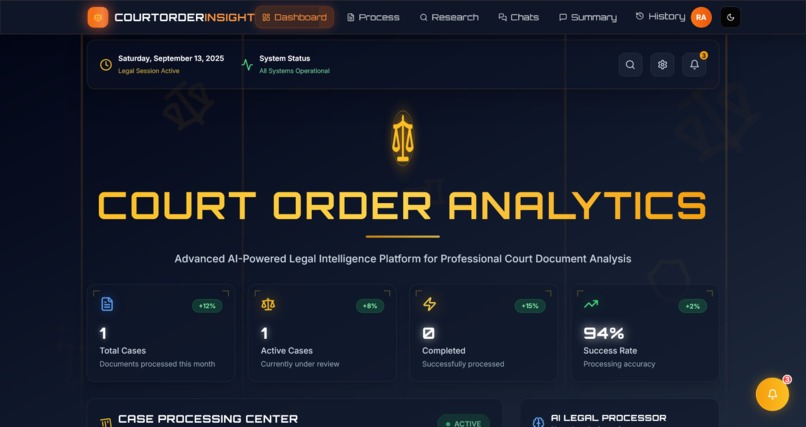
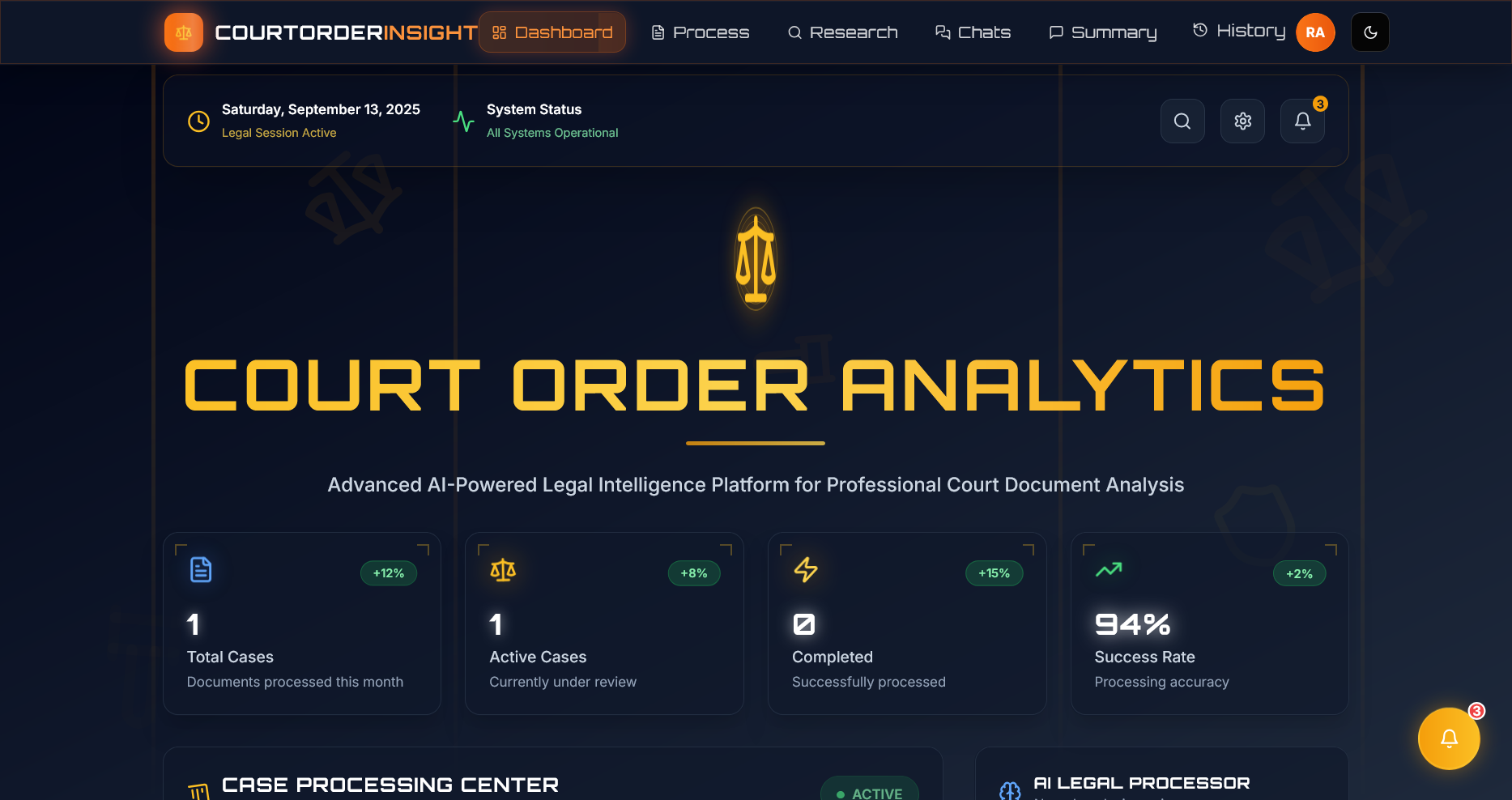
Dashboard
-
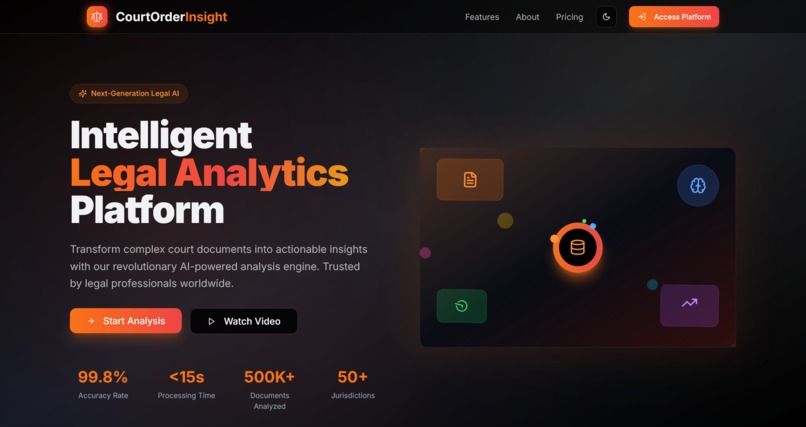
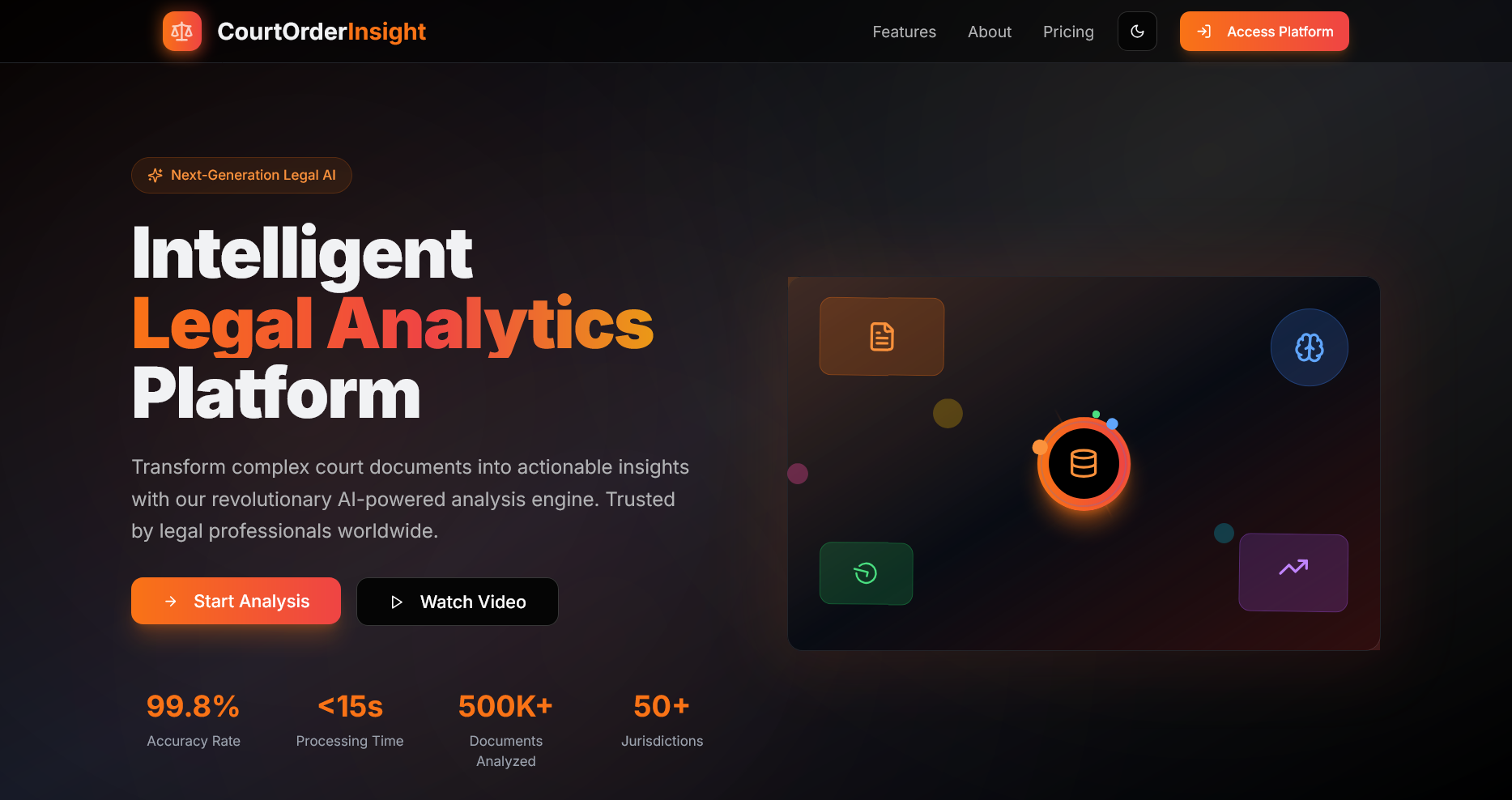
Home-Page
About the Project
Inspiration
Our team was inspired by the challenges faced by legal professionals in India who spend countless hours manually processing court orders and legal documents. We observed that legal practitioners often struggle with information overload, language barriers, and the time-consuming nature of document analysis. The Indian legal system, with its vast repository of case law and multilingual requirements, presented a unique opportunity to apply modern technology to streamline these workflows.
The idea for Court-Order-Insight emerged from conversations with practicing lawyers who expressed frustration with the inefficiencies in their document review processes. We realized that by combining AI, natural language processing, and modern web technologies, we could create a comprehensive solution that addresses these pain points and revolutionizes how legal professionals interact with court documents.
What it does
Court-Order-Insight is an advanced legal document analysis and research platform that helps legal professionals efficiently process, analyze, and research court orders and legal documents. The platform offers several key functionalities:
Intelligent Document Processing: Users can upload court orders, which the system automatically analyzes to extract key information such as case numbers, parties involved, dates, and citations.
Document Summarization: The platform generates concise summaries of lengthy legal documents, saving lawyers valuable time while ensuring they don't miss critical information.
Multilingual Support: Court-Order-Insight features translation capabilities that support English, Hindi, and Gujarati, addressing the multilingual nature of the Indian legal system.
AI-Powered Legal Research: The platform includes a powerful search interface connected to Indian Kanoon for comprehensive legal research, allowing users to quickly find relevant case law and statutes.
Advanced Citation Analysis: The system automatically detects, extracts, and cross-references legal citations across uploaded documents, building relationship graphs between cases and laws.
Chat-Based Legal Assistant: Users can interact with an AI assistant trained on legal documents and case law to get insights and answers to legal questions.
Case Management: The system organizes documents into cases, tracking active and completed matters with comprehensive metadata.
How we built it
We developed Court-Order-Insight using a modern tech stack that combines powerful frontend and backend technologies:
Frontend:
- React with TypeScript for type-safe code
- Vite for fast development and building
- Tailwind CSS for utility-first styling
- Shadcn UI components for a modern, accessible interface
- Framer Motion for smooth animations
- React Three Fiber for 3D visualizations
- Recharts for data visualization
Backend:
- Node.js with Express for the server framework
- PostgreSQL database with Sequelize ORM for data storage
- Passport.js for secure authentication
- JWT for API authorization
- RESTful API architecture for client-server communication
AI & Translation:
- Integration with LibreTranslate for multilingual support
- Connection to Indian Kanoon API for legal research
- Custom AI models for document analysis and summarization
- N8N for research workflow automation
We implemented a modular architecture that separates concerns between the frontend React components, the backend Express API, and various services. This approach ensures maintainability and scalability as the application grows.
Challenges we ran into
Developing Court-Order-Insight presented several significant challenges:
Legal Document Complexity: Court orders vary greatly in structure, formatting, and content, making it difficult to create consistent extraction algorithms.
Multilingual Processing: Supporting Hindi and Gujarati alongside English required handling different scripts and linguistic structures, especially when translation services were unavailable.
Legal Research Integration: Creating a seamless connection to legal databases while maintaining a user-friendly interface proved challenging.
Performance Optimization: Processing large PDF documents and extracting meaningful information in real-time required careful optimization of our data processing pipeline.
Security and Compliance: Handling sensitive legal documents necessitated robust security measures and compliance with data protection standards.
AI Response Quality: Ensuring the AI assistant provided accurate legal information without making incorrect assertions required extensive training and guardrails.
Time Taken for Summarization: Ensuring the AI Takes Less than 10-20 Seconds for large court documents.
Accomplishments that we're proud of
Despite the challenges, we achieved several notable accomplishments:
Intuitive User Experience: We created a modern, futuristic interface that makes complex legal tasks accessible and visually appealing.
Robust Multilingual Support: Our fallback mechanisms ensure reliable translation services even when external APIs fail.
Comprehensive Research Tools: The integration with legal databases provides powerful search capabilities for case law, statutes, and legal literature.
Efficient Document Processing: Our system can process and extract information from court orders with impressive accuracy.
Seamless 3D Visualizations: The incorporation of Three.js for 3D document visualization adds a unique and engaging element to the user experience.
Responsive Design: The application works flawlessly across different devices and screen sizes.
What we learned
Throughout the development process, our team gained valuable insights:
Domain-Specific AI: We learned how to tailor AI models to understand and process legal terminology and document structures.
Balancing Technology and Usability: We discovered the importance of keeping advanced technology accessible to legal professionals who may not be tech-savvy.
Handling Document Variations: We developed techniques to address the inconsistent formatting and structure of legal documents from different courts.
Full-Stack Performance Optimization: We learned strategies for optimizing both frontend and backend performance when working with large documents and complex data.
Security Best Practices: We deepened our understanding of implementing robust security measures for sensitive legal data.
Team Collaboration: We improved our ability to coordinate frontend, backend, and AI development efforts across the team.
What's next for Court-Order-Insight
Looking ahead, we have exciting plans to enhance Court-Order-Insight:
Enhanced Reasoning Capabilities: Upgrading our custom LLM with advanced reasoning and thinking capabilities to provide more nuanced legal analysis, better handle complex legal scenarios, and offer strategic insights based on case law patterns.
Mobile Application: Developing a companion mobile app for on-the-go access to case information and document reviews.
Expanded Language Support: Adding support for more Indian languages to better serve legal professionals across the country.
Document Comparison: Introducing tools to compare multiple court orders and identify similarities and differences.
Predictive Analytics: Implementing AI-driven predictions for case outcomes based on historical data.
Collaboration Features: Adding tools for multiple legal professionals to collaborate on document analysis and case research.
Integration with Court Systems: Working toward direct integration with court document management systems for streamlined workflows.
Enhanced AI Training: Continuously improving our AI models with more legal documents and expert feedback to increase accuracy.
By pursuing these enhancements, we aim to make Court-Order-Insight an indispensable tool for legal professionals throughout India and potentially expand to other legal jurisdictions.
NOTE: The website is fully functional; however, the server responsible for document summarization and question-answering features is currently inactive, as these services require additional financial resources and infrastructure to operate. Due to cost constraints, these modules are temporarily in hibernation but will be reactivated during showcases and once sustainable funding or sponsorship is secu
Built With
- express.js
- faiss
- huggin-face
- kaggle
- llama
- node.js
- postgresql
- python
- rag
- react
- tailwind
- tensorflow
- typescript
- vector-db


Log in or sign up for Devpost to join the conversation.