-
-
-
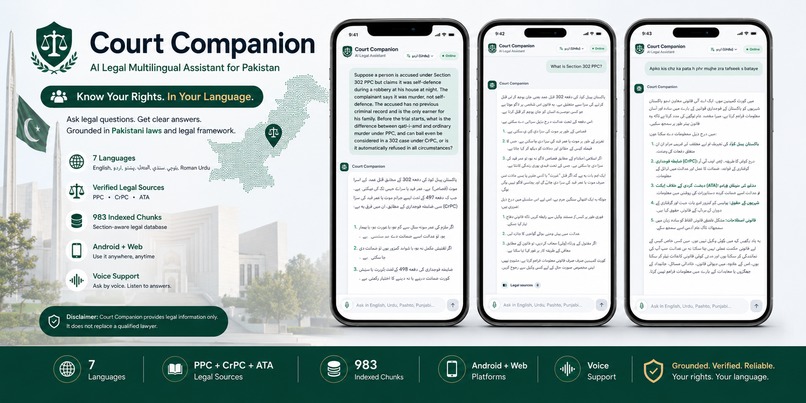
: )
-
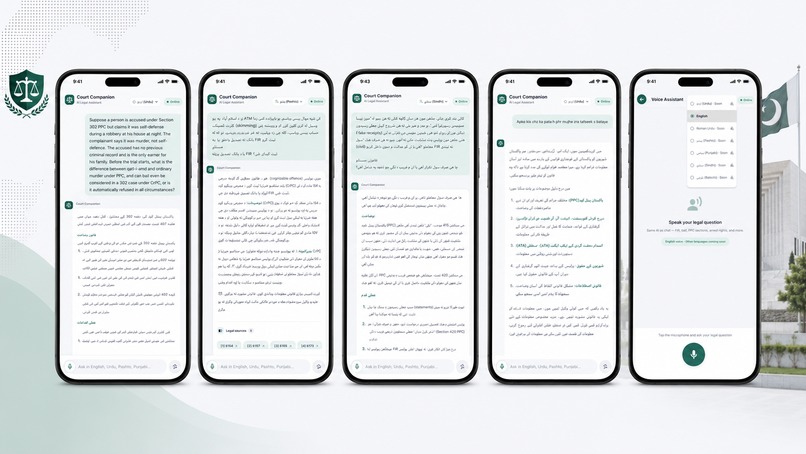
Demo-Screens
-
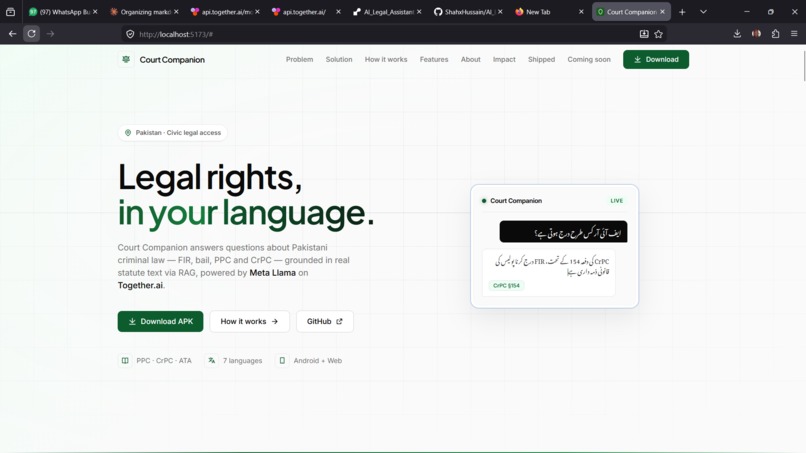
Hero Section - Intro
-
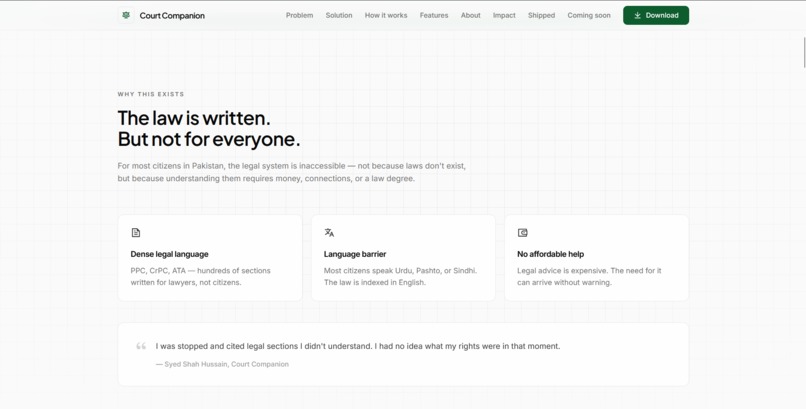
Motivation & Reason Behind
-
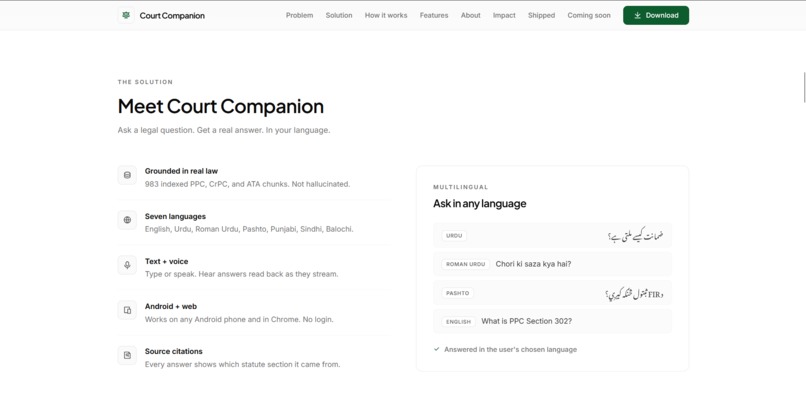
The Solution
-
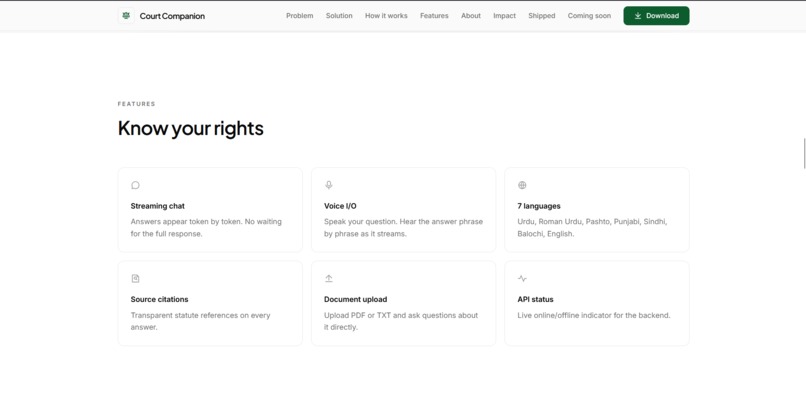
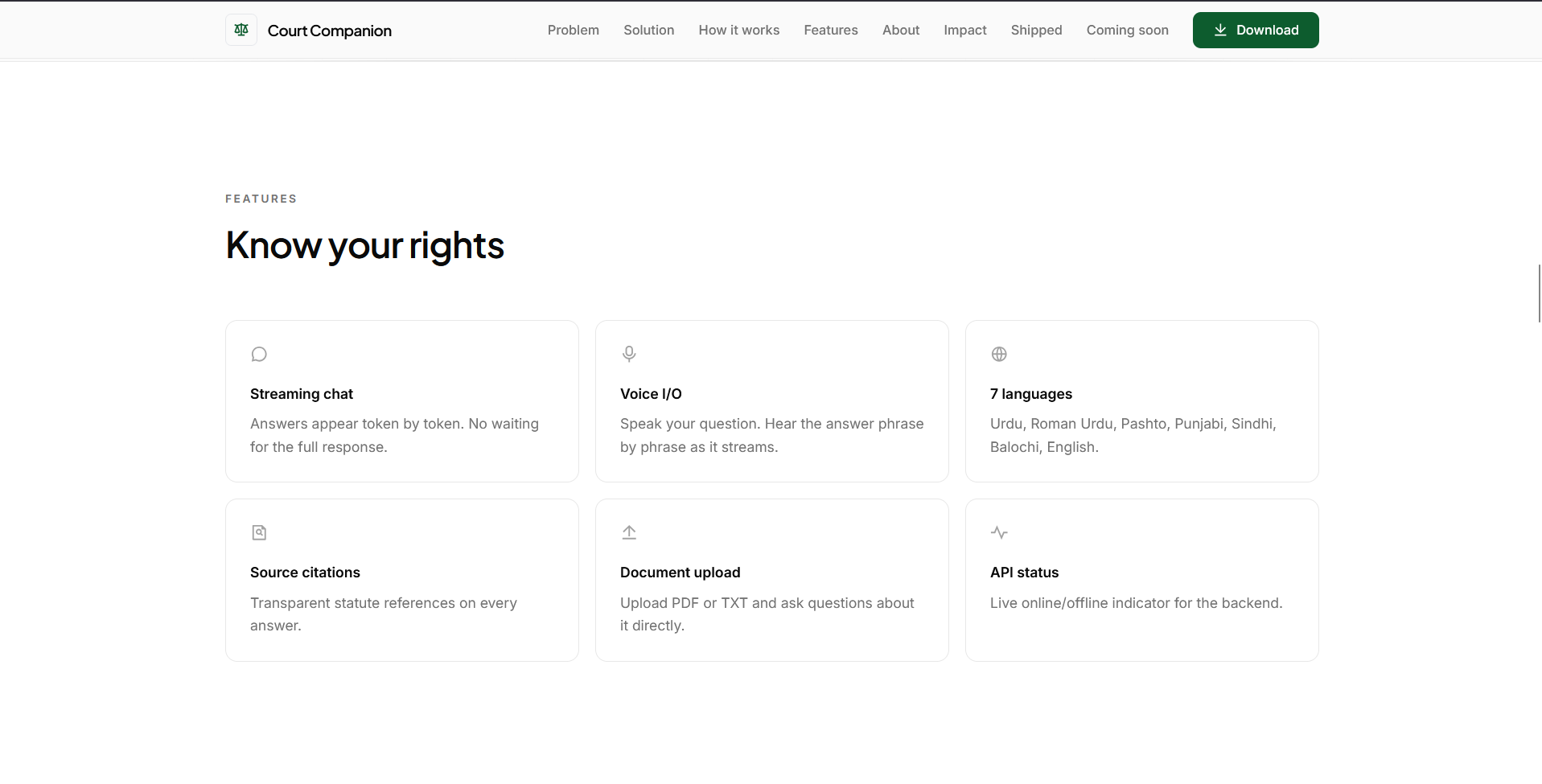
Features
-
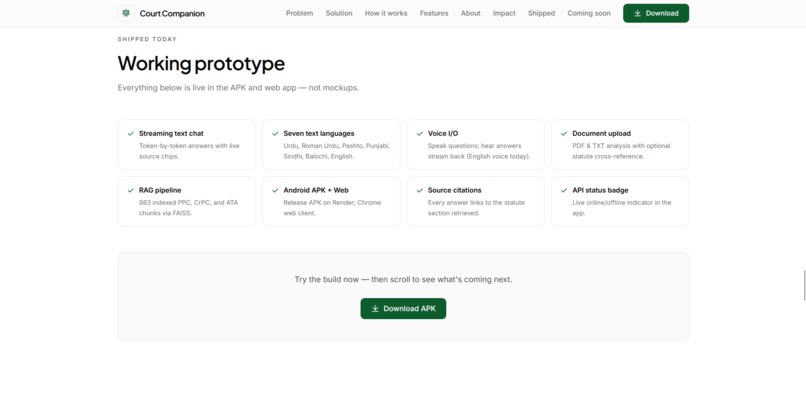
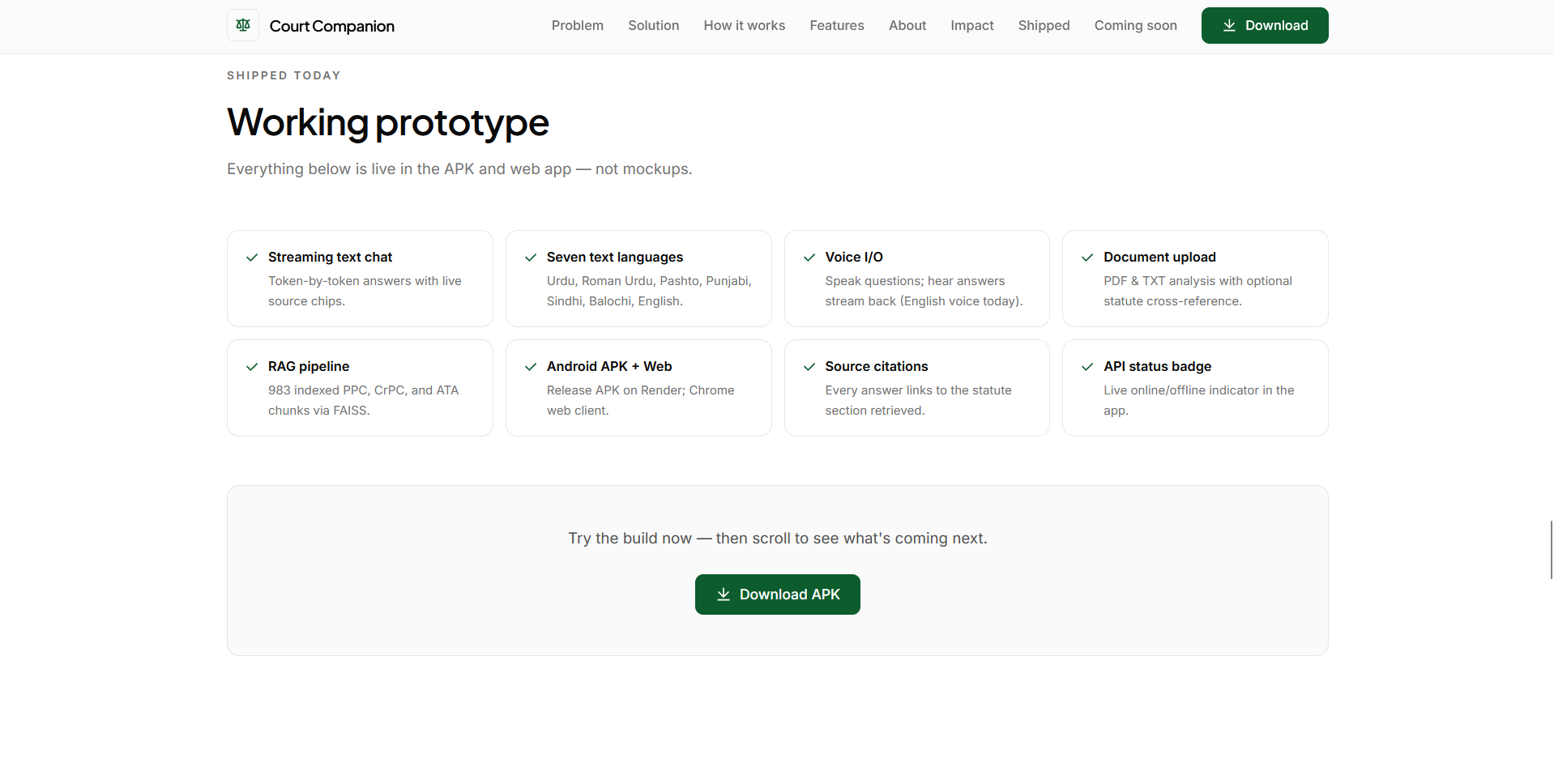
Whats done till now?
-
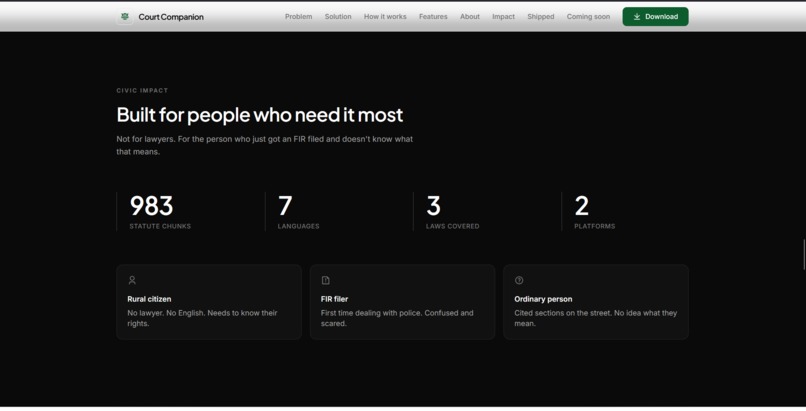
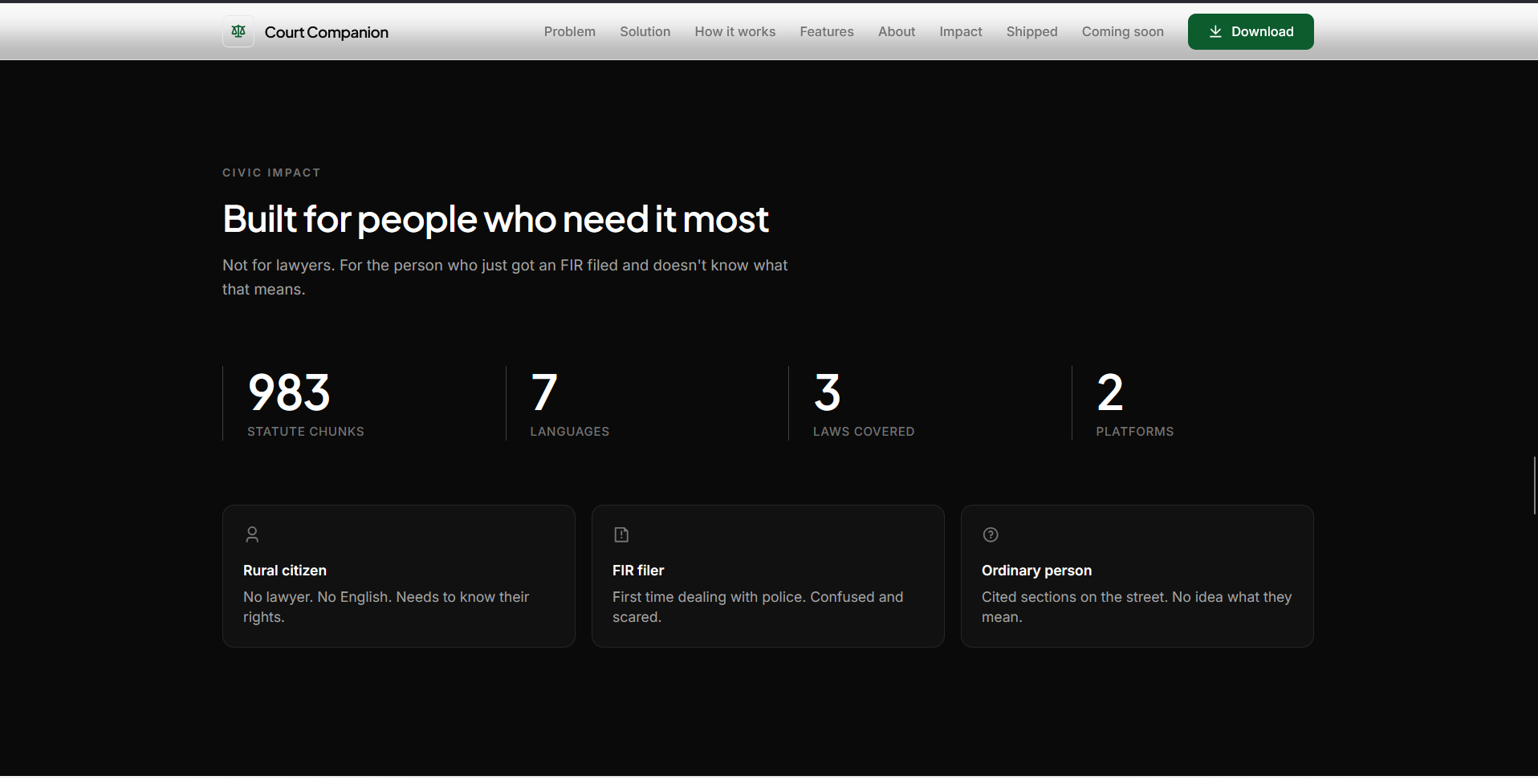
Impact
-
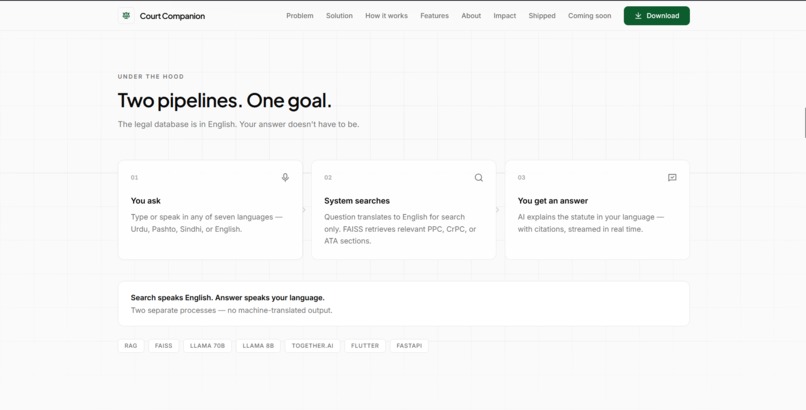
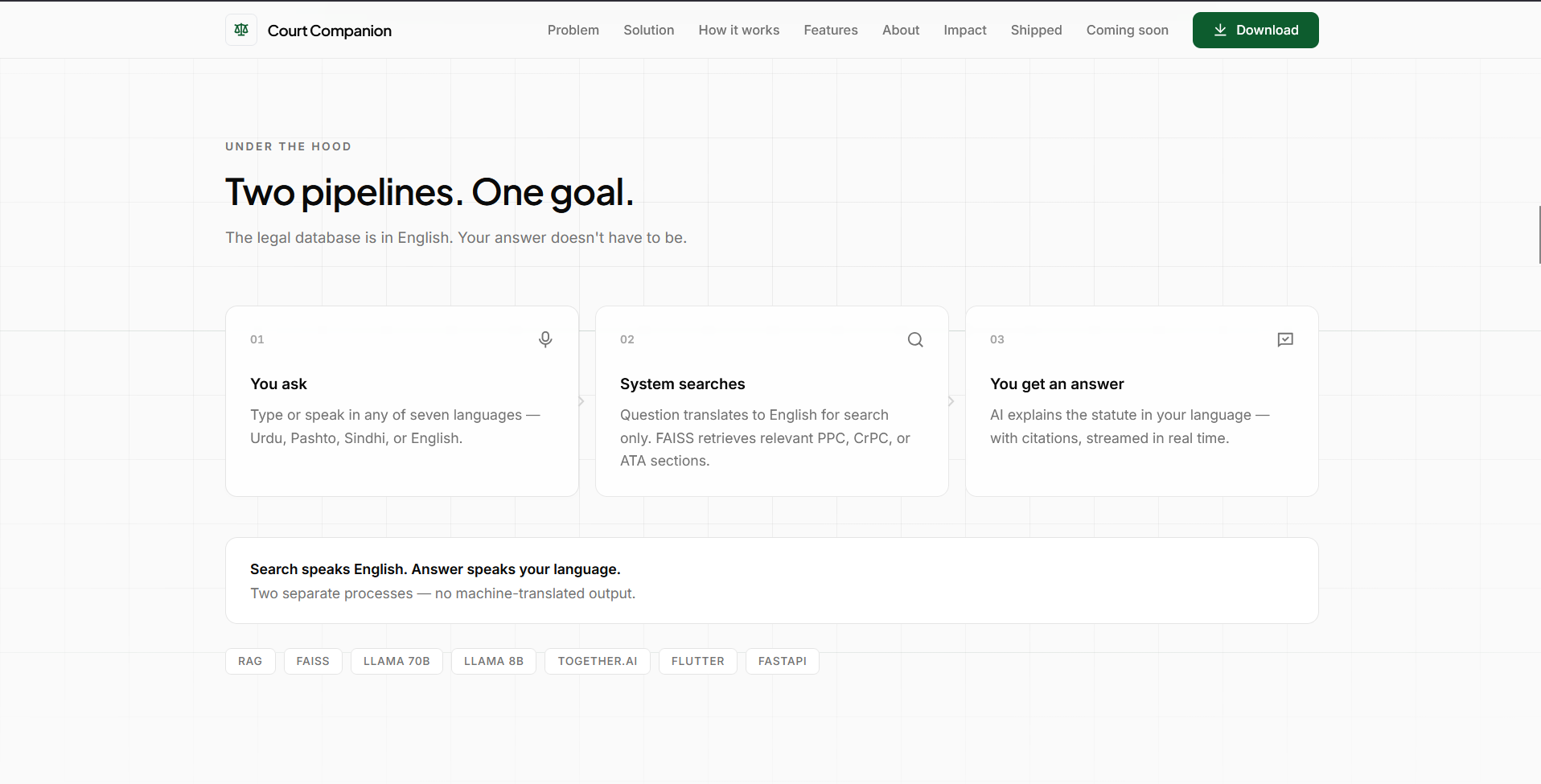
Technical Execution
-
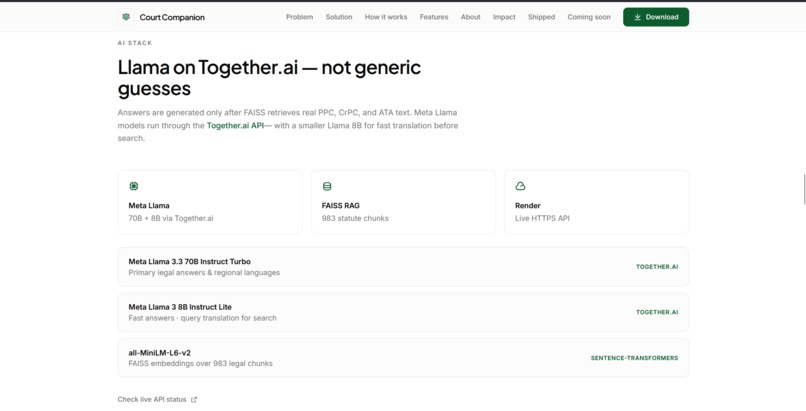
AI Stack
-
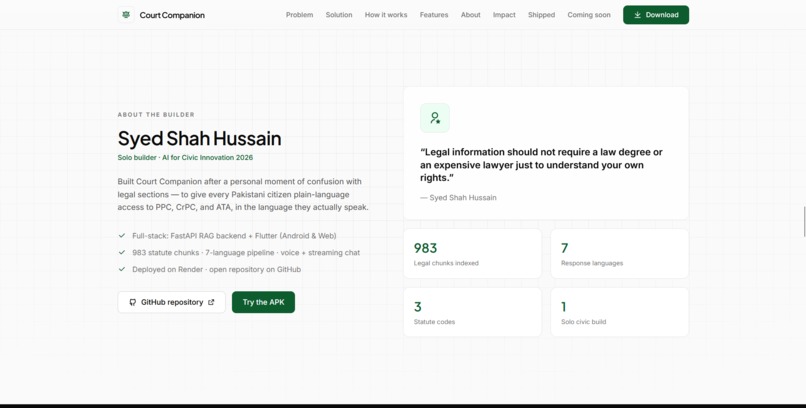
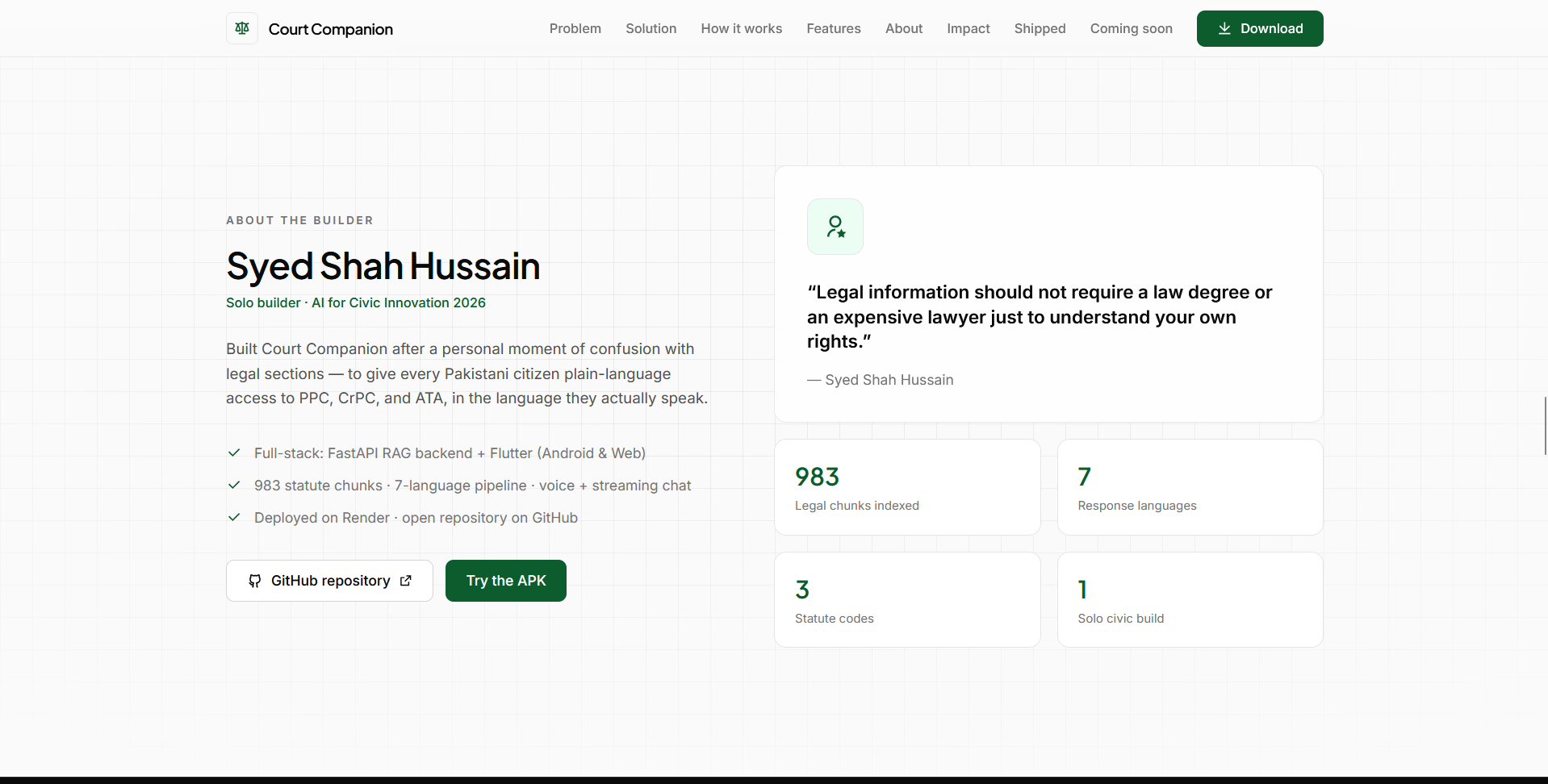
About Me : )
-
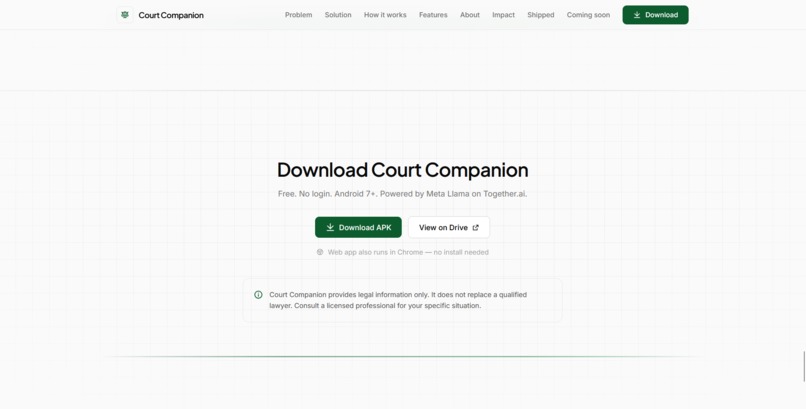
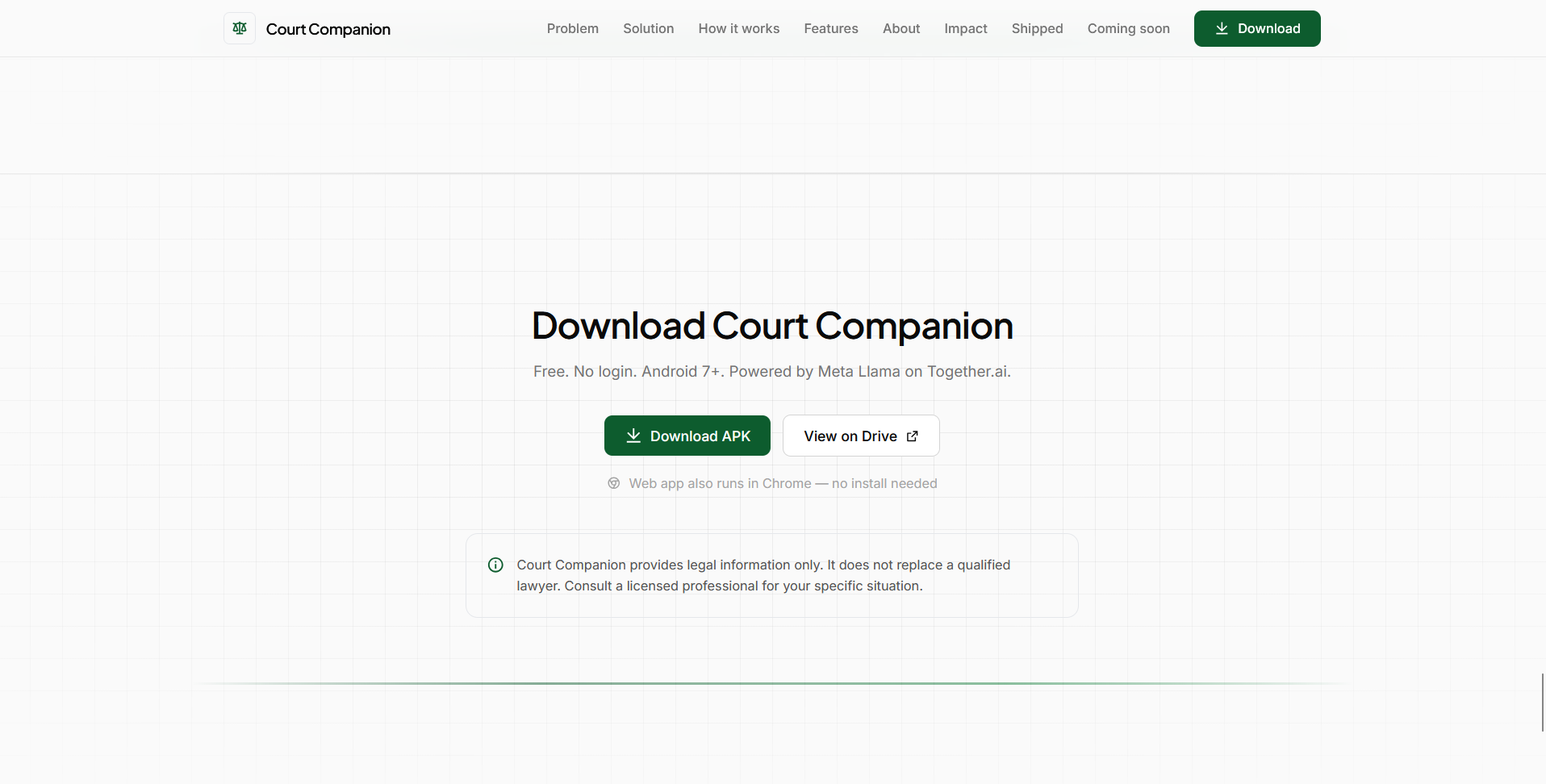
CTA
-
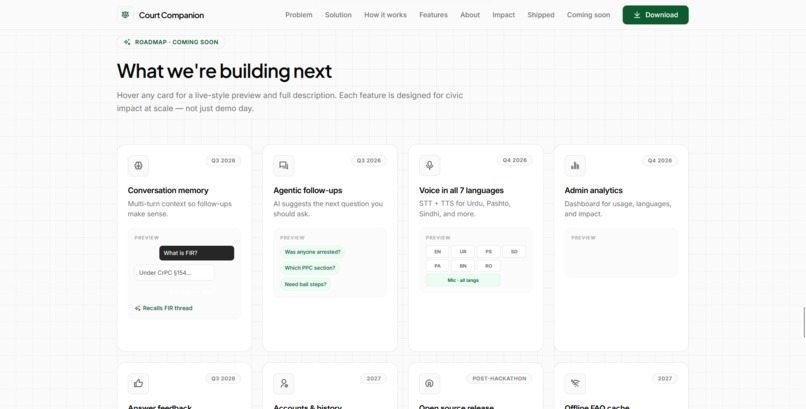
Coming Soon (Next 4 Days)
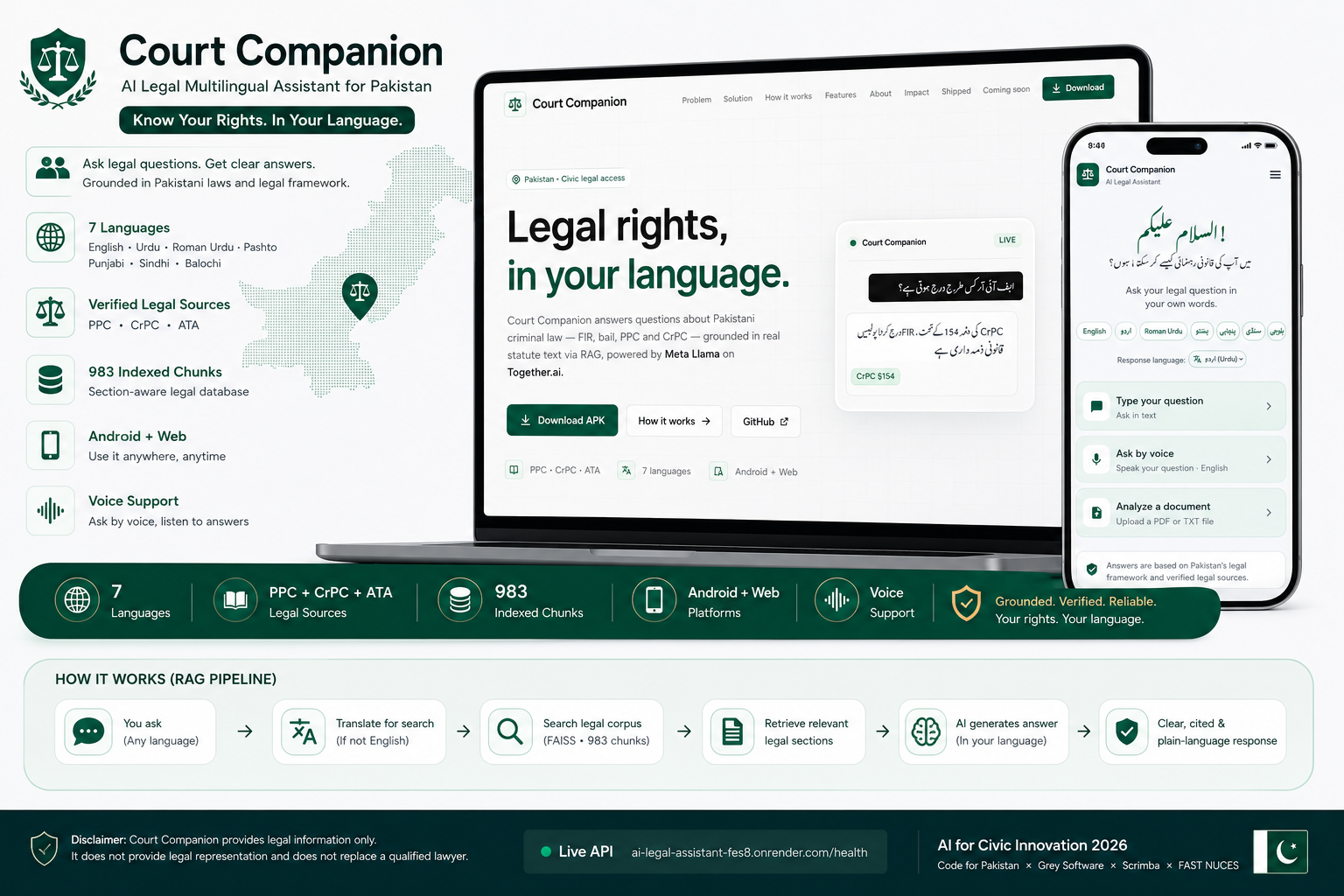
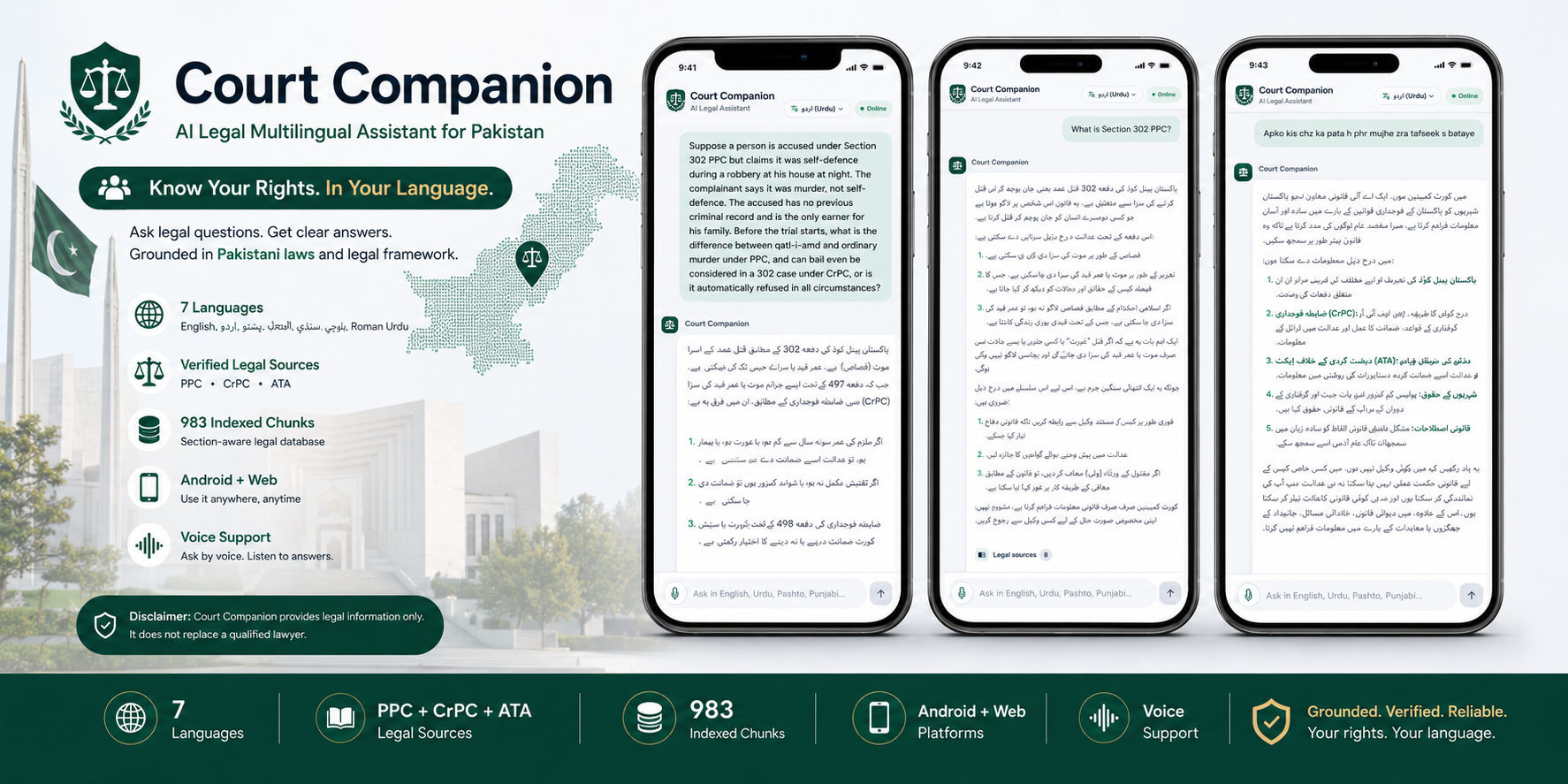
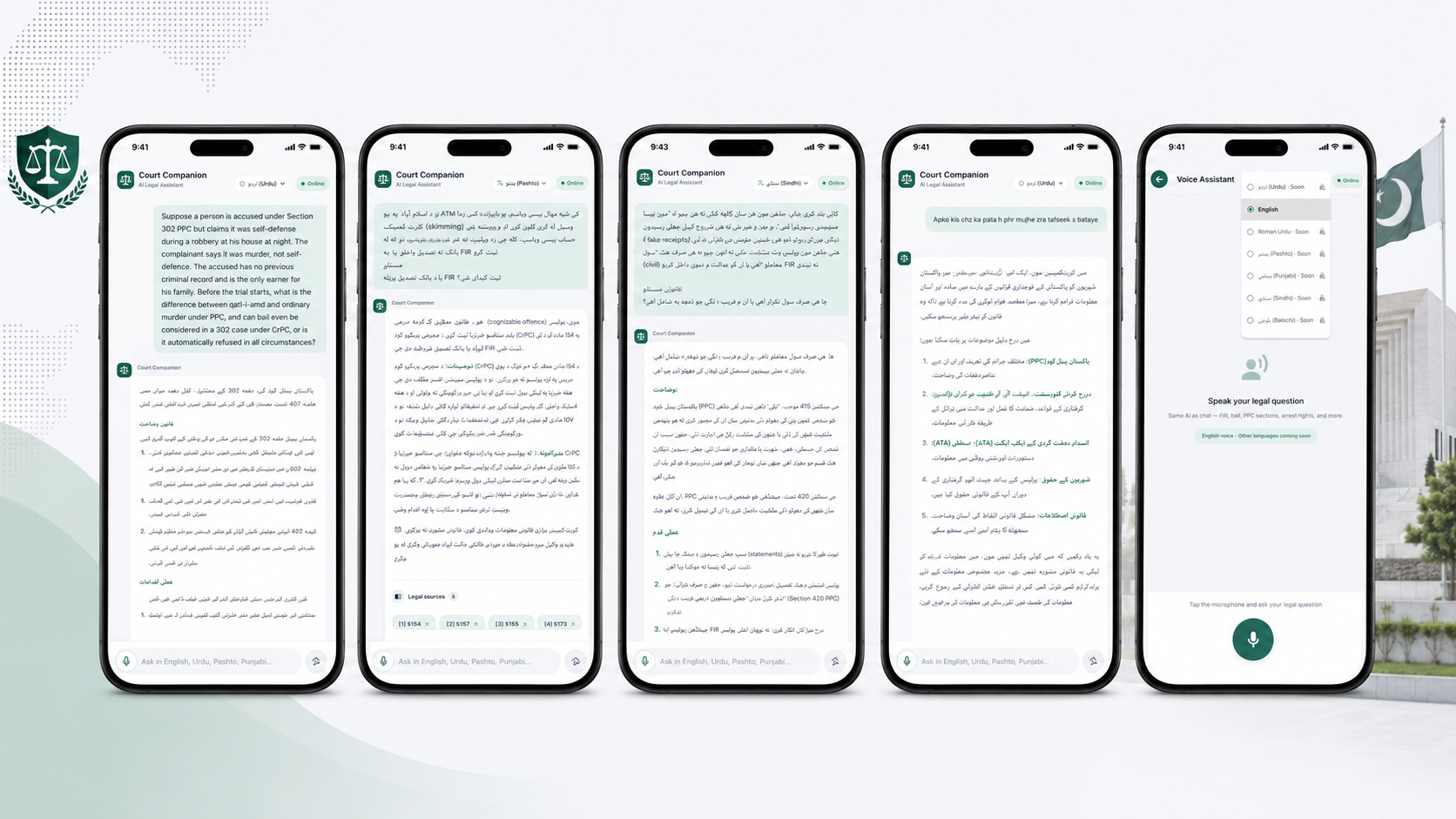
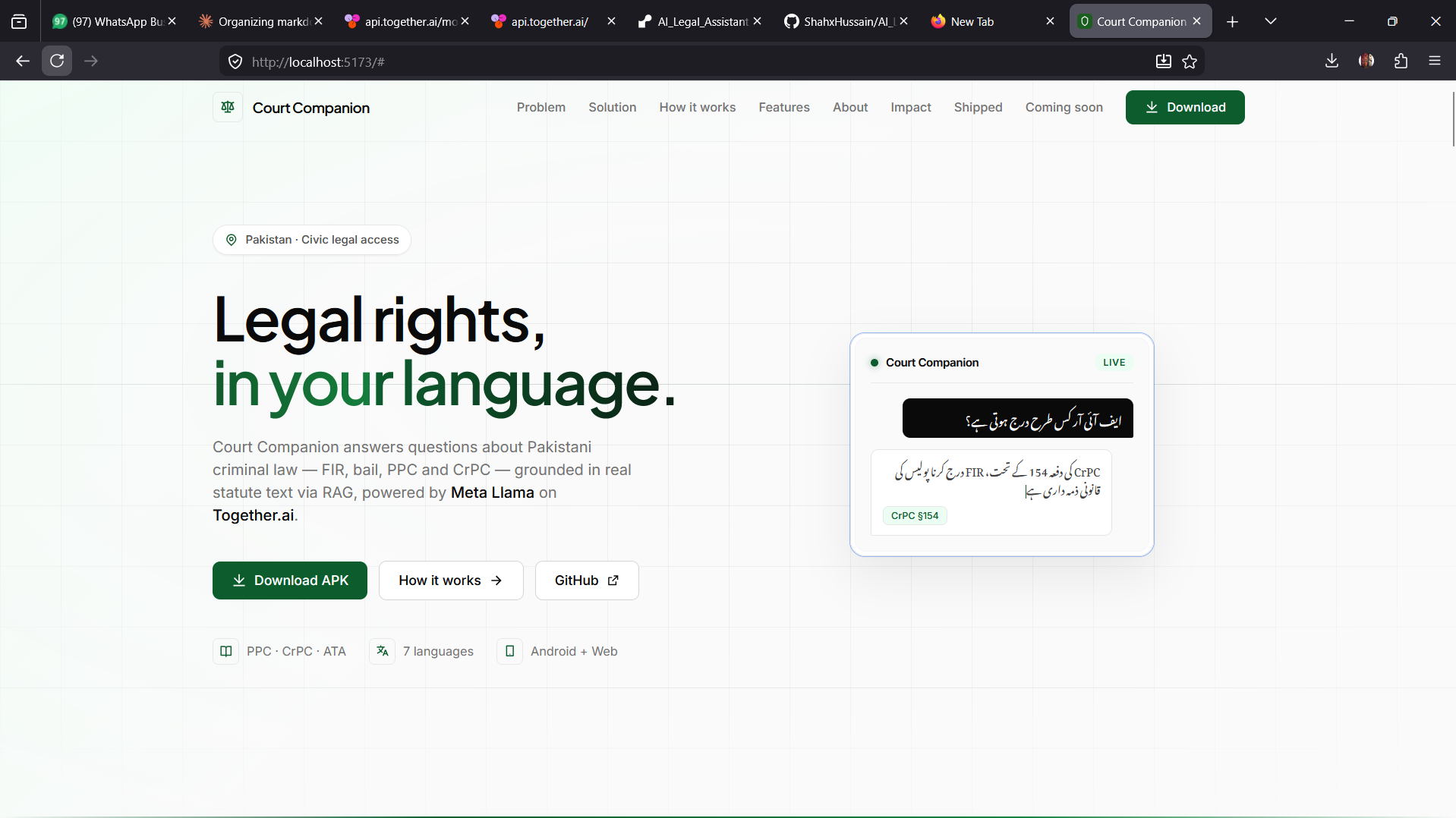
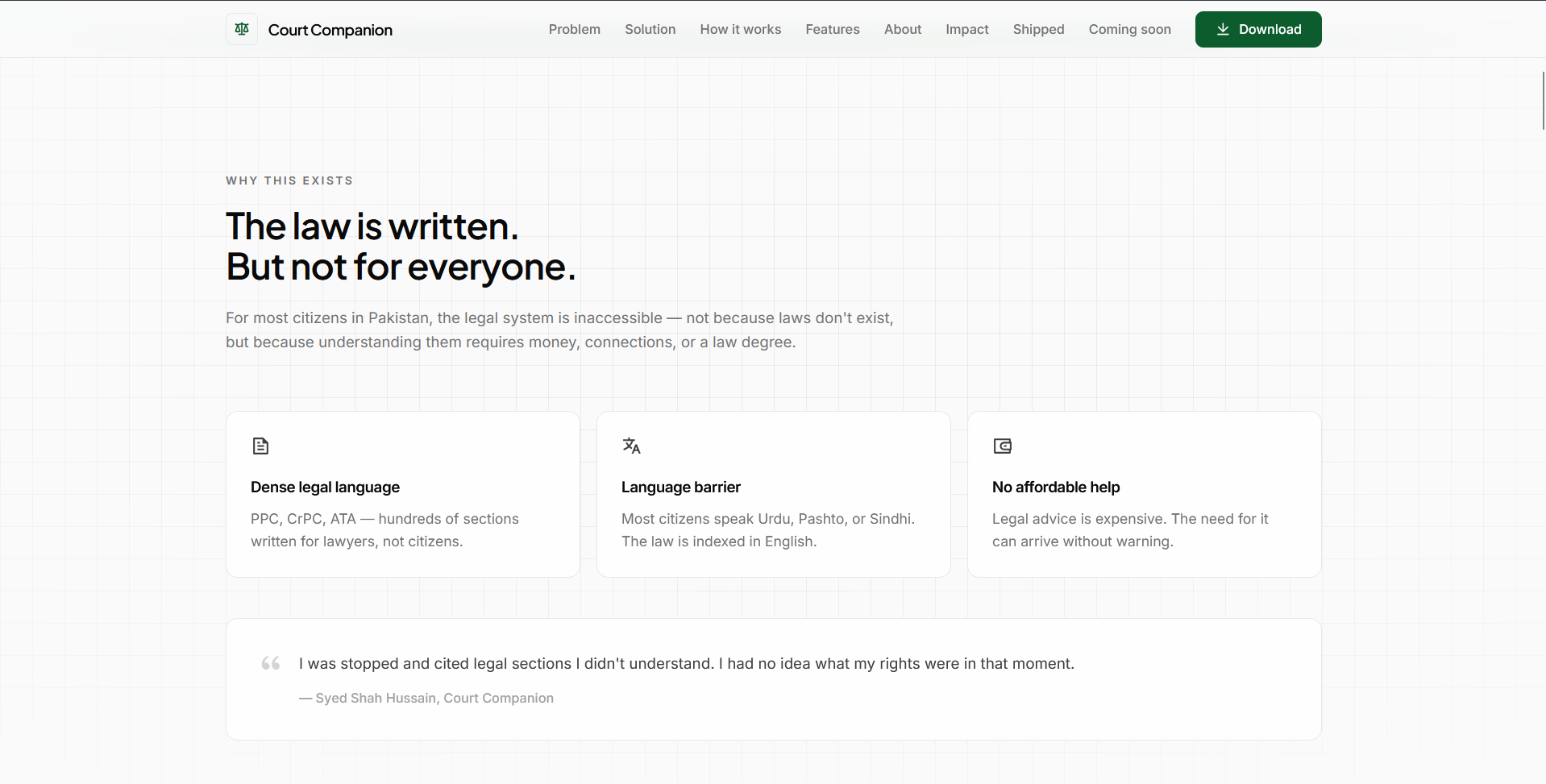
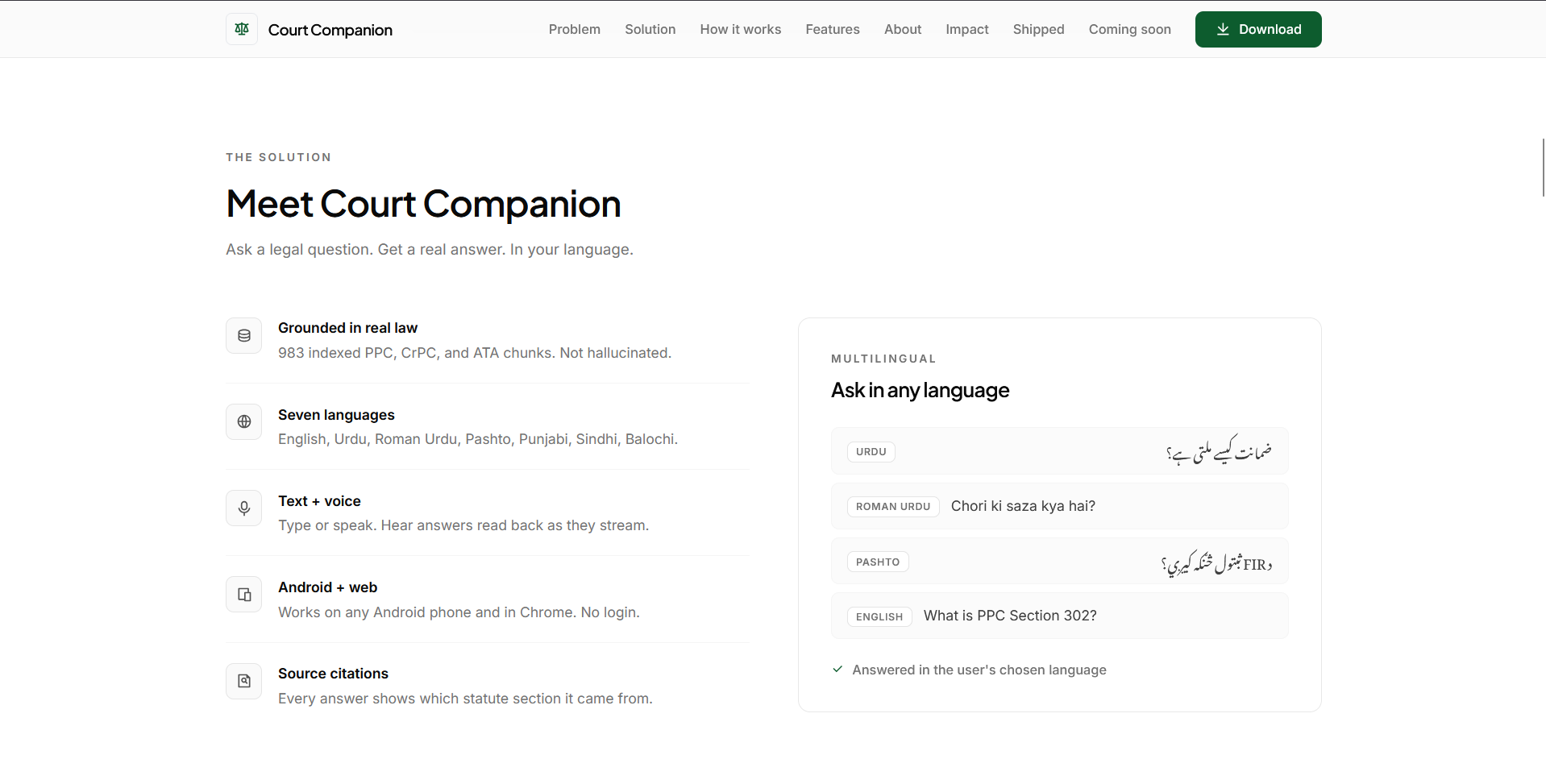
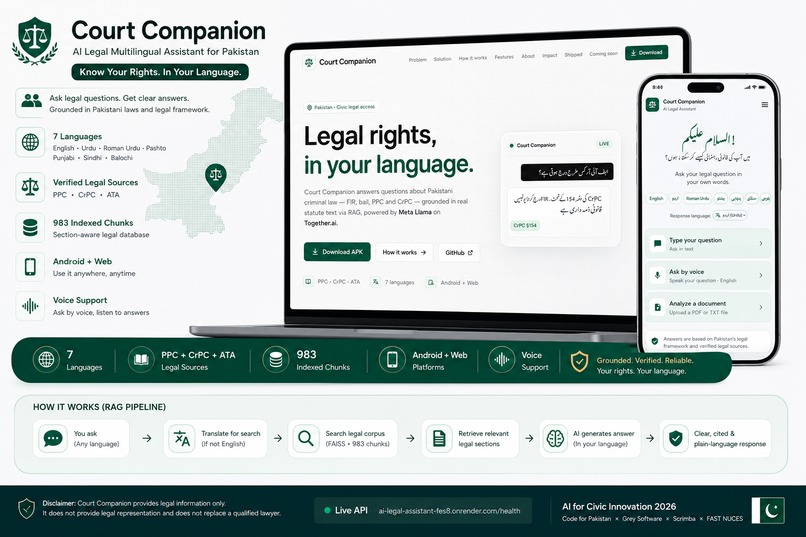
Court Companion | AI Legal Multilingual Assistant for Pakistan
Theme 3: Open Data & Access to Information
LIVE Here: https://ai-legal-assistant-seven.vercel.app/
| Admin dashboard | https://ai-legal-assistant-seven.vercel.app/admin |
| Admin Passkey | Admin123
Why I Built This
Here's the honest story behind this project.
At some point, I — along with some people I know — had an unsettling experience during travel. We were stopped and questioned in a way that felt intimidating. The officer brought up legal sections, offence numbers, and procedural language that I didn't fully understand. That moment was confusing and frightening. You just want to resolve the situation and move on — but you don't know what your rights are, what those law sections actually mean, or how to respond calmly.
I'm not making accusations against anyone — many officers serve with integrity. But that experience stayed with me. It showed how easily a lack of legal literacy can leave ordinary people feeling powerless, even when they've done nothing wrong.
When I saw the AI for Civic Innovation Hackathon, it clicked: what if legal rights and procedures were accessible to anyone, in their own language, on their phone — before or during a stressful moment?
That's why Court Companion exists.
Disclaimer: Court Companion provides legal information only — not legal advice or representation.
The Problem
Most citizens in Pakistan can't easily understand criminal law — FIR procedures, bail rights, PPC/CrPC sections — especially when they're under pressure, communicating in Urdu or a regional language. And real situations are rarely simple "What does Section X mean?" questions.
They look more like:
- "The police are refusing to file my FIR — is that even allowed?"
- "My cousin was arrested without a warrant — what happens now?"
- "I acted in self-defence but I'm being accused of murder — can I even get bail?" Court Companion is designed to answer these real-world, scenario-based legal questions by combining statutory retrieval (PPC, CrPC, ATA) with plain-language explanations grounded in the law.
These are messy, multi-part, real-life situations — mixed with conflicting advice from neighbours, police, and "a guy who knows a guy." Keyword search doesn't work here. Generic AI just makes things up. People are left more confused than when they started.
What I Built
Court Companion is an AI legal assistant that thinks through real situations — not just definitions.
Ask it a textbook question like "What is PPC 379?" and it'll explain it clearly. But ask it a real, messy situation — with multiple facts, conflicting claims, and an actual decision to make — and it walks through it properly: identifies which laws apply, explains the relevant procedure, and lays out what the person's actual rights and next steps are.
- In plain, simple language
- Grounded in real Pakistani statutes (PPC, CrPC, ATA) — every answer is backed by the actual law text, not guesses
- Using RAG (Retrieval-Augmented Generation) — finds the relevant sections first, then reasons through the scenario using them
- In 7 languages for text — Urdu script, Roman Urdu, Pashto, Punjabi, Sindhi, Balochi, and English
- Voice in English and Urdu — speak your question and hear answers aloud (more voice languages as resources allow)
- Three ways in from home: Ask in chat · Ask by voice · Court Companion Pro (beta info for lawyers)
- Runs on Android (APK) and web (Chrome)
Court Companion is an AI-powered multilingual legal assistant that helps Pakistani citizens understand their rights, FIR procedures, bail, and criminal laws (PPC, CrPC, ATA) in plain language. Built with Flutter for Android and Web, users can ask questions by text or voice in seven languages. Behind the app, a FastAPI backend on Render uses Retrieval-Augmented Generation (RAG): non-English questions are translated to English for search across 983 indexed statute chunks, then the model explains the retrieved legal sources in the user's chosen language with live streaming and source citations.
It makes trustworthy legal information accessible when people need it most — not as a dictionary, but as someone walking through the situation with you.
What It Can Handle — Real Scenarios, Not Just Definitions
This is the part that's hard to capture in a feature list, so here are real examples of the kind of situations Court Companion is built to handle. These aren't simplified "textbook" questions — they're the kind of messy, multi-part, real-life situations people actually bring.
Scenario — "My cousin was arrested without a warrant"
My cousin was arrested yesterday evening from his home without showing any warrant. The police said it is related to a fight that happened three days ago where someone was injured but not killed. He has not been produced before any magistrate yet and it has been more than 24 hours. If the injury was serious but not fatal, can police still hold him without bail, and under which sections of CrPC and PPC should his family understand his rights regarding bail and production before a magistrate?
Why this matters
A simple FAQ bot can answer "what is PPC 302?" Court Companion is built to handle the version of the question that actually shows up in someone's life — with conflicting information, emotional stakes, multiple legal issues tangled together, and a real decision on the other end. That's the gap between "looks like AI" and "is actually useful."
Target Audience
| Primary Users | Secondary Users |
|---|---|
| General citizens — people seeking quick and simple legal guidance | Legal aid organizations — groups providing free or low-cost legal help |
| Students — learners exploring basic legal awareness and rights | NGOs — organizations working on legal awareness and social justice |
| Rural communities — users with limited access to legal resources | Community support groups — local bodies assisting people with legal issues |
| Low-literacy users — individuals needing easy, simplified legal explanations | Legal researchers — professionals studying laws, cases, and legal systems |
| Individuals under stress or intimidation — people needing urgent legal clarity in difficult situations | Lawyers & advocates — future Court Companion Pro workspace (beta info in app today) |
| Women and first-time complainants — especially in harassment, domestic disputes, or property cases where not knowing the process means giving up before even starting | — |
How It Works — The Tech Stack
Before I commit to a final stack, I'm testing all these things to answer two honest questions — is this actually feasible, or not? Am I on the right track, or not? Everything here is still being evaluated. Later on, the plan is to replace proprietary APIs with open-source alternatives where possible.
Step-by-step (what happens when you ask a question)
| Step | Layer | What happens |
|---|---|---|
| 1 | User | Opens Ask in chat or Ask by voice from home; picks response language. |
| 2 | Flutter | Sends POST /ask/stream with { question, language, device_id, conversation_id } to Render. |
| 3 | API | Validates request; checks FAISS index and Together.ai API key. |
| 4 | API | Resolves or creates a conversation (Supabase) for multi-turn context when configured. |
| 5 | API | IF greeting/small talk → skip search, LLM replies briefly. ELSE → legal RAG path. |
| 6 | API | IF question is not English → Llama 8B translates it to an English search query. |
| 7 | API | Embeds the English query → FAISS retrieves top PPC/CrPC/ATA chunks (hybrid keyword + vector). |
| 8 | API | Builds prompt: prior turns + English statute text + mandatory answer-language rule from app picker. |
| 9 | API | Primary LLM streams the answer token-by-token in the user's chosen language (model is env-configurable — Gemma 4 31B on Render today). |
| 10 | Flutter | Shows live text, top 3 source chips (most relevant), disclaimer; optional 👍/👎; voice mode speaks each sentence as it arrives. |
Court Companion uses two separate language pipelines that must not be confused:
| Pipeline | Purpose | When it runs |
|---|---|---|
| A — Search translation | Turn the user's question into English so FAISS can find the right statute chunks | Before retrieval |
| B — Response language | Tell the LLM which language to write the answer in | During generation |
The knowledge base (embeddings + FAISS index) is English-only.
The user's answer can still be in any of 7 languages.
Knowledge Sources
| Source | Coverage |
|---|---|
| Pakistan Penal Code (PPC) | Offences, punishments, sections |
| Criminal Procedure Code (CrPC) | FIR, arrest, bail, investigation |
| Anti-Terrorism Act (ATA) | Scheduled offences & procedures |
Why RAG and not just a chatbot?
Legal statutes are long, dense, and multilingual — keyword search alone fails. Citizens describe real situations, not search terms. RAG retrieves the relevant sections first, then the LLM reasons through the scenario using them. The translate-before-retrieve step makes an English-indexed corpus work across Urdu, Pashto, Sindhi, and more — so the reasoning step still happens in the user's own language.
Technology Stack
| Layer | Technology |
|---|---|
| Frontend | Flutter (Dart) — Android, Web |
| Backend | FastAPI (Python) |
| Database | Supabase PostgreSQL — conversations, messages, feedback, usage events |
| Vector search | FAISS (file-based, 983 vectors) |
| LLM API | Together.ai |
| Hosting | Render (API) · Vercel (landing + admin UI) |
| Voice | speech_to_text, browser TTS / flutter_tts |
| Admin | React + Vite at /admin on landing site |
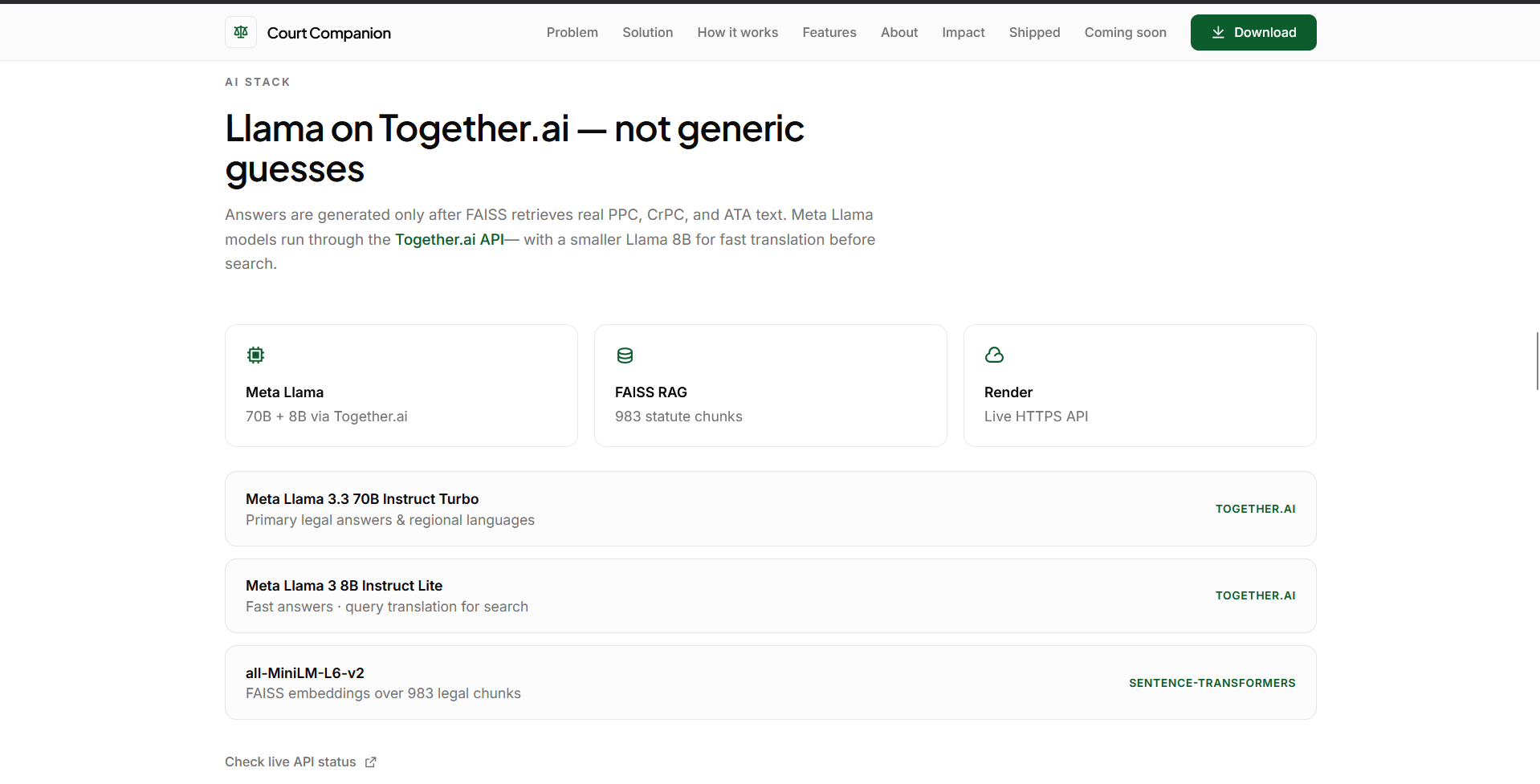
Models — what we use and how
| Model | Provider | Role in pipeline |
|---|---|---|
| meta/meta-llama/Meta-Llama-3-70B-Instruct-Turbo | Together.ai | Primary answer generation on deployed API (Render LLM_MODEL) |
| meta-llama/Meta-Llama-3-8B-Instruct-Lite | Together.ai | Query translation — non-English questions → English before FAISS search |
| all-MiniLM-L6-v2 | sentence-transformers (local) | Embeddings — runs on the API server; no per-query API cost |
How the LLM is used (not a raw chatbot):
- Retrieve first — FAISS finds relevant PPC/CrPC/ATA chunks (hybrid vector + keyword).
- Constrain the prompt — system prompt says: answer only from retrieved context; cite sources; legal information not advice.
- Guard output — sanitize step strips unsafe formatting; preserve Urdu script.
The model never sees the full statute books — only the top-k retrieved chunks plus short conversation history (capped). That keeps token use bounded and reduces hallucination risk.
Model choice is swappable — change LLM_MODEL in Render env; no app rebuild required.
Cost — honest numbers
| Layer | Hackathon / pilot cost | Notes |
|---|---|---|
| Render API | $0 (free tier) | Cold start ~30–50s after idle; fine for demo, not for 24/7 production |
| Vercel (landing + web) | $0 (hobby) | Static landing + Flutter web build |
| Supabase | $0 (free tier) | Conversations, feedback, usage events |
| Embeddings | $0 at runtime | Pre-built index; MiniLM runs locally on server |
| Together.ai | Pay-per-token — main variable cost | Only paid component at scale |
Cost controls already in the architecture:
- RAG reduces tokens — model reads ~5–8 chunks, not whole corpora
max_tokenscaps per request (LLM_MAX_TOKENSon Render)- Conversation history limited (
CONVERSATION_HISTORY_LIMIT=10) - Smaller 8B model for translation only; larger model only for final answer
- Admin dashboard tracks volume — can throttle or switch to cheaper model if usage spikes
Scalability
Today (prototype): One Render instance, file-based FAISS in memory, Supabase for state. Good for hundreds to low thousands of users/month on free tiers.
What scales cleanly:
| Piece | Now | Scale path |
|---|---|---|
| Client | Flutter web + APK | Stateless; CDN/Vercel handles web traffic |
| API | Single FastAPI container | Horizontal replicas behind load balancer |
| Vector search | FAISS in RAM (~983 vectors) | Chroma / pgvector / Pinecone when corpus grows to case law |
| LLM | Together.ai API | Managed inference — no GPU ops on our side |
| DB | Supabase Postgres | Connection pooling; read replicas at NGO scale |
| Index builds | Offline build_index.py |
Rebuild on corpus update; no downtime if blue-green deploy |
Features
Everything below is implemented and working in the current prototype — not a mockup.
App & access
| Feature | What you get |
|---|---|
| Home screen | Ask in chat · Ask by voice · Court Companion Pro (beta) |
| Platforms | Flutter web (Vercel — primary) + Android APK (release build → Render API) |
| Landing page | React marketing site with Pro section, live links, admin at /admin |
| API status | Online / offline badge on chat and voice screens |
| No login required | Anonymous device_id — citizens use the app without accounts |
Text chat
| Feature | What you get |
|---|---|
| Streaming answers | Live token stream, markdown, source chips, disclaimer |
| 7 text languages | English, Urdu (script), Roman Urdu, Pashto, Punjabi, Sindhi, Balochi |
| Chat history sidebar | Reopen past conversations; tap New chat for a fresh thread |
| Session follow-up | Same chat thread keeps context — e.g. FIR first, then "What about bail?" |
| Document attach | PDF/TXT via clip icon in chat or /analyze-document API |
| Answer feedback | 👍 / 👎 on each reply → admin Helpfulness metrics |
Voice assistant
| Feature | What you get |
|---|---|
| English voice | Mic input (STT) + spoken streaming answers (TTS) |
| Urdu voice | Speak in Urdu (اردو) and hear replies in Urdu script — same RAG backend as chat |
Legal intelligence (RAG)
| Feature | What you get |
|---|---|
| Statute corpus | PPC, CrPC, ATA — 983 indexed chunks with section metadata |
| Hybrid retrieval | FAISS vector search + keyword signals; translate-before-retrieve for non-English |
| Scenario reasoning | Multi-fact questions → applicable law, procedure, rights, next steps |
| Source citations | Every legal answer tied to retrieved statute excerpts; UI shows top 3 most relevant chips |
| Output guard | Sanitized LLM output; preserves Urdu punctuation and formatting |
How analytics categorizes "hot topics":
- When a user asks a question, the API runs keyword-based topic detection on the question text (e.g.
fir,bail,theft,ppc_sections,arrest_rights,fraud,assault,terrorism, orother). - These tags are stored on
usage_events→ admin Top topics chart. - Feedback (👍/👎) is stored separately in
answer_feedback— drives Helpfulness % (up vs down in last 7 days). Topics on feedback rows can be enriched later by linking to the parent question.
Dependencies & Feasibility
I want to be upfront about what I'm relying on — and what breaks if anything changes.
| Dependency | What I rely on | Risk if it changes |
|---|---|---|
| Together.ai | LLM + API for generation and translation | Model deprecation → swap model name in .env; that's it |
| Render | Free-tier HTTPS hosting for FastAPI + FAISS | Cold starts; may need paid tier for uptime |
| Supabase | Conversation history, feedback, analytics | Service outage → local chat still works; server context may lag |
| sentence-transformers | Local embeddings (all-MiniLM-L6-v2) |
Pinned version; index rebuilds if changed |
| FAISS index | File-based vector store (983 chunks) | Rebuilt from build_index.py if corpus changes |
| Flutter | Cross-platform client (APK + web) | Standard; no vendor lock-in |
Is this easy to replicate?
A basic ChatGPT wrapper — yes, in days. My stack — curated legal RAG, 7-language pipeline, voice, conversation persistence, admin analytics, APK, deployed API — would take meaningful effort. The legal data curation and section-aware indexing are the hardest part to copy quickly.
What am I currently validating?
I'm not claiming a final model choice yet. I'm actively testing:
- Answer quality across languages (sindhi, balochi)
- Reasoning quality on multi-part, scenario-based questions
- Multi-turn follow-up quality with conversation context
Known constraints (being honest):
- No dedicated funding yet — relying on free / minimal-cost resources
- First request after idle can take ~50 seconds while Render wakes up
- Voice: English + Urdu live today; five more languages once STT/TTS resources are finalized
- Agentic clarifying questions (AI asks you first) ship with Court Companion Pro, not free chat yet
Language Support
| Mode | Supported now | Coming next |
|---|---|---|
| Text (chat) | English, Urdu (script), Roman Urdu, Pashto, Punjabi, Sindhi, Balochi | — |
| Voice (STT + TTS) | English and Urdu (script) | Roman Urdu, Pashto, Punjabi, Sindhi, Balochi — as device/API resources are finalized |
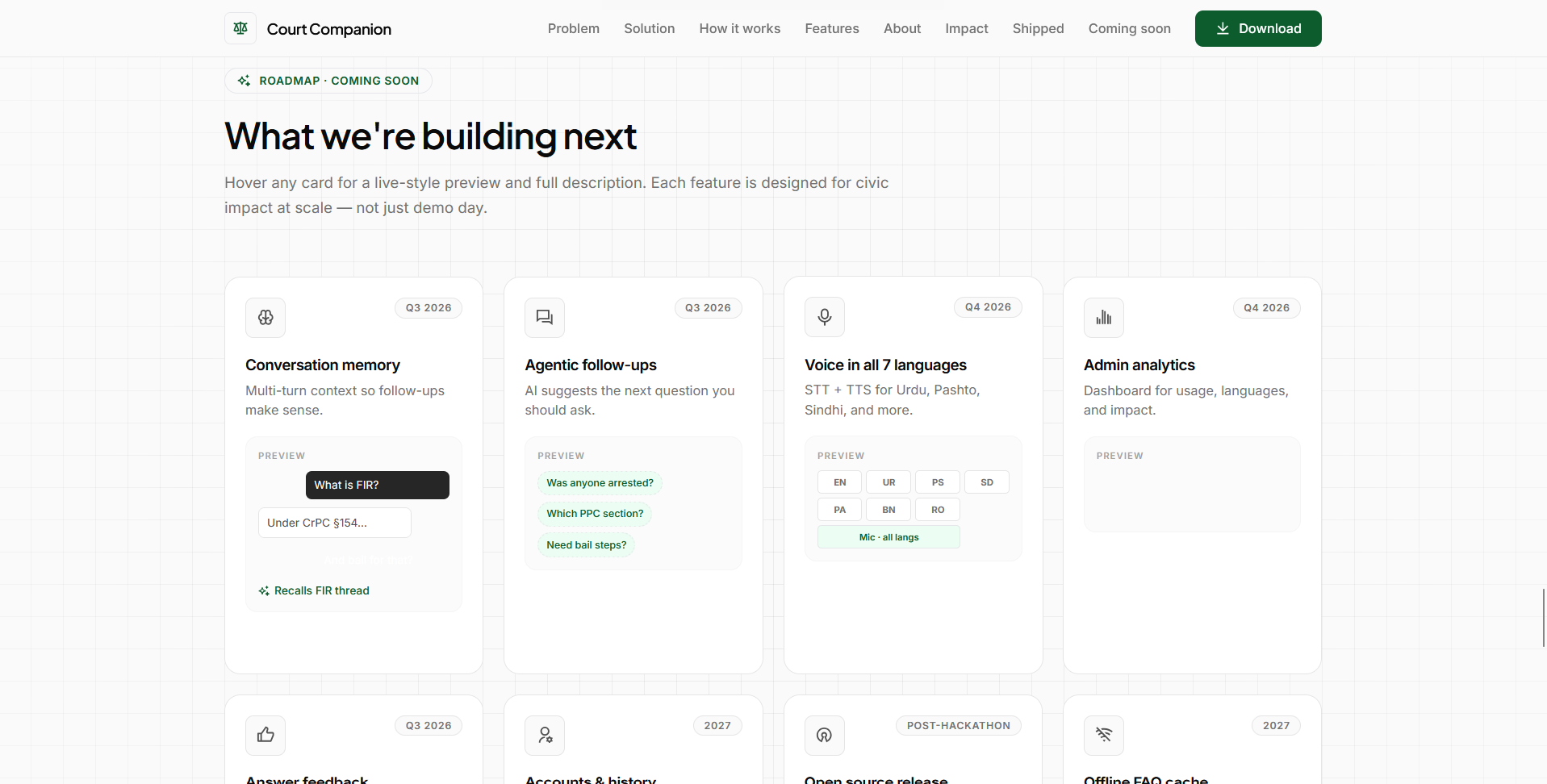
What's Coming — Roadmap
Court Companion Pro (lawyers) - Paid subscription
- Full case workspace — upload pleadings, FIR, orders; one case = full context throughout
- Agentic follow-ups — e.g. "Someone took my phone" → AI asks Was it taken by force? Do you know the person? → then cites PPC + precedents
- Case-law RAG from public Supreme Court, High Court, and Sessions judgments
- Gap / procedural flags for counsel (limitation, bail category, evidence gaps)
Platform & scale
- Voice for remaining languages — Roman Urdu, Pashto, Punjabi, Sindhi, Balochi (STT + TTS)
- Horizontal API scaling — multiple Render/Fly instances + load balancer
- Vector DB migration — pgvector or managed search when case-law corpus grows
- Offline FAQ cache — core rights without internet (rural users)
- Open source release — public repo, docs, contribution guide
- Corpus expansion — constitutional, civil, family law
Quick Summary
| Question | Answer |
|---|---|
| Working prototype? | Yes — web app, APK, chat, voice (EN + Urdu), 7 text languages, admin, deployed API |
| Live demo URL? | Web: https://ai-legal-assistant-two.vercel.app/ · Landing: https://ai-legal-assistant-seven.vercel.app/ |
| AI used meaningfully? | Yes — RAG over 983 legal chunks + multilingual LLM pipeline + multi-turn context |
| Models & cost? | Together.ai (Llama 70B generates + Llama 8B translate); ~$0 infra on free tier; pennies per question at pilot scale |
| Civic impact? | Legal rights in plain language, 7 text languages + Urdu voice, on mobile; data-driven admin KPIs |
| What's next? | Court Companion Pro workspace; more voice languages; case-law corpus; open-source path |
Built by: Syed Shah Hussain Badshah — June 2026 | AI for Civic Innovation Hackathon 2026 — Code for Pakistan × Grey Software × Scrimba × FAST NUCES — Final Round



Log in or sign up for Devpost to join the conversation.