-
-
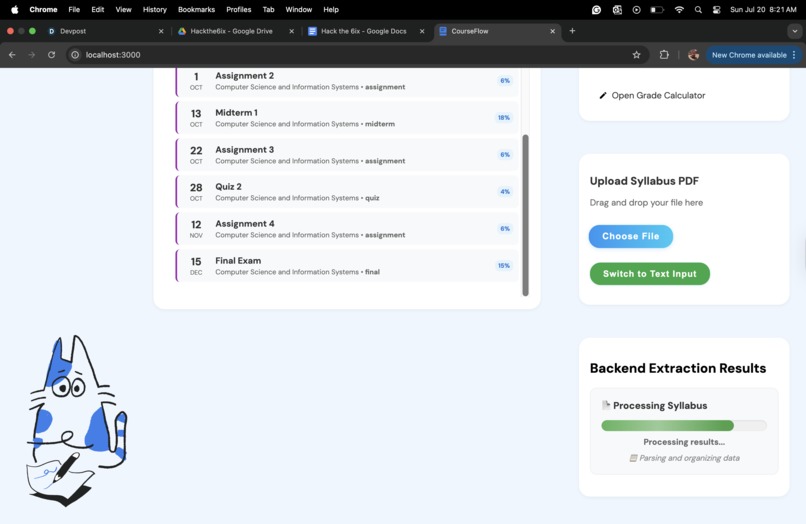
Upload your syllabus!
-
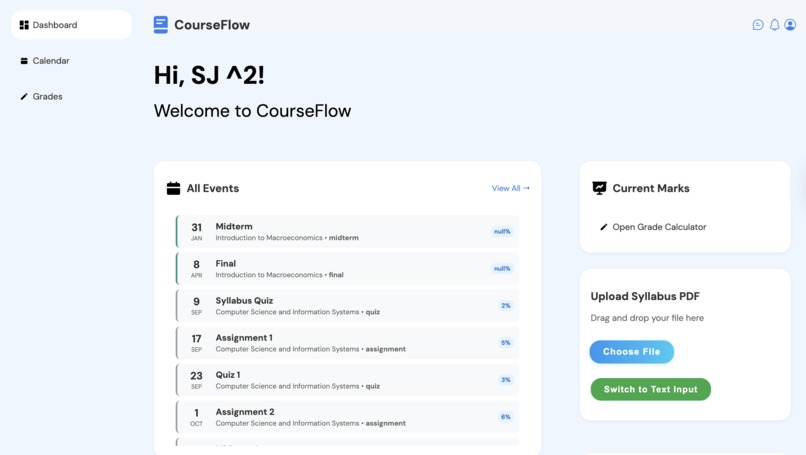
Watch as your assessments automatically get organized.
-
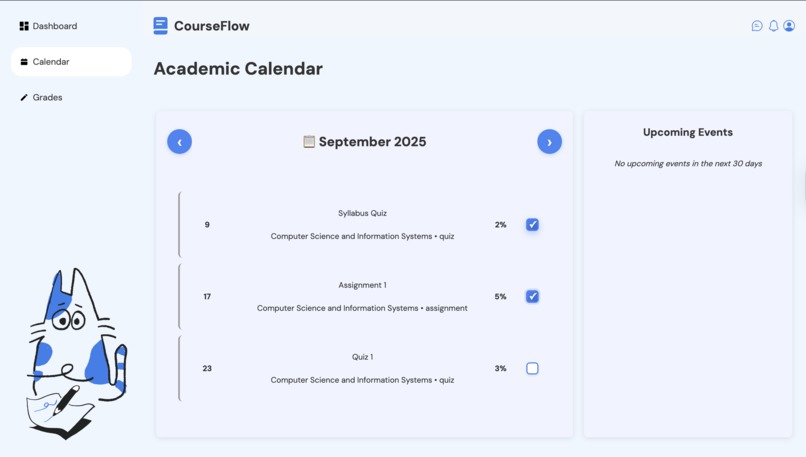
Toggle through your personalized calendar and check off completed tasks.
-
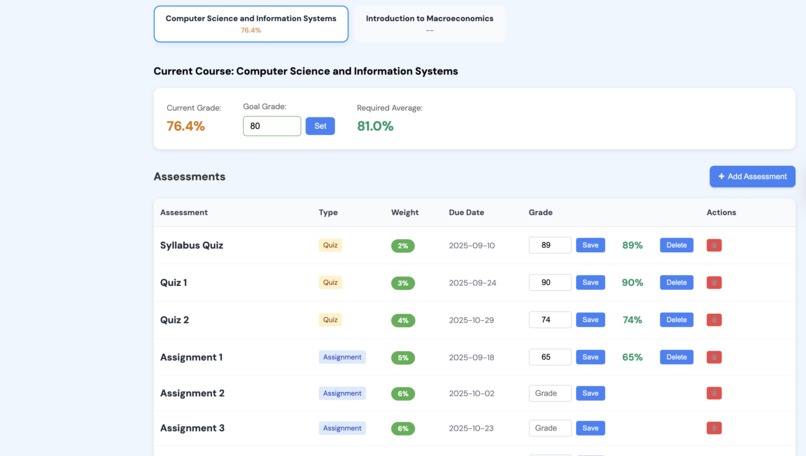
Input your marks throughout the semester to stay on track.


Inspiration
As students ourselves, we’ve often felt overwhelmed at the beginning of a new term, having to sift through lengthy syllabi to find key information and manually input calendar deadlines. Additionally, trying to calculate grades using online calculators proved frustrating because they were not course-specific and did not save user information. We realized that while academic success depends heavily on organization and clarity, the available tools are often inefficient or fragmented. We aimed to develop a solution that alleviates the mental burden of administrative tasks, enabling students to focus on what truly matters: learning.
What it does
CourseFlow allows students to upload their course syllabus, which instantly extracts important deadlines and organizes them in a user-friendly calendar. It also features a dynamic grade calculator, where students can input their current grades and goals, and receive feedback on what they need to score in order to move forward. By bundling these two powerful tools, CourseFlow offers an all-in-one academic assistant that saves time, reduces stress, and minimizes errors.
How we built it
We began with user research and UX design in Figma to map out the pain points and flows. Our front-end was developed using HTML and CSS, focusing on a clean, accessible, user-friendly UI. On the back end, we used Node.js and JavaScript to handle file parsing and logic. For syllabus parsing, we integrated the Gemini API to extract and summarize key dates into a specified format. The information was then input into variables and streamlined into the website. Throughout development, we focused on ensuring every feature truly served the user’s needs.
Challenges we ran into
Getting started with the Gemini API required overcoming hurdles around API key access and documentation, as well as file uploading. As first-time hackathon participants, we also had to quickly learn new tools and languages while managing our time, scope and team coordination, ensuring everyone worked with their most comfortable aspect. As well, connecting the front and back end, especially when deploying publicly rather than on localhost, was another learning curve. Balancing our vision with feasibility pushed us to make thoughtful design tradeoffs and prioritize effectively.
Accomplishments that we're proud of
We’re especially proud of our communication and how well we adapted as a team. Even when roadblocks came up, we collaborated with empathy and kept each other motivated. We successfully brought our initial ideas to life, from UX design to a working prototype, and managed to connect a real solution to a real problem. Our ability to stay user-focused throughout, from wireframes to final features, is something we’re genuinely proud of.
What we learned
We learned how to integrate tools like the Gemini API for PDF parsing, refining prompts to extract accurate course data. On the front end, we improved our skills in building accessible, responsive UI with HTML and CSS, while also learning how to connect components and pass data effectively. Deploying a full-stack app taught us how to manage external integrations and connect the front and back end seamlessly. Most importantly, we learned to stay user-focused and make fast, collaborative decisions under time pressure.
What's next for CourseFlow
We plan to continue refining the interface to make it even more intuitive and accessible, especially for students with different learning needs. Usability testing is a top priority so we can identify where users may get stuck or confused. Feature-wise, we hope to expand our grade calculator with smart recommendations using AI to offer students insights into their academic strengths and areas to improve. Ultimately, we want CourseFlow to be a calm, intelligent companion for every student navigating the chaos of a busy semester.
Built With
- chatgpt-4.1
- css
- cursor
- figma
- gemini
- html
- javascript
- node.js


Log in or sign up for Devpost to join the conversation.