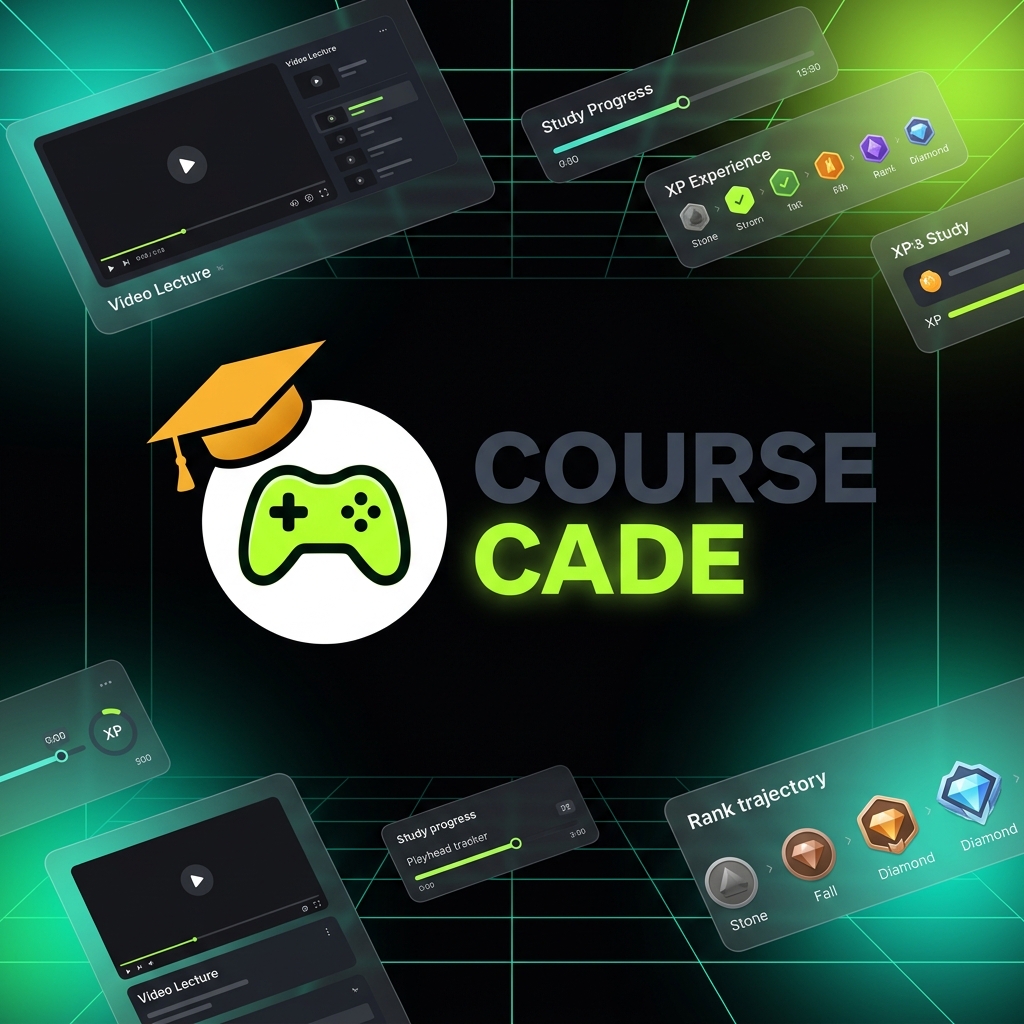
CourseCade is a gamified learn-to-earn educational streaming platform. It replaces the boring, static video player interface with a futuristic, esports-inspired Head-Up Display (HUD).
As learners watch verified curriculum videos, CourseCade tracks their active attention in real time. For every minute of legitimate study, students accomplish three things simultaneously:
Mine Real-Time Tokens: Accumulate digital cryptocurrency rewards that tick up live on the dashboard as the video plays. Gain Experience Points (XP): Boost their overall knowledge score with every milestone achieved. Climb Rank Trajectory Tiers: Progress through a competitive multi-tiered ranking system—starting at rough Stone, forging through Bronze, Silver, Gold, and Platinum, all the way to the prestigious Diamond tier. 🔍 How it works (in detail) To ensure that progress is earned fairly and the user experience remains frictionless, CourseCade operates on a multi-layered telemetry and state-verification architecture:
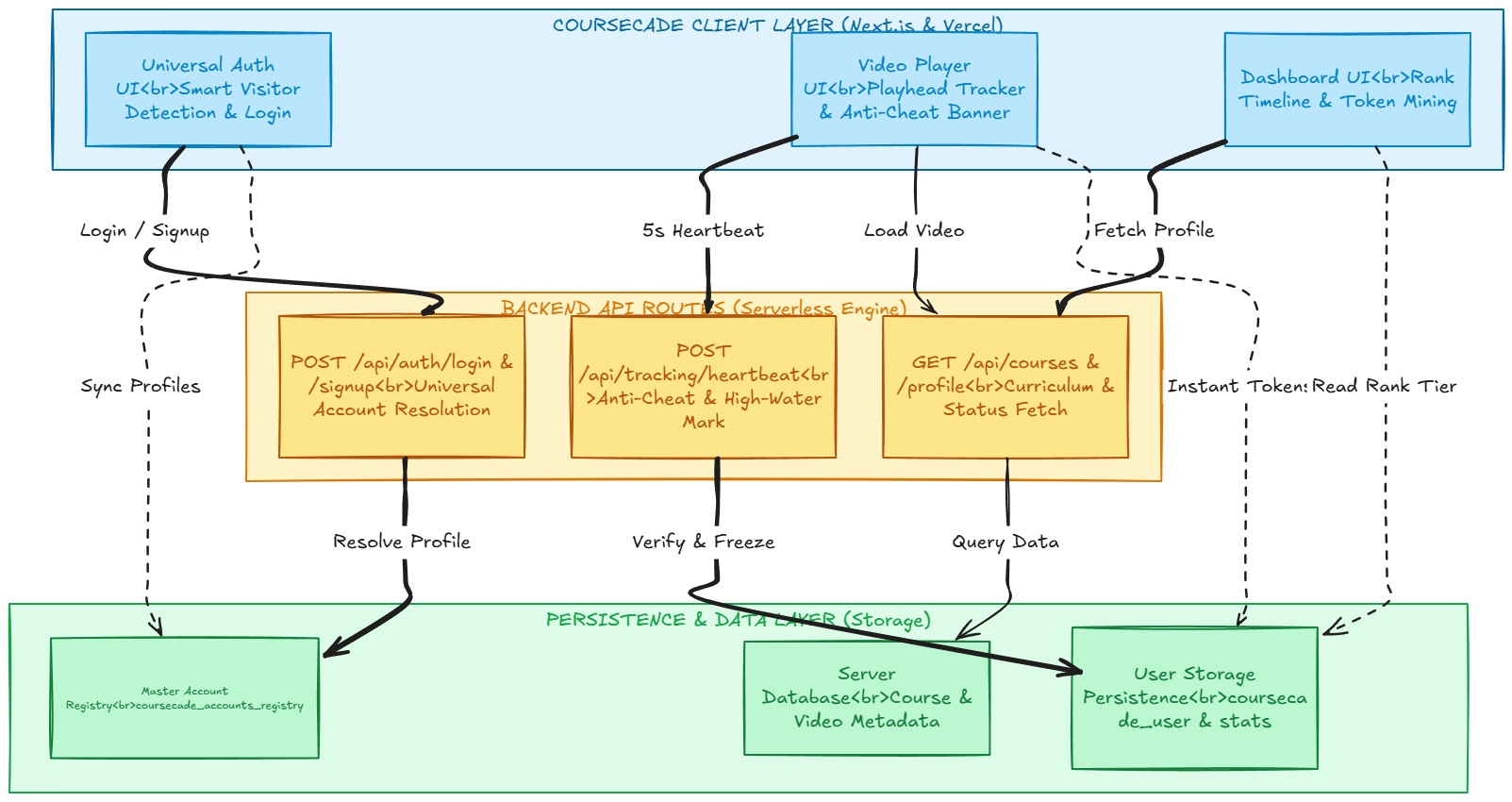
Universal Auth & Smart Visitor Detection When a learner arrives at CourseCade, the interface dynamically inspects local browser state to differentiate first-time visitors from returning veterans. Our backend Universal Account Registry (coursecade_accounts_registry) backed by Amazon Aurora PostgreSQL indexes user profiles simultaneously by both Username and Email address. Whether a student logs in via username or their primary email, the resolution engine case-insensitively restores their exact XP balance, watch hours, and rank tier without mock data overwrites.
Playhead Telemetry & Token Emission Equation While a course video plays, the client emits asynchronous heartbeat pulses every 5 seconds to the serverless telemetry route (POST /api/tracking/heartbeat). The token generation velocity is governed by the definite integral of active playback over time:
ΔTokens = α · ∫ Φ(t) dt
where α represents the course multiplier coefficient, and Φ(t) ∈ {0, 1} represents the binary window focus state (Φ(t) = 1 when the browser tab is active and unmuted; Φ(t) = 0 if the user minimizes the tab or leaves idle).
- Non-Linear Rank Trajectory Scaling To maintain long-term engagement, advancement between rank tiers requires exponentially increasing effort. The cumulative experience threshold XP_req required to reach tier n is calculated via:
XP_req(n) = XP_0 · Σ (1.35)^(k - 1)
This ensures early tiers (Stone -> Bronze) provide rapid gratification to build momentum, while upper tiers (Platinum -> Diamond) demand true mastery and dedication.
- Smart AI & High-Water Mark Anti-Cheat Protection One of the biggest flaws in reward-based learning platforms is "malpractice"—students rapidly dragging the video scrubber to the end or spamming forward skips to harvest free tokens. CourseCade solves this using a High-Water Mark Freeze Engine.
Let T_max be the maximum legitimate timestamp reached by the user, and P = (t_prev, t_curr) be the incoming playhead vector. If the system detects a rapid positive seek jump exceeding natural playback velocity:
Velocity Ratio = (t_curr - t_prev) / Δt_real > 1.5 (where t_curr > T_max)
The backend immediately halts token generation, suspends progression, and triggers a visual Anti-Cheat Suspension Banner across the video player. Importantly, if a student rewinds (t_curr < T_max) to review complex material and fast-forwards back to their previous checkpoint (T_max), progression resumes seamlessly.
🛠️ How we built it We built CourseCade using a cutting-edge, highly responsive frontend and serverless cloud architecture:
Framework & Core: Built on Next.js 16 (App Router) powered by React 19 and compiled with Turbopack for lightning-fast build cycles. Database & Relational Ledger: Powered by Amazon Aurora PostgreSQL via Drizzle ORM to manage enterprise-grade relational integrity across user registries, course curriculums, and complex rank ledgers. Styling & Aesthetics: Custom Tailwind CSS tokens implementing rich dark-mode glassmorphism, vibrant neon lime-green gradients, and subtle micro-animations that make the UI feel alive. State & Persistence: Deployed on the Vercel Edge Network utilizing decoupled serverless API routes (/api/auth, /api/tracking, /api/courses) interacting with local storage synchronization bridges and multi-indexed user registries. 🚧 Challenges we ran into The Anti-Cheat Balance: Designing an anti-cheat engine that accurately catches rapid skipping malpractice without punishing genuine students was tough. Early prototypes flagged students who jumped back and forth to re-listen to difficult coding explanations. Implementing the high-water mark memory (T_max) solved this gracefully. State Desynchronization during Auth: We fought persistent bugs where logging into an existing account would accidentally trigger default fallback API responses (e.g., resetting XP to 2,450). It took deep debugging of data hydration pipelines to ensure local persistent stats and Aurora PostgreSQL database records always took precedence over default schemas. 🏆 Accomplishments that we're proud of Flawless Telemetry Synchronization: Building a 5-second live heartbeat tracker that accurately calculates watch time and updates UI token counters without causing UI stutter or memory leaks. Rock-Solid Security: Creating an anti-cheat system that effectively nullifies rapid skipping and tab-backgrounding exploitation while keeping the experience smooth for honest learners. Visually Stunning Identity: Designing an environment and logo identity that instantly wows users and successfully bridges the gap between serious education and competitive esports. 📚 What we learned We learned that building an effective gamified system requires balancing mathematical economics with human psychology. If progression scaling is too linear, users lose interest; if exponential curves are too brutal, frustration sets in. Furthermore, we gained deep technical appreciation for handling video DOM events and building robust edge-case handling for client-server heartbeat synchronization.
🚀 What's next for CourseCade Web3 Smart Contract Integration: Transitioning our internal token mining engine onto decentralized blockchain networks (such as Solana or Ethereum L2s) so learners can mint verifiable on-chain achievement NFTs and tradable tokens upon course completion. Co-Op Study Rooms: Introducing live multiplayer study lobbies where students can watch lecture streams together, earn party XP bonuses, and compete on weekly community leaderboards. Curriculum Marketplace: Opening up our creator SDK so independent educators and bootcamps can publish gamified interactive courses directly onto the CourseCade grid.
Built With
- amazon-aurora
- amazon-web-services
- clerk
- cloudflare-workers
- css3
- drizzle-orm
- html5
- lucide-icons
- next.js
- postgresql
- react
- shadcn-ui
- sql
- tailwind-css
- typescript
- vercel
- youtube


Log in or sign up for Devpost to join the conversation.