Video Link: https://www.loom.com/share/ed93556b87d84a258309c3d06b814bea
Problem: Presently in COVID era, there is an increase in the trend of elderly being the majority of the population who are living alone, home bound especially those who are living in the remote areas that limit access to basic amenities such as health care and medicines. Among them, few are not equipped with computers or unable to use them because of their physical ailments. There is also a shortage of pharmacies in rural areas because of the establishment costs and other factors. As a result, local businesses in many small rural towns, and pharmacies that dispense medications to older adults are at risk of closing. In 2018, 16% of rural independent pharmacies had closed during the past 16 years. Community pharmacies dispense 90% of medications in the United States, and pharmacy closures create disruptions in medication access that negatively affect medication adherence in the underserved population. Decreasing adherence rates lead to greater disease progression and create a substantial financial burden on the healthcare system (Pathak, Haynes, Qato and Urick., 2020). For elderly with chronic conditions, skipping a dose or two is common but can also be risky. Frequent medication in adherence has accounted for emergency department visits, hospitalizations and even death (Salako, Ullrich and Mueller, 2018).
Further, In a report by Kaplan, Abou-Sabe, Ramgopal and Mcfadden (2020) with NBC news reported that “Millions of Americans feel trapped in the mail in order prescriptions delivery that has left them with crushed pills, damaged vials and life saving drugs exposed to extreme weather. A Utah mother who receives her sons insulin and her daughters medication by mail states '' I would give anything to just be able to pick up the prescriptions from our local pharmacy instead of worrying so much about the temperature of medications being shipped to me every three months”.
Solution: A community based approach that incentivizes both community members as well as local pharmacies.
We are proposing a potential solution for maintaining medication access and delivery to rural communities/ patients in a timely manner. This solution can be well implemented in urban areas, suburban low income and developing countries. We envision to create a platform to connect patients, pharmacies and drivers to deliver the medications safely.
For example when a elderly person is unable to make a trip to the local pharmacy due to lack of transportation. Traditionally prescriptions orders have been made via phone. But our technology can be easily adapted for now and generations to come. This health tech application would enable connecting patients, pharmacies and community members to our platform.
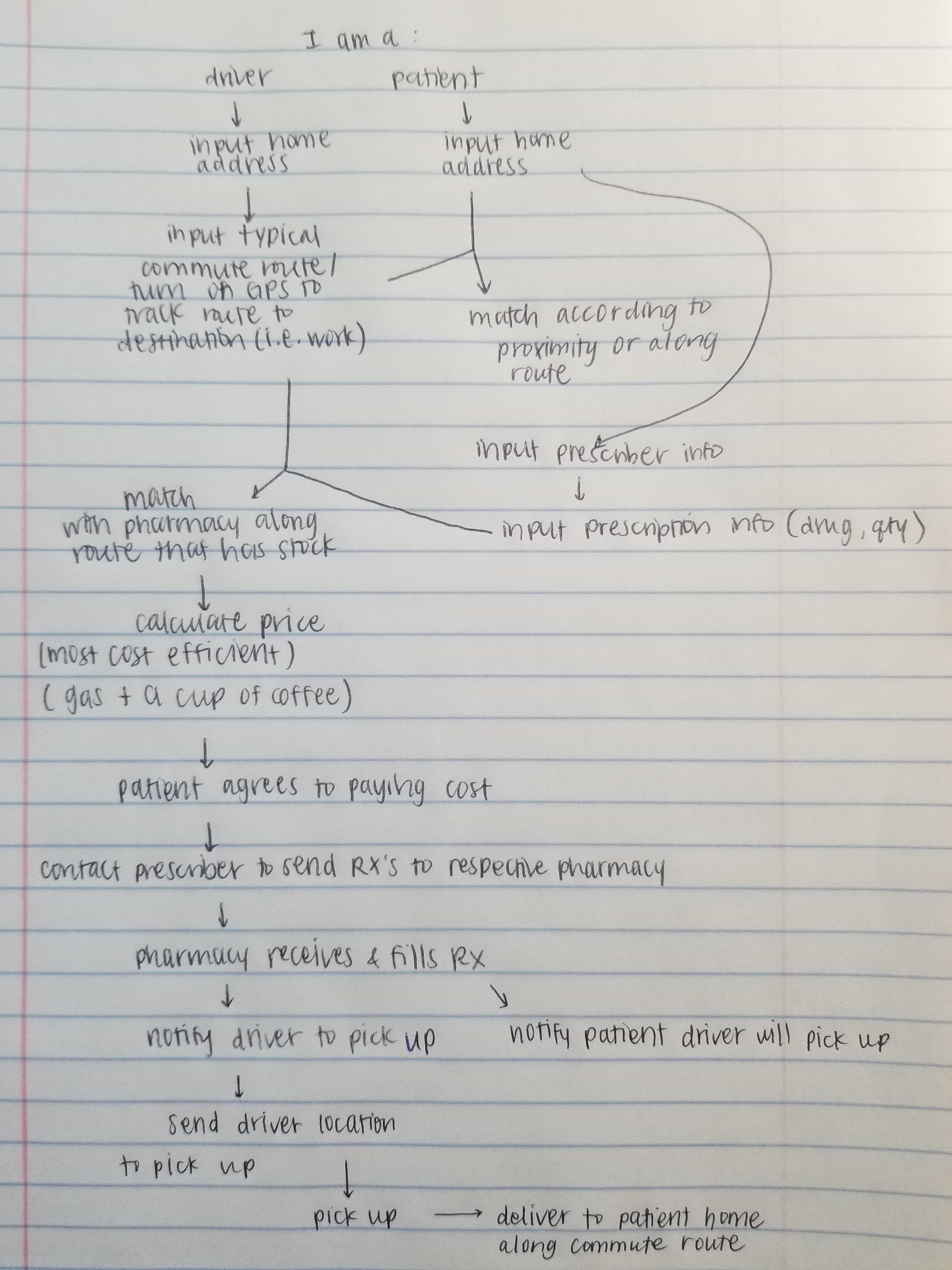
Patient: Order medication needed and choose the pharmacy with most price efficient or the application would connect with local pharmacies with price efficiency and stock availability. Once the patient agrees for the price, the order is placed with the pharmacy selected by the patient.
The application will notify the community members/nominated persons who are willing to deliver this medication to the patient in a safe box. Patient is notified about the pick up , has been picked up and on its way to their home with a feature of tracking the driver in case of reducing any errors in finding the house.
Business Plan: Currently we plan to offer this solution to elderly patients, people with disabilities, and those otherwise living in rural areas. In the future we plan to extend these services to telehealth providers who need to send prescription medications in 24 hours other than mail in order, hospital discharge planners who can set up medication available at home as soon as the patient returns to home after being discharged from hospital, urban, suburban areas, college students living in dorms who just moved to universities where parents can arrange for the delivery.
Drivers/ community members/ nominated people will be incentivised by providing rewards points which can be used at the local coffee shops or at any of the participating pharmacies for their own medications.More over we are no minimum order and ensure 24 delivery of medications to the home. Patients don't have to wait 2 weeks for their mail in order prescriptions to arrive damaged, tampered, crushed. We Believe that this technology and application has potential for global rollout.
Present competitors in the market: Scriptdrop services and retail pharmacies with option of home delivery. However they are rural areas and underserved areas in the United States that depend on independent pharmacies and most retail pharmacies have no weekend or after hours delivery.
Value Proposition: Our valuable goal is to improve medication access and delivery in rural areas. We anticipate that for a person to be using our application subscription fee of $10 per month/$120 per year( platinum package). For on demand services, charges would be different depending on the package the patient will be choosing to opt for such as platinum, gold, and silver packages.
Our Mission: Democratizing Prescriptions Delivery
Team members: Hari Vennelakanti PT, DPT, Madhuri Kundojjula, B. Tech, Brent Wesley, M.S and Crystal Tse, PharmD
Mentors: Dr. Ankur Shahi., Dr. Nainesh Gandhi., Mr. Wil Orinion., Dr. Asif Ahmed., Health ++ @ Stanford hackathon workshops and organizers.
References: Kaplan, A., Abou-Sabe, K., Ramgopal,K., & McFadden, C. (December 8, 2020). Millions of Americans receive drugs by mail. But are they safe?. Retreived from https://www.nbcnews.com/specials/millions-of-americans-receive-drugs-by-mail-but-are-they-safe/ Millions of Americans receive drugs Pathak, S., Haynes, M., Qato, D. M., & Urick, B. Y. (2020). Telepharmacy and Quality of Medication Use in Rural Areas, 2013-2019. Preventing chronic disease, 17, E101. https://doi.org/10.5888/pcd17.200012
Salako, A., Ullrich, F., & Mueller, K. J. (2018). Update: Independently Owned Pharmacy Closures in Rural America, 2003-2018. Rural policy brief, 2018(2), 1–6.
Built With
- figma

Log in or sign up for Devpost to join the conversation.