-
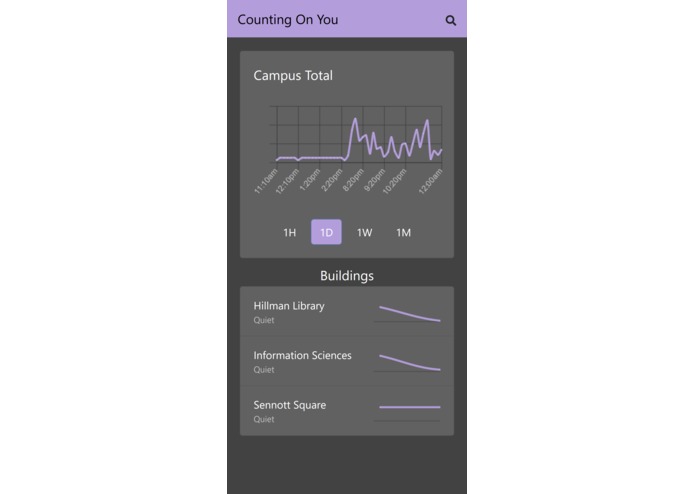
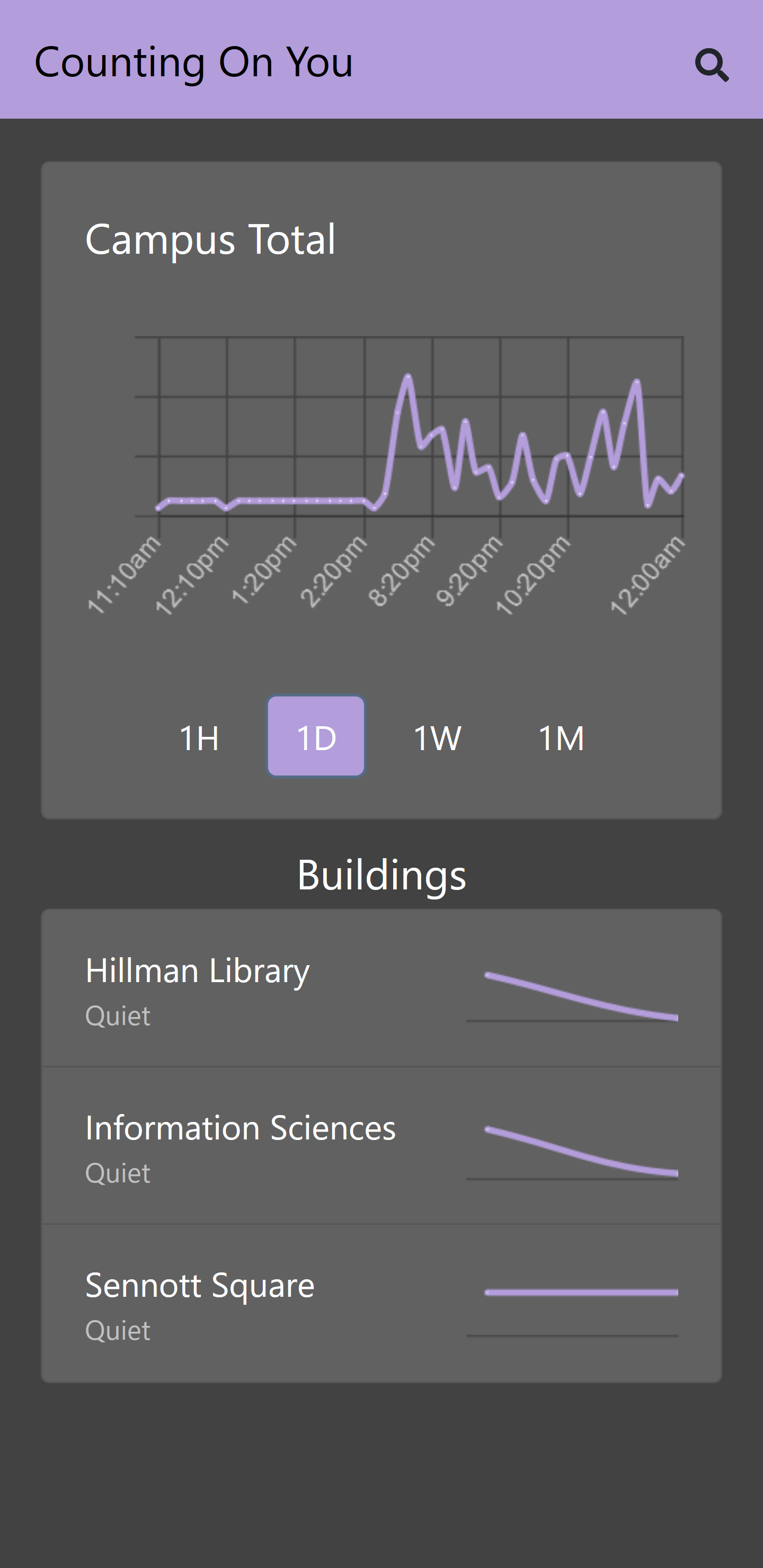
Home Page (Day Tab)
-
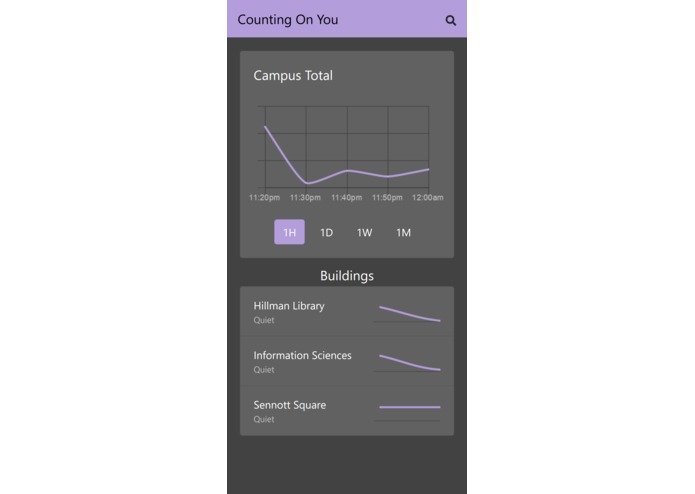
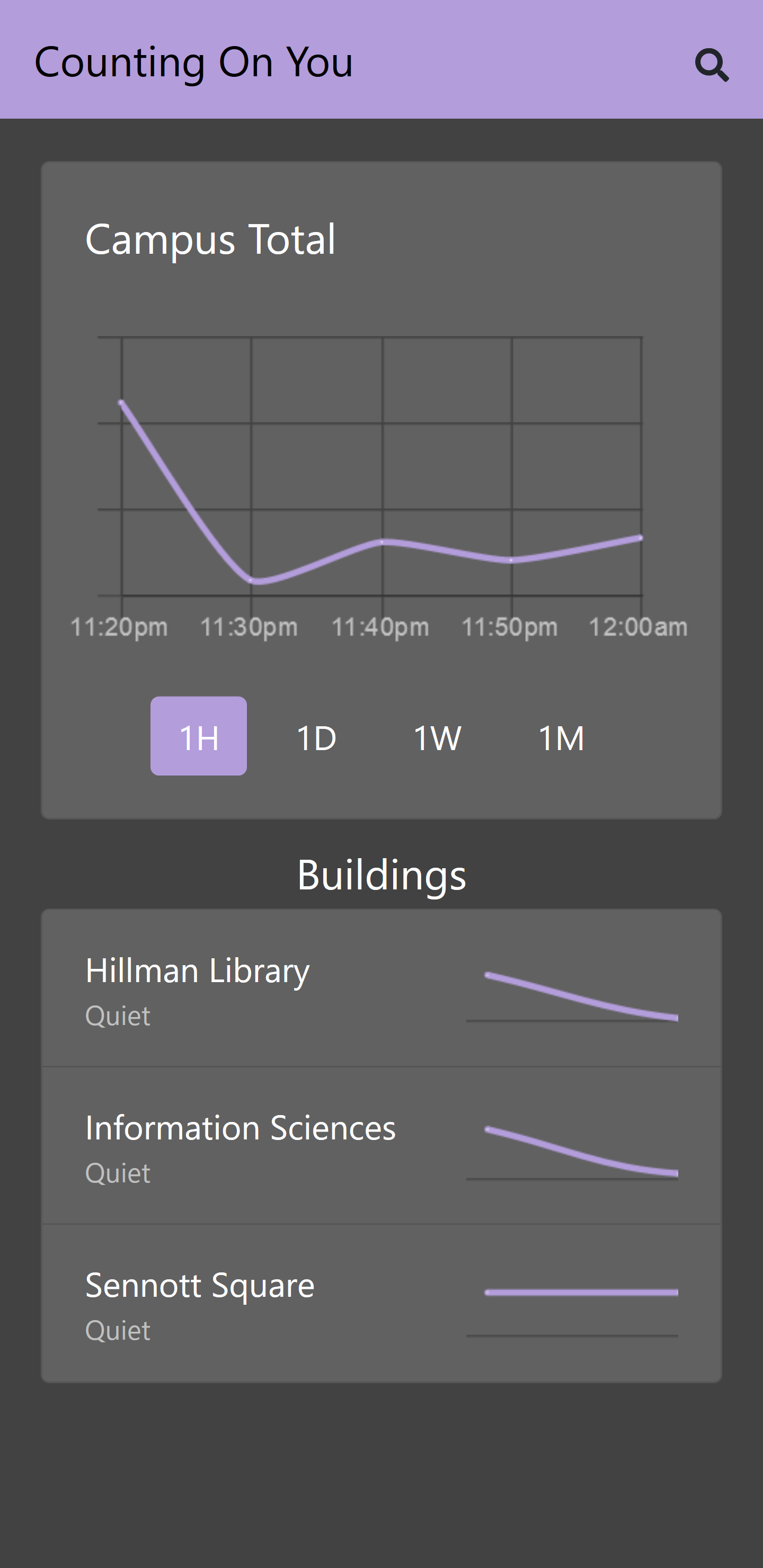
Home Page (Hour Tab)
-
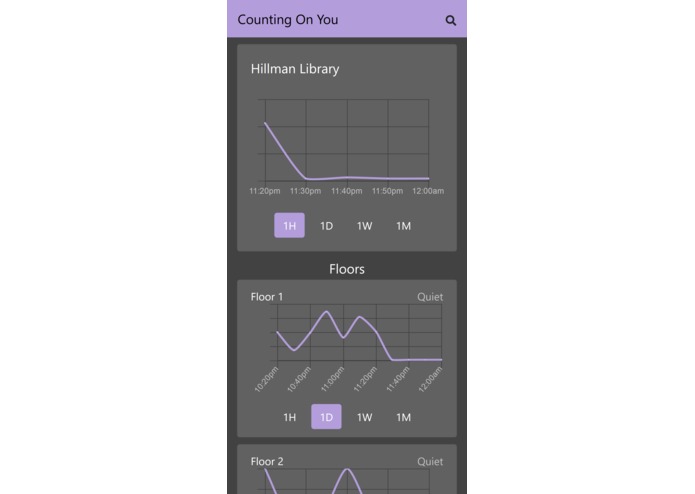
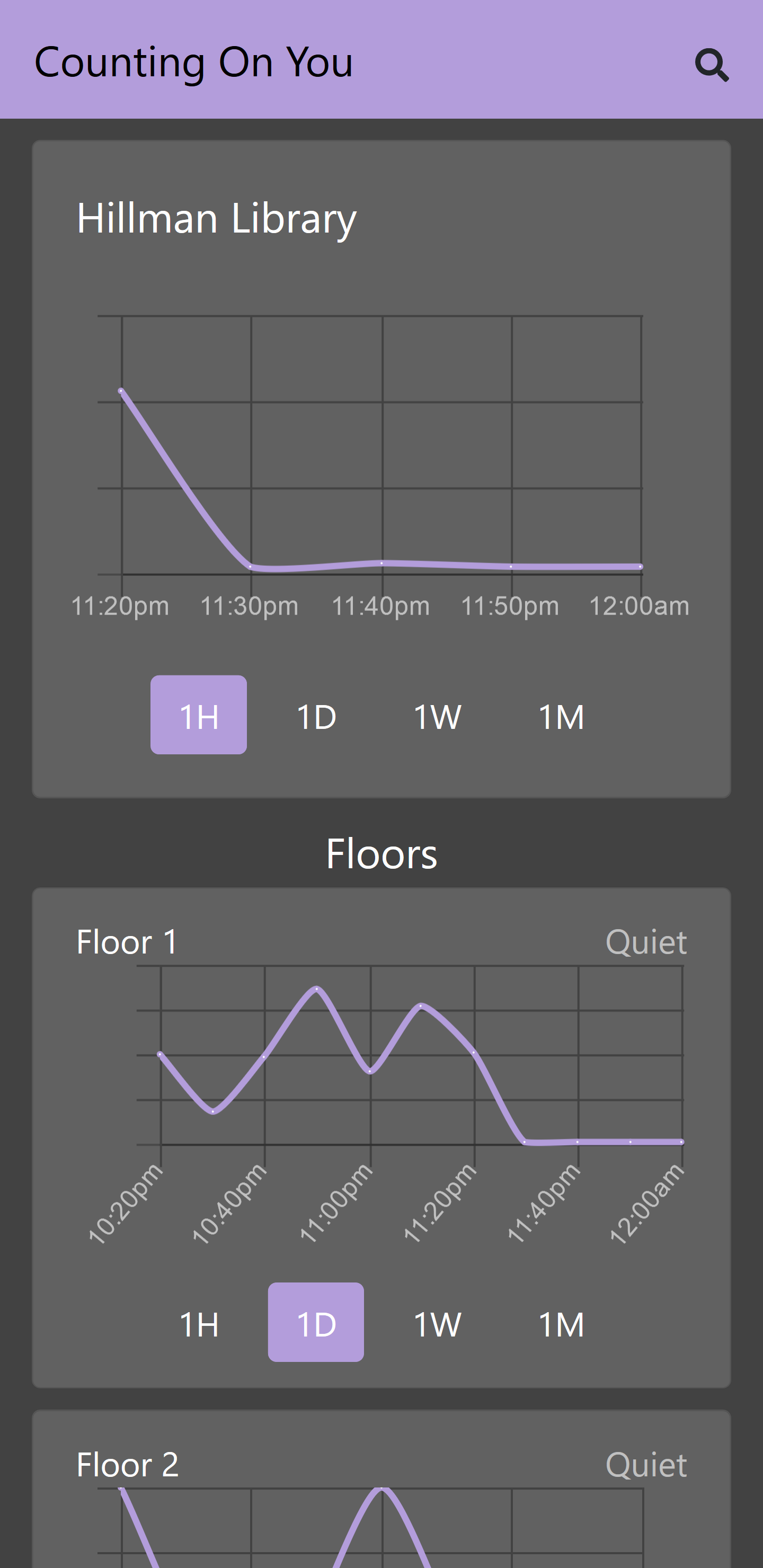
Hillman Library with floors
-
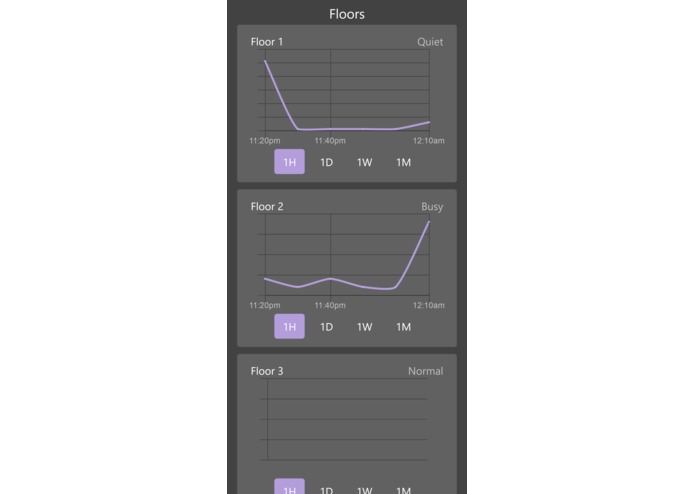
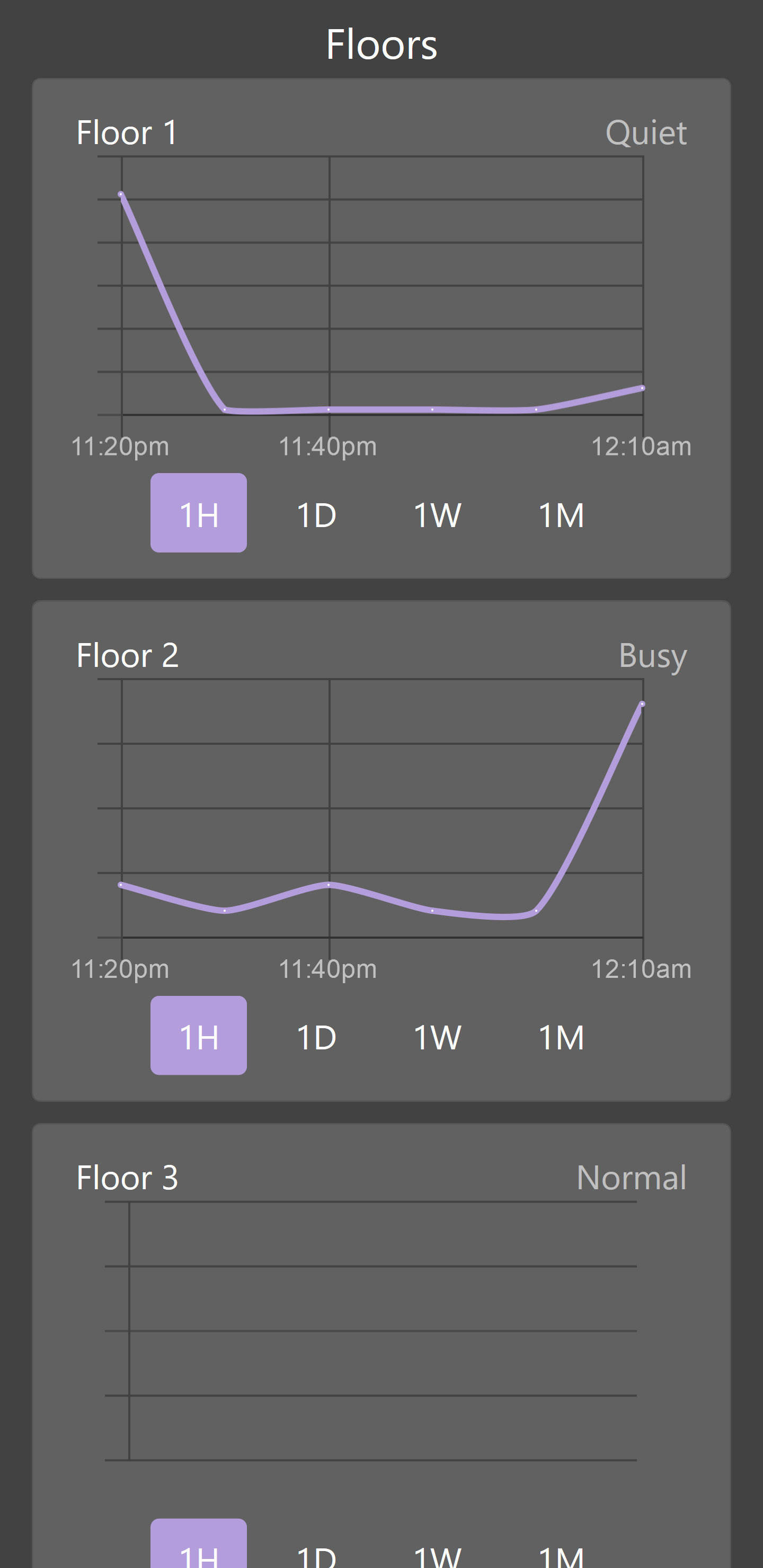
Hillman Floor Data
Inspiration
As a student, your time is precious. Nothing is more frustrating than having to walk through all of the floors of Hillman, the Union, and Posvar just to find a place to study.
Today, technology is at the tip of our fingers and can provide us with information about major campus events, track approaching buses, and order food to our exact location. Yet there is nothing to provide students at the University of Pittsburgh with real time visitor levels in academic buildings. This leaves students wandering around, potentially checking upwards of 4 different places in hopes of finding a place to study.
With Counting On You, the University of Pittsburgh can deliver the most up-to-date number of people inside buildings on campus.
What it does
Counting On You is an interactive program that allows students and faulty to gauge concentration of people on a given floor in any academic building on the University of Pittsburgh’s campus.
This program uses raspberry pis as an access point and logs the number of connection attempts to the local wifi, something that your phone does any time you walk into a room. This data is not only building specific but floor specific.
How we built it
We decided to utilize the howmanypeoplearearound library and apply it to the University of Pittsburgh’s campus. The library makes use of raspberry pis as access points to track connections to the local wifi. Due to legality issues, we decided that a test driver to emulate data was in our best interest for this Hackaton.
We created an admin portal (with angular 7) and a user portal (with react). The admin portal allows you create and manage buildings, floors, and raspberry pi locations to ensure accurate frequency readings. The database was created with a Firebase Realtime database to connect our front ends to. The information displayed on the user portal uses graphs and words to convey the frequency of wifi connection attempts.
Challenges we ran into
With this being a dynamic program, our team ran into a couple of challenges, some that include incompatible proxies, inconsistent documentation, and the raspberry pi not connecting to the university’s wifi.
We attempted to use a cutting edge JavaScript package (MobX - A simple state management tool) but unfortunately, none of the major browsers supported it. We overcame this challenge by using an older version of MobX.
We also ran into some difficulties when trying to understand the inconsistent documentation of angular libraries. Through trial and error we were able to persevere and eventually understand the documentation.
Lastly, we had a great deal of difficulty with connecting the raspberry pi to the university’s wifi. We were unable to download any of the necessary packages to connect to PittNet. Eventually, we opted to not use the wifi and emulate the test data.
Accomplishments that we're proud of
For this project, we are most proud of our ability to integrate multiple applications into a cohesive system. This was a long and difficult process but we believe that our product is well designed and user friendly.
We are also very proud of the professionalism of the charts that display the number of users as well as the color scheme we came up with for this program.
What we learned
As a group coming from many different levels of programming experience, we were able to use this opportunity to grow both in our group communication skills as well as JavaScript, web design, Python, and how to properly pipe data between Python programs.
What's next for Counting On You
We believe that by bringing it to the Innovation Center or even entering it in the Randall Family Big Idea Competition will help us achieve greater success with this project. Ideally we would like to explore the possibility of implementing a program like Counting On You to the University of Pittsburgh’s campus.


Log in or sign up for Devpost to join the conversation.