-
-
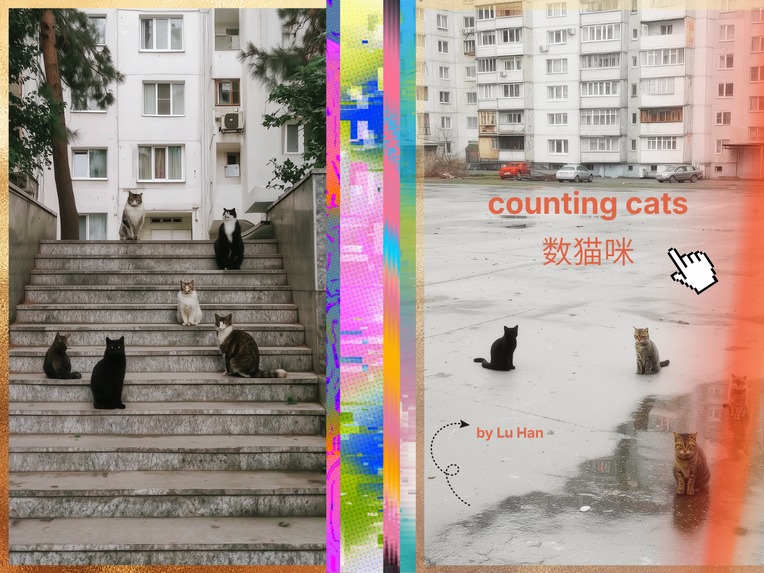
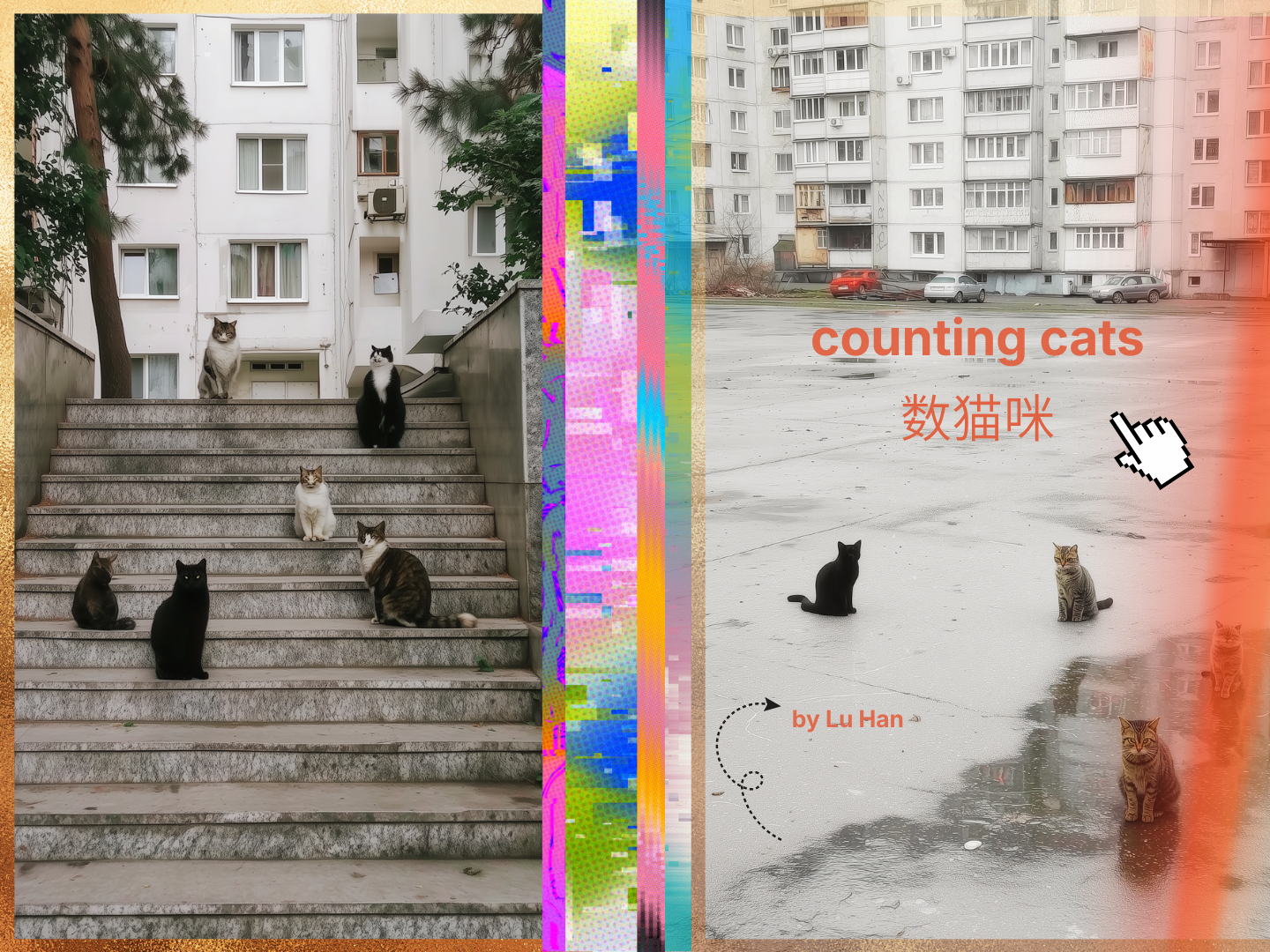
poster
Counting Cats — Project Story
by Lu Han
Inspiration
Counting Cats began with a simple observation: In everyday life, we often overlook small disturbances hidden inside familiar scenes.
I was reviewing street photos on my phone — ordinary residential corners, stray cats resting on the pavement — and noticed how often subtle signs of tension or quiet violence blended into the background.
This led me to a larger question:
What if the way we look is not just natural, but trained?
Not only by habit, but by authority, environment, and the silent rules that shape what we treat as “normal.”
The project uses a harmless and almost playful action — counting cats — to expose how attention is conditioned, and how certain forms of everyday violence become invisible by design.
What I Learned
1. Vision is shaped by power, not just perception.
We are guided to focus on certain details and to ignore others. This is not accidental — it is learned.
2. Everyday violence hides in plain sight.
It becomes “normal” through repetition and familiarity. Visible violence becomes background noise over time.
3. Correction can feel like clarity.
When hesitation disappears and responses become “perfect,” it often means training has overridden instinct.
4. Silence speaks more loudly than explanation.
The moment the voice falls silent becomes the emotional hinge of the entire film.
How I Built the Project
1. Image Construction
I created two sets of 9:16 images:
Set A: normal street scenes with stray cats
Set B: similar scenes with subtle but more pointed disturbances
They were generated using Midjourney, guided by real photographs as mood references.
2. Audio Structure & Voice Design
The audio is divided into two contrasting sequences:
Part 1: human hesitation — breaths, pauses, uncertainty
Part 2: corrected precision — flat tone, consistent pacing, no breath
Using ElevenLabs, I created two versions of the same voice with different stability values to reflect the psychological transformation.
Mouse clicks and room tone serve as the underlying rhythm.
3. Editing & Timing
In DaVinci Resolve, I built the piece around:
repetition timing gaps controlled silence the “click → image → answer” cycle
The structure intentionally resembles a training module or dataset review session.
Challenges I Faced
1. How to reveal violence without showing violence
The project avoids explicit imagery. The challenge was finding the right level of disturbance — visible enough to register, subtle enough to remain “ignored.”
2. Balancing minimalism with emotional weight
Too minimal felt hollow; too expressive broke the cold, observational tone. The solution came through micro-variations: breaths, pauses, tiny vocal cracks.
3. Maintaining ambiguity without losing meaning
I wanted the viewer to feel something shifting without being told what to think. This meant removing any dialogue that explained too much.
Conclusion
Counting Cats is not a film about cats. It is a study in how we are taught to see and how we quietly learn to ignore what doesn’t fit the frame.
Through repetition, authority, and correction, hesitation becomes error, and precision becomes obedience.
The work reflects on attention, power, and the subtle violences that persist not because they are hidden, but because we have learned not to look.
Built With
- elevenlabs
- midjourney

Log in or sign up for Devpost to join the conversation.