Inspiration
Teachers often receive a wall of student responses right when they need to decide what the class should discuss next. The ideas are there—misconceptions, partial explanations, and useful observations—but finding meaningful patterns quickly is difficult.
We built Counterpoint to make that moment useful. Instead of asking AI to give students an answer, Counterpoint helps teachers turn anonymous reasoning into a better peer conversation.
What it does
Counterpoint turns de-identified claim-and-evidence responses into a teacher-controlled discussion plan.
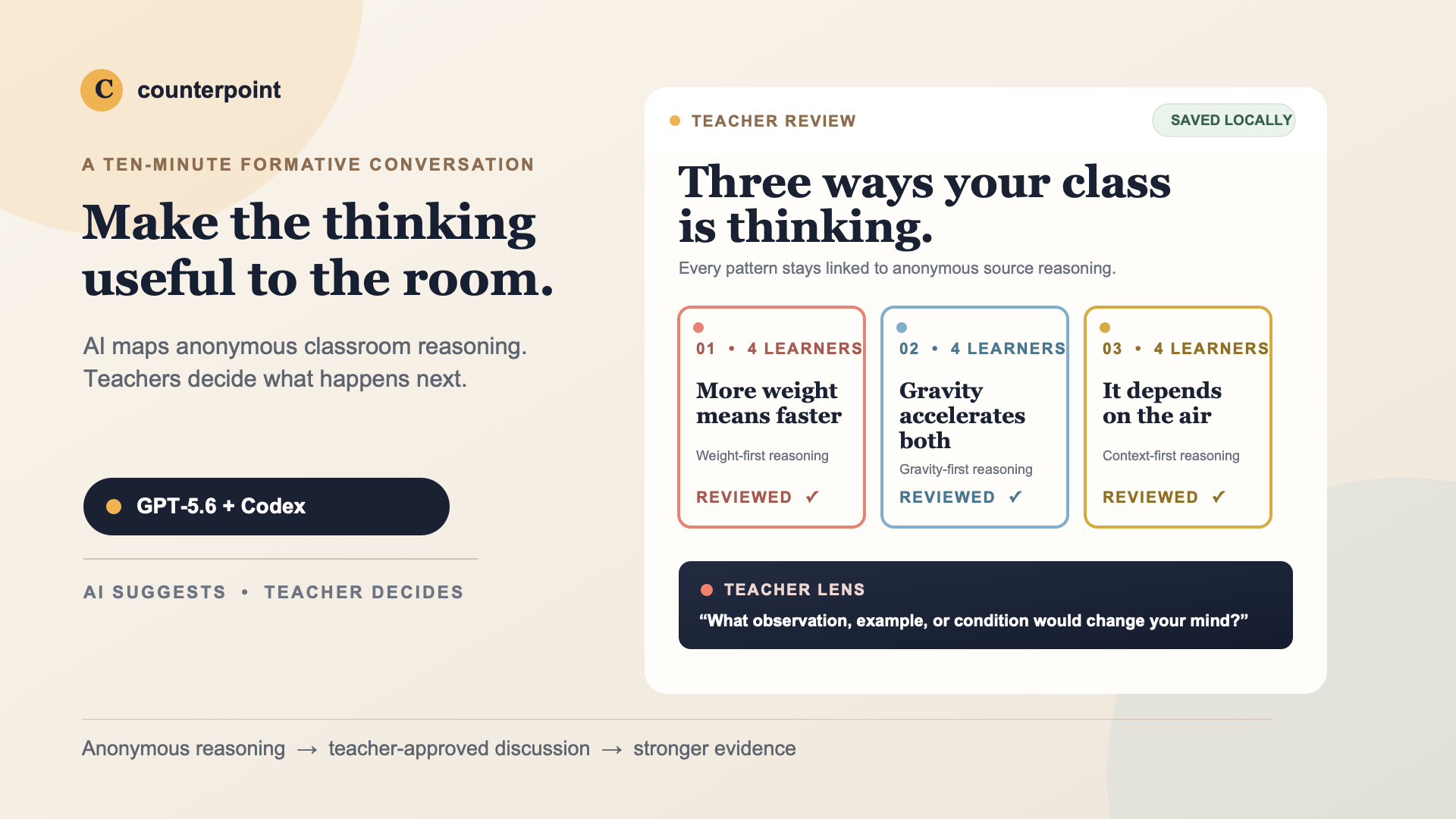
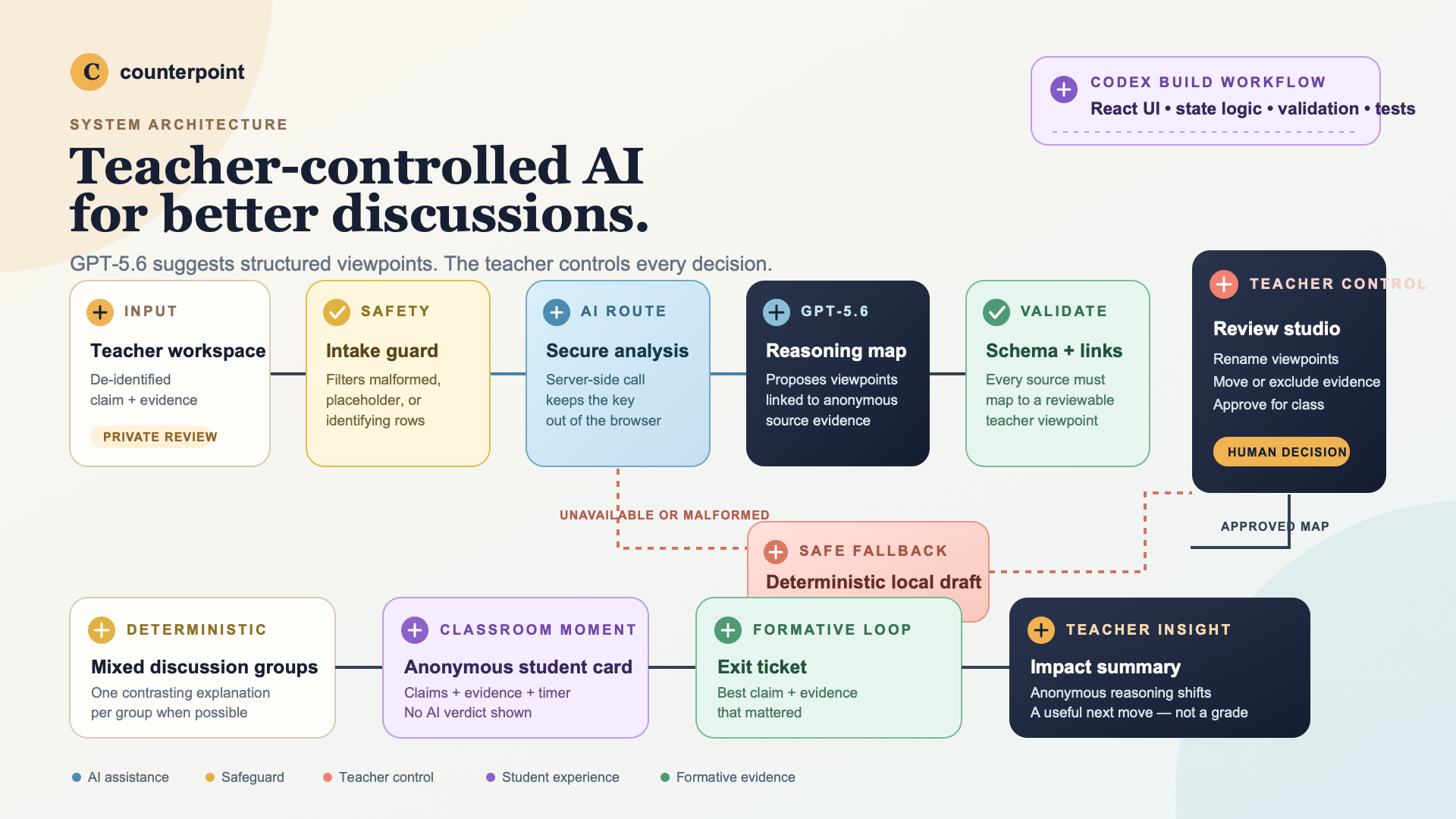
A teacher can paste anonymous responses, review any held-out or malformed rows, and generate a source-linked reasoning map. GPT-5.6 can propose viewpoints when the secure analysis route is available; every proposed pattern remains connected to the anonymous responses that informed it.
The teacher can rename viewpoints, move or exclude evidence, mark each pathway reviewed, and approve the map before anything reaches students. Counterpoint then builds mixed-reasoning discussion groups, creates an anonymous student discussion card with evidence and a timed prompt, and collects a two-question exit ticket. The final impact view summarizes formative reasoning shifts without turning them into grades.
How we built it
We built Counterpoint as a React and TypeScript web experience with Codex.
Codex accelerated the product design, component implementation, structured GPT-5.6 integration, deterministic grouping logic, refresh-safe teacher state, validation paths, and tests for the core safeguards.
GPT-5.6 is used to propose structured, source-linked reasoning viewpoints. We designed the workflow so that AI output must pass a schema and traceability check before it can become part of the teacher review experience. If the AI route is unavailable or returns an invalid result, Counterpoint visibly switches to a deterministic local draft instead of silently failing or sending unvalidated content to students.
Challenges we ran into
The hardest challenge was not generating categories—it was making AI assistance trustworthy in a classroom setting.
We needed to avoid creating a black-box system that labels students as right or wrong. We also needed to protect privacy, keep teachers in control, preserve evidence traceability, handle malformed imports safely, and ensure teacher edits persisted after refresh.
Another challenge was making the demo show real educational value, not just an AI grouping feature. That led us to build the full loop: anonymous intake, teacher approval, mixed discussion groups, student evidence cards, exit tickets, and a formative impact summary.
Accomplishments that we're proud of
We are proud that Counterpoint is not an “AI teaches the class” product. It is a teacher-controlled orchestration tool.
Every important safeguard is visible in the interface:
- Anonymous responses stay linked to the reasoning map.
- Teachers can edit, approve, or reject AI suggestions.
- Invalid or unavailable AI analysis falls back safely.
- Discussion groups are built with a transparent deterministic rule.
- Students receive contrasting ideas and evidence—not an AI verdict.
- Impact is framed as formative reflection, not a grade or causal claim.
We are also proud of the end-to-end experience: Counterpoint starts with messy student thinking and ends with a concrete next teaching move.
What we learned
We learned that educational AI earns trust through constraints, not just capability.
A strong model can identify patterns quickly, but teachers need to inspect the evidence, adjust the language, and decide what is appropriate for their students. We also learned that reliability features—validation, fallbacks, persistence, and transparent rules—are part of the product experience, not hidden engineering details.
Most importantly, we learned that the best role for AI in a classroom is often to make human thinking easier to notice, discuss, and improve.
What's next for Counterpoint
Next, we want to pilot Counterpoint with real teachers and refine the workflow around actual lesson planning and classroom timing.
We plan to add secure classroom integrations, richer teacher approval tools, configurable discussion protocols, and privacy-first data controls. We also want to help teachers compare recurring reasoning patterns across lessons—without building student profiles or reducing learning to a score.
Counterpoint’s goal remains the same: make the thinking already in the room more useful to the room.
Built With
- ai
- api
- artificial
- css3
- data
- edtech
- education
- generative
- gpt-5.6
- html5
- intelligence
- node.js
- openai
- react
- teacher
- tools
- typescript
- vercel
- vite

Log in or sign up for Devpost to join the conversation.