Inspiration
Legal problems rarely feel like "legal problems" when you're living them — they feel like a landlord who won't answer your texts, or a write-up at work that showed up right after you filed a safety complaint. The people who need legal help most are usually the ones least equipped to translate their situation into legal language, find the right statute, or afford an hour of an attorney's time to find out if they even have a case. We wanted to build something that could sit between "I have no idea what my rights are" and "I've hired a lawyer" — a tool that reasons like counsel but is honest about not being one, and that never asks you to just trust it. If it tells you something, it shows you where that came from.
What it does
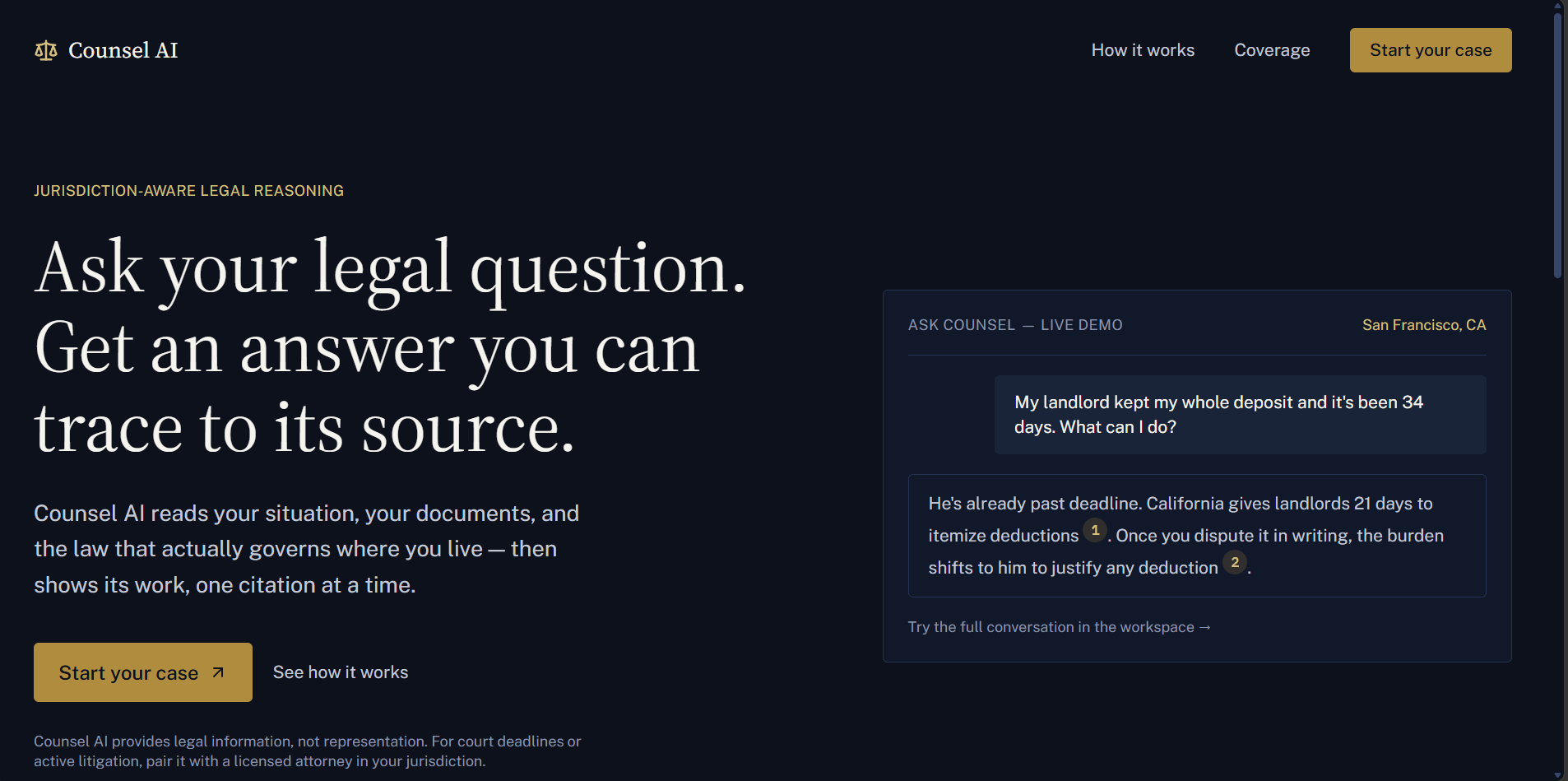
Counsel AI is a jurisdiction-aware legal assistant that walks a real workflow, not just a chatbot: Ask Counsel — describe your situation in plain language and get an answer grounded in the statutes, regulations, and case law that actually apply in your jurisdiction, with every claim attached to a clickable citation you can read in full. Document analysis — upload a lease or contract and get each clause flagged by risk, with a plain-language explanation of what it actually means for you (including when a clause is likely unenforceable). Conversation review — paste a text or email thread and see which messages carry legal weight: unsupported claims, retaliation, threats — separated clearly from ordinary back-and-forth. Case dashboard — track open matters, deadlines, and a concrete action plan (send this letter, file this form, by this date). Voice mode — a hands-free, phone-call-style interface with live captions, built for anyone who finds typing or reading dense text difficult. Multilingual support — speech in and out across six languages, because legal help shouldn't stop at English. Legal aid directory — when a matter genuinely needs a human, one tap connects to a free or income-qualified organization that can actually represent you. Every screen enforces the same rule: if Counsel AI asserts something, it's traceable to a source — not a paraphrase it invented.
How we built it
The frontend is React, TypeScript, and Tailwind CSS v4, with React Router driving the case-dashboard → matter → chat/document/conversation flows. We designed a dedicated visual language for it rather than reaching for a generic SaaS look: dark "ink" surfaces for AI reasoning, a separate "paper" surface for source documents, and a citation system (brass numbered chips) that opens a source drawer with the full statute or case text — so the interface itself teaches the difference between what the law says and what Counsel AI concluded from it. Voice is real, not simulated: dictation and read-aloud run on the browser's native Web Speech API, wired through small hooks so any page can offer "listen" or "speak" without duplicating logic. Language switching drives both the speech locale and a fully translated demo conversation (English/Spanish), rather than just relabeling a button. Everything is demo-data-driven by design for this phase — a realistic security-deposit dispute, a lease, a flagged text thread — structured so the same interfaces could sit in front of a real retrieval-augmented legal research pipeline later without a rewrite.
Challenges we ran into
Getting the citation system to feel load-bearing rather than decorative took real iteration — it's easy to make "click for source" feel like a footnote nobody reads. Tying it to an actual side panel with the primary text and a plain "why this applies to you" line made it feel more like evidence than decoration. Voice mode was its own challenge: browser speech APIs are inconsistent (Safari and Firefox don't support recognition the same way Chrome does), so we had to design for graceful degradation rather than assume it universally works, and be honest in the UI when it doesn't. We also had to resist scope creep responsibly — it would have been easy to fake translations for languages we couldn't actually verify, or to blur legal analysis with safety response. We chose to label what we couldn't fully support (four of six languages are voice-only in this demo) and to keep the safety banner in Conversations structurally separate from legal reasoning, so a threat never gets processed as just another litigation strategy point.
Accomplishments that we're proud of
A citation system that's genuinely clickable everywhere a claim appears — not just in the chat, but in document analysis, conversation flags, and rights summaries. A real, working voice mode (not a mockup) that makes the product usable hands-free or for someone who struggles with dense text. Designing a visual identity specific to this product — ink/paper/brass, not another generic dark-mode SaaS dashboard — that reinforces the product's core idea (source vs. reasoning) instead of just decorating it. Keeping a safety-first instinct baked into the design: the app distinguishes "this helps your case" from "you might be in danger" and treats the second one as more urgent, always. A legal aid directory that turns "you should talk to a real attorney" from a throwaway line into an actual, one-tap next step.
What we learned
That trust in an AI legal tool isn't built by sounding confident — it's built by being falsifiable. The most valuable thing we added wasn't a feature, it was the discipline of never letting an assertion exist without something a person could go check for themselves. We also learned how much "accessibility" and "access to justice" overlap once you take them seriously: voice input, plain-language toggles, and multilingual support aren't nice-to-haves bolted onto a legal product — for a lot of the people this is meant to serve, they're the difference between a usable tool and one that never gets opened.
What's next for Counsel AI
Replace the demo data layer with a real retrieval-augmented pipeline over an actual statute/case index, so citations are live rather than curated. Real document ingestion (OCR + clause extraction) instead of a pre-annotated demo lease. Expand full conversational translation beyond English/Spanish, and validate translations with native speakers before shipping them as content rather than voice-only. Partner directly with legal aid organizations so the directory reflects real intake capacity, not a static list. Add outcome tracking — did the demand letter work? did the claim get filed? — so the action plan can learn what actually resolves matters like this one.
Built With
- lucide-react
- react
- tailwindcss
- typescript
- vite

Log in or sign up for Devpost to join the conversation.