-
-
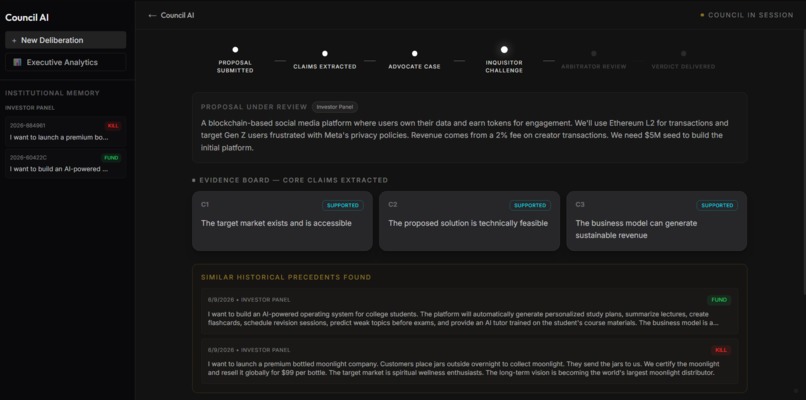
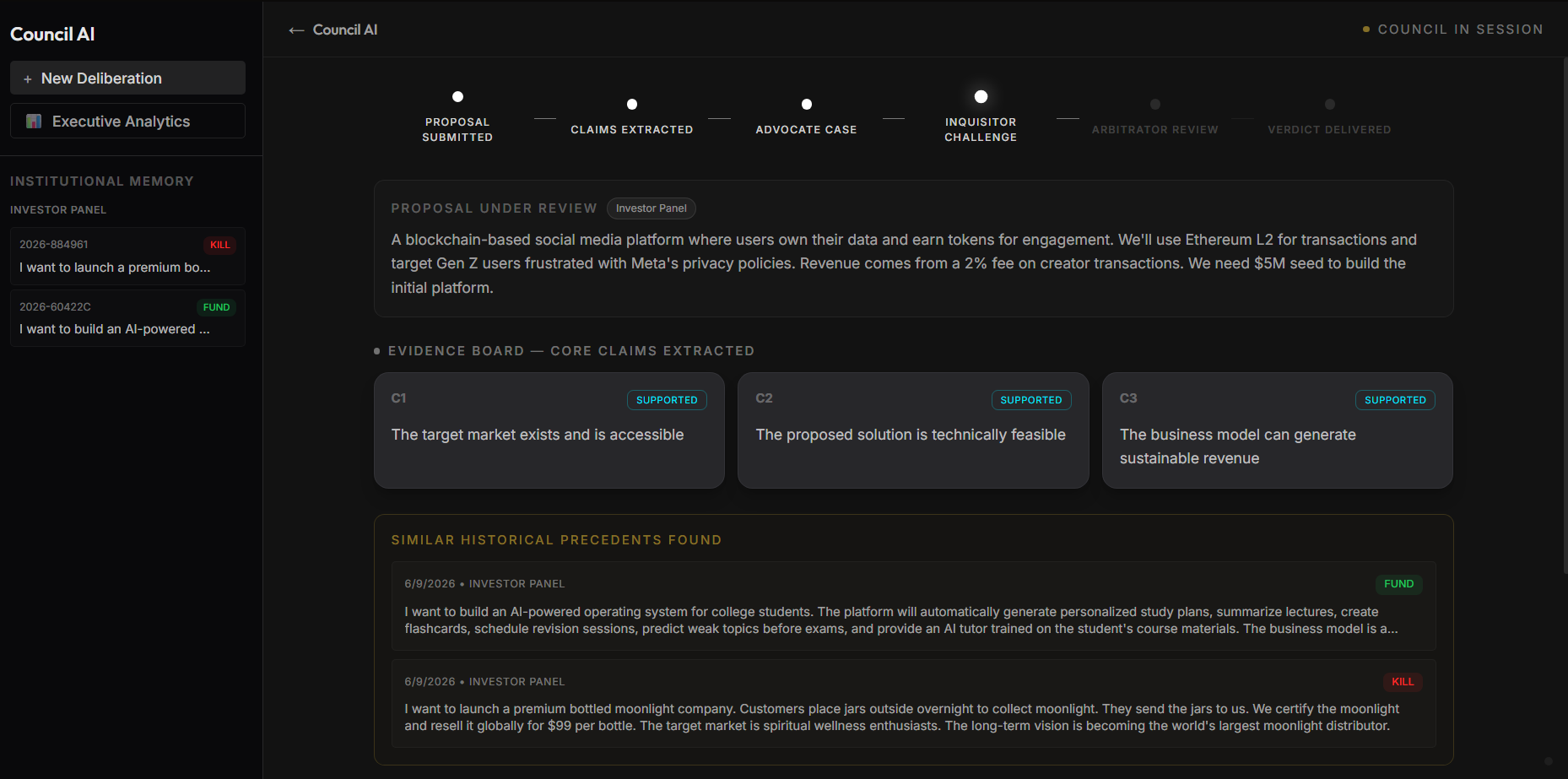
Live Deliberation
-
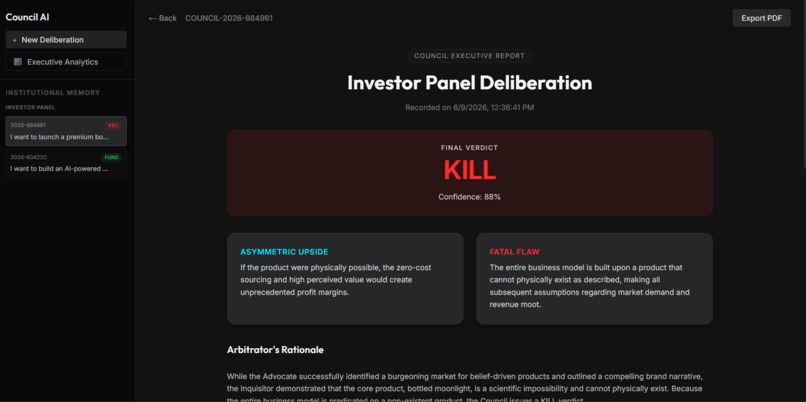
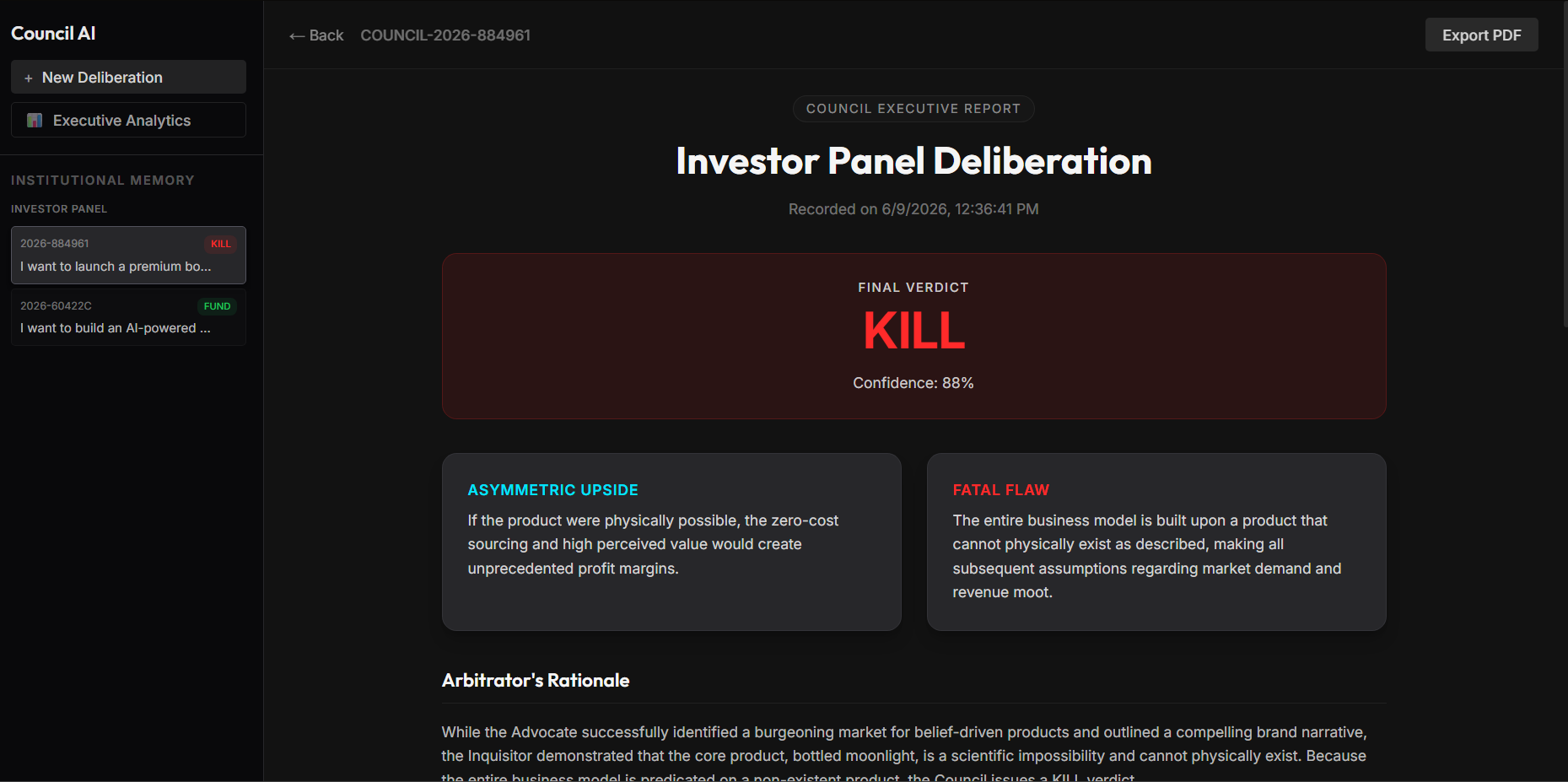
Verdicts
-
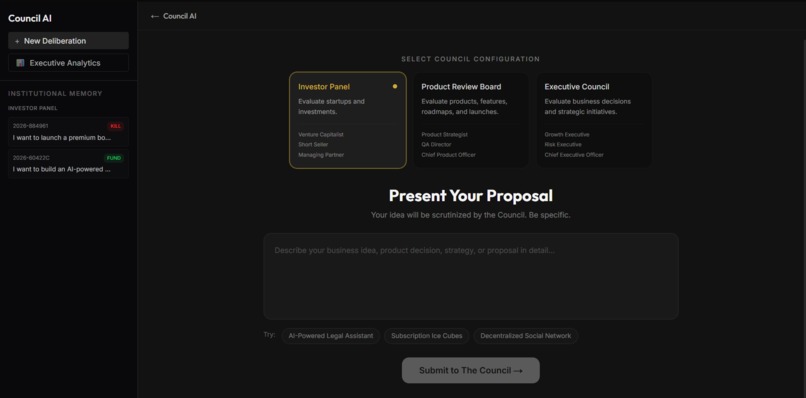
Chat Window
-
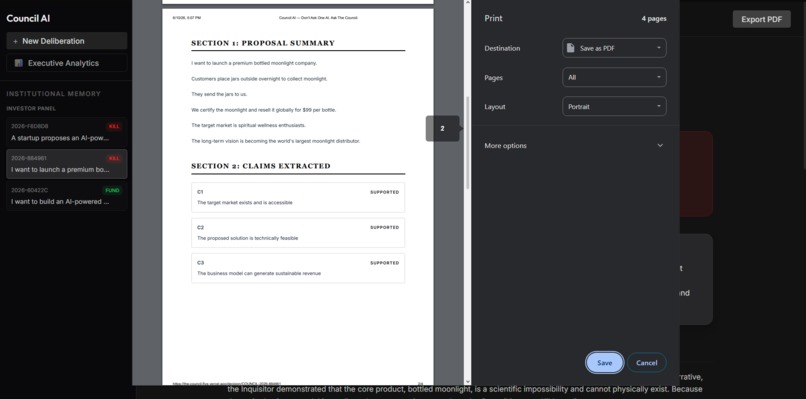
Export Reports
-
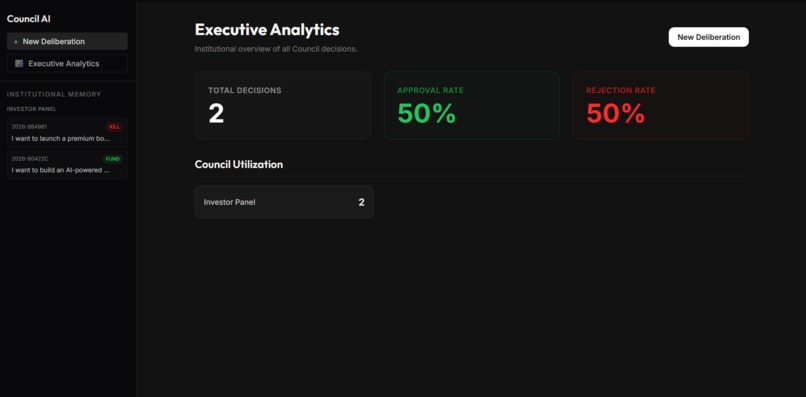
Analytics
-
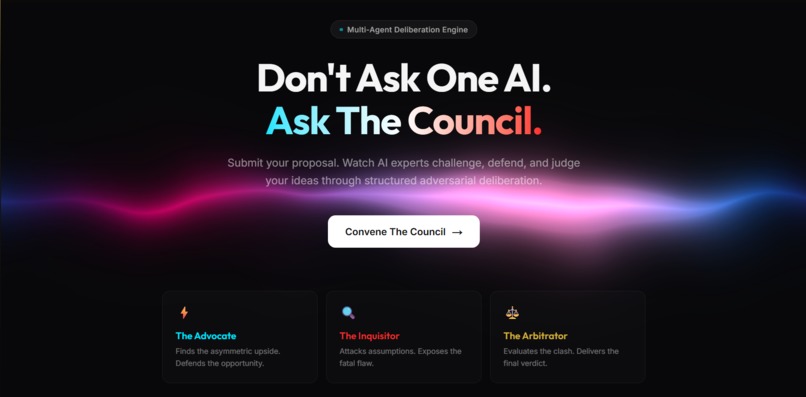
Landing Page
Inspiration
Over the last few years, I've found myself constantly making decisions with incomplete information.
Some decisions were academic: choosing projects, prioritizing skills, selecting opportunities, and deciding where to invest limited time and energy. Others were entrepreneurial: evaluating startup ideas, validating concepts, deciding whether to pivot, and determining which opportunities deserved deeper investment.
One thing became increasingly clear: the quality of a decision is often limited by the diversity of perspectives behind it.
Large organizations rarely make important decisions alone. They have executives, investors, advisors, product leaders, and domain experts who challenge assumptions before resources are committed. Most students, solo founders, and small teams don't have access to that luxury. We often make critical decisions alone, relying on intuition, scattered internet advice, or a single AI response.
That realization inspired Council AI.
We asked a simple question:
What if everyone had access to a virtual boardroom capable of rigorously challenging their ideas before they acted on them?
Instead of generating a single answer, Council AI creates structured disagreement. Ideas are examined from multiple perspectives, assumptions are challenged, risks are exposed, and a final verdict is reached through deliberation rather than blind agreement.
Our goal is not to replace human judgment.
Our goal is to improve it.
What It Does
Council AI is a multi-agent decision intelligence platform that simulates the dynamics of a real executive boardroom.
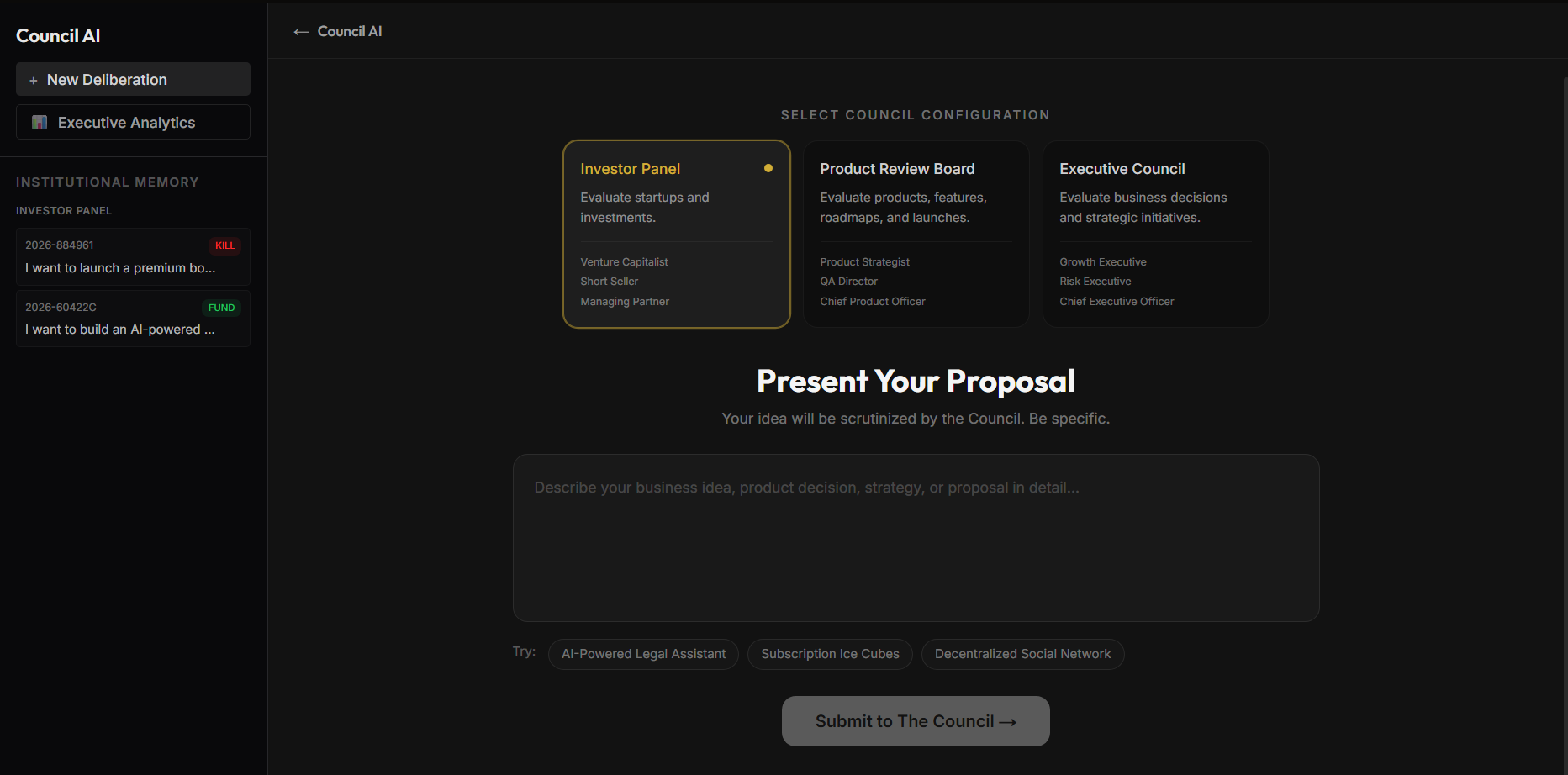
Users submit a proposal, startup idea, product strategy, business decision, or long-term plan for evaluation.
The platform then convenes a specialized council of Gemini-powered agents with deliberately conflicting objectives:
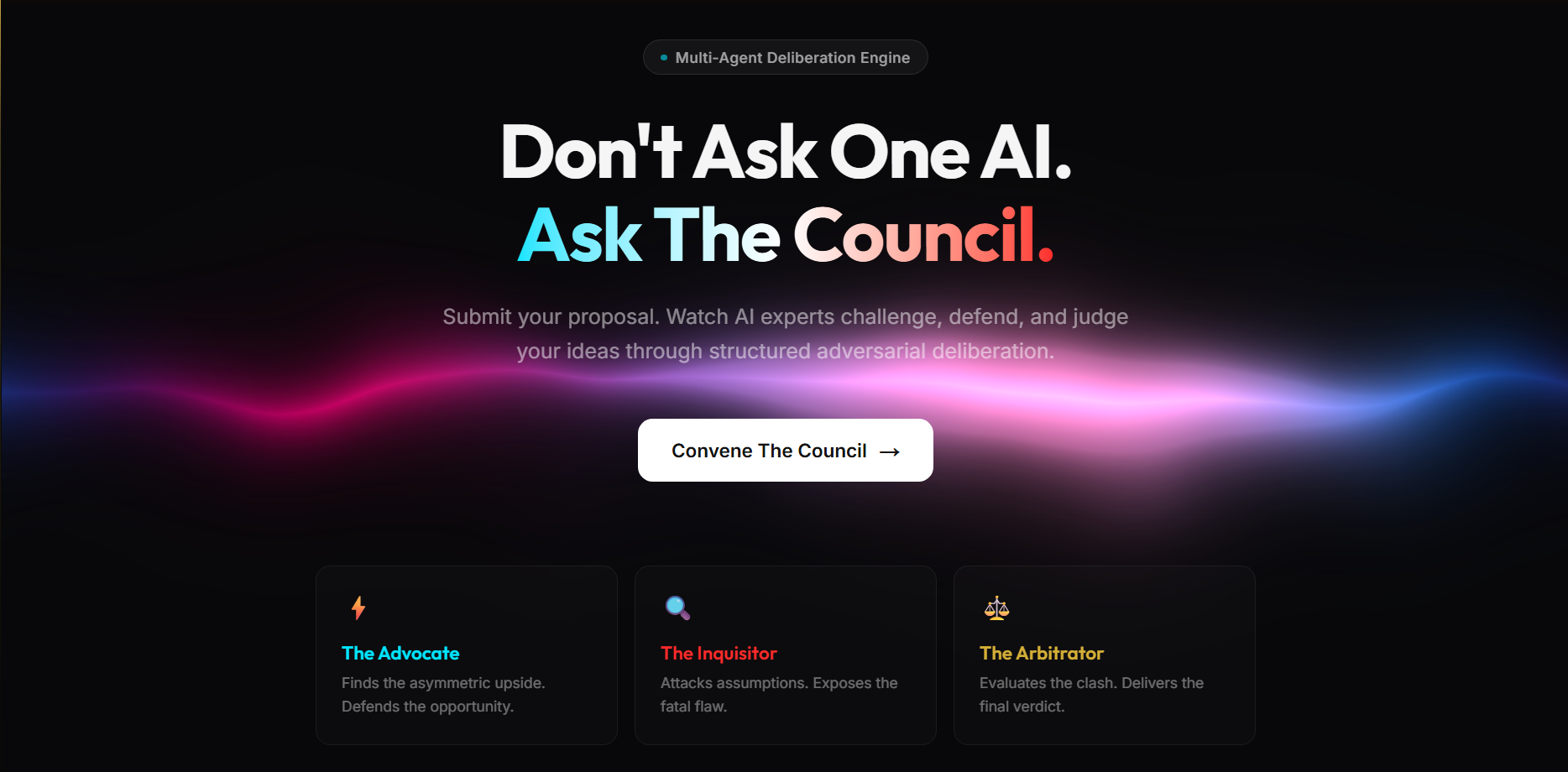
- The Advocate identifies opportunities, strategic advantages, and long-term upside.
- The Inquisitor challenges assumptions, exposes weaknesses, and identifies failure modes.
- The Arbitrator evaluates both perspectives and delivers a final verdict with a confidence score, rationale, fatal flaw analysis, and asymmetric upside assessment.
Rather than receiving a generic AI response, users gain access to a transparent decision-making process they can inspect, understand, and learn from.
The result is a decision that has survived scrutiny rather than one that simply received agreement.
How We Built It
Council AI was built using a multi-agent architecture powered by Gemini and supported by MongoDB Atlas.
The system consists of four major layers:
Claim Extraction
Before deliberation begins, Gemini transforms unstructured user proposals into structured, falsifiable claims that can be independently evaluated.
Adversarial Deliberation
Specialized Gemini agents operate with opposing incentives.
The Advocate maximizes opportunity.
The Inquisitor maximizes skepticism.
This intentional conflict produces deeper reasoning than a traditional single-model interaction.
Arbitration
A dedicated Arbitrator synthesizes both perspectives into a final structured verdict containing:
- Verdict
- Confidence Score
- Winning Argument
- Fatal Flaw
- Asymmetric Upside
- Executive Rationale
MongoDB Institutional Memory
MongoDB Atlas serves as the persistent memory layer of the platform.
Every proposal, argument, deliberation, and verdict is stored as organizational knowledge, enabling:
- Historical decision tracking
- Institutional memory
- Historical precedent retrieval
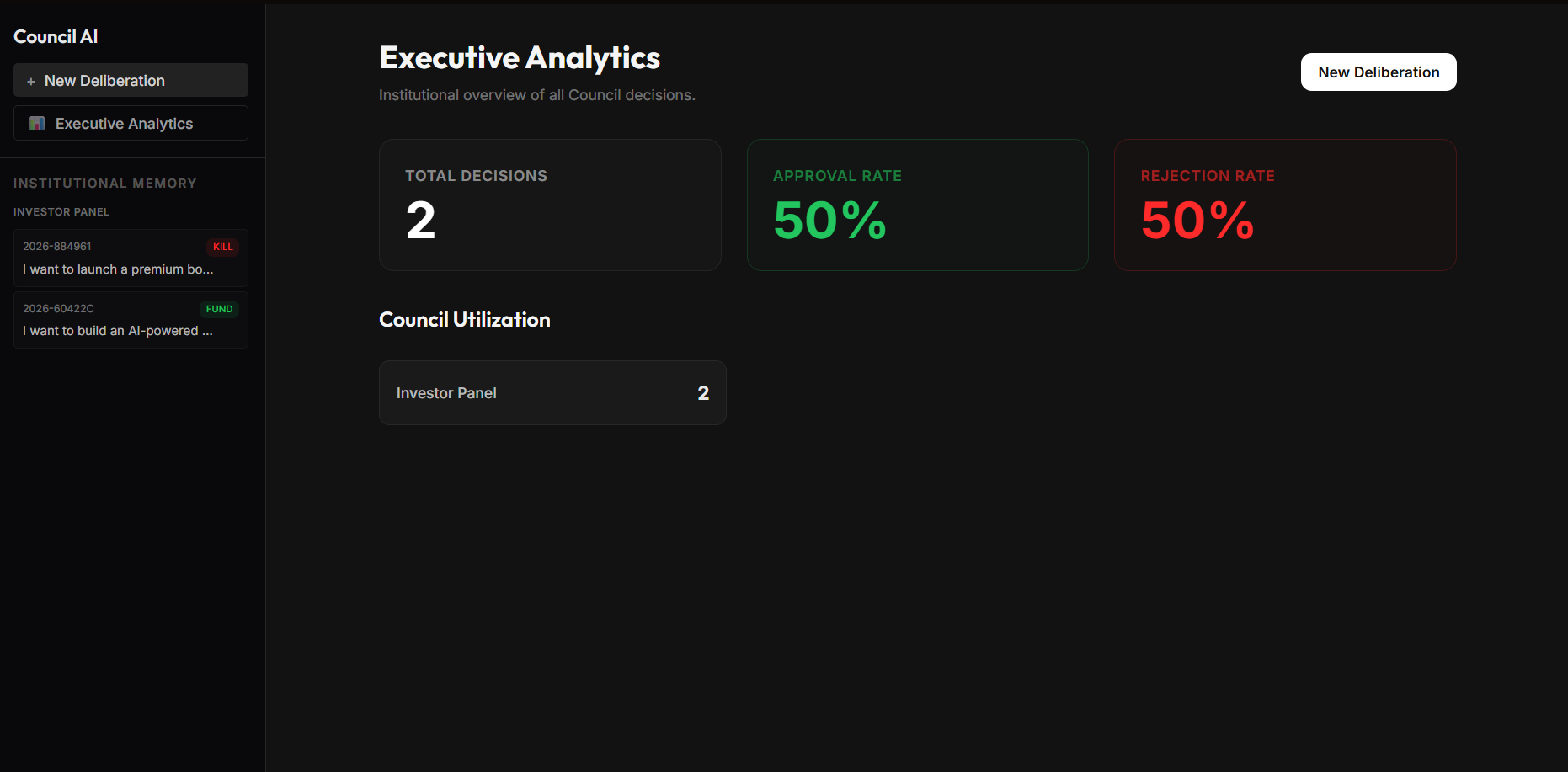
- Executive analytics
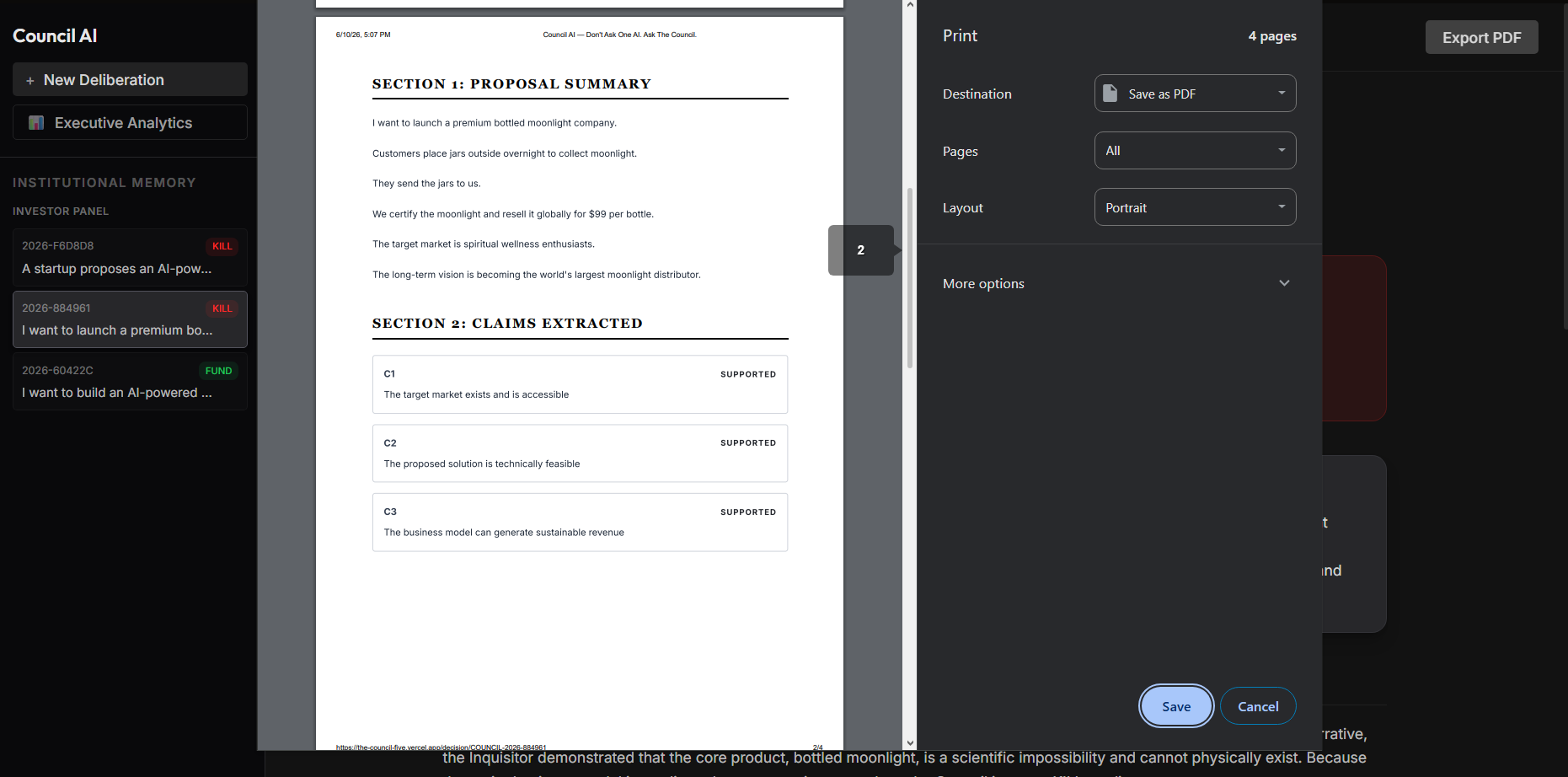
- Persistent executive reports
MongoDB transforms Council AI from a temporary AI conversation into a continuously evolving decision intelligence platform.
Technology Stack
Frontend
- Next.js
- React
- Tailwind CSS
- Framer Motion
Backend
- FastAPI
- Python
- Gemini 2.5 Flash
- AsyncIO
Database
- MongoDB Atlas
- Motor
Challenges We Ran Into
The most difficult challenge was not technical—it was behavioral.
Modern AI systems are optimized to be helpful and cooperative. When multiple AI agents interact, they naturally drift toward consensus.
However, meaningful decision-making requires disagreement.
To solve this, we designed agents with fundamentally opposing objectives. The Advocate is incentivized to maximize opportunity, while the Inquisitor is incentivized to identify risks and failure modes. Creating productive tension between these agents required extensive prompt engineering, validation logic, and iterative testing.
Another major challenge was reliability.
Because Council AI relies on multiple AI-generated outputs, ensuring consistent formatting, resilient parsing, structured verdict generation, and stable streaming became critical. We implemented retries, validation layers, fail-safe arbitration logic, and error recovery systems to maintain a reliable user experience.
Finally, building institutional memory introduced challenges around persistence, retrieval, analytics, and historical precedent management. MongoDB Atlas allowed us to solve these challenges while maintaining flexibility as the platform evolved.
Accomplishments That We're Proud Of
We're particularly proud that Council AI evolved far beyond a traditional AI chatbot.
Over the course of development, we successfully built:
- A multi-agent deliberation architecture powered by Gemini
- An adversarial reasoning framework that encourages structured disagreement rather than blind agreement
- A transparent arbitration system capable of explaining every verdict
- A MongoDB Atlas institutional memory layer that preserves organizational knowledge across decisions
- Historical precedent retrieval that allows past deliberations to influence future evaluations
- An executive analytics dashboard for tracking decision trends and council utilization
- Professional PDF executive reports suitable for founders, teams, and stakeholders
Most importantly, we transformed a simple idea into a fully deployed decision intelligence platform that helps users think more critically about important decisions.
What We Learned
This project taught us that the future of AI may not simply be larger models.
It may be better conversations between specialized models.
Some of the strongest insights emerged not from individual responses, but from the conflict between opposing viewpoints.
We also learned that users trust AI more when they can inspect the reasoning process rather than simply receiving a final answer.
Transparency creates confidence.
Debate creates rigor.
And structured disagreement often leads to better decisions.
What's Next for Council AI: The Executive Decision Engine
Today, Council AI acts as a virtual executive boardroom.
Tomorrow, we envision it becoming a comprehensive decision intelligence platform capable of preserving organizational memory, learning from historical decisions, and helping individuals, startups, institutions, and enterprises make better choices with greater confidence.
Future plans include:
- Atlas Vector Search for richer precedent retrieval
- Organizational memory across teams and departments
- Decision outcome tracking and feedback loops
- Document-grounded deliberation using external knowledge sources
- Collaborative councils that combine human and AI participants
Because the most important decisions in life should never rely on a single perspective.
Don't Ask One AI. Ask the Council.
Built With
- css
- fastapi
- framer-motion
- google-cloud
- google-gemini-api
- html
- html2canvas
- javascript
- jspdf
- mongodb
- mongodb-atlas
- motor
- next.js
- node.js
- pydantic
- python
- react
- recharts
- shadcn-ui
- tailwind-css
- typescript
- uvicorn

Log in or sign up for Devpost to join the conversation.