-
-

thumbnail
-

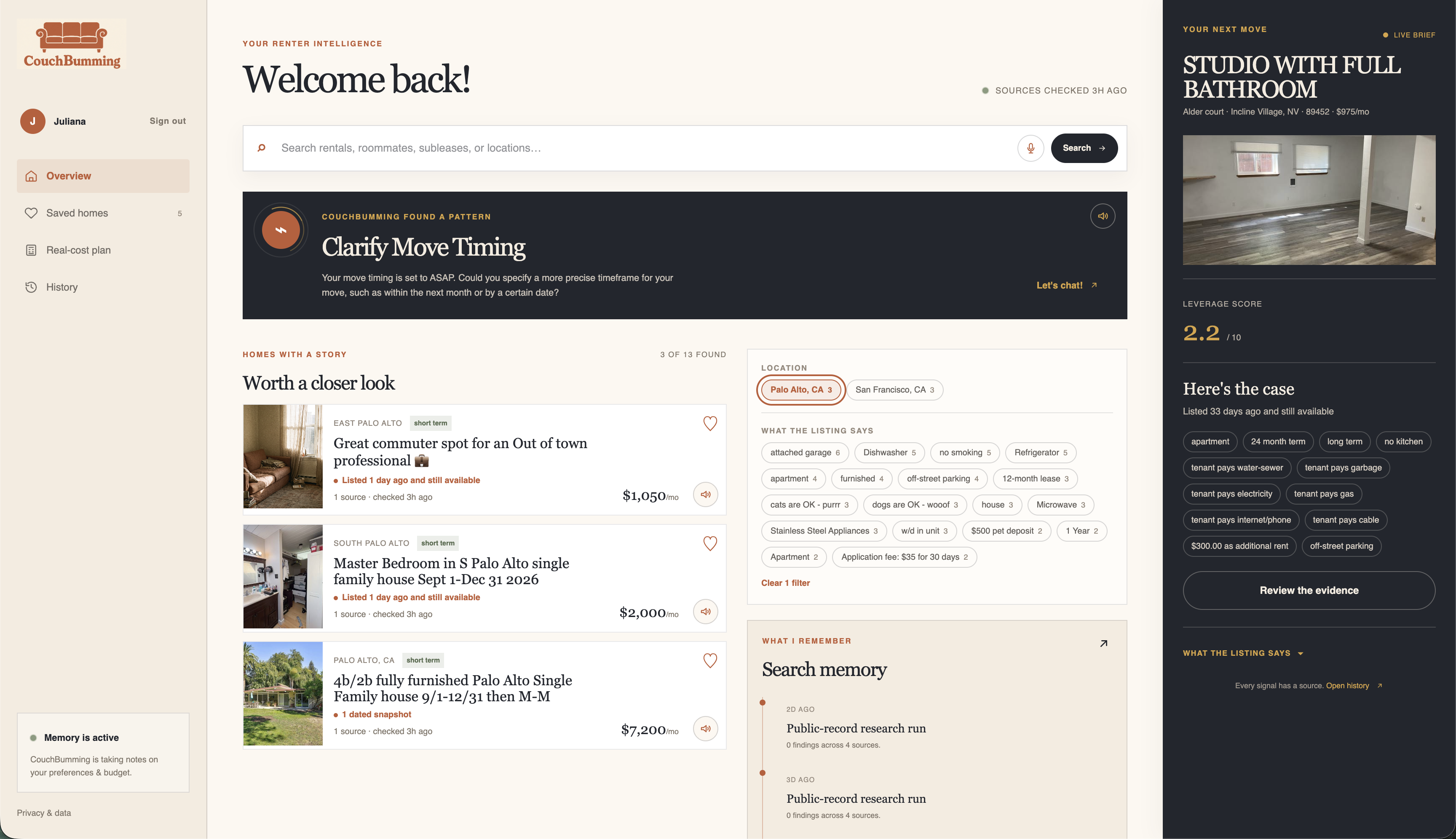
landing page
-
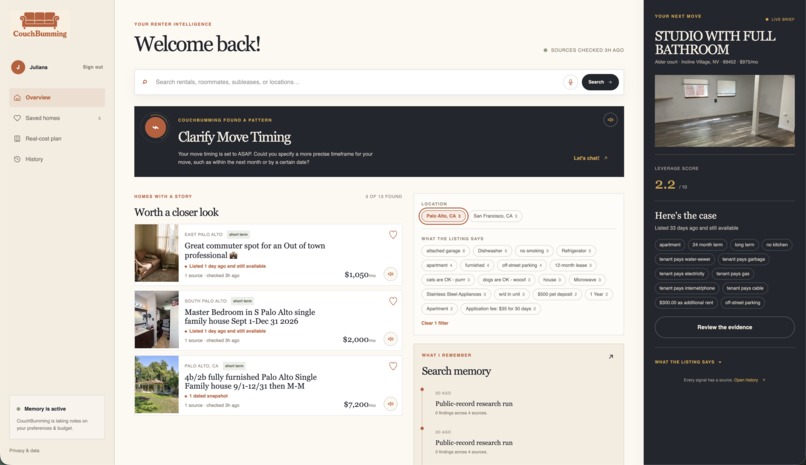
search results
-
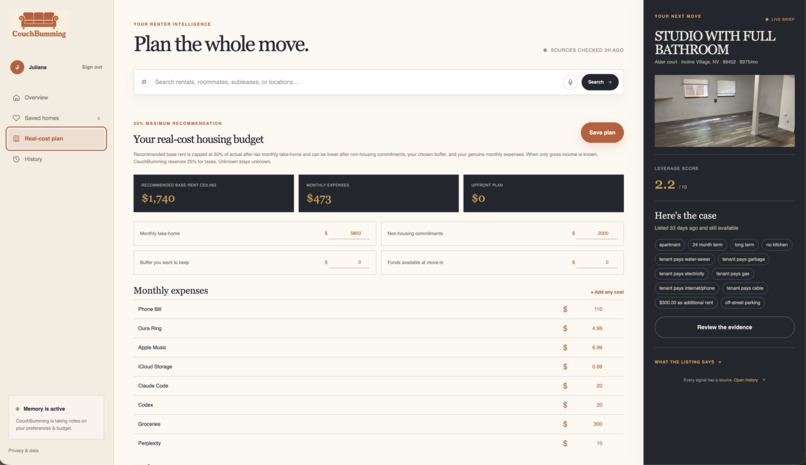
budgeting



About the project
Inspiration
In 2025, the Department of Justice compelled RealPage to stop enabling landlords to share non-public pricing data in order to coordinate rent increases across competing properties. The resulting settlement required RealPage to pay more than $359.9 million to overcharged renters, and Austin was identified as one of the most affected markets, where nearly half of all multifamily units were priced through RealPage's algorithm at its peak. For years, landlords had access to a system that quietly worked in their favor during negotiations. CouchBumming was conceived to place a comparable advantage on the side of the renter. Using only public listing data, it performs the same fundamental task that led to RealPage's prosecution: tracking pricing and market history to create genuine negotiating leverage, in this case for the tenant rather than the landlord.
What it does
CouchBumming is an agentic rental search assistant designed to retain the information that pricing algorithms have historically withheld from renters. A user selects a neighborhood, whether their current one or a market they are considering relocating to, and the system performs the following functions:
- It aggregates listings across multiple channels, including standard leases, Airbnb monthly stays, and shared housing or roommate arrangements.
- It tracks each unit's price and vacancy history over time, so that it can inform a user that a given unit has remained vacant for thirty four days and has already been reduced in price once, while comparable units nearby are listed for one hundred fifty to two hundred dollars less.
- It identifies whether a listing requires a soft credit inquiry, which does not affect a credit score, or a hard inquiry, which does, and defaults to recommending soft pull options for credit sensitive users.
- It recognizes when a single physical unit is listed across multiple platforms under different terms, such as a standard lease compared to an Airbnb monthly stay, and informs the user which channel offers a lower cost or reduced credit risk.
- It retains a record of the user's own search and application history, so that a listing that previously affected the user's credit score, or one the user has already declined, is not resurfaced.
- It logs the specific data underlying each recommendation and how current that data is, forming a transparency ledger that intentionally mirrors the remedy the Department of Justice imposed on RealPage.
How we are using CockroachDB and AWS
- CockroachDB Distributed Vector Indexing powers the cross platform unit identity matching, an embedding based similarity search that recognizes a single physical unit listed differently across separate platforms.
- The CockroachDB Cloud Managed MCP Server routes all agent memory operations, including price history, user search history, and negotiation briefs, through MCP tool calls rather than direct SQL access from the application tier.
- AWS Lambda handles the ingestion jobs and serves as the API backend.
- Amazon Bedrock generates the negotiation briefs and performs credit safety classification.
How we built it
CouchBumming is a new project developed specifically for this hackathon and is not derived from any prior work. The architecture is built around a central premise: the negotiation leverage feature depends entirely on retained history. A single price snapshot cannot indicate that a unit has reduced its price twice within six weeks, but a system with persistent memory can. CockroachDB serves as that memory layer, storing price history, vacancy data, and user interaction records, while its vector indexing capability resolves the cross platform deduplication problem. Because Zillow, Airbnb, and typical roommate matching platforms do not provide open developer APIs, the data layer combines Zillow Research's public CSV market data with a clearly documented, seeded demonstration dataset, rather than relying on a scraper that would likely be unreliable or prohibited by platform terms of service on the day of the demonstration.
Challenges we ran into
- None of Zillow, Airbnb, or common roommate matching platforms offer an accessible developer API, which required the data strategy to be scoped honestly around public CSV data, a limited free tier listings API, and clearly labeled seeded data rather than an unavailable live integration.
- Maintaining factual accuracy regarding the RealPage narrative, including the correct settlement figures, while ensuring the product itself relies exclusively on public listing data, so that it cannot be mistaken for repeating the practice it is designed to counter.
- Designing credit safety classifications that are presented as informational estimates rather than guarantees, since an incorrect soft pull designation could have material consequences for a credit sensitive user.
Accomplishments that we're proud of
- A memory architecture in which persistence is functionally essential. The negotiation leverage feature cannot operate without it.
- A cross platform unit identity matching system, built on CockroachDB's vector indexing, that resolves a genuine deduplication problem: the same unit appearing differently across platforms.
- A data provenance ledger that deliberately reflects the remedy the Department of Justice imposed on RealPage, offering transparency about the data used and its recency.
What we learned
- Grounding a hackathon submission in a documented, ongoing regulatory case, rather than a hypothetical harm, produces a considerably stronger and more verifiable case for real world impact.
- Acknowledging data source limitations at the outset, such as the absence of open APIs for Zillow and Airbnb, and designing around them with legitimate sources, results in a more defensible submission than a scraper that may not function reliably by the time of the demonstration.
What's next for CouchBumming
- Transition from seeded demonstration data to a licensed data aggregator partnership for real time Airbnb monthly stay and roommate matching listings.
- Expand the credit safety classifier to incorporate more reliable signals beyond inference from listing text.
- Introduce a proactive alert for renters at risk, surfacing affordable alternatives before a lease renewal notice results in a forced move.
Built With
- amazon-bedrock
- amazon-web-services
- aws-lambda
- cockroachdb
- distributed-vector-indexing
- html
- javascript
- mcp
- model-context-protocol
- node.js
- postgresql
- python
- react
- rest-api
- sql
- typescript
- vector-search

Log in or sign up for Devpost to join the conversation.