Inspiration
I’ve always been curious about the cost of major megaprojects, like the Burj Khalifa. I used to wonder: if we had to rebuild something like the Pyramid of Giza today, how much would it cost? One day, I had an idea: building a smart city near my hometown, a city where artificial intelligence is present everywhere. That’s when I asked myself: how much money would I need to make it happen? I started looking for an application that could estimate the cost of such a project, but I couldn’t find any. So I decided to create one myself. When I saw what deep research tools like Sonar could do, I realized I had a way to bring this idea and many others to life.
What it does
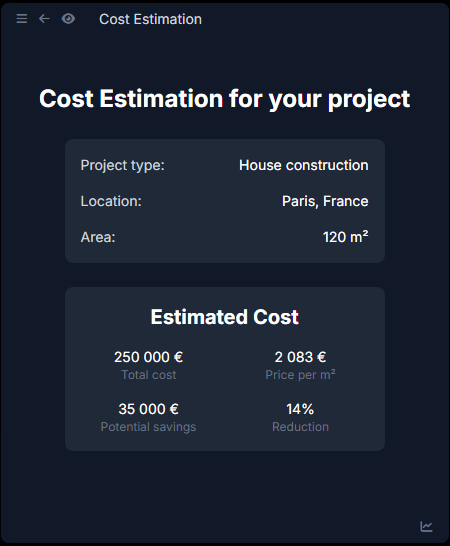
It provides a total cost estimate for any kind of project, in any field, in any country or city in the world. It helps users make smarter decisions before jumping into a project. For example, it can identify unexpected costs or requirements that people often overlook, like legal permissions, regulations, or hidden constraints.
How I built it
Since I’m working alone, with no real background in coding, I’m still a student and have no professional experience. I relied heavily on AI to help turn my idea into reality.
Challenges I ran into
There were so many possible scenarios for each type of project. I worked alone, with just the idea and an algorithm in mind, but without the technical foundation to fully implement it. On top of that, I developed the project during my exam revision period, which made it even more challenging.
Accomplishments I'm proud of
This was my first hackathon, and I’m proud that I managed to build something that actually works. Even if it’s not yet at the level I dreamed of, it’s a great first step and a satisfying one.
What I learned
Even as a beginner in coding and AI, I learned that it’s possible to build something that once felt impossible, as long as you have the idea and the will to try.
What’s next for Crafting Cost
After the end of the academic year (scheduled for May 27), I’ll continue developing the app to improve its accuracy and usefulness. I plan to expand it beyond just monetary costs, for example by estimating time costs too. I also want to integrate it into other domains like law. Imagine being able to upload a legal case file and instantly find the relevant laws that could either incriminate or exonerate someone.
I’d also like to add an execution phase. For example, if a user estimates the cost of a trip to London, the app could then organize the trip by booking the flight, hotel, museum tickets, etc. And it wouldn't stop there. On any site with a reservation form or a phone number, the app could place orders automatically. For instance, it could use an AI voice to call a cement supplier and order 200 bags to a specific location. All the user would have to do is confirm and pay.
Of course, all this won’t be possible if I continue working alone. I’ll need to invest money, build a team, and eventually start my own company. According to ChatGPT, the market potential of this kind of application is between $10 and $30+ billion, meaning that if the project succeeds and isn’t copied or stolen, it could be revolutionary. But even if it doesn’t work out, I have many other innovative ideas that I can pursue in the coming years.
So for Crafting Cost, or maybe Planum.AI in the future, if I find the right people to help me, it could become a massive company.
Why This Project Deserves to Go Beyond a Hackathon
I thought a lot about whether I should participate in the hackathon with this project, because to me, it’s much more than just a hackathon idea. If it works as expected, I truly believe it will be used across all fields in the future. It gives users the ability to prevent mistakes, minimize risks, and think more clearly before starting any project, all at a very low cost.
This tool is designed to cover everything from the smallest projects, like organizing a weekend trip to Rome, to the most ambitious ones, such as building an entire smart city from scratch.
That’s why I’m 99% sure that once it’s fully developed, it could be used anywhere in the world, and maybe even become something essential, a tool people can’t make decisions without.
If I had the means to fully build it, I would have done it already. But for now, the hackathon is a step toward turning this vision into reality.
Built With
- css3
- html5
- javascript
- perplexity
- sonar

Log in or sign up for Devpost to join the conversation.