✍️ Project Description (StudentHackpad 2026 Hackathon)
The Concept As humanity transitions into a multi-planetary species, our Earth-bound expectation of "instant" communication becomes a physical and psychological bottleneck. On Earth, we measure latency in milliseconds; in the Solar System, we measure it by the speed of light. CosmosTerminal is a high-latency communication simulator built to bridge this gap. It replaces the instant gratification of modern messaging with a "clinical" interface that respects the laws of physics.
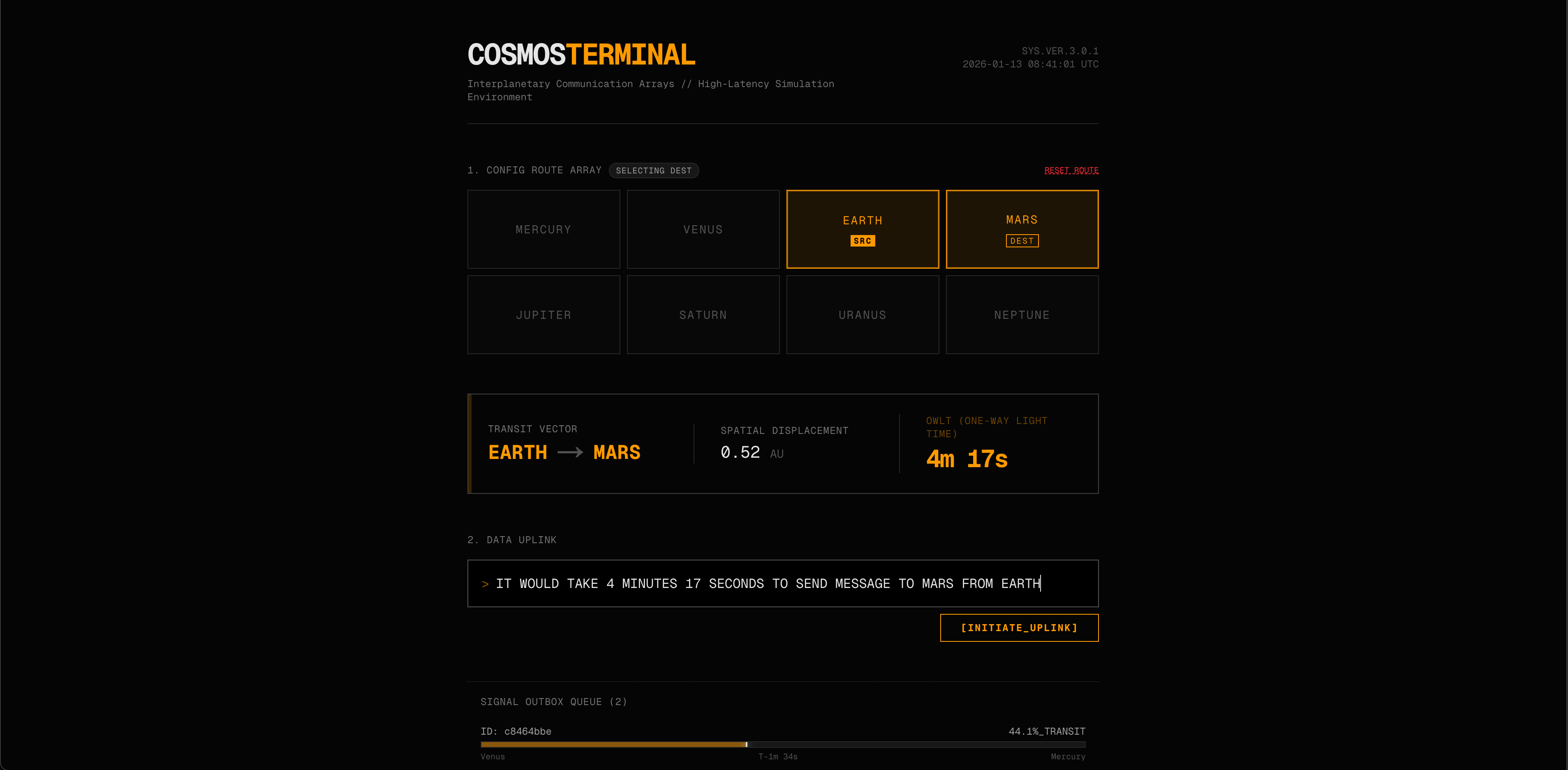
What I Built CosmosTerminal is a specialized, zero-backend Next.js application that simulates a "Store-and-Forward" interplanetary protocol.
Deterministic Latency Engine: Instead of a standard chat, the app uses a physics-based model where travel time is determined by the absolute distance between planetary orbital radii.
The "Wait" UX: Messages are not "sent"; they are "uplinked." Once broadcast into the vacuum, the data packet is physically locked in a transit queue. The receiver cannot decode the message until the calculated One-Way Light Time (OWLT) has elapsed.
Telemetry Dashboard: A brutalist, monochrome UI provides real-time data readouts of spatial displacement in Astronomical Units (AU) and precise countdowns to signal arrival.
🛰️ Interface Architecture
1. Config Route Array
A tactile selection grid where the user designates the Source (SRC) and Destination (DEST) nodes. The system currently supports all major planetary bodies from Mercury to Neptune, visually tracking active array paths.
2. Transit Vector Dashboard
A real-time telemetry readout that calculates critical flight data:
- Spatial Displacement: Displays the distance between nodes in Astronomical Units (AU).
- OWLT (One-Way Light Time): The precise latency incurred by the speed of light constant, calculated as the physical barrier to "instant" communication.
3. Data Uplink Terminal
The primary interaction point. Users input their PAYLOAD_DATA into a command-line style field. Clicking [INITIATE_UPLINK] doesn't send a message—it broadcasts a signal that must then physically survive the journey across the vacuum.
4. Signal Outbox Queue
A live tracking system for all "Packets in Transit."
- Packet ID Tracking: Unique identifiers for every transmission.
- Transit Progress: Real-time percentage bars showing the signal's current position in deep space.
- T-Minus Countdown: High-precision timers indicating the exact moment of custody transfer at the destination planet.
📐 Protocol Physics
The simulation follows a Direct Line-of-Sight model. By calculating the absolute difference between planetary orbital radii (measured in Light Minutes), the system enforces a strict waiting period:
$$t_{arrival} = t_{now} + (d_{displacement} \times c_{constant})$$
Why It Matters
Current UI/UX patterns (WhatsApp, Slack) fail when the Round-Trip Time is measured in minutes or hours. CosmosTerminal serves as a training ground for the asynchronous reality of space colonization. It moves the conversation from "Are you there?" to "This is where the signal is now." By making the delay a visible, tangible feature rather than a bug, it prepares the multi-planetary citizens of tomorrow for the isolation and patience required by the cosmos.
"Space is vast, and light is slow. COSMOSTERMINAL ensures we never forget the distance."
🤖 AI Tools Disclosure: Claude (for general code)
Gemini (Google): Assisted in generating the core useInterplanetarySimulation TypeScript hook and the mathematical models for light-minute distance calculations.
Built With
- nextjs
- tailwind
- typescript

Log in or sign up for Devpost to join the conversation.