Inspiration
Apollo 13 , not the explosion but the recovery. Three astronauts and a ground team with no playbook, improvising solutions to cascading failures in real time. We kept coming back to one question: what if they'd had an AI that could see the next failure coming three seconds before it happened? And what if that AI still needed a human to pull the lever? That tension between machine prediction and human execution is exactly what COSMOS-OS is built around. As the space industry democratizes and more humans find themselves responsible for spacecraft systems with less training time than ever before, that gap between what an AI knows and what an operator understands becomes a genuine safety problem worth solving.
What it does
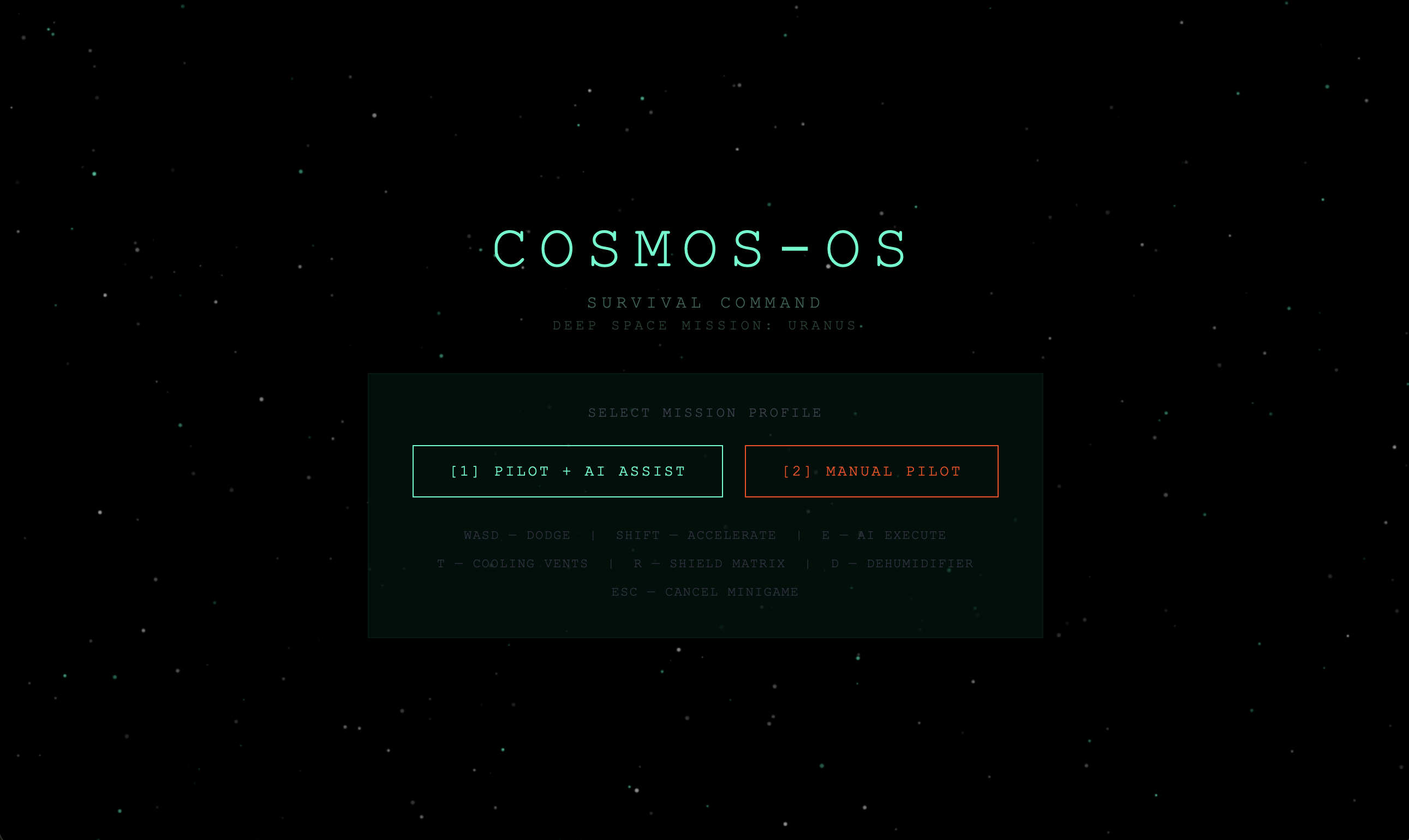
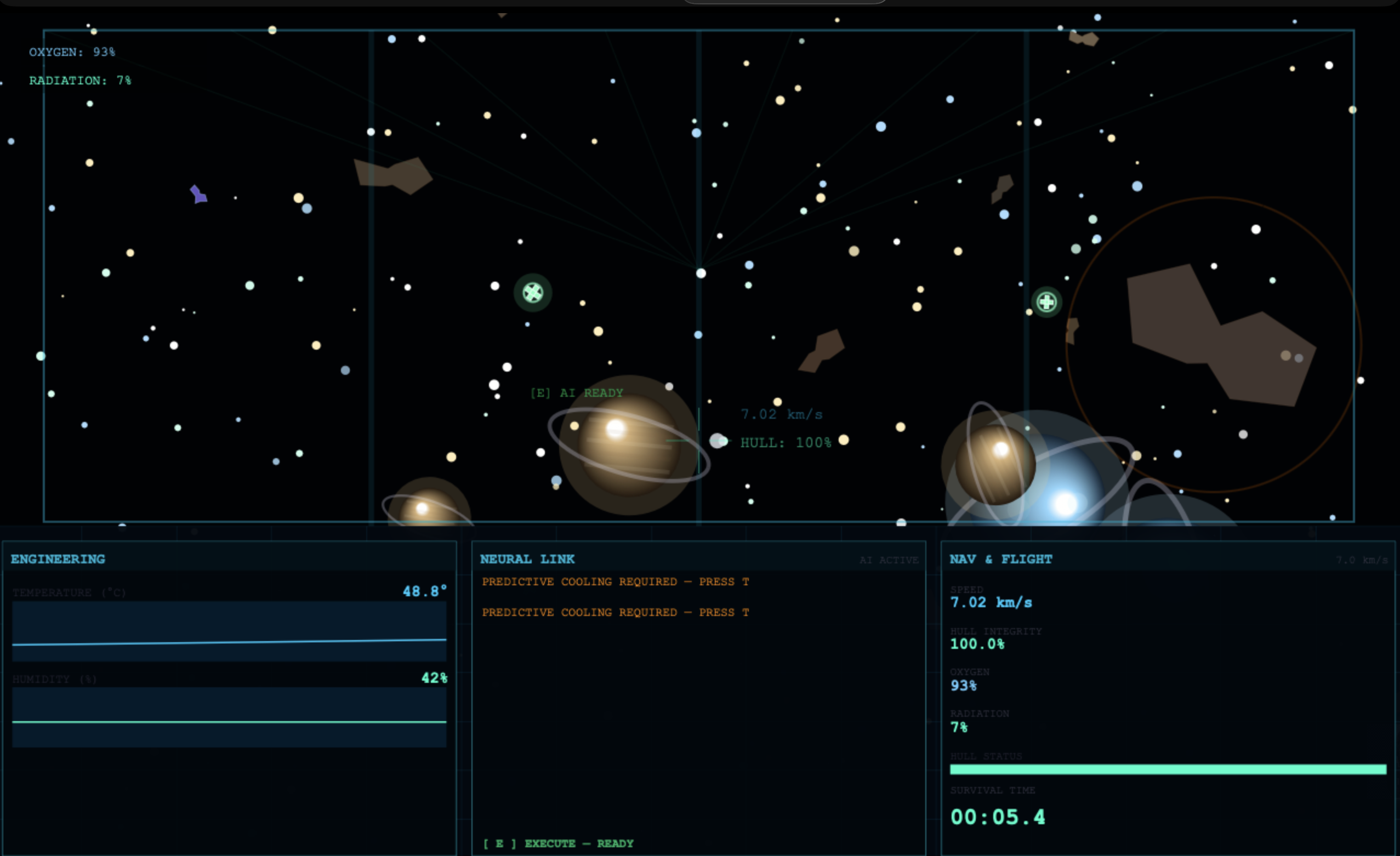
COSMOS-OS is a real-time spacecraft systems simulator with a live AI co-pilot. You manage five critical onboard systems — hull integrity, thermal load, oxygen, radiation, and atmospheric humidity — all degrading simultaneously as you navigate asteroid fields and alien encounters. The onboard AI runs a predictive risk model every frame, projecting system states three seconds into the future and alerting you to the highest-priority threat before it becomes a crisis. When a system goes critical, you don't just press a button , you execute a hands-on repair minigame that scales in difficulty based on how bad things already are. A thermal overload at 120°C gives you a faster needle, a narrower target zone, and less time than one at 70°C. Every decision has a downstream consequence on another system. It's a functional proof-of-concept for how transparent AI advisory systems could work aboard real spacecraft, where human override always remains the final word.
How we built it
The entire visual layer runs on the HTML5 Canvas API , stars, asteroids, planets, aliens, the cockpit HUD, and all three MFD instrument panels are drawn procedurally every frame. The AI system is a custom multi-variable predictive risk model: it computes projected values for all five sensor channels, scores each possible intervention by expected damage prevented, and surfaces the single most urgent action. Minigames are parameterised dynamically , their speed, target size, sequence length, and regen rate all derive from live system readings at the moment of trigger. All audio is synthesised in real time via the Web Audio API using oscillators, noise buffers, and gain envelopes, with zero audio files loaded. The alien encounter system uses a typed resolution tree where each alien class carries its own behaviour, visual identity, and consequence table
Challenges we ran into
The hardest problem was making the AI feel trustworthy rather than just technically correct. An alert that fires the moment a system fails is useless unless the operator is already in crisis. We had to tune the prediction window and risk thresholds through dozens of playtests until warnings arrived at exactly the moment they were actionable. The other major challenge was the minigame difficulty curve: too easy and the AI feels pointless, too punishing and the player feels like the AI set them up to fail.
Accomplishments that we're proud of
Building a complete, playable, polished game with reactive AI, procedural audio, five interlocking systems, minigames, alien encounters, health pickups, and particle effects in a single hackathon. The predictive AI model genuinely works: it catches compound failure chains before they happen and gives advice that, if followed, meaningfully extends survival time.
What we learned
Designing an AI that earns trust is fundamentally different from designing one that is technically correct. Timing and framing matter as much as the underlying logic as we learned to think about AI communication as a UX problem, not just an algorithm problem.
What's next for COSMOS - OS
We want to build a multiplayer mode where one player operates the ship and another plays the AI role, making advisory calls for the operator to execute a human in the loop experiment that directly mirrors crew resource management training used by actual space agencies.
Built With
- html5canvasapi
- javascript
- web-audio-api


Log in or sign up for Devpost to join the conversation.