
🌌 My Journey Building Cosmos Explorer
The Spark of Inspiration
I've always been fascinated by space, but I noticed that space education often feels static, like a history lesson. Meanwhile, real space exploration is happening right now! Rockets are launching, rovers are exploring other worlds, and new discoveries are made every day.
My goal was simple: build a platform that makes learning about space as dynamic and exciting as space exploration itself. I wanted to connect everyone—students, teachers, and enthusiasts—directly to the action, using real-time data and the power of AI to bring the cosmos to life.
What I Learned
This project was a deep dive into modern web development. I learned how to:
- Wrangle Live Data: I integrated multiple, complex APIs from NASA, NOAA, and other space agencies. It taught me how to handle data that's constantly changing and sometimes unpredictable.
- Build with AI: I didn't just use an AI, I learned how to teach it. Crafting the right personality and knowledge base for Luna, our AI guide, was a fun challenge in prompt engineering.
- Design for Experience: I focused on creating an interface that was clean, intuitive, and could make complex topics like orbital mechanics easy to understand and explore.
How I Built It
I started with a powerful foundation using Next.js 15 and TypeScript.
- Core Structure: First, I laid out the main pages and navigation to ensure the app was easy to use.
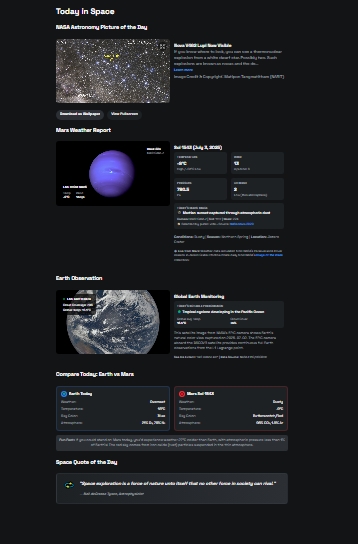
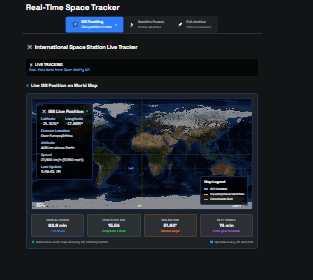
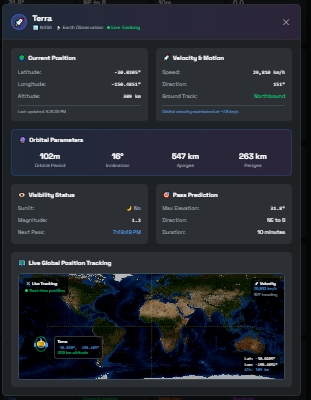
- Live Data Feeds: Next, I plugged into real-time data sources for rocket launches, space weather, and satellite tracking. This formed the dynamic backbone of the application.
- The AI Assistant: The most exciting part was bringing Luna to life. I connected to the OpenRouter API and carefully trained Luna to be a friendly, knowledgeable space tutor.
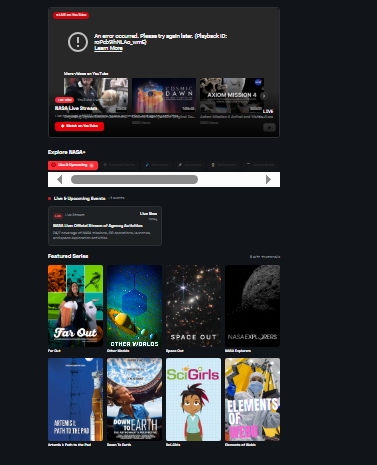
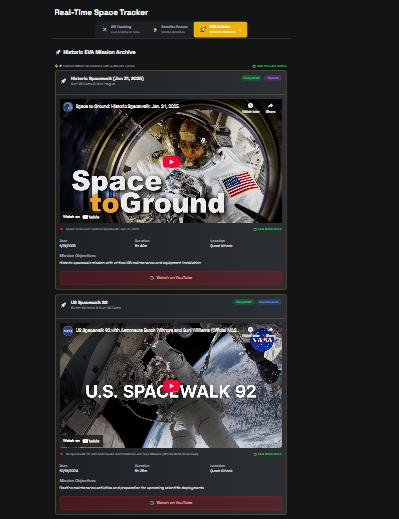
- Interactive Features: Finally, I layered on the fun, interactive elements like the NASA TV live stream, the events calendar.
The Challenges I Overcame
It wasn't all smooth sailing!
- Data Chaos: My biggest challenge was managing the different data feeds. Each API had its own format and quirks, so creating a unified, reliable experience took a lot of work.
- Tuning the AI: Getting Luna's personality just right was a process of trial and error. It needed to be smart and accurate, but also fun and encouraging.
- Keeping it Simple: With so much information, it was a constant challenge to present it in a way that wasn't overwhelming. I focused on clean design and letting users explore at their own pace.
APIs & Data Sources OpenRouter API: Serves as the gateway for accessing AI language models. OpenAI o4-mini: The specific AI model used for real-time educational responses in the Luna AI Assistant. Launch Library 2 API: Provides live, detailed data on upcoming rocket launches from global space agencies. NOAA Space Weather Prediction Center (SWPC) API: Delivers real-time alerts and data on solar activity and geomagnetic storms. NASA APIs: Used for a wide range of official content, including live video streams for NASA TV, imagery, and foundational space science data. Frameworks, Languages & Tools Next.js 15: The core React framework for building the full-stack application. React 19: The JavaScript library for creating the user interface. TypeScript: The language used for writing type-safe, robust code. Tailwind CSS: The utility-first CSS framework for all styling and responsive design. Vercel: The platform used for deploying, hosting, and scaling the application. Git & GitHub: For version control and source code management. Node.js: The JavaScript runtime environment. npm: The package manager for handling project dependencies.
Building Cosmos Explorer has been an incredible adventure. It pushed my skills to the limit and deepened my own passion for space. I hope it inspires others to look up at the stars and wonder. 🚀✨
Built With
- api
- nasa
- nextjs
- typescipt

Log in or sign up for Devpost to join the conversation.