-
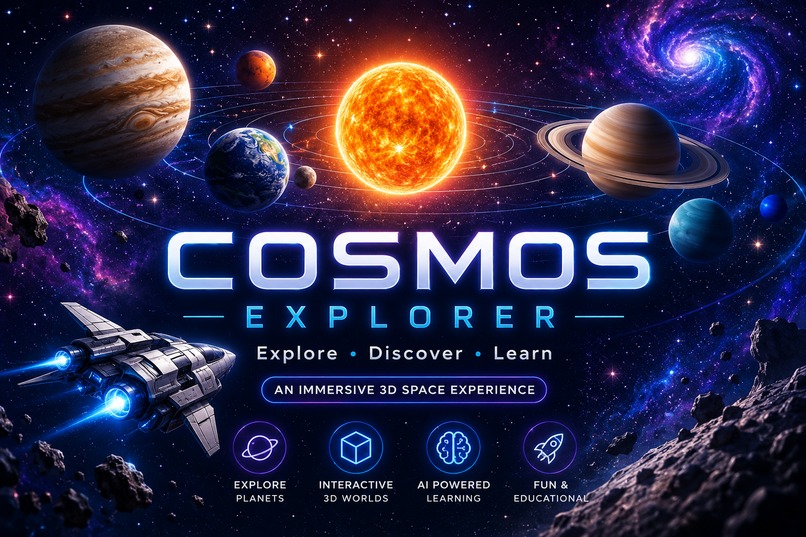
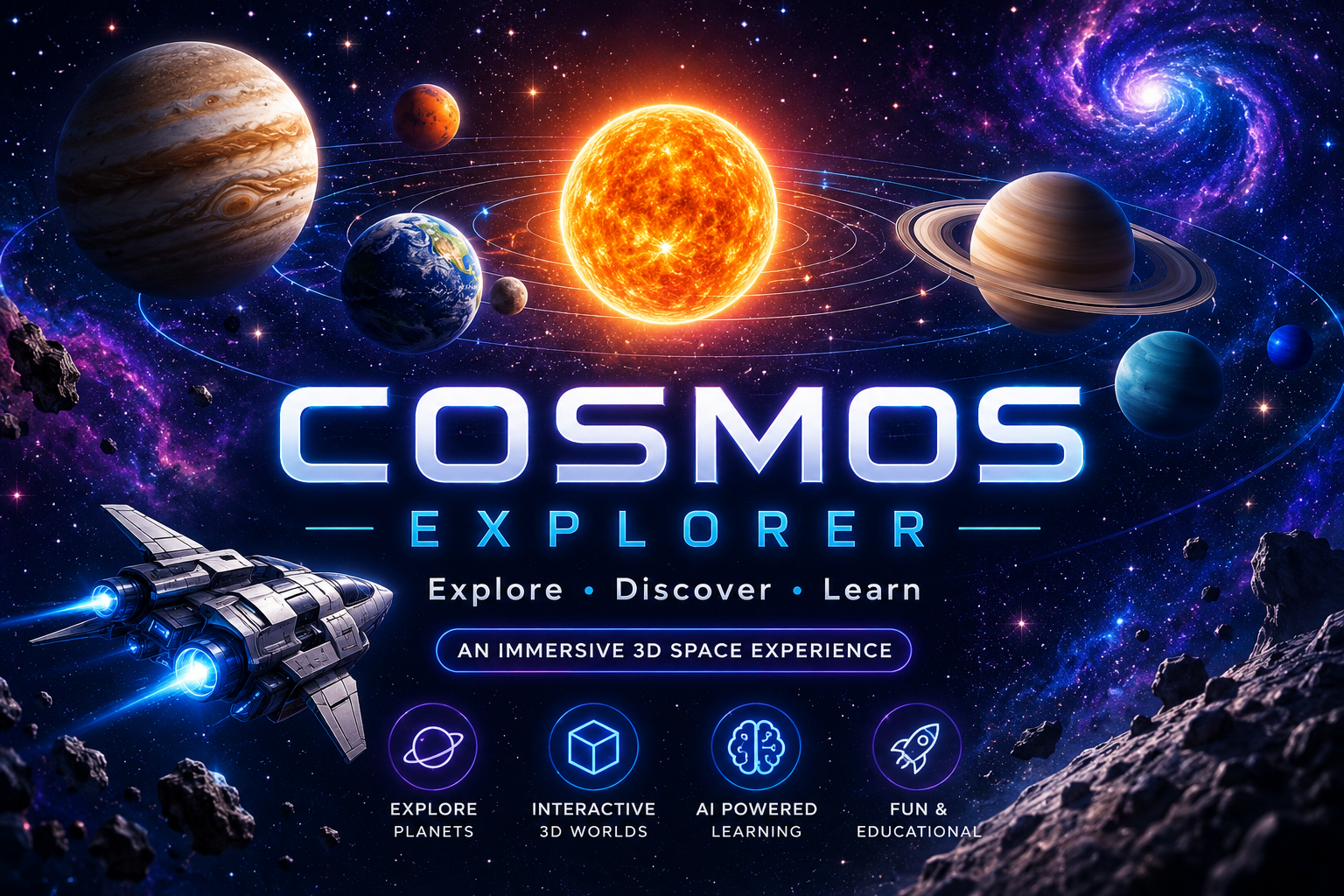
Cosmos Explorer — An immersive 3D web experience for exploring the universe.
-
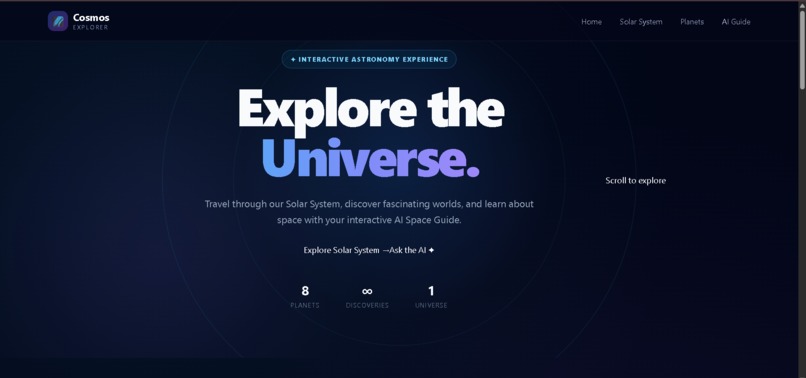
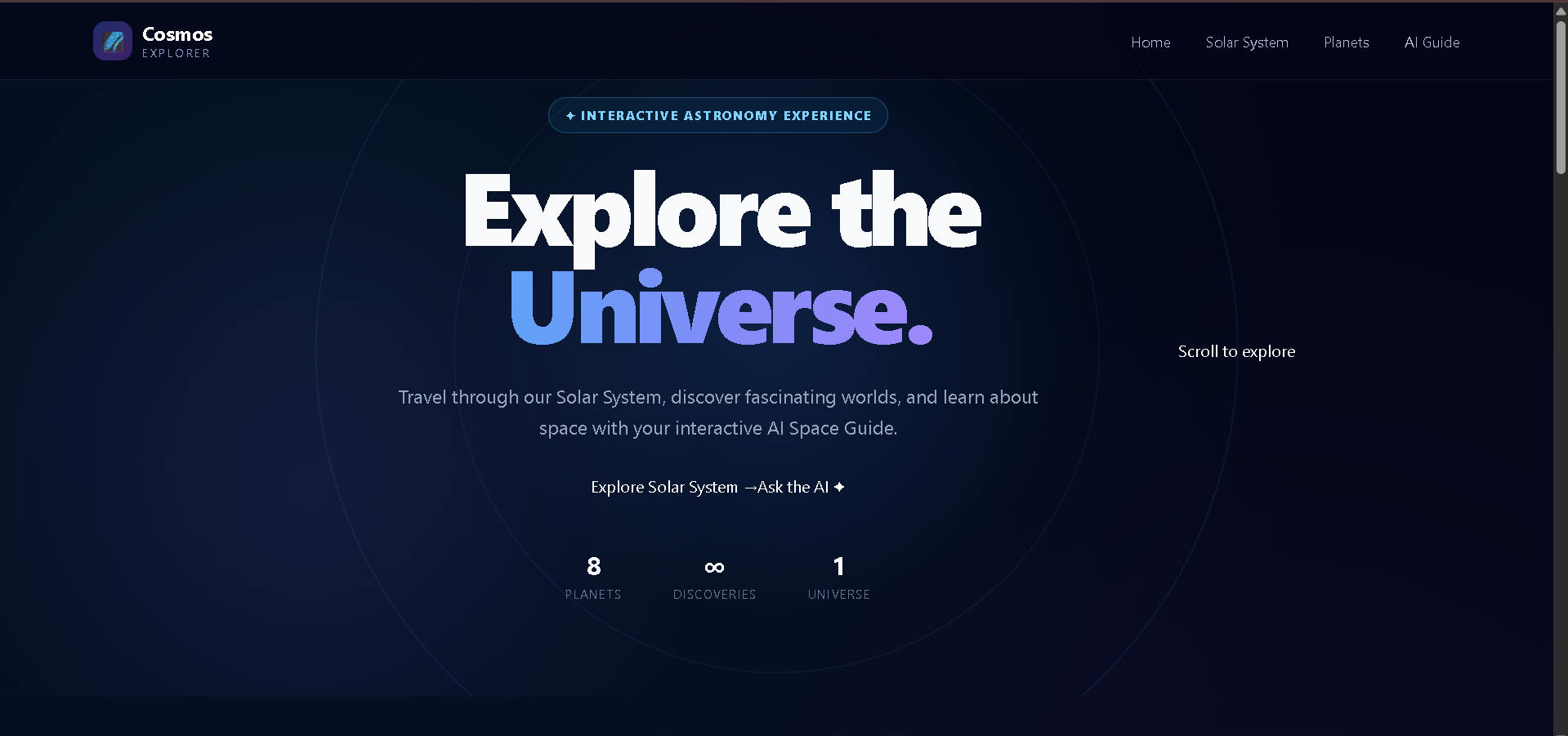
Explore the Universe — Interactive landing page introducing the Cosmos Explorer experience.
-
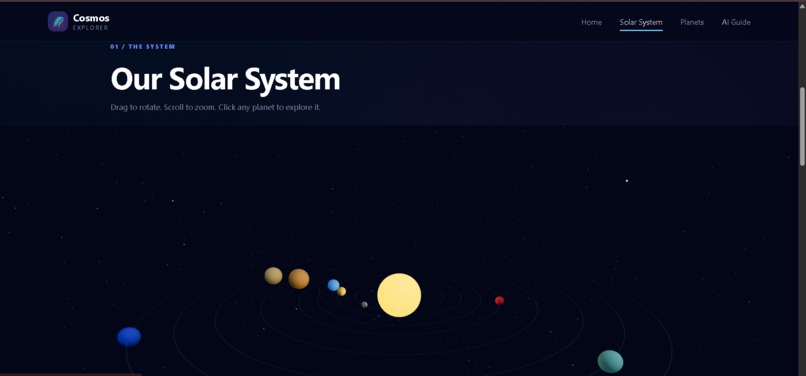
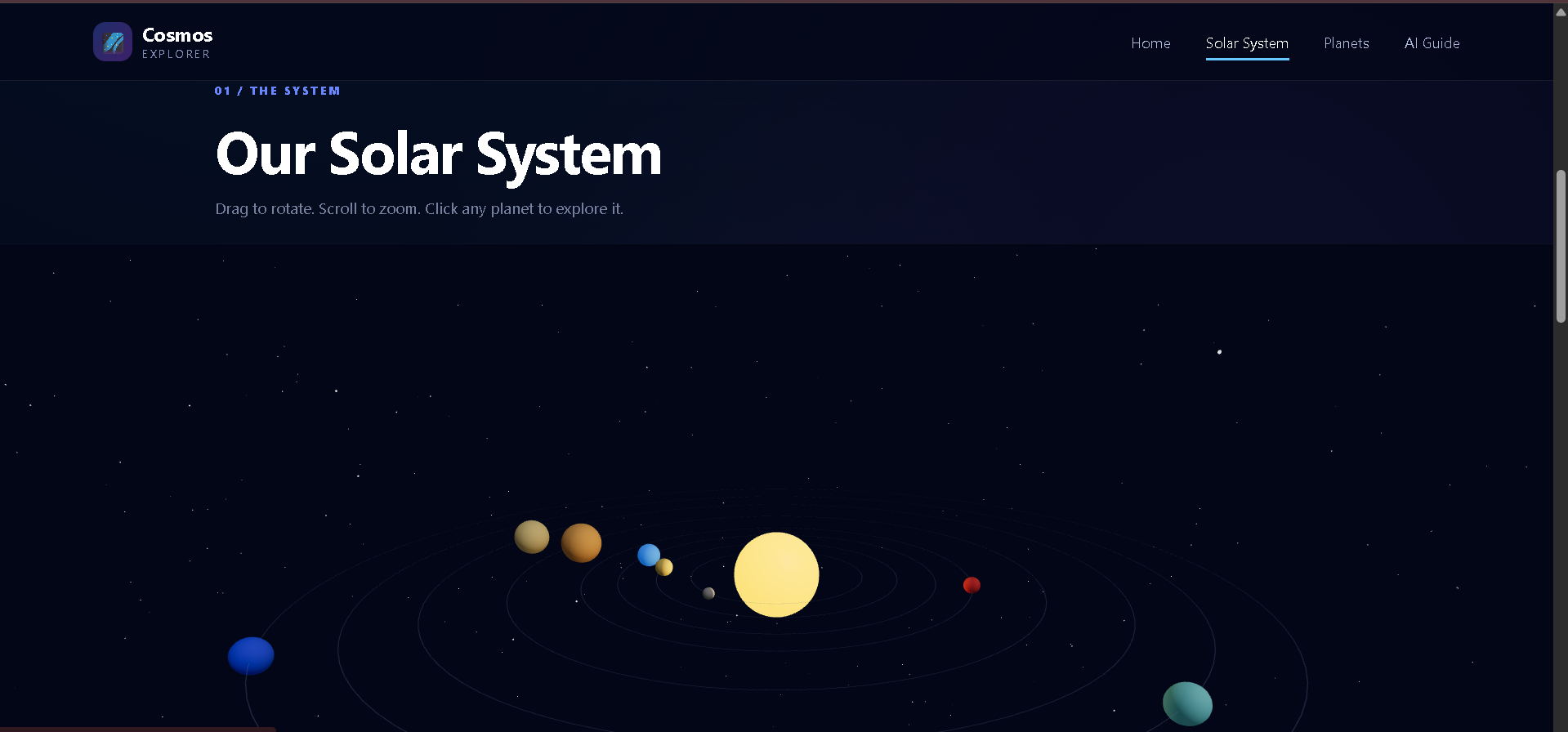
Interactive Solar System — Explore planets through an animated 3D solar system.
-
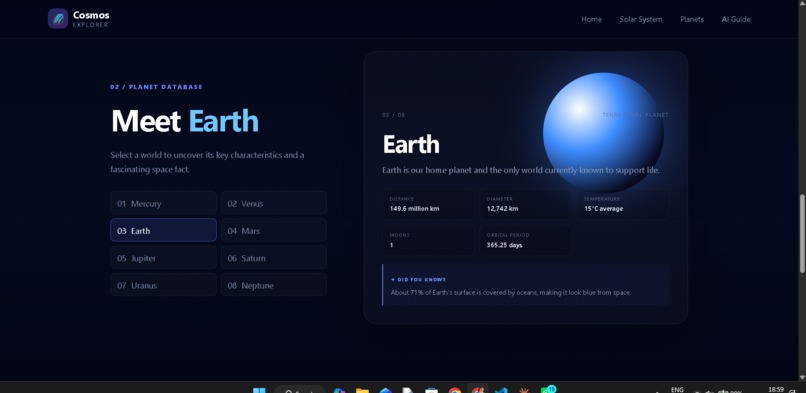
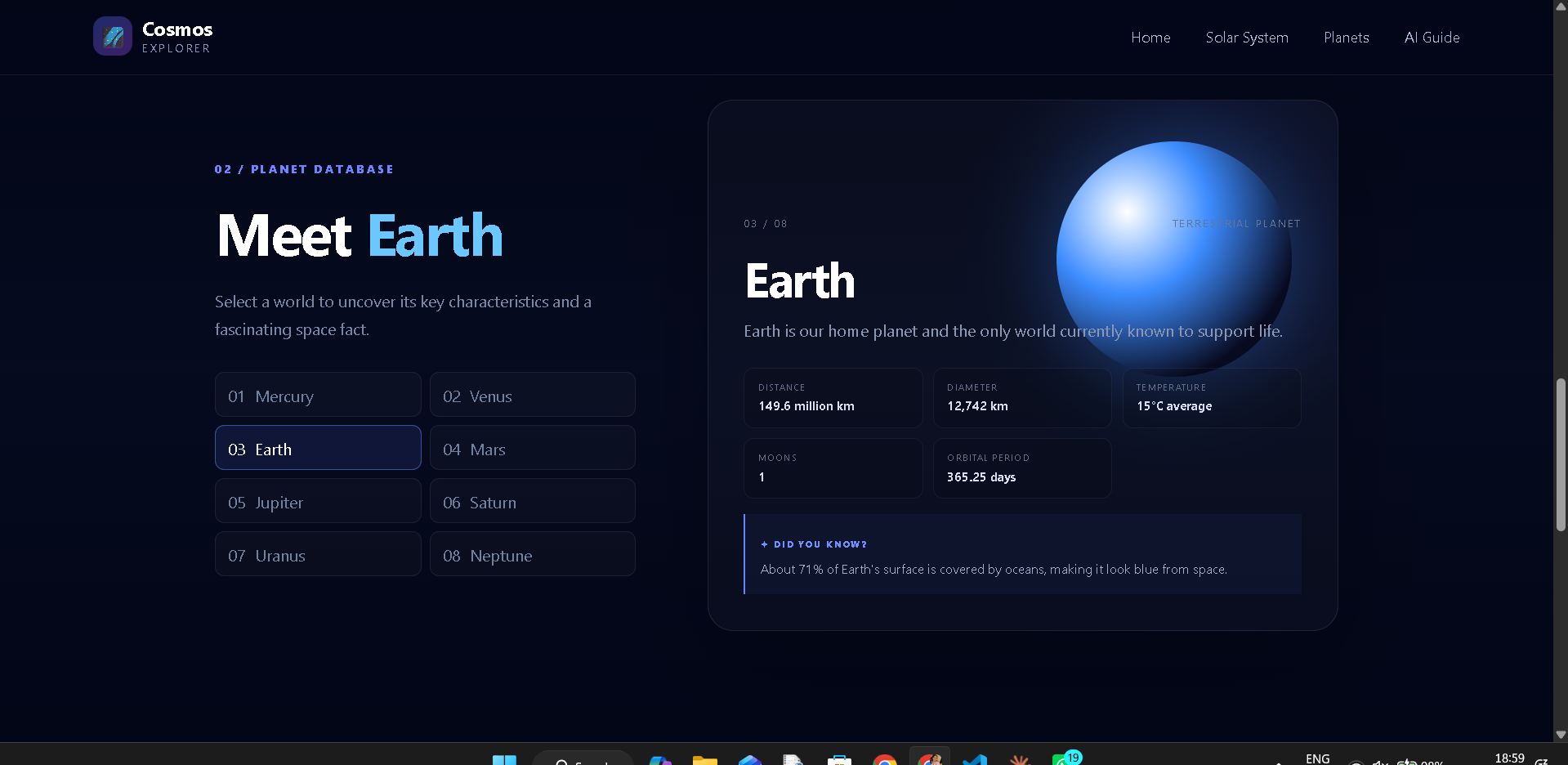
Planet Explorer — Discover detailed information and facts about individual planets.
-
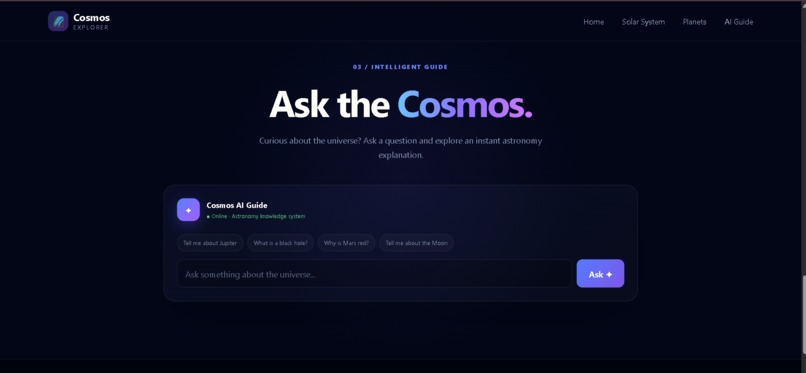
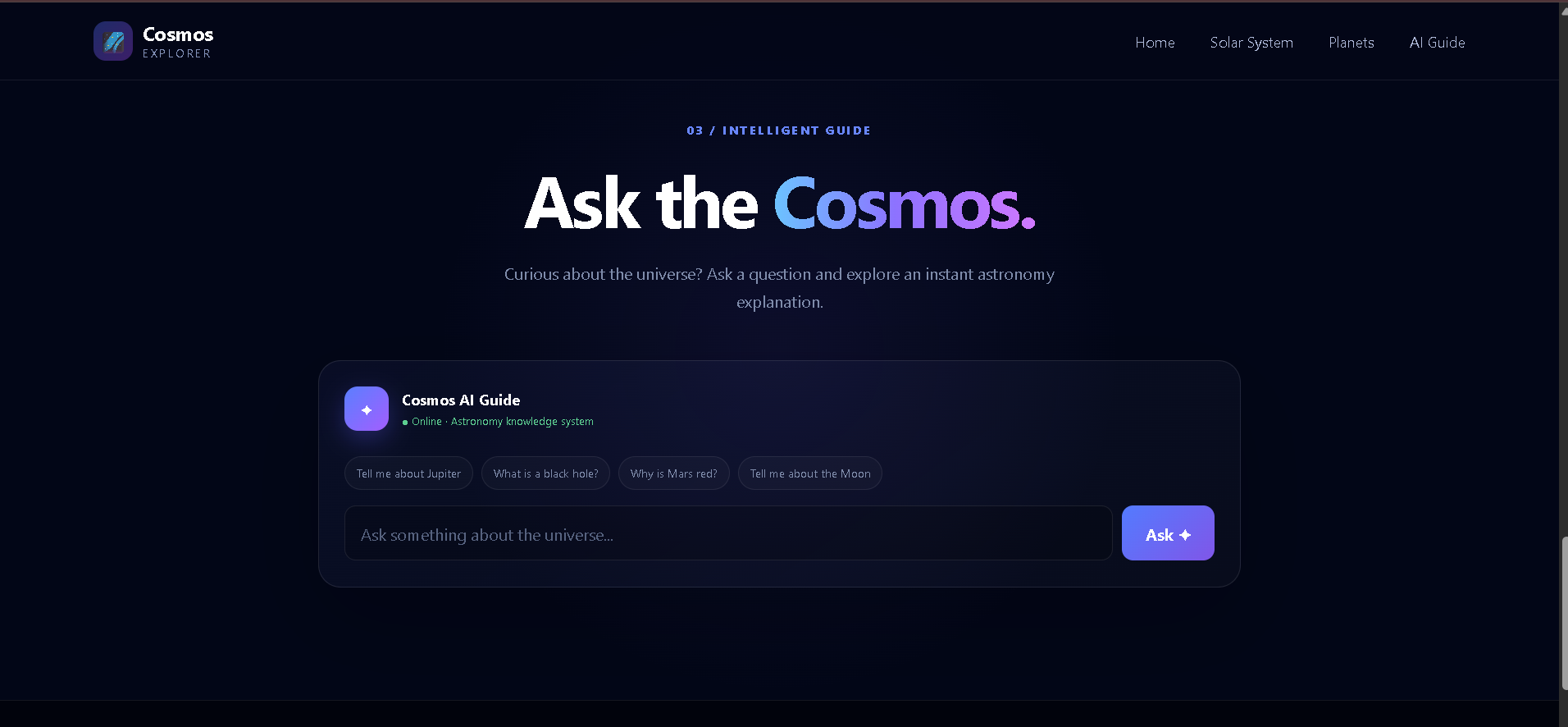
AI Space Guide — Ask questions and learn about planets, stars, galaxies, and astronomy.
-
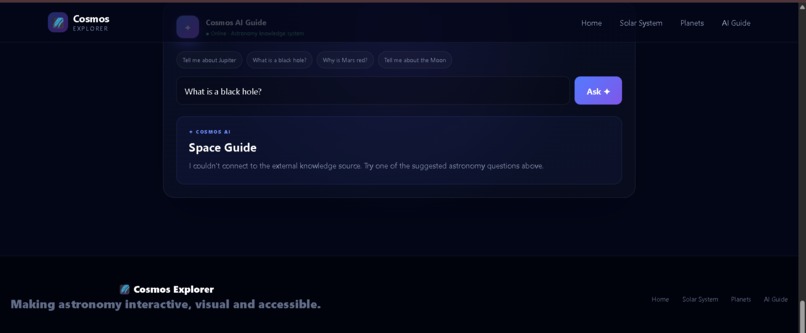
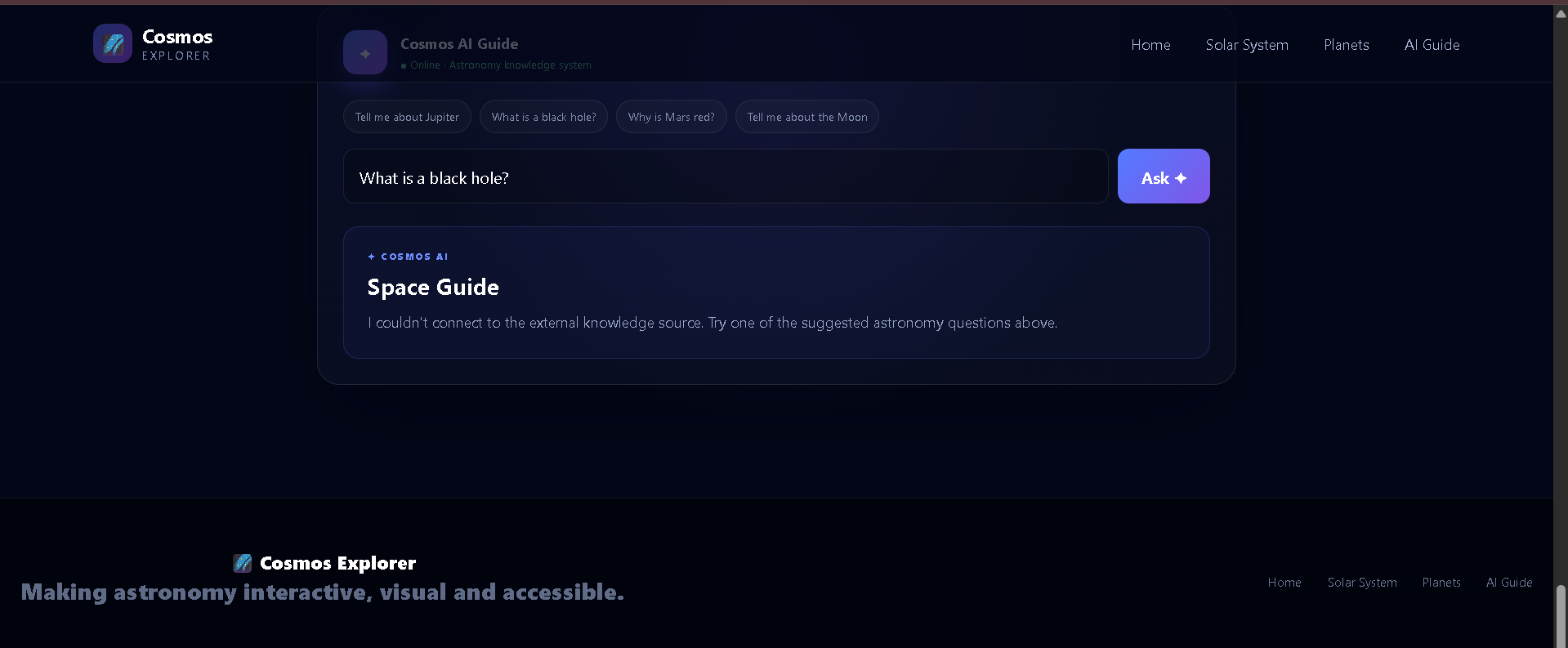
AI Astronomy Assistant — Get instant educational explanations through the interactive AI guide.
🌌 Inspiration
Space is one of those subjects that naturally makes people curious, but learning about it online can often feel like reading through long pages of static information.
We wanted to create something different — an experience where users could see, interact with, and explore the solar system instead of simply reading about it.
That idea became Cosmos Explorer, an interactive 3D web experience designed to make astronomy more visual, engaging, and approachable.
Our goal was simple:
Make learning about the universe feel like exploring it.
🚀 What it does
Cosmos Explorer is an interactive 3D astronomy experience where users can explore a virtual solar system and learn about planets and space.
Users can:
- 🌍 Explore an interactive 3D solar system
- ☀️ View animated planets orbiting the Sun
- 🪐 Navigate around the solar system using 3D camera controls
- ✨ Explore a space environment filled with stars
- 📖 Discover information and facts about planets
- 🤖 Ask the Cosmos Space Guide questions about astronomy
- 💫 Navigate between different sections of the experience
- 📱 Use the experience across different screen sizes
The project combines 3D graphics, interactive UI, animations, and educational content into a single web experience.
🛠️ How we built it
Cosmos Explorer was built with modern web technologies:
- React.js — component-based application architecture
- Vite — fast development and build tooling
- Three.js — 3D graphics
- React Three Fiber — integrating Three.js with React
- Drei — useful helpers and controls for the 3D environment
- GSAP — animations and interactive motion
- Framer Motion — UI animations and transitions
- JavaScript — application logic
- CSS — responsive visual design
The solar system is rendered using React Three Fiber and Three.js. Planets are represented as 3D objects positioned around the Sun, with orbit paths and animation creating the feeling of a living solar system.
We also created a star field to give the experience a deeper space atmosphere.
The Cosmos Space Guide provides an interactive way for users to search astronomy-related topics and receive educational information.
🧩 Challenges we ran into
Building a 3D experience inside a web application introduced several challenges.
Performance
Rendering many objects in a 3D scene can become expensive. We had to balance the number of stars, geometry complexity, lighting, and animations with browser performance.
Camera controls
Creating a camera experience that feels natural was another challenge. Users should be able to zoom and rotate around the solar system without getting lost.
3D positioning
We needed to carefully position the Sun, planets, and orbit paths so that the solar system was visually understandable while still feeling immersive.
React + Three.js
Combining React's component model with a continuously rendered 3D environment required us to understand a different way of thinking about UI and rendering.
Responsive design
We also had to make sure that the experience remained usable when the browser size changed, rather than designing only for one desktop screen.
Every challenge helped us understand more about interactive graphics, performance, and modern web development.
🏆 Accomplishments we're proud of
We're proud that we were able to turn a simple idea about learning astronomy into a working interactive experience.
Some highlights include:
- 🌌 Built a functional interactive 3D solar system
- 🪐 Added animated planetary orbits
- ✨ Created a procedural star field
- 🎮 Added interactive 3D camera controls
- 🤖 Built an interactive astronomy guide
- 🎨 Designed a futuristic space-themed interface
- 💫 Combined 3D graphics with traditional web UI
- ⚡ Built the application with a modern React + Vite architecture
Most importantly, we created something that feels more like exploring space than reading a traditional educational website.
📚 What we learned
This project gave us the opportunity to learn technologies and concepts that were new to us.
We learned:
- How 3D rendering works in the browser
- How to use Three.js with React
- How React Three Fiber maps React components to 3D scenes
- How to work with cameras, lighting, meshes, and materials
- How to create animated objects and orbital motion
- How to improve performance in graphics-heavy applications
- How to design interfaces around immersive experiences
- How to combine educational content with interactive technology
We also learned that creating a visually impressive experience isn't only about adding more effects — it is about finding the right balance between design, usability, performance, and functionality.
🔭 What's next for Cosmos Explorer
Cosmos Explorer is only the beginning.
Future versions could include:
- 🌌 Deep-space exploration beyond the solar system
- 🛰️ NASA API integration for real-time space information
- 🔭 Real astronomical event tracking
- 🌑 Moons and dwarf planets
- 📊 Interactive planetary comparisons
- 🎮 Astronomy quizzes and challenges
- 🏆 Achievements and learning progress
- 🥽 VR/AR exploration
- 🌠 Constellation exploration
- 👥 Collaborative exploration experiences
Our long-term vision is to turn Cosmos Explorer into an interactive astronomy platform where people can explore, learn, and satisfy their curiosity about the universe.
🌟 Our Vision
The universe is enormous, but learning about it shouldn't feel distant.
Cosmos Explorer brings the universe closer through interactive technology.
Instead of asking users to imagine what the solar system looks like, we give them a place to explore it.
