-
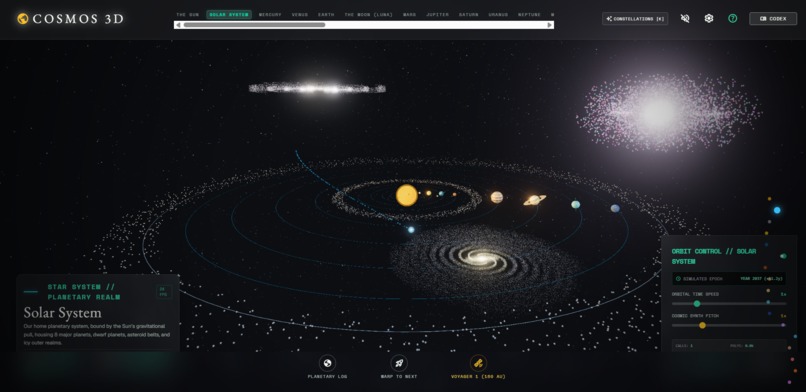
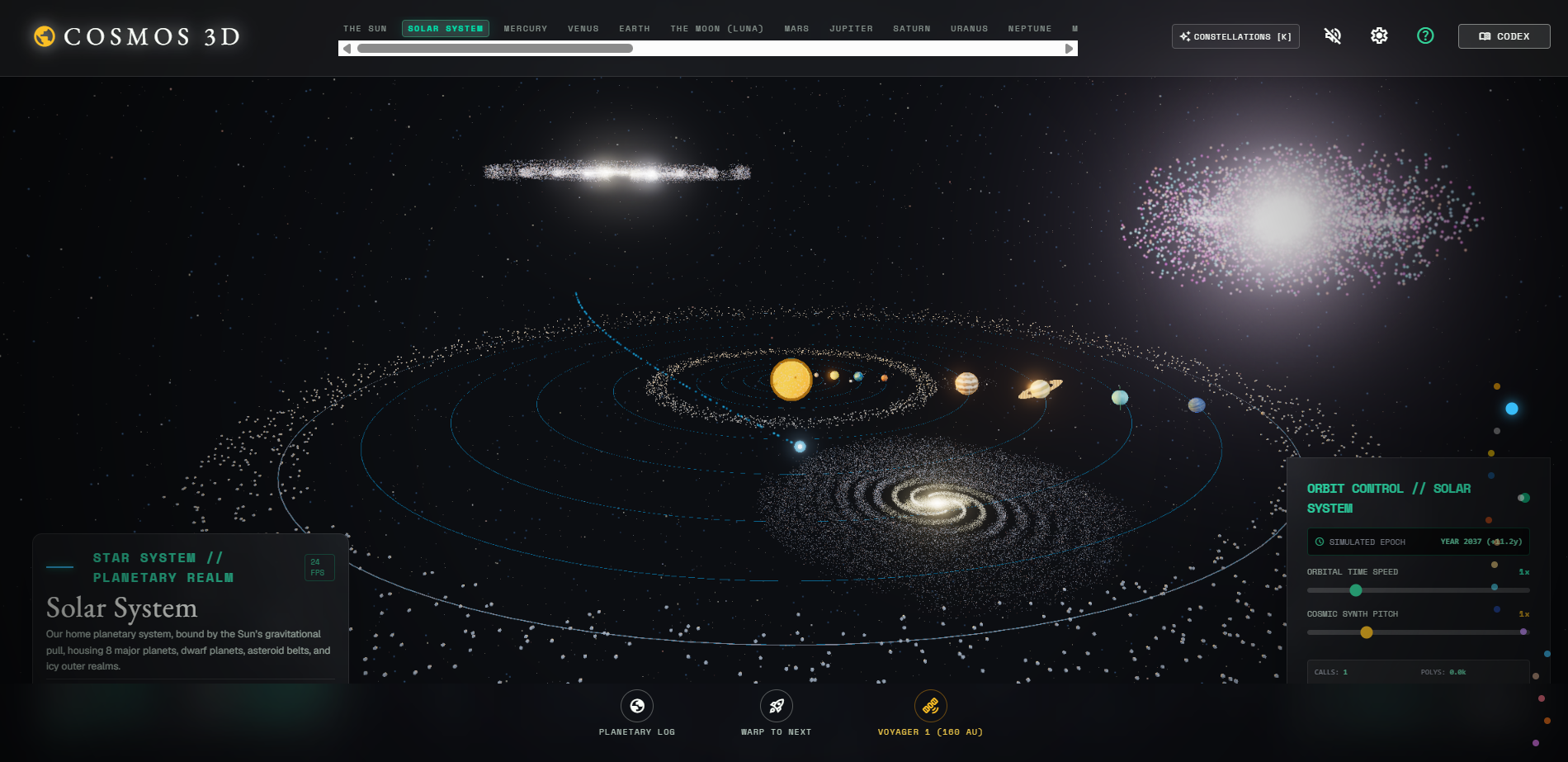
COSMOS 3D Solar System Realm — 3D WebGL orbital dynamics, planetary alignment, and interactive telemetry controls.
🌌 COSMOS 3D — Deep Space Realms
Inspiration
Space has always been humanity's greatest frontier — infinite, mysterious, and breathtaking. But most people never get to experience it beyond flat images and documentaries.
I wanted to change that.
COSMOS 3D was born from one question: What if you could explore the entire observable universe right in your browser? Not with static textures downloaded from NASA — but with procedurally generated, scientifically accurate planets, galaxies, and deep space objects rendered live, in real-time 3D.
🚀 What It Does
COSMOS 3D is an interactive 3D space exploration engine built entirely in the browser using React and Three.js. Users can:
- 🌍 Fly through the Solar System — visit all 8 planets + Pluto, the Moon, Asteroid Belt, Kuiper Belt, ISS, and Voyager 1
- ☀️ Explore The Sun — with volumetric corona plasma glow, solar prominence arcs, and 500 animated solar wind particles streaming outward
- 🌋 Witness active phenomena — Jupiter's Jovian lightning storms flickering inside cloud bands, Earth's Aurora Borealis & Australis glowing at the poles
- 🪐 Discover Saturn's hexagonal polar jet stream — a real Cassini-discovered atmospheric feature rendered in glowing teal
- ❄️ See Pluto's heart — the iconic Tombaugh Regio nitrogen glacier with dual-lobe Sputnik Planitia and Hayabusa Terra
- 🌌 Travel to Deep Space — visit the Milky Way Galaxy, Andromeda (M31) with dwarf companions M32 & M110, the Orion Nebula (M42), a Supermassive Black Hole with relativistic jets, and a comet
- 🔭 Interact with every object — click any body for a detailed Codex panel with real scientific data, or trigger a 3D Cutaway view revealing internal planetary layers
🛠️ How It Was Built
Architecture
| Layer | Technology |
|---|---|
| UI Framework | React 18 + Vite |
| 3D Engine | Three.js (WebGL) |
| Post-Processing | Three.js EffectComposer + UnrealBloomPass |
| Styling | Tailwind CSS |
| Audio | Web Audio API (custom cosmic synth engine) |
Procedural Texture Generation
Every planet surface is generated live in the browser using HTML5 Canvas 2D API — no image files downloaded:
- Earth — 7 organic continent polygon regions, 5 ocean bodies, biome coloring (Amazon rainforest, Sahara desert, Antarctic ice sheet), separate cloud mesh layer, and a 3D internal cutaway (Crust, Mantle, Outer Core, Inner Core)
- Mars — Iron oxide dust, dual polar ice caps, semi-transparent dust storm shell
- Jupiter — Turbulent sine-wave cloud band system, Great Red Spot storm vortex
- Saturn — Golden cloud bands, Cassini Division ring texture
- Pluto — Reddish tholin terrain, dual-lobe nitrogen heart glacier (Tombaugh Regio)
Galaxy Physics
To render Andromeda without gimbal lock warping its disk as it spins:
- Stars are generated symmetrically in local \(XZ\) space
- The galaxy lies flat in its local group plane
- Only
androPoints.rotation.yincrements in the render loop - Camera is angled \(15°\) above the plane, naturally rendering the disk as a tilted oval
Scientific Data
All orbital data, structural compositions, temperatures, and atmospheric details are sourced
from real NASA, ESA, and IAU datasets — embedded in a structured spaceData.js file covering
every object from Mercury to Voyager 1 (163.5 AU from Earth).
🧗 Challenges Faced
1. WebGL Particle Texture Artifacts
PointsMaterial without a texture map renders solid square pixels instead of round stars.
Solution: Every particle system (nebula gas clouds, jet streams, solar wind) uses a
procedurally generated soft radial gradient canvas texture with depthWrite: false.
2. Andromeda Disk Gimbal Lock
Applying rotation.x directly to a spinning galaxy mesh causes Euler axis gimbal lock —
the disk stands face-on to the camera. Solution: Keep particles flat in local space,
tilt via parent group or camera perspective angle.
3. Earth Continents in 3D
Drawing geographically accurate continent shapes on a sphere required building a full polygon node system for each landmass and biome region — North America, South America, Africa, Eurasia, Australia, and Antarctica — each with realistic color gradients (tropical green, desert tan, tundra grey, ice white).
4. Memory Management
Three.js WebGL contexts leak if geometries and materials aren't disposed on unmount.
Solution: A trackResource() wrapper registers every geometry and material created,
enabling full cleanup on React component unmount.
🌠 What I Learned
- Advanced Three.js WebGL rendering: instanced geometry, additive blending, post-processing bloom
- Real astronomical mechanics: axial tilts, orbital speeds, galactic rotation curves
- Procedural texture generation entirely in JavaScript without any external assets
- Performance optimization: zone-based culling, instanced asteroid belts, LOD-aware rendering
- Scientific accuracy in visual representation: spectral star colors, atmospheric hazing, limb darkening shaders
🔭 What's Next
- [ ] VR/WebXR support — walk on Mars and look up at Earth
- [ ] Real-time NASA API integration — live solar flare data, asteroid close approaches
- [ ] Multi-player co-exploration — share your position in the universe with others
- [ ] Time travel — simulate planetary positions for any date in history
Built with ☕ and a deep fascination for the cosmos.

Log in or sign up for Devpost to join the conversation.