-
-

Meet our mascot- Robodim!
-
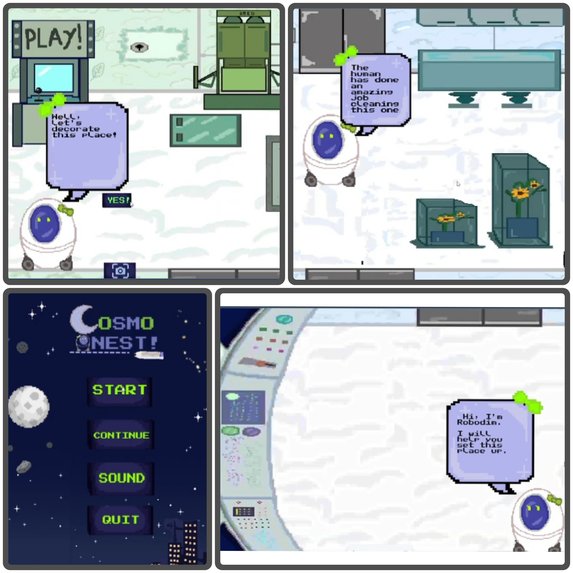
Here is a collage with bits and pieces of our game.

CosmoNest
What inspired us
Many of us, especially children and youth dream of being astronauts but often lack the bare minimum knowledge and end up losing interest even though we are dreaming about living in space in this 21st century - it can happen because of lack of resources, lack of accessible learning materials, or even the misconception that astronomy is useless. To solve this issue through education, we created CosmoNest - our interactive and educational game about space, space habitat and spaceship that aligns real time resources and engaging storylines while connecting to real time tools like Windy and OpenMeteo.
What it does
The game itself has interactive functions and storylines, immersing players into a dystopian world. The game contains furnishing and decorating features requiring players to repair and decorate the spaceship accurately to make it a habitable spacecraft. Clicking on the materials will show players the functions and use of machines so they can learn about real life spacecraft systems, the habitants, as well as hidden stories they may miss because of a few clicks. The game also directs players to climate data detector services, also serving as a tool.
How we built it
We used Pixilart and Canva for graphic designing and animation. As for programming and creating the game we used GoDot. Lastly, we connected the game with GitHub for making it accessible, connecting to everyone on the web. For live broadcast and information we used Windy and OpenMeteo.
Challenges we ran into
CosmoNest is our first ever game, so we ran into a huge amount of challenges. Firstly, we noticed that mp4 files' qualities drastically reduces after making the background transparent, making it hard to put high quality animations. We fixed it by minimalizing our animation frames, putting them into grid sheet, and manually putting the animations in the game. Another challenging part was showing the Windy and OpenMeteo data directly in the game so that people can use it as tools. But since it proved to be above our understanding, we still wanted players to learn about available tools so we integrated their links into our game. Lastly, the greatest issue was unstable internet connection. Due to frequent power outages, we pre-purchased mobile data to continue working offline.
Accomplishments that we're proud of
Making the first game in our lives itself was a huge pride for us, but what made us most proud about CosmoNest was successfully integrating the color mechanic. Our team has plenty gamers, and we have not seen coloring mechanics in many decoration games, so it felt like a huge achievement to us. Other than that, we were truly happy to be able to integrate useful tools into the game.
What we learned
Creating a game for the first time was a huge step for us in our learning journey. The biggest thing that we learned was to create a refined and detailed project in the shortest amount of time with very minimal resources confidently, while still being determined. The project has also made us learn animation and a new coding language, which definitely contributed greatly to our understanding.
What's next for CosmoNest
In future, CosmoNest will bring more interactive features like more customizable furnishings, ability to move and change furnishings, a feature where our guide and mascot Robodim can test users on their learning about space and such and give furnishing or other rewards based on their grades, and an archive for the players to learn from- much similar to open world games. We also want to make the rooms bigger, let players move Robodim around to explore and add more fun facts and snippets of stories in the game.
After improving the game's functionalities as well as lore, we want to release its full version by 2026, and see an impactful future where people will be able to use games as real time tools, and explore a new era of games.
Built With
- gdscript
- godot
- openmeteo
- windy


Log in or sign up for Devpost to join the conversation.