-
-
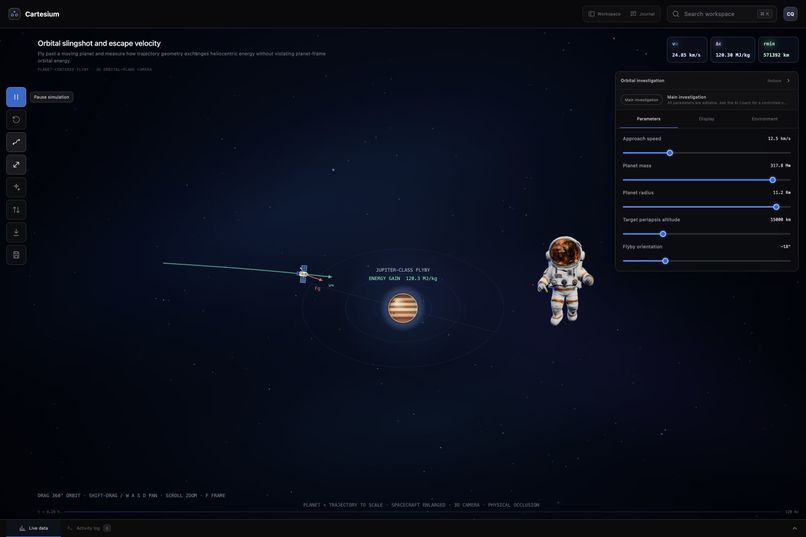
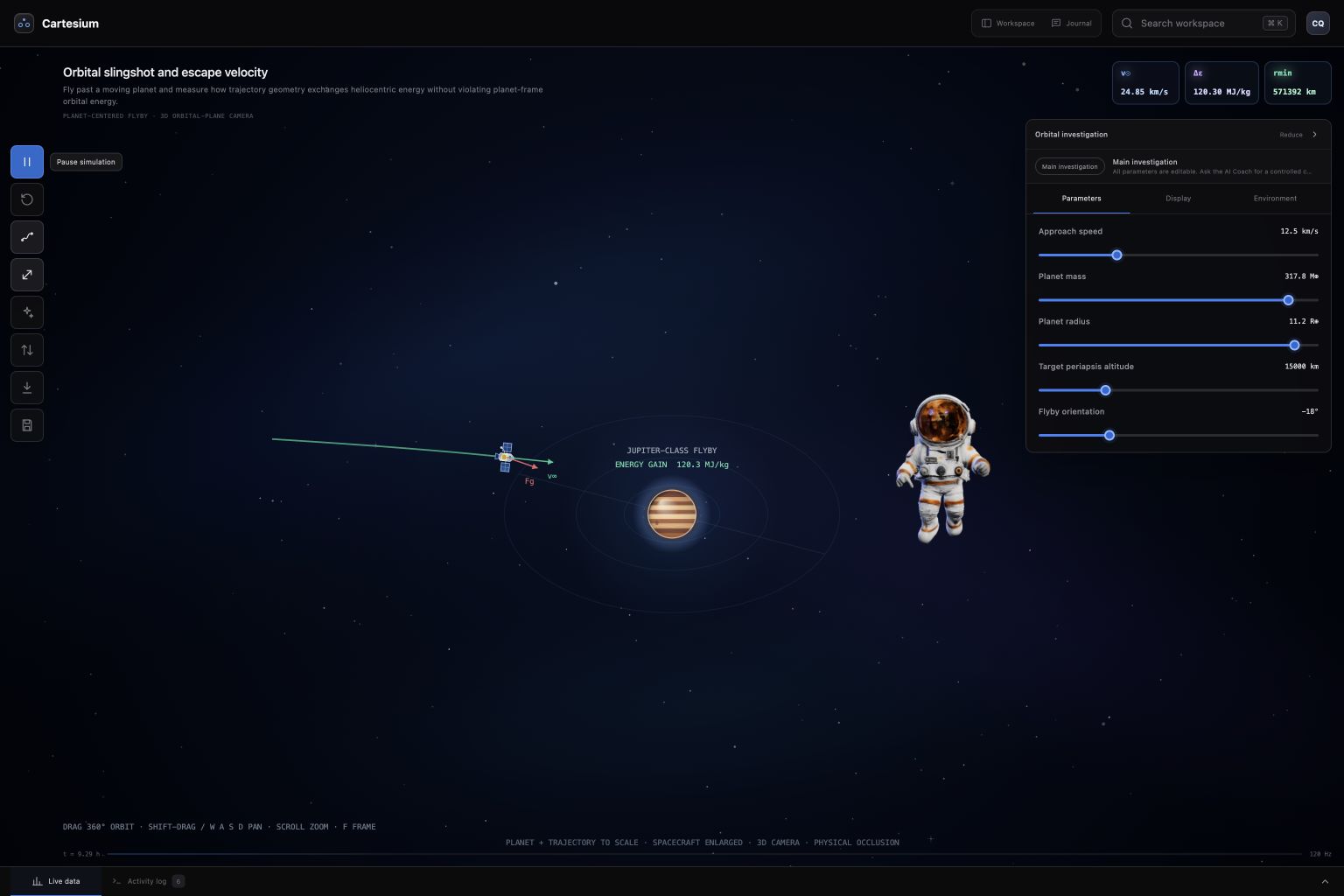
Orbital 3d Investigation
-
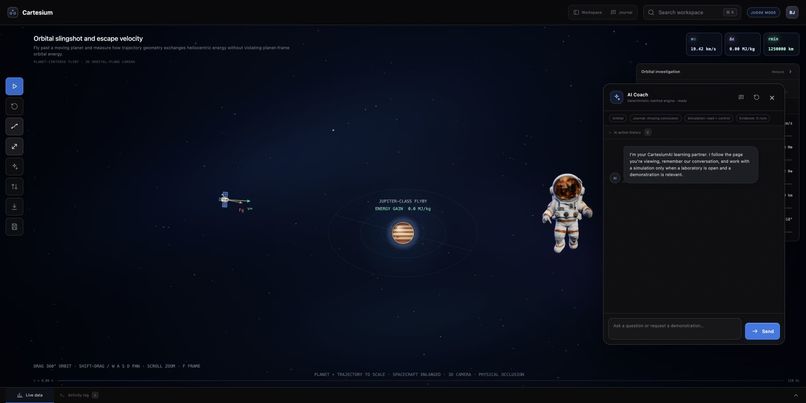
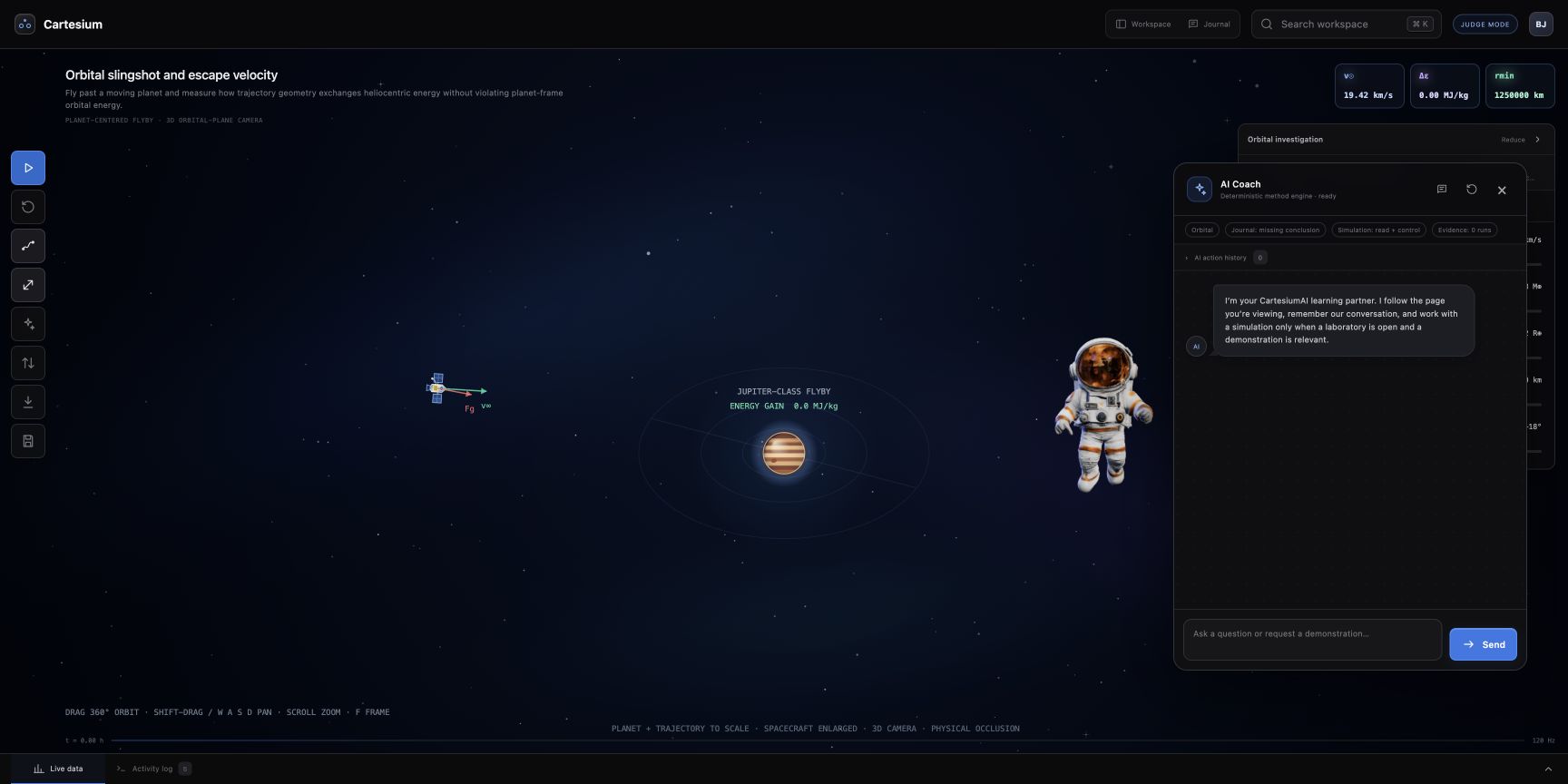
AI Coach Live Demonstration
-
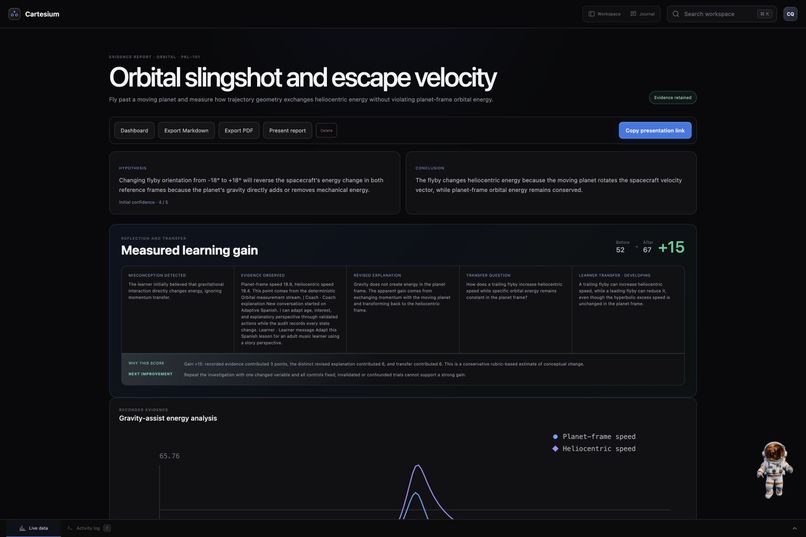
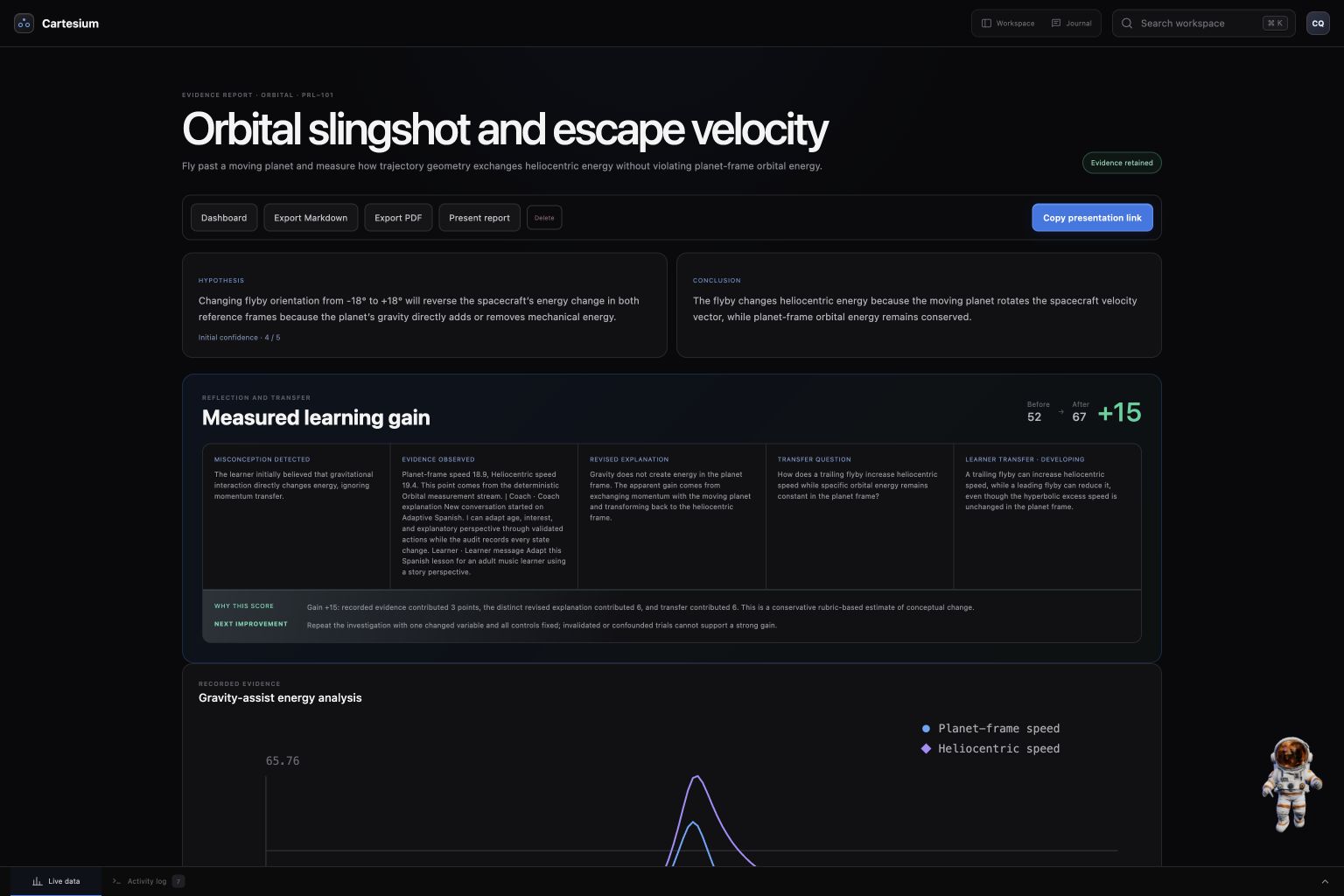
Evidence Report and Analysis
-
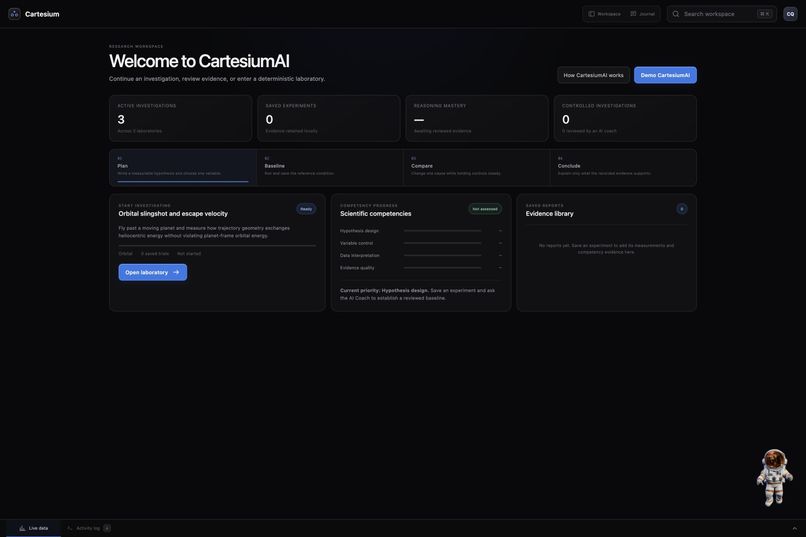
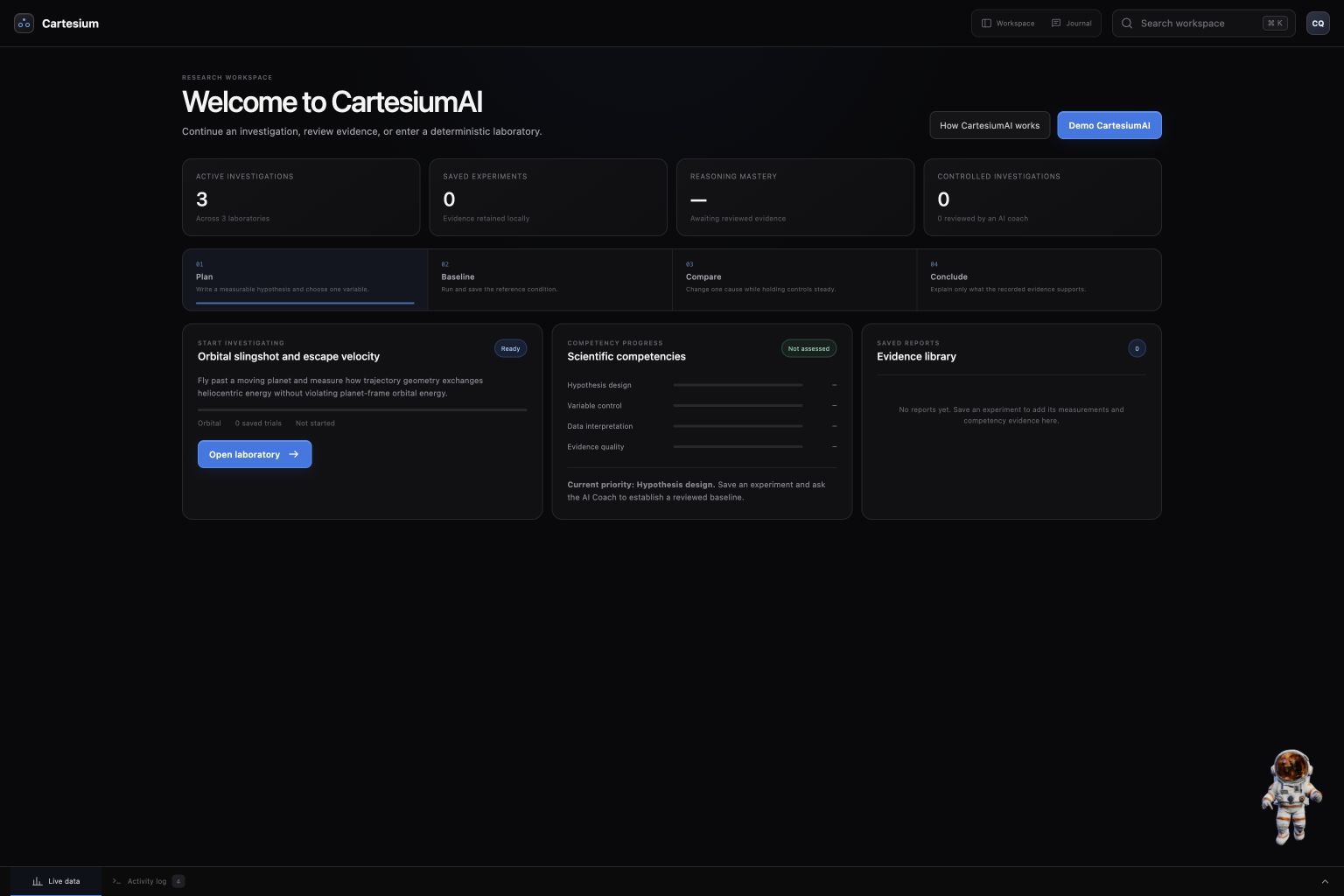
Scientific Workflow Dashboard
-
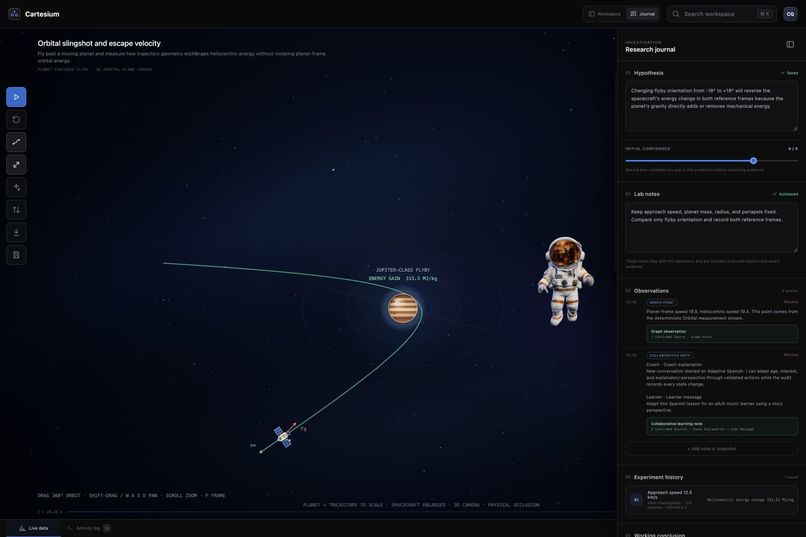
Journal Evidence
-
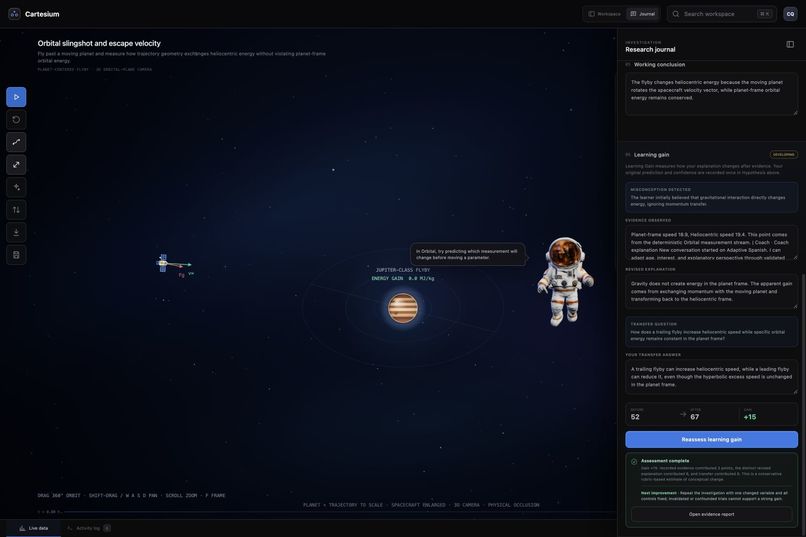
Learning Gain Reflection
-
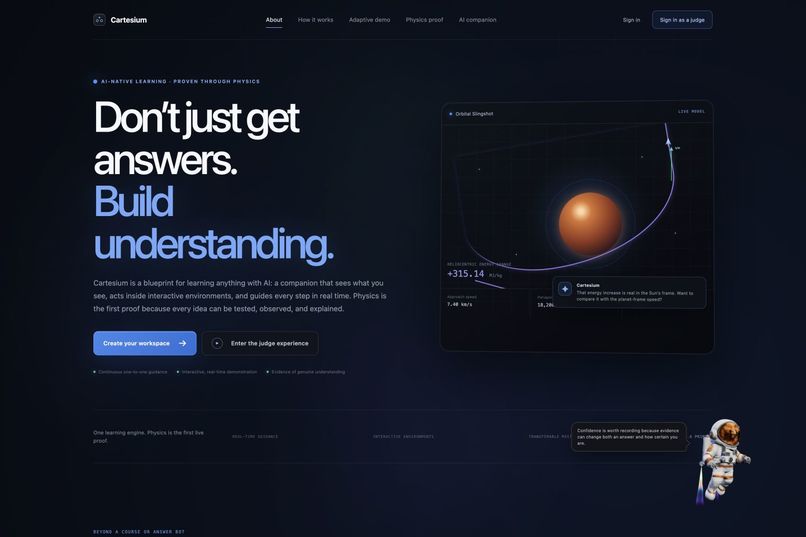
Build Real Understanding
-
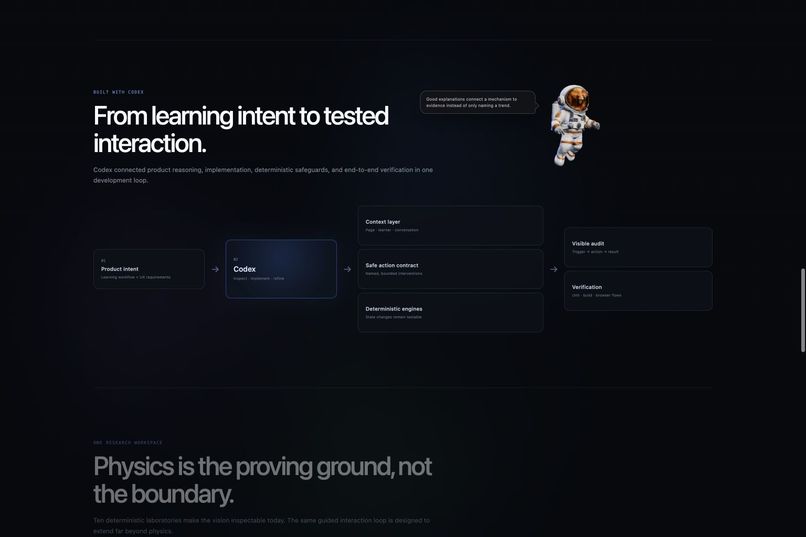
Codex Learning Architecture
Inspiration
The name Cartesium was inspired by René Descartes and his Discourse on the Method. Years ago, I was fascinated by how Descartes questioned the path laid out for him and explored different disciplines in search of both a reliable method and his own direction in life.
Cartesium grew from the same belief: learning should not force everyone along a single, predetermined path. With the right method, curiosity, and guidance, anyone can learn across disciplines, connect knowledge to personal interests, and gradually discover the path that is truly their own. Cartesium aims to make that freedom to explore and learn available to everyone.
Most educational AI tools are still chat interfaces placed beside static content. They can explain a concept or provide an answer, but they rarely teach students how to think like scientists and the learning process feels dry either in a classroom or as self-taught.
Answers delivered too early can remove the productive struggle through which learners form, test, and revise an explanation.
Everything can now be wrapped up in a unique conscious and efficient ecosystem, by bringing simulation, guided inquiry, contextual AI actions, evidence collection, and reflection into one auditable learning environment.
CartesiumAI wanted to pursue this different path:
What if an AI could learn alongside the student, see the same evidence, manipulate the same environment, and guide the complete reasoning process without taking away the learner’s agency?
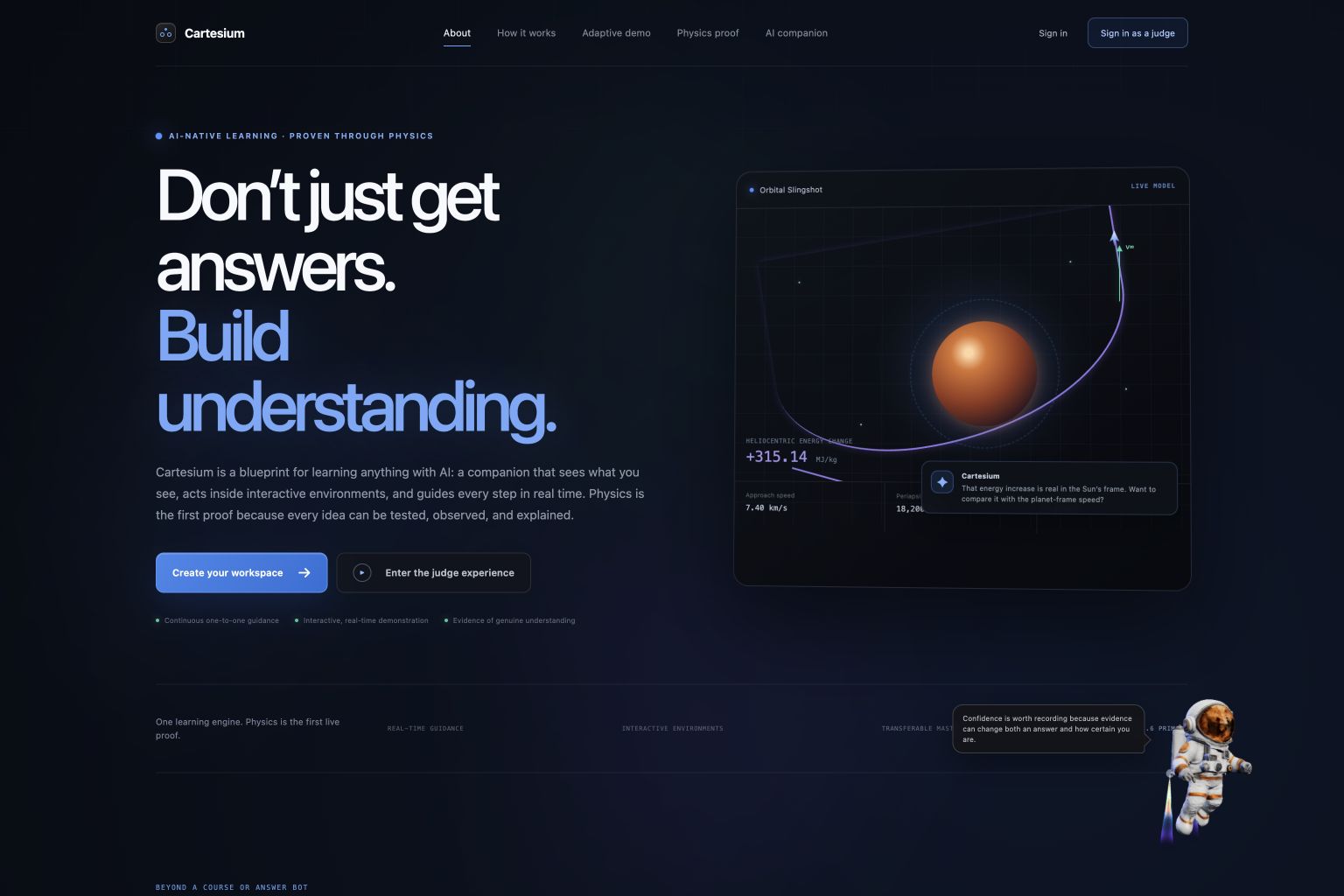
This became CartesiumAI, an evidence-first learning workspace where students do not simply request answers. They predict, experiment, observe, revise their explanation, and transfer what they learned to a new situation.
Physics became the first proving ground because its behavior can be modeled deterministically and it opens more doors to experiment with this new teaching approach. If a learner changes a pendulum’s length, electrical resistance, magnetic field, or orbital trajectory, the result can be calculated, visualized, repeated, and verified.
However, CartesiumAI is not intended to stop at physics. Its underlying architecture is designed for any subject where a learner can act, receive feedback, compare perspectives, and refine an explanation.
What it does
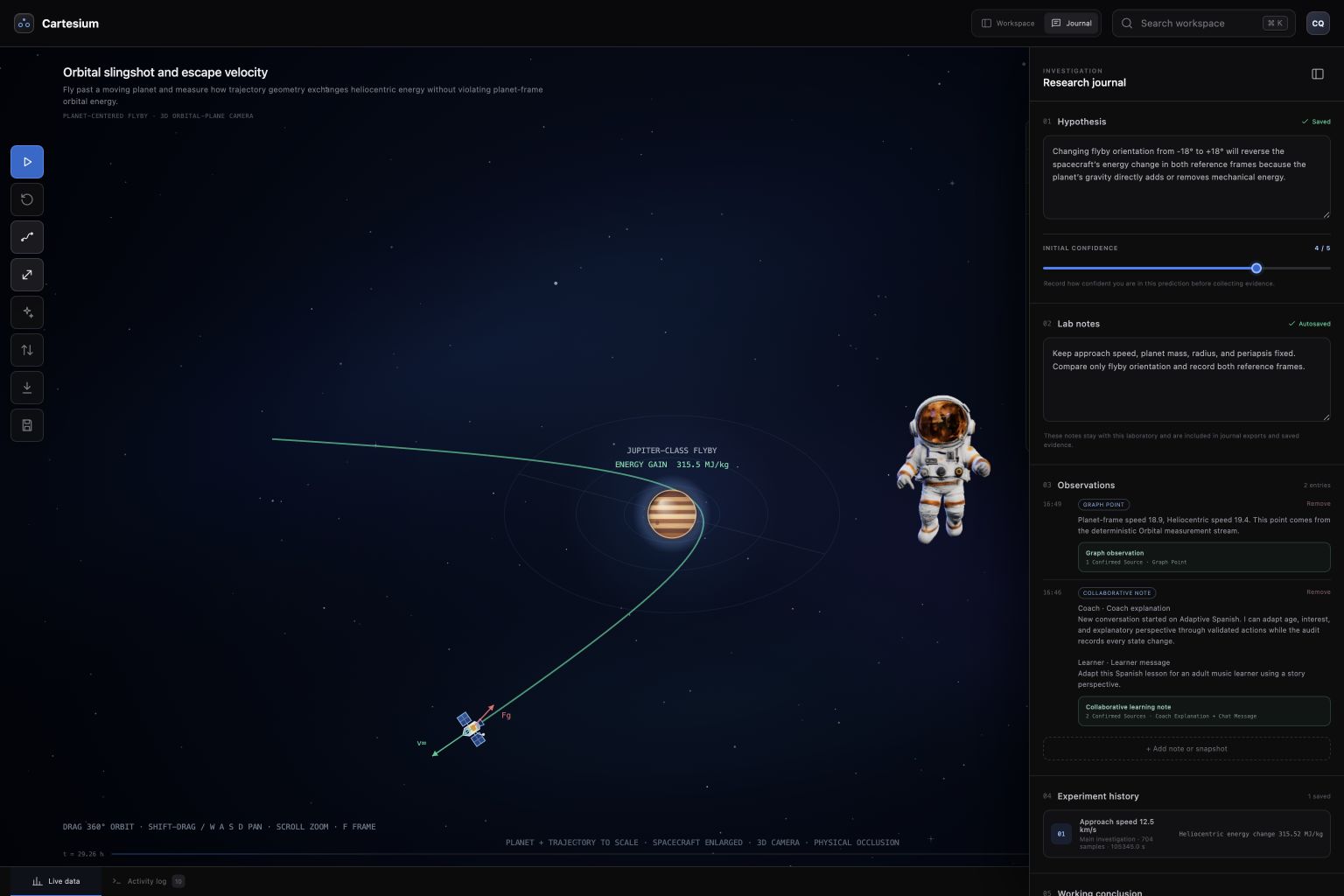
CartesiumAI combines ten interactive physics laboratories with a context-aware 3D AI learning companion.
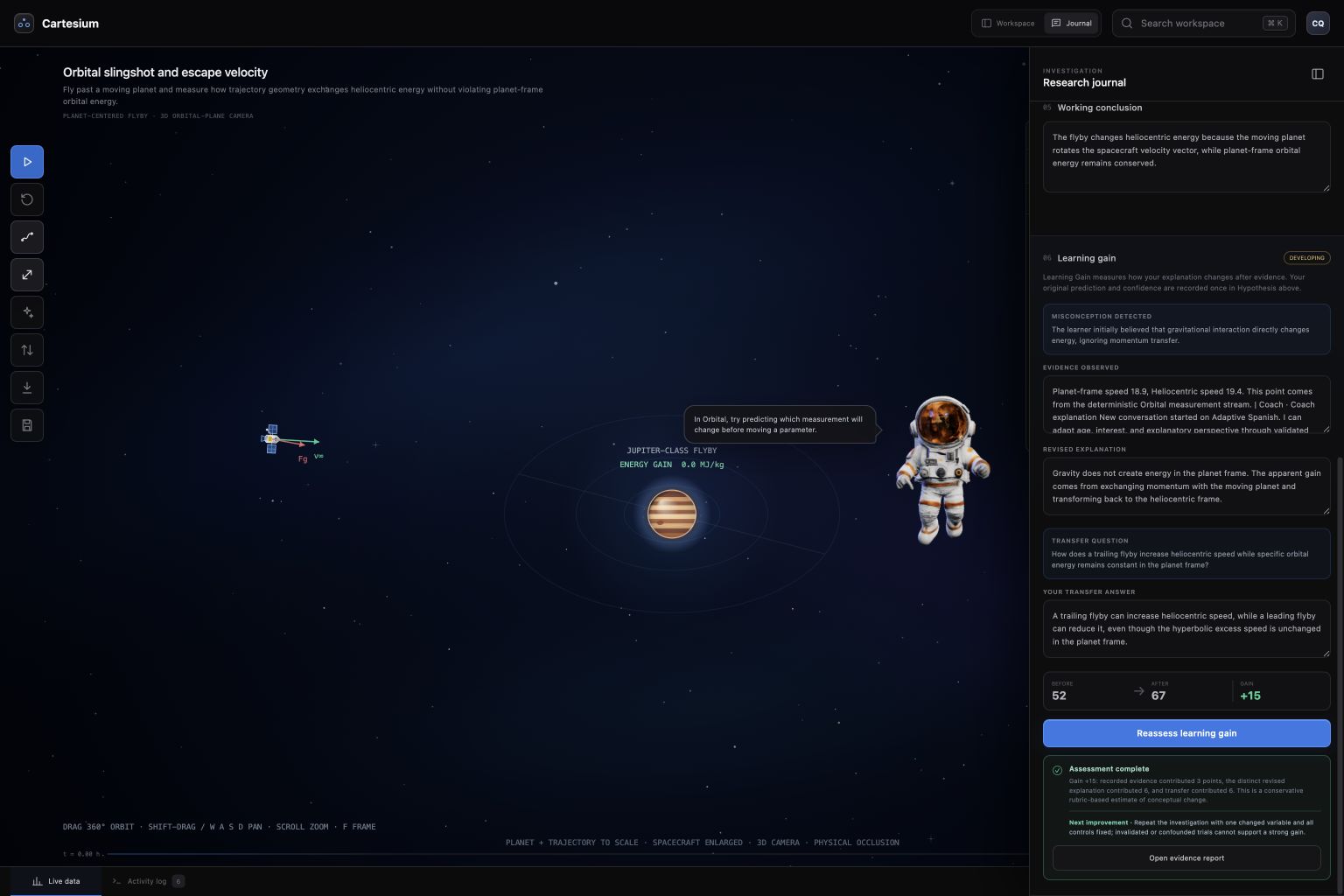
A typical investigation follows a complete learning cycle:
- Write a measurable hypothesis.
- Record initial confidence.
- Run and save a baseline.
- Change one variable while keeping controls fixed.
- Record personal observations and simulation snapshots.
- Discuss the evidence with the AI companion.
- Revise the original explanation.
- Answer a transfer question.
- Measure the resulting Learning Gain.
- Build a presentation-ready evidence report.
The laboratories cover mechanics, dynamics, energy, momentum, oscillations, waves, electricity, magnetism, optics, and orbital motion. Each simulation is governed by a deterministic scientific model. For example, the pendulum laboratory compares the numerical trajectory with
$$ T = 2\pi\sqrt{\frac{L}{g}}, $$
while the electricity laboratory visualizes the capacitor response
$$ V_C(t)=V_s\left(1-e^{-t/(RC)}\right). $$
The Orbital Slingshot laboratory uses numerical integration to model a planetary flyby while tracking planet-frame specific orbital energy, $$ \varepsilon=\frac{v^2}{2}-\frac{\mu}{r}. $$
This deterministic layer is important because the language model never invents measurements. It explains and guides, while the simulation engine remains the source of numerical truth.
The AI companion
The floating 3D astronaut is the interface for Cartesium, the AI learning companion. It is aware of the current page, recent conversation, laboratory parameters, live simulation state, journal, observations, and saved experiments.
The learner can ask Cartesium to:
- Explain a scientific concept or selected interface element.
- Review an investigation plan.
- Compare saved experiments.
- Identify uncontrolled variables or weak evidence.
- Navigate to another laboratory.
- Change a parameter and demonstrate its effect.
- Run, pause, or reset a simulation when explicitly requested.
- Turn selected messages, graph points, explanations, or parameter changes into a structured journal entry after confirmation.
- Help build a conclusion and evidence report.
- Answer broader science-related questions.
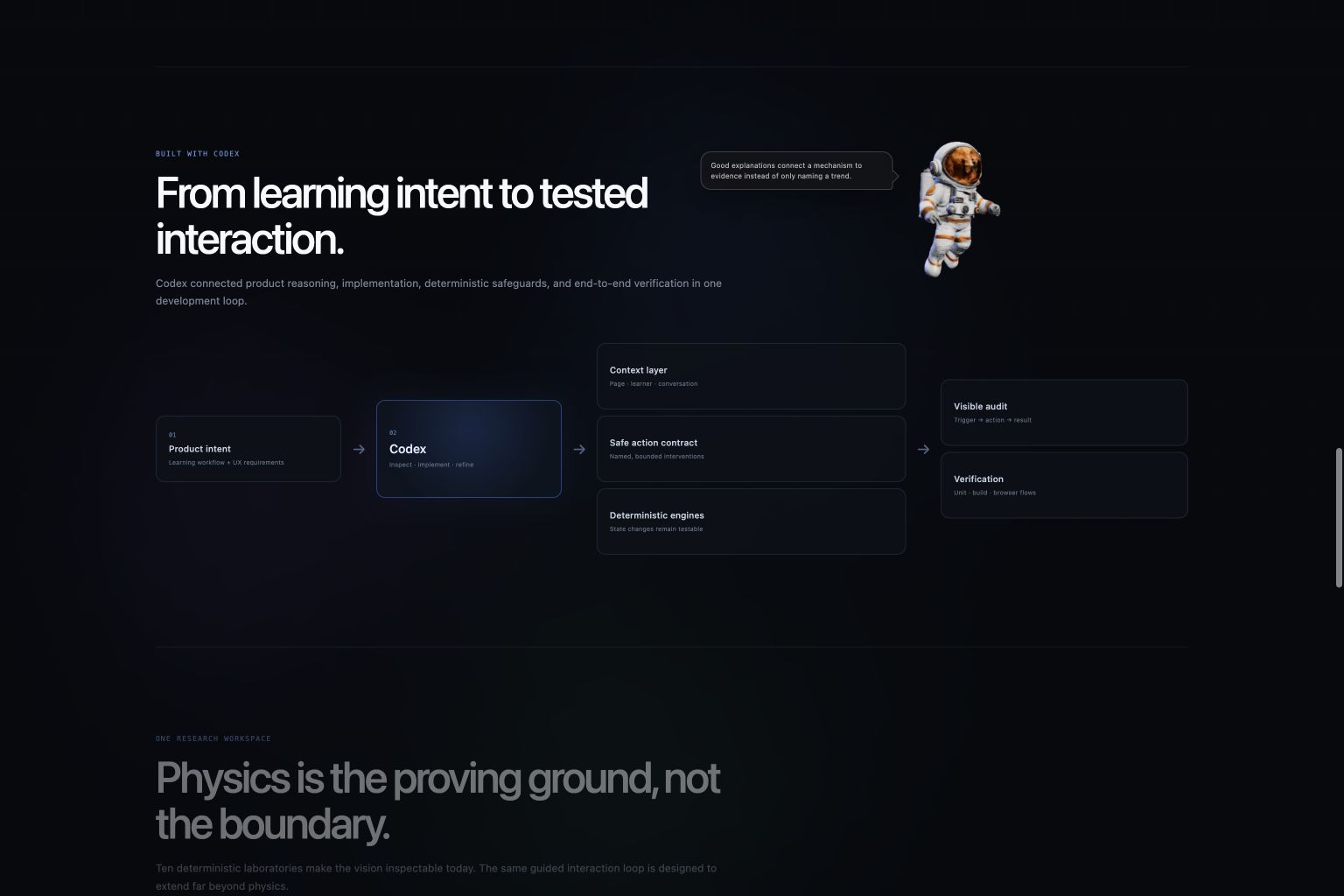
Every executable AI action follows a strict JSON schema. The server verifies the requested action, laboratory, parameter name, and allowed numerical range before applying it. The interface then records a visible audit trail:
Triggering message → validated AI action → deterministic state change
If a learner requests a complete solution, the assistant asks for confirmation before revealing it.
GPT-5.6 is the production reasoning model through the OpenAI Responses API. When model access is unavailable, CartesiumAI clearly switches to its deterministic method engine, preserving the complete judge and learner workflow without pretending that a live model response occurred.
How I built it
CartesiumAI was engineered through a Codex-led development workflow. My direction defined the product vision, learning philosophy, detailed requirements, feedback, and final decisions. Codex supported architecture, implementation, debugging, scientific hardening, interface refinement, testing, and deployment. It's been also very helpful for feature suggestions or extensive brainstorming sessions.
Different Codex models were used according to the complexity of the task:
- Codex Luna, medium reasoning: quick questions, focused doubts, and rapid implementation checks.
- Codex Terra, medium reasoning: brainstorming, design alternatives, lightweight fixes, and bounded refinements.
- Codex Sol, xhigh reasoning: the heavy engineering work, including architecture, core implementation, scientific debugging, complex interactions, animation behavior, testing, performance refinement, and deployment preparation.
Codex provided great animations for the AI avatar and an impressive UI appearance in general. The 3D companion, backed by GPT 5.6, is controlled by a deterministic state machine rather than raw model-generated movement: idle → listening → thinking → explaining → demonstrating → celebrating
The language model can request meaningful actions, but it cannot directly control bones, animation frames, arbitrary DOM elements, or unrestricted simulation values.
Challenges I faced
Preserving scientific accuracy
Interactive simulations can look convincing while still being physically wrong. I had to test not only common scenarios but also edge cases such as zero charge, extreme damping, total internal reflection, perfectly inelastic collisions, and orbital impact trajectories. One major problem was orbital collision tunneling. With discrete integration steps, the spacecraft could move from one side of the planetary surface to the other without a sampled position landing exactly inside it. With Codex, I implemented continuous segment-to-surface collision detection so an impact terminates at the interpolated planetary radius.
Making the AI active without making it unsafe
Allowing an AI to manipulate a simulation is much harder than letting it produce text. I needed to prevent fabricated parameters, unauthorized page changes, unintended automatic runs, and explanations based on actions that never occurred. The solution was a small allowlisted action language, deterministic validation, synchronized state updates, and a visible audit trail.
Designing guidance without overwhelming the learner
A newcomer can easily feel lost inside a laboratory. Under my guidance, Codex iterated on an optional guided workflow with a visible cursor, slower explanations, clear milestones, and a complete path from hypothesis to report. At the same time, the normal workspace remains immersive and lets experienced learners control panels, parameters, notes, and evidence directly.
Building a believable 3D companion
The avatar needed animation blending, safe screen placement, dragging, chat attachment, page awareness, landing-page flight, and contextual gestures without obscuring controls or becoming distracting. I also had to address rigging problems, disconnected limbs, movement jitter, camera transitions, and performance.
What I learned
The most valuable educational role for AI may not be answering questions. It may be deciding which question should be asked next.
Currently, trustworthy AI systems benefit from separating responsibilities. The physics engine calculates outcomes, the trace records evidence, the model analyzes methodology, and the verifier enforces constraints. No single component is trusted to do everything, at least for now.
Structured outputs were essential. They transformed the coach from a conversational feature into a dependable application component that could drive experiment forks, reports, and competency updates.
Most importantly, CartesiumAI demonstrates how formative assessment can incorporate observable scientific decisions rather than relying only on final answers. A learner’s choice to hold a variable constant can reveal more about their understanding than whether they remembered a formula.
Accomplishments that I am proud of
Building a whole learning ecosystem has been the best part of it. A dynamic and context-aware AI companion just make it more immersive.
The project includes ten deterministic physics laboratories, with both 2D and 3D interactive experiences, as the first implementation of a broader learning architecture.
What’s next for CartesiumAI
The next step is to extend the same architecture beyond physics.
CartesiumAI is not just a regular educational platform, but a real learning ecosystem that could support languages, mathematics, programming, history, engineering, and any other domain. Future versions could adapt explanations to the learner’s age, interests, maturity, preferred perspective, prior misconceptions, and demonstrated mastery.
A learner interested in football, music, gaming, or visual design could receive examples connected to those interests without changing the underlying learning objective. Concepts could be demonstrated through interactive 3D scenes, multiple perspectives, simulations, conversation, and structured practice rather than through text alone.
The long-term vision is an AI companion that does more than answer questions. It observes how someone learns, helps them test ideas, adapts its support, makes every intervention inspectable, and remains beside the learner throughout the complete process of understanding.


Log in or sign up for Devpost to join the conversation.